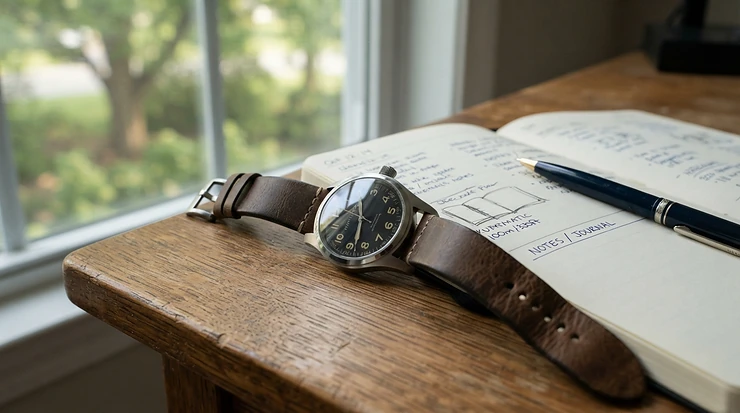
Automatic is not the opposite of mechanical, and that mix-up sits behind most of the confusion over watch movement types. An automatic is a mechanical watch with a rotor that winds the mainspring as your arm moves. The other mechanical kind is hand-wound, and everything powered by a battery or by light falls under quartz.
This 2027 guide is watch movement types explained for beginners, sorted by habit rather than by prestige, with one real watch attached to each. The numbers come from Seiko’s, Citizen’s, Orient’s and Hamilton’s own pages, IEEE Spectrum’s profile of a Casio classic, a Longines explainer, and owner and reviewer comments on two specialist sites; none of the five watches was worn or timed for this piece, so every opinion about feel or accuracy belongs to a named source.
Watch movement types explained for beginners: one family tree, three engines
Every wristwatch keeps time with one of two engines. A quartz watch uses an electronic oscillator and a power source, either a replaceable battery or a solar cell that charges a reserve. A mechanical watch uses a coiled mainspring that has to be wound, either by your hand turning the crown or by a weighted rotor that spins as you move.
That gives you three practical choices: quartz, automatic and hand-wound. Two of the five watches below are quartz, two are automatics that also accept crown winding, and one is purely hand-wound. Four questions separate them better than any brand name does.
How many days a week will the watch actually be on your wrist? How much accuracy do you need, a few seconds a month or a few seconds a day? Do you want a daily ritual, or none? And what are you willing to maintain, a battery swap now and then or a mechanical service every several years?
The answers matter more than the label because the engines behave differently when neglected. Seiko’s instruction manual says the 4R36 automatic is rated for a daily rate of plus 45 to minus 35 seconds and carries about 41 hours of reserve. A quartz watch has no reserve to run down in that way, which is why it forgives a week in a drawer and an automatic does not.
Mechanical vs automatic watch movement types: the wording that trips people up
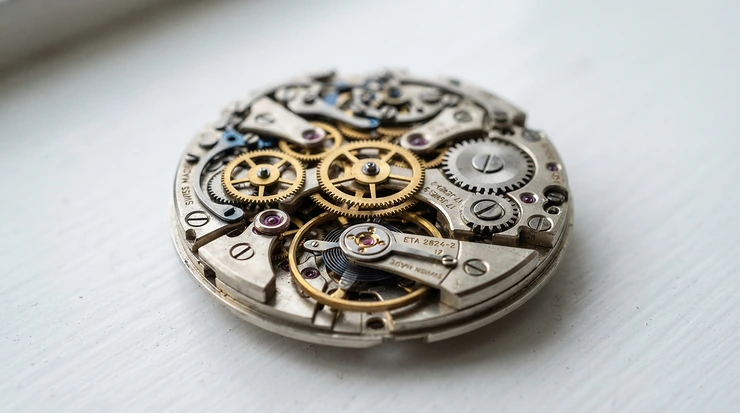
Shops and listings often set “mechanical” against “automatic,” as if you had to choose one. You don’t. Mechanical is the family and automatic is a member of it. A hand-wound watch and an automatic share the same basic parts, a mainspring and a balance wheel regulating the release of that spring’s energy, and the automatic simply adds a rotor.
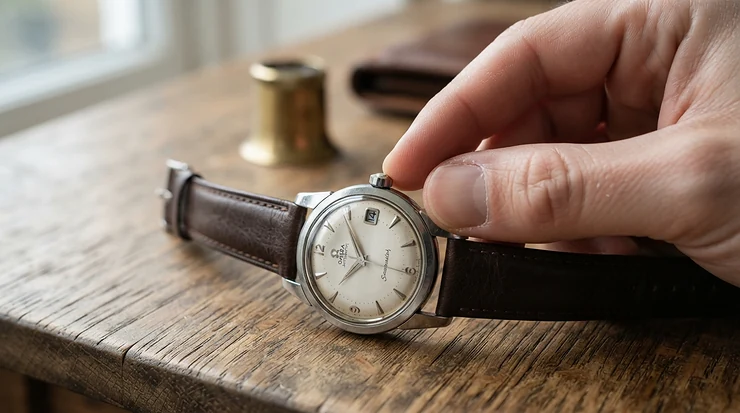
The practical difference is attention. A hand-wound watch stops when you stop winding it. An automatic keeps itself topped up while you wear it, and Longines’ explainer adds a detail many buyers miss: if an automatic has fully run down, wrist motion alone may not restart it, so you wind the crown first. Longines puts the number of crown turns needed to restart at roughly 20 to 114, depending on the caliber.
Thickness is the other visible trade. Dropping the rotor lets a case slim down, and the numbers in this guide show it: the hand-wound Hamilton Khaki Field Mechanical H69439931 measures 9.5 mm thick on Hamilton’s page, against 11.8 mm for the automatic Orient Bambino Version 2 FAC00009N0 and 13.4 mm for the automatic Seiko 5 Sports SRPD55. The cases differ in more than the rotor, since the Seiko is a 100-meter sport design, so read the gap as a tendency and not a rule.
Watch movement type automatic with manual winding: how to read the label
Seiko’s spec pages file the 4R36 under the watch movement type automatic with manual winding, and Orient’s own wording for the F6724 is automatic, hand-winding and hacking. Those words describe two extra abilities. Hand-winding lets you start the watch from a dead stop without shaking it, and hacking means the seconds hand freezes when you pull the crown, so you can set the time to the second.
A watch with neither ability can still run fine, but it is slower to restart and harder to set precisely. Owners commenting on Caliber Corner’s 4R36 page describe the winding feel as uneven: one says it stiffens as the spring fills, another noticed the resistance varying. That is anecdotal, two owners among many, but it is the kind of texture to expect from a budget automatic.
Best watch movement types for five different habits
Each pick below starts from a habit and works back to a movement. Here is how they line up before the details.
Movement
What powers it
What you do
Quoted figure
Watch
Quartz, battery
Replaceable battery
Swap the battery eventually
About a second a day (Casio, via IEEE Spectrum); battery about seven years
Casio F-91W-1
Quartz, solar
Light, stored in a cell
Keep it exposed to light
Runs over six months in total darkness on a full charge (Citizen)
Citizen Garrison BM8180-03E
Automatic, hand-windable
Wrist motion or the crown
Wear it, or wind it
Plus 45 to minus 35 seconds a day; about 41 hours of reserve (Seiko)
Seiko 5 Sports SRPD55
Automatic, hand-windable
Wrist motion or the crown
Wear it, or wind it
About 40 hours of reserve (Orient)
Orient Bambino Version 2 FAC00009N0
Hand-wound
The crown only
Wind it
80 hours of reserve (Hamilton)
Hamilton Khaki Field Mechanical H69439931
The quoted figures are not like-for-like: quartz makers state accuracy per day or per month, mechanical makers state a daily rate range, and reserve only applies to the winding kinds. What the table does show is the spread in demand, from nothing at all on the left to a daily crown turn on the right. Read each listing’s movement and power-source lines on Amazon.com before you commit.
1. Casio F-91W-1 — quartz that asks for almost nothing
Cheap does not mean crude here. IEEE Spectrum’s Consumer Electronics Hall of Fame entry describes the Casio F-91W-1 as a quartz digital with accuracy of about one second a day, which is the figure Casio claims, and a battery that lasts about seven years. It adds a daily alarm, an auto calendar and a stopwatch that counts hundredths of a second, all in a resin case about a third of an inch thick with a steel back.
Durability is where the written record is most consistent. IEEE Spectrum reports that customers commend the resin strap for longevity and that the watch earns admiration as durable and reliable, which is a summary of reviewer sentiment, not a lab result. The article puts the price at a little over ten dollars, so budgeting somewhere around $10 to $20 is reasonable; check the current price on Amazon.com, because listings vary by color and seller.
The limits are built in. There is no analog dial, the water resistance carries no depth rating in that source, and nothing about it will make a mechanical-watch fan’s heart beat faster. It is the movement for someone who wants a watch that never becomes a chore.
Casio F-91W-1See current price, sizes and reviews on Amazon.
Light-powered watches fail in one specific way, and it is the dark drawer. Citizen’s support page on Eco-Drive says a full charge keeps a watch running for more than six months in total darkness, that some models run for less than six months without light, and that power-saving models can go up to seven years. When the hands stop to save energy and light returns, they move quickly to the correct time. The page also describes a light-level indicator on models that include it; the Garrison page does not mention one.
The Citizen Garrison BM8180-03E is the field-style way into that technology. Citizen’s US page lists a 37 mm stainless steel case with 18 mm lugs and a screw-back, mineral crystal, 100-meter water resistance, a black dial with day and date, luminous hands and markers, and a woven strap. It lists no accuracy figure. It also names the caliber as E101 in one section and E100 in another, so the movement label on the listing you buy from deserves a second look.
Nothing here needs winding, and Citizen says the watch never needs a battery replaced. That makes it the quartz pick for someone who rotates watches, since an occasional day by a window keeps it charged. Check the current price on Amazon.com.
Citizen Garrison BM8180-03ESee current price, sizes and reviews on Amazon.
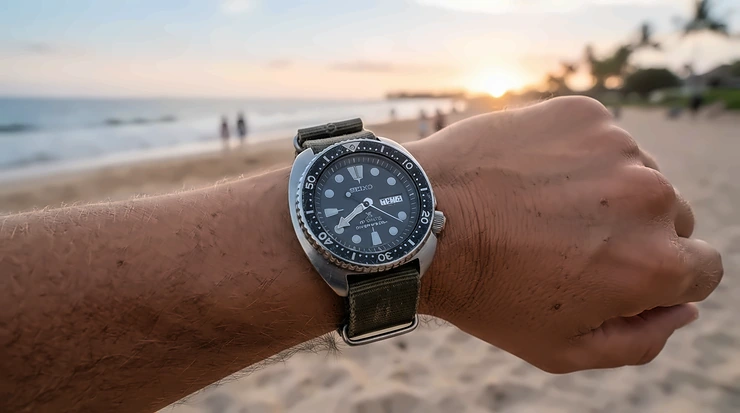
A first mechanical watch has to survive its owner’s habits, and this is where the Seiko 5 Sports SRPD55 earns its place. It runs the 4R36 with 24 jewels at 21,600 beats per hour, can be wound by hand, and hacks, according to Seiko’s manual and a dealer page that lists the same abilities. A dealer listing gives the case as 42.5 mm across, 13.4 mm thick and 46 mm lug to lug, with a Hardlex crystal, a screw-in exhibition caseback, 100 meters of water resistance and a 22 mm bracelet.
Accuracy is the honest weak spot. Seiko’s manual adds that the actual daily rate can fall outside its range depending on how long you wear the watch, the temperature, arm movement and how fully the mainspring is wound. Owner comments on Caliber Corner’s 4R36 page back that up with scatter: one King Turtle owner reports about minus 30 seconds a day, another regulated theirs to about minus 5 with positional swings of 5 to 6 seconds, and an SRPD51 owner reports about plus 3. These are individual reports, not a sample.
Dealer pages put the Seiko 5 Sports SRPD55 in the few-hundred-dollar tier, far above the Casio and well below the Hamilton, so check the current price on Amazon.com.
Pros:
Hand-winding and hacking make it easy to restart and set
100-meter water resistance on the dealer spec
A display caseback shows the movement working
Cons:
At 13.4 mm thick it is the chunkiest mechanical pick here
The factory rate allows up to 45 seconds fast or 35 seconds slow a day
Seiko 5 Sports SRPD55See current price, sizes and reviews on Amazon.
Dress watches rarely leave the case long enough to prove an automatic’s worth, which suits the Orient Bambino Version 2 FAC00009N0. Orient USA’s page lists the in-house F6724 caliber as automatic, hand-windable and hacking, with about 40 hours of reserve, a 40.5 mm case 11.8 mm thick, 21 mm lugs, a domed mineral crystal and 30 meters of water resistance. That is splash-level protection and not a swim watch.
Caliber Corner repeats Orient’s own description of the F6724 and lists affordability, hacking and hand-winding as its strengths. Its weakness, per the same page, is thin official documentation and parts availability for Orient movements. Two commenters there report timing within about 3 seconds after 24 hours out of the box, which is a one-day snapshot and not a rate.
The 21 mm lug width sits between the common 20 and 22 mm sizes, so strap shopping is narrower than on the others. For a slimmer, smaller-faced automatic than the Seiko, it makes sense; for a watch you want to dive in, it does not. Look up the current price on Amazon.com before deciding.
Orient Bambino Version 2 FAC00009N0See current price, sizes and reviews on Amazon.
Hamilton’s own US pricing and dealer pages place this watch well above the Seiko, and what the money buys is a Swiss-made H-50 hand-wound caliber with an 80-hour reserve, a 38 mm case 9.5 mm thick, 20 mm lugs, a sapphire crystal and 50 meters of water resistance. With no rotor and no date window, restarting it is a matter of turning the crown until it resists.
Two Broke Watch Snobs’ hands-on review is the most useful real-use source. Over a week on the wrist, the reviewer measured about plus 0.8 seconds a day, lost 8 seconds on the one day they forgot to wind it, and concluded that winding more often improved accuracy. The crown is not screw-down, so the reviewer advises against submerging it, and the supplied NATO strap irritated their skin. That is one reviewer over a short stretch.
Reviews on Hamilton’s page for the sibling H69439933 reference average 4.4 out of 5 across 20 reviews. They split on accuracy, with one buyer gaining about 10 seconds a day and another losing one to two, and one complains the strap is too large for a 6.5-inch wrist. The reference differs from this one by strap, so treat it as supporting color. The current price on Amazon.com is worth a look, since sellers there vary.
Pros:
An 80-hour reserve carries it through a weekend off the wrist
At 9.5 mm it is the slimmest of the three mechanical picks
Sapphire crystal where the other mechanical picks use Hardlex or mineral
Cons:
The Hamilton Khaki Field Mechanical H69439931 has no rotor, so it stops if you forget to wind it
Only 50 meters of water resistance and no screw-down crown
Hamilton Khaki Field Mechanical H69439931See current price, sizes and reviews on Amazon.
Quartz upkeep is mostly a battery. Longines describes quartz maintenance as low, mainly battery replacement plus keeping the watch clean and dry, and the Casio F-91W-1 is rated for about seven years on one cell. The Citizen Garrison BM8180-03E skips the battery question entirely on Citizen’s account.
Mechanical watches ask more. Longines lists occasional winding and servicing for automatics and daily-or-so winding for hand-wound watches. The cost of servicing varies a great deal by brand and complexity, so get a quote from a watchmaker for the specific caliber before you buy, instead of trusting a generic figure. Budget automatics like the Seiko 5 Sports SRPD55 and the Orient Bambino Version 2 FAC00009N0 sit at the cheaper end of that world, but servicing a mechanical movement is never as cheap as swapping a quartz cell.
Three ways people end up with the wrong movement
An automatic bought by a desk-bound owner is the first mistake. Wearing the watch tops up its reserve, and both the Seiko 5 Sports SRPD55 and the Orient Bambino Version 2 FAC00009N0 run about 40 hours before stopping. If you swap watches daily, expect to restart them, and use the crown instead of shaking your wrist.
Treating solar as maintenance-free is the second. Citizen’s own figures cover the dark case in months, but a watch left in a drawer past that window is out of charge, and its hands stop when power-save engages.
The third is expecting mechanical accuracy to match quartz. Seiko rates its automatic across an 80-second daily range, while the Casio’s claim is about a second a day. If being right to the second matters more than the pleasure of a mechanism, quartz is the better pick.
Searching sap movement types? That is inventory software, not watches
SAP movement types belong to enterprise inventory management. SAP’s public knowledge-base article describes a movement type as a three-digit key identifying a goods movement, grouped into ranges such as 1xx for goods receipts and 2xx for goods issues. A reversal uses the code plus one, so 101 reverses as 102. Nothing in it touches a watch, so go to SAP’s own documentation for that subject.
Quick answers on watch movements, from crown winding to SAP codes
What are the main watch movement types?
Three engines cover almost every watch: quartz (battery or solar powered), automatic (a rotor winds the mainspring from wrist motion) and hand-wound (you turn the crown). Automatic and hand-wound are both mechanical; quartz is electronic and typically needs the least attention.
Is a mechanical or automatic watch better?
The question mixes categories, because automatic is a kind of mechanical. Pick automatic if you will wear the watch most days, and hand-wound if you enjoy a daily winding ritual. Longines notes wrist motion alone may not restart a fully run-down automatic.
Do automatic watches ever need winding by hand?
Sometimes. Some automatics, including Seiko's 4R36 and Orient's F6724, also accept crown winding, which restarts a watch that has run down. Both calibers quote a reserve of roughly 40 hours, after which an unworn automatic stops.
Which watch movement type is the most accurate?
Quartz, by a wide margin. Casio claims about one second a day for its classic digital model, while Seiko rates the 4R36 automatic between 45 seconds fast and 35 seconds slow per day. Mechanical watches can be regulated closer, but expect more drift than quartz.
What are SAP movement types?
They are unrelated to watches. In SAP inventory management, a movement type is a three-digit key identifying a goods movement, such as 101 for a goods receipt against a purchase order or 261 for a goods issue to an order. Reversals add one, so 101 reverses as 102.
Match the movement to your week, then buy
Among watch movement types, the useful split is how much attention you will give the watch. Give it none, and the Casio F-91W-1 or the Citizen Garrison BM8180-03E will keep time for years. Wear one watch most days, and the Seiko 5 Sports SRPD55 or the Orient Bambino Version 2 FAC00009N0 will charge themselves from your arm, with the crown as a backup. Enjoy a small daily ritual, and the Hamilton Khaki Field Mechanical H69439931 rewards it with a three-day reserve.
For someone curious about mechanical watches, the first pick would be the Seiko 5 Sports SRPD55, because crown winding and a stopping seconds hand make a run-down watch easy to restart and set. Spend more on the Hamilton only if the slim case and hand-winding appeal to you.
WatchWiseHub is an independent buying-guide site for watches, smartwatches, straps and accessories. Our editorial team compares gear using manufacturer specifications, independent tests from specialist watch media, owner reports and retailer listings. We do not claim to have tested the watches ourselves; see How We Choose Gear for our method.