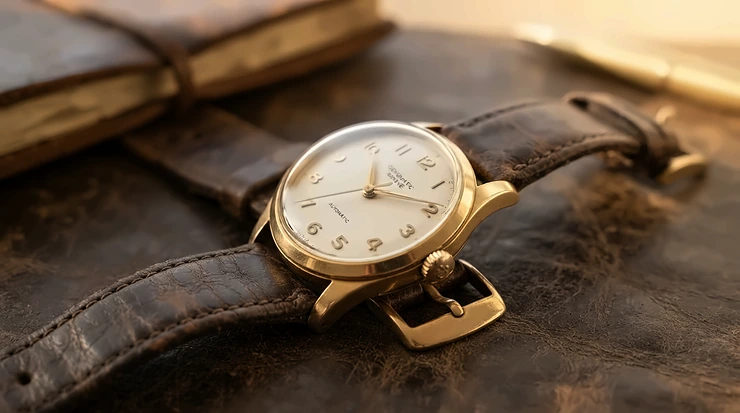
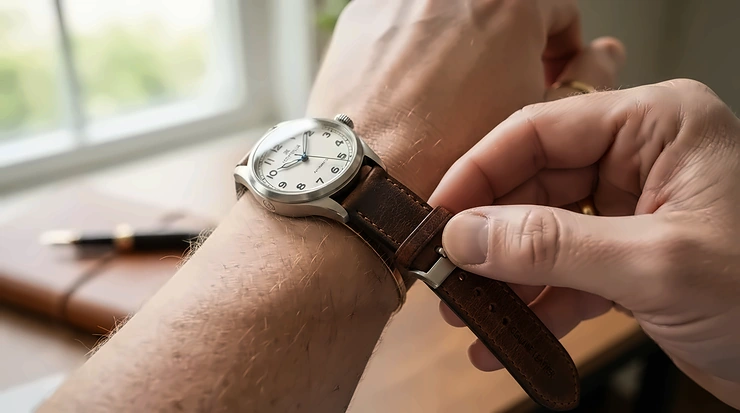
Longines sells its HydroConquest line in three different lug widths, 19mm, 21mm and 22mm, according to the reference table in Watch & Strap’s Longines strap guide, so even one family cannot be trusted to share a size. That is the first lesson of any watch lug width guide: the number belongs to the exact reference on your wrist, not to the brand or the case diameter. This 2027 edition covers how to measure it with calipers or a ruler, what to do when the answer is an odd 21mm, and the three tools that make the job quick.
The findings rest on measuring walkthroughs from two strap sellers, a watch-strap magazine, owner threads on Omega Forums and similar boards, a calipers test from Bob Vila and retailer listings. No watch or tool was handled for this article, and prices appear as ranges because the current figure on Amazon.com may differ.
Three numbers people mix up
Lug width is the inside gap between the two lugs on one side of the case, the space where the strap end and spring bar sit. It is the only figure that decides whether a strap fits.
Lug-to-lug is a different animal. Anchor Strap Co. notes that a watch with 20mm lugs can measure 48mm lug-to-lug, a number that tells you how the case will sit on a wrist and nothing about which strap to buy.
Two more figures cause trouble. Strap listings often show a pair such as 20/16, and only the first number, the width at the lugs, has to match your watch; the second describes the buckle end, per De Lugs’ fitting guide. Case diameter predicts nothing either, since Watch & Strap points out that two 40mm watches can take different lug widths.
Work in millimeters from the start. Watch & Strap warns that converting from inches invites rounding errors and a wrong strap size.
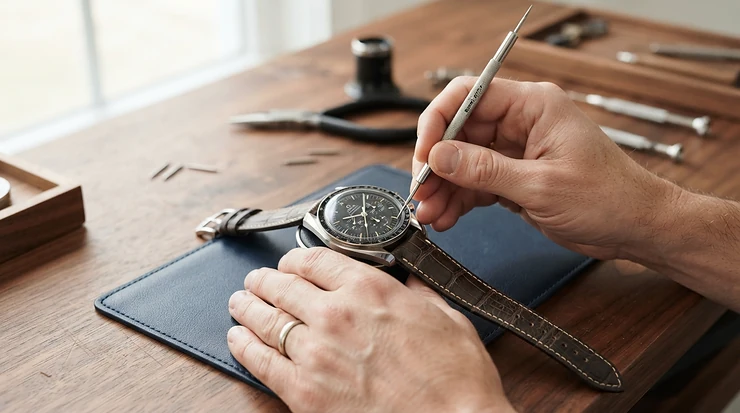
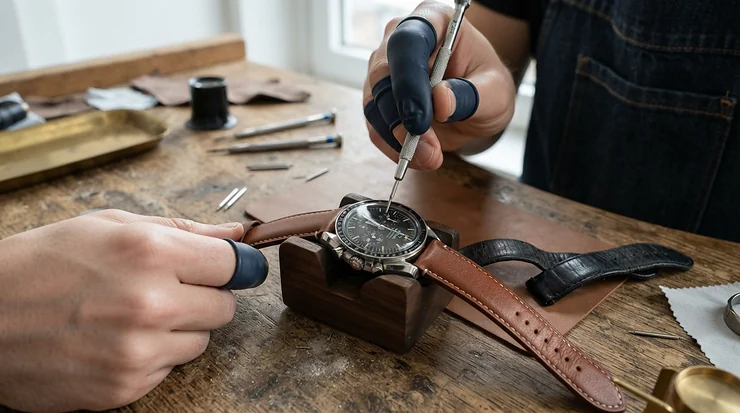
Take the strap off if you can. Set the forked end of a spring bar tool against the bar’s shoulder, compress it, and free one side of the strap, working over a soft cloth or tray because bars can jump.
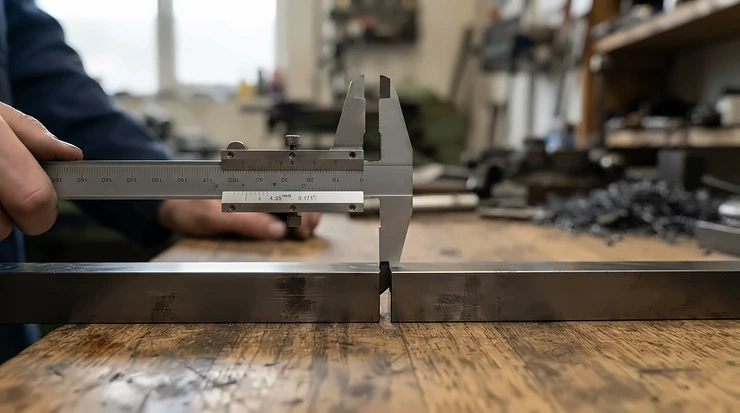
Slide the small inside jaws of your calipers into the gap and spread them until both tips touch the inner faces of the lugs. Keep the jaws square across the opening, not tilted.
Read the number at the spring bar line, where the strap end actually sits. Anchor Strap Co. says most lug widths are whole millimeters, so a reading like 20.4mm usually means the jaws caught a chamfer or a curve; reposition and measure again.
No calipers? Lay a metric ruler across the gap in good light and read straight down, twice. Watch & Strap notes that a ruler gap just over 20mm may really be 21mm, so measure the bare gap before ordering if the reading falls between sizes.
Check the result against the maker’s number for your exact reference, which Watch & Strap suggests finding on the case-back engraving, the paperwork or the brand’s spec page.
Most watch lug width guide tips come down to one habit: measure the bare gap, then compare it with the maker’s figure before spending anything.
Where a clean measurement still ends in a return
The most common slip is measuring from the outside edge of one lug to the outside edge of the other. Watch & Strap flags that this gives the overall span, which is wider than the gap the strap needs.
A second slip is trusting the family name. The same Longines table that lists the HydroConquest 41 at 21mm shows a HydroConquest GMT reference at 22mm, so two similar-looking cases from one brand can disagree.
Fitted end links and fitted rubber straps are a third. Watch & Strap explains they are shaped for one case design, so a matching width alone does not guarantee a fit, and Anchor Strap Co. adds that some cases, usually with integrated bracelets, have no conventional gap for a spring bar at all.
Spring bars matter too. Watch & Strap cautions that quick-release bars can sit awkwardly on very tight openings, thick straps or heavily curved cases. A buyer on a retailer listing for a 21mm quick-release band reports that the bars were too short for a Victorinox INOX; that is one report on one product, but it shows why the bar length deserves a glance.
Watches with 21mm lug width and the straps that suit them
WatchGecko’s article on odd lug widths names a handful of watches that use 21mm lugs: the Breitling Navitimer 8 (41mm case, which Breitling moved to 21mm at Baselworld 2018), Certina DS Action Powermatic 80, Zenith El Primero, Orient Bambino, Omega Seamaster 300 Master Co-Axial, Seiko SNA411 Flightmaster, an Oris Carl Brashear edition and an IWC “Le Petit Prince” edition. Exquisite Timepieces adds the Omega Speedmaster Chronoscope and the Oris Big Crown telemeter chronograph, and Watch & Strap’s table puts several HydroConquest references at 21mm.
Why does the size exist? Strapcode reports that some collectors believe odd widths help a maker individualize a watch, limit aftermarket choice and protect its own straps. WatchGecko complicates that story by noting that Citizen and Tissot sell odd-width watches without matching branded straps, and some forum voices simply credit design proportion.
Availability gets two verdicts. Exquisite Timepieces calls 21mm straps more difficult to source, while WatchGecko says off-the-shelf options for 19mm and 21mm have never been wider. Both can be true: the choice is thinner than 20mm and 22mm, but it is no longer empty.
Owners facing a 21mm gap have three routes, and their experiences differ.
Choice
Works best on
Main risk
True 21mm strap
Leather, nylon, rubber, mesh
Narrower selection than 20mm or 22mm
22mm, one size up
Supple leather, nylon
Buckling or deforming on stiff straps; not for bracelets
20mm, one size down
Nothing recommended
Visible gap, spring bars that can pop out
The table’s middle row is where opinions split. WatchGecko says one size up can work with a supple leather strap but not with metal bracelets, and strongly advises against sizing down because it looks wrong and raises the risk of a dropped watch. A Breitling forum reply agrees that a 20mm strap on 21mm lugs always looks bad while a 22mm can sometimes be compressed. One Omega Forums owner of a 21mm Speedmaster reports that 22mm leather straps either would not fit or had to be bent and ended up deformed, whereas a Longines owner in another thread found a 22mm nylon NATO looked acceptable. Milano Straps recommends conventional spring bars over quick-release ones for the 22mm-on-21mm trick so the strap can be pushed in during fitting, and a poster on WatchCrunch suggests curved 21mm bars to help a 22mm strap sit properly.
The takeaway: look for a true 21mm strap first, accept a 22mm only in soft nylon or supple leather, and leave 20mm alone. On strap ideas, Strapcode lists 21mm woven nylon, leather, rubber and mesh, including an FKM rubber band that tapers from 21mm at the lugs to 18mm at the clasp, and a buyer on the StrapsCo site says a 22mm mesh was a hair too wide while the 21mm replacement fit perfectly. Read WatchGecko’s odd lug width advice before you commit to an off-size strap.
Three tools that match the steps
You can finish this job with a ruler and patience, but three items make it faster and safer: one for measuring, one for removing the old strap, and one for the strap itself.
Steps 3 and 4 are where a caliper earns its keep, because it shows 21.0 and 20.4 as different numbers the instant the jaws touch. The Neiko 01407A Electronic Digital Caliper reads 0 to 6 inches (150mm) and toggles between inches, fractions and millimeters with one button; listing text mirrored on Desertcart states 0.02mm resolution and a stainless steel body.
Bob Vila’s testers called it especially easy to use, liked the thumbwheel and the readable display, and flagged the lack of a warranty, no IP54 rating and shrinking decimal digits. Machinist Guides calls it not the best caliper money can buy but possibly the best value. Anchor Strap Co. puts basic digital calipers at about $20, and the exact Amazon price is worth checking on the day.
Steel jaws are harder than a polished lug. Omega Forums members suggest composite calipers for watch work, and one poster says a cheap plastic pair is accurate enough for lug width but goes back to steel for finer jobs.
Neiko 01407A Electronic Digital CaliperSee current price, sizes and reviews on Amazon.
The fork on a Bergeon 6767-F Spring Bar Tool is narrow, between about 1mm and 1.2mm depending on whether you read WatchGecko’s product page or Two Broke Watch Snobs, and that narrowness is the reason to pick the F over the wider 6767-S. Two Broke Watch Snobs explains that the thin tip reaches the small bar openings on metal bracelets, the S fork of about 3mm suits heavy leather and rubber, and the Bergeon 6767-SF carries both forks for a mixed drawer of straps.
The tool is Swiss made, 145mm long and has hardened steel points, according to WatchGecko. One reviewer at Two Broke Watch Snobs found it gripped bars far better than cheap marketplace tools, a view echoed by a buyer on a retailer listing whose bundled kit tool flexed too much to hold a bar. A single eBay buyer, though, found the fork too wide for Rolex steel bracelets. US watch-parts dealers list the F between about $20 and $40, and it is the item that most reduces the risk of a scratched lug on step 2.
Bergeon 6767-F Spring Bar ToolSee current price, sizes and reviews on Amazon.
Anyone who has searched for a 21mm leather strap knows the selection is thinner than at 20mm and 22mm, which is what makes the WOCCI 21mm Old-fashioned Watch Band worth a look. Its listing data, mirrored on Desertcart, describes top grain saddle leather, hand-stitched French wax thread, hand-painted edges, a quick-release stainless steel spring bar and buckle, and a fit for wrists from 6.3 to 8.1 inches.
The same page shows 4.5 out of 5 on 1,206 ratings and a rank of #81 in men’s watch bands; ratings move, so treat that as a snapshot. Reviewers there mention one buyer who found the band stiff at first and expected break-in to ease it, and another whose quick-release bar interfered with fit on a 16mm watch. Because buyers mention 20mm and 16mm versions of the same strap, confirm that 21mm is the size selected before checkout. Watch & Strap’s caution about quick-release bars on tight or curved cases applies here too, and no price appears on the mirrored page, so check the current price on Amazon.com.
WOCCI 21mm Old-fashioned Watch BandSee current price, sizes and reviews on Amazon.
Adding the ranges gives a full kit of roughly $60 to $90 (my arithmetic: about $20 for calipers, $20 to $40 for the Bergeon 6767-F Spring Bar Tool, and $20 to $30 for a strap). The strap figure comes from specialist seller Trendhim, which lists 21mm leather and steel quick-release straps in the $20s on its own store, so it is a guide to the category rather than an Amazon price.
The expensive path is custom. One Omega Forums owner says custom-made straps for a 21mm Speedmaster start around $260, which is why the true-21mm route is worth trying first.
Savings are easy to find. Watch & Strap says a careful metric ruler works if calipers are not an option, and Anchor Strap Co. offers to confirm lug width from a model and reference number before you order.
Odd widths, in-between readings and fit: straight answers
Is lug width the same as lug-to-lug distance?
No. Lug width is the gap between the two lugs on one side, and it decides which strap fits. Lug-to-lug is the case length from the top lugs to the bottom lugs, which affects how the watch sits on your wrist.
Can a 22mm strap fit 21mm lugs?
Sometimes. Supple leather or nylon can flex into a 21mm gap, and a conventional spring bar helps more than a quick-release one. Stiff leather, bracelets and thick padded straps can buckle, so size up only on soft straps and never force one.
What if my calipers read 20.4mm?
Lug widths are usually whole millimeters, so a reading like that often means the jaws caught a chamfer or curve. Reposition the jaws along the spring bar line and measure again. If it still falls between sizes, round to the nearest whole number and check the maker's spec.
Do I need a spring bar tool for quick-release straps?
Not always. A quick-release strap has a small lever that frees the bar without a tool. You still want a fork-tipped tool to remove the original strap, to handle a stuck bar, or to fit conventional bars, and a tray helps catch anything that jumps.
Why do some watches use 21mm lugs?
Sources disagree. Some collectors argue odd widths protect a maker's own straps, yet Citizen and Tissot use odd sizes without selling matching branded straps. Others say it is design proportion, since 20mm or 22mm lugs could upset the balance of a particular case.
One measurement, three decisions
A watch lug width guide boils down to a single reading taken from the bare lug gap at the spring bar line, compared with the maker’s number for your exact reference. If the answer is 21mm, buy a true 21mm strap first, accept a 22mm only in soft nylon or supple leather, and leave 20mm on the shelf. Keep the Neiko 01407A Electronic Digital Caliper for the reading, the Bergeon 6767-F Spring Bar Tool for the swap, and a strap such as the WOCCI 21mm Old-fashioned Watch Band for the finish. Measure first, then open the picks above.
WatchWiseHub is an independent buying-guide site for watches, smartwatches, straps and accessories. Our editorial team compares gear using manufacturer specifications, independent tests from specialist watch media, owner reports and retailer listings. We do not claim to have tested the watches ourselves; see How We Choose Gear for our method.