
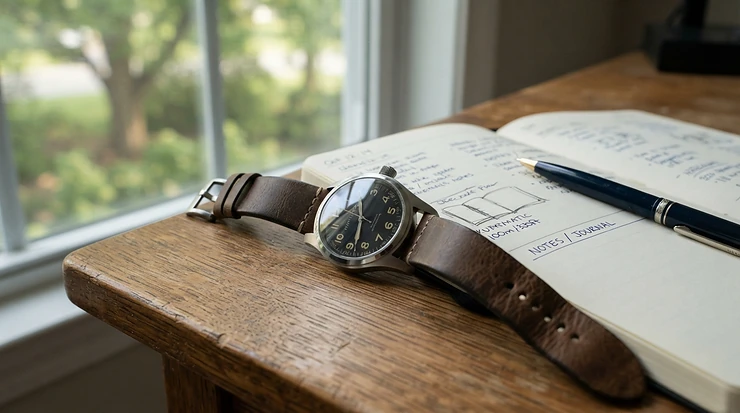
The best value automatic watches in 2027 give you a movement that hand-winds, a case that survives daily wear, and a price somewhere between $150 and $800, and five models clear that bar: the Orient Bambino Version 4, the Seiko 5 Sports SRPD, the Citizen Tsuyosa NJ0150, the Tissot PRX Powermatic 80 and the Hamilton Khaki Field Auto 38mm. Specs below come from maker pages and spec sheets, ownership details are credited to the reviewers who reported them, and any accuracy number that is only a rated spec rather than a measured result is labeled that way.
“Value” has a second meaning for a lot of buyers: what the watch fetches when you sell it. The two ideas pull apart more often than most roundups admit, so a later section covers watches with the highest resale value and why none of these five belong on that list. A short detour into old Gucci ladies watches closes the article, because people researching resale prices tend to land there.
What “best value” means when the movement is mechanical
Four things separate a good-value automatic from a merely cheap one.
Power reserve decides whether the watch is still running on Monday morning. The Seiko and Citizen picks store roughly 41 to 42 hours; the Tissot and Hamilton store 80.
The crystal is next. Hardlex mineral glass scratches more easily than sapphire, and a sapphire swap on a Seiko runs around $40 at a watchmaker, according to a 2026 owner guide on Authentic Wrist.
Fit matters more than the diameter on the spec sheet. Lug-to-lug length and thickness decide whether a 42 mm case feels like 40 or like 46.
The price you actually pay is the last one, and it moves. Dappered caught the Citizen on Amazon in the mid-$300s in September 2025, when the maker was rolling out a successor, while the same review places its normal position firmly under $500.
One more cost hides in the entry tier: owners keep replacing straps and bracelets. Budget $15 to $30 for that, a figure Authentic Wrist gives for Seiko 5 owners and Two Broke Watch Snobs echoes for the Orient’s stock strap.
Where the money goes: movement, size, and reserve in one table
| Watch | Movement | Power reserve | Case | Water resistance | Typical price range |
|---|---|---|---|---|---|
| Orient Bambino Version 4 | Orient F6724, hand-winding, hacking | Not stated in the sources reviewed | 40.5 to 42 mm | 30 to 50 m | $150 to $350 |
| Seiko 5 Sports SRPD | Seiko 4R36, hand-winding, hacking | 41 hours | 42.5 mm | 100 m | $200 to $350 |
| Citizen Tsuyosa NJ0150 | Miyota 8210, hand-winding, hacking | 42 hours | 40 mm | 50 m | Under $500, mid-$300s when discounted |
| Tissot PRX Powermatic 80 | Powermatic 80 (ETA 2824 base) | 80 hours | 40 mm (35 and 38 mm also sold) | 100 m | About $700 to $850 |
| Hamilton Khaki Field Auto 38mm | H-10 automatic | 80 hours | 38 mm | 100 m | Just under $800 |
The jump from the second row to the fourth buys you roughly double the power reserve and a Swiss-made label, and it costs somewhere around $400 to $500 more. Whether that is worth it depends on how often the watch sits on a nightstand: a daily wearer rarely uses more than 42 hours. Check current availability below, because several of these are discounted at one retailer and not another.
Five automatics, sorted from about $150 up
1. Orient Bambino Version 4 — dress-watch looks for pocket money
Two Broke Watch Snobs gives $150 to $350 as the range for the Bambino family and about $250 as the average, which makes the Orient Bambino Version 4 the cheapest way into a dressy automatic with a domed crystal and sloped lugs. One blogger at Dennis Amith’s site reports paying around $116 on eBay and advises against going past $150 unless the watch ships from outside the US.
The movement is Orient’s in-house F6724. It hand-winds, hacks, and is rated at −15/+25 seconds a day; the same blogger saw no significant time loss on his own example, which is one owner’s experience and not a test. Version 4 grew to 42 mm according to Orient USA’s product page, and he warns it may be too big for smaller wrists. Two Broke lists 40.5 mm versions with a short 44.3 mm lug-to-lug that wear smaller than the number suggests.
Water resistance is modest at 30 to 50 m depending on the version, and the V4 has a solid caseback, so the movement stays out of sight. Two Broke says the factory strap is usually the first thing owners replace.
2. Seiko 5 Sports SRPD — the default first automatic diver-style
A 100 m rating is the complaint SKX loyalists raise first, and Two Broke Watch Snobs says plainly that the Seiko 5 Sports SRPD is no substitute for a serious dive watch. For everyday exposure it is plenty: Authentic Wrist says 100 m covers swimming and light snorkeling, though not scuba, hot tubs, or saunas.
Inside is the Seiko 4R36, which hacks, hand-winds, and stores 41 hours. Its rated accuracy is +45/−35 seconds a day (Bespoke Unit and The Truth About Watches both list that spec). Authentic Wrist reports typical examples at about ±15 to 25 seconds, with some at ±10 and some at ±30, which in daily life means resetting the time once or twice a week. The case measures 42.5 mm by 46 mm by 13.5 mm per Two Broke, which lists the price at $200 to $350; Authentic Wrist cites $180 to $260, so dial and retailer move the number.
Authentic Wrist calls the bracelet the weak point, with hollow end links and a stamped clasp, and mentions minor quality-control flaws such as a chapter ring slightly off-center or a bezel that does not click exactly at 12. These are mostly visible under magnification, so inspect the watch when it arrives. The guide expects two to five small scratches on the Hardlex after a year of daily wear. It is one guide, though Two Broke’s praise for the lume and its note about the 100 m rating line up with it.
Pros:
- ✅ Hacking and hand-winding movement at a very low price
- ✅ Strong LumiBrite glow, which Two Broke calls excellent
- ✅ 27 models launched together in 2019, so dial and style choice is wide, per IZ Review
Cons:
- ❌ Hardlex crystal scratches sooner than sapphire
- ❌ Stock bracelet rattles and is the first upgrade
- ❌ Rated accuracy window is wide
3. Citizen Tsuyosa NJ0150 — integrated bracelet, sapphire front and back
Anyone who wants a watch that slides under a shirt cuff and still shows a moving rotor should start with the Citizen Tsuyosa NJ0150. WatchTime editor Roger Ruegger’s hands-on review of the family notes the Miyota 8210 is visible through a see-through caseback, hacks, hand-winds, and holds about 42 hours; his full write-up also praises the balance between bracelet and case weight, though he finds the 4 o’clock crown less convenient to operate.
Dappered scored it 4 out of 5, with sapphire on both the front and back and a fit suited to wrists of about 6.5 to 8.5 inches. Its complaints are specific: the crown is hard to pull out and needs a fingernail, and the integrated bracelet makes strap swapping impractical. Dappered also notes the newer generation stores 60 hours against this model’s 42.
Accuracy reports differ. The rated spec is −20/+40 seconds a day. Teddy Baldassarre’s review measured +7 to +11, Vivir cites typical examples at +10 to +20, and one verified buyer on Citizen’s own store reports an example running 10 to 15 seconds fast daily, with a hard-to-see seconds hand and lume that is only OK. That is a spread of reports, not a defect pattern. Water resistance is 50 m.
4. Tissot PRX Powermatic 80 — three days of power reserve
Gear Patrol’s reviewer set the 35 mm version on a nightstand around midnight on a Thursday, picked it up Monday morning, and found it still running, which is the 80-hour reserve doing what the Tissot PRX Powermatic 80 promises. The same review measured accuracy within about two seconds a day and said it beat the reviewer’s Seiko, Sellita, and ETA-based watches. That is one tester and one watch, so treat it as encouraging rather than guaranteed.
The movement is a modified ETA 2824 architecture slowed to 21,600 beats an hour to stretch the reserve, per Teddy Baldassarre. Water resistance is 100 m. The standard case is 40 mm, with 38 mm titanium and 35 mm versions also sold. Gear Patrol saw the gold-PVD 35 mm at $825 at Nordstrom and Exquisite Timepieces describes the line as a roughly $700 Swiss watch, so expect $700 to $850 for mainstream versions.
Owner sentiment on Dialicious, a French watch-review community, averages about 4.2 out of 5 across 23 reviews, with value for money scoring 4.6 and robustness the lowest at 3.8 (a small sample).
Pros:
- ✅ 80-hour reserve survives a weekend off the wrist
- ✅ Integrated bracelet finishing is praised for the price
- ✅ 100 m water resistance
Cons:
- ❌ Gear Patrol calls the 35 mm crown “painfully small” and the lume very weak
- ❌ The 40 mm bracelet is described as cuff-like, with non-articulating end links
- ❌ Integrated bracelet limits strap changes
5. Hamilton Khaki Field Auto 38mm — Swiss field watch with 80 hours
A buyer who wants Swiss-made, sapphire-covered, and thin enough to wear under a sleeve is the person the Hamilton Khaki Field Auto 38mm was built for: Hamilton’s own page lists an 11 mm case, 20 mm lugs, 100 m water resistance, an 80-hour H-10 caliber, and a two-year international warranty. Teddy Baldassarre adds a Nivachron balance spring, 25 jewels, a 3 Hz beat, and an exhibition caseback that modernizes the old closed-back field design.
Price is where it sits above the rest, at just under $800 on a strap in Teddy Baldassarre’s account. The reviewer’s text lists 38, 40, 41, and 42 mm in different places, so confirm the exact size and reference on the Amazon listing before buying, since Hamilton sells several Khaki Field Auto sizes and materials.
Straps shape the character: a NATO is the historically correct choice, and the three-link bracelet makes it feel more contemporary. Compared with the Seiko and Orient, the Hamilton gives you a thinner case, a sapphire crystal, and nearly double the reserve; compared with the Tissot, it gives up the integrated bracelet and some brand buzz.
Check current availability on Amazon.com for the size and dial you want, since discounts vary by variant.
What the value automatic watches reviews keep agreeing on
Owner reviews and tester notes cluster around three findings, and each comes with a small-sample caveat.
First, accuracy is the soft spot of the cheapest movements. The Seiko guide’s ±15 to 25 seconds a day and the Citizen buyer’s 10 to 15 seconds fast are consistent with rated specs, and Dialicious reviewers rate the Tsuyosa’s accuracy lowest of its sub-scores (3.4 out of 5 in an earlier snapshot of 20 reviews) while scoring its value for money 4.8. The Tissot’s reviewers rate its accuracy 4.2, in line with Gear Patrol’s tight measurement. These are small samples, so use them for direction only.
Second, the bracelet and strap are the usual first upgrade on the Seiko 5 Sports SRPD and the Orient Bambino Version 4, per Authentic Wrist and Two Broke. Neither is a defect, but it is a $15 to $30 line item most price comparisons leave out.
Third, the Citizen and the Tissot trade ease of use for style. Dappered’s note about the hard-to-pull crown on the Citizen Tsuyosa NJ0150 and Gear Patrol’s note about the tiny crown on the Tissot PRX Powermatic 80 describe the same compromise: integrated-bracelet designs look sleek, but small crowns and unswappable bracelets make them less forgiving.
Best value automatic watches for men: sizing that prevents returns
Wrist size decides more returns than movement choice. The Seiko 5 Sports SRPD at 42.5 mm is comfortable for most wrists above 6.25 inches, according to Authentic Wrist, which suggests the smaller 38 mm SRPE under 6 inches. Dappered says the Citizen Tsuyosa NJ0150 suits roughly 6.5 to 8.5 inches. The Orient Bambino Version 4 at 42 mm may be too much for slim wrists, though 40.5 mm versions exist. Gear Patrol found the 40 mm PRX bracelet cuff-like and the 35 mm far more comfortable on a 6.25-inch wrist.
For a larger wrist, the 42.5 mm Seiko and the 42 mm Bambino carry visual weight easily. For a smaller wrist, the Hamilton Khaki Field Auto 38mm, at 11 mm thick, stays under most cuffs. Women shopping for the same category will find the PRX in 35 mm and the Bambino in smaller sizes; the sizing logic above applies equally.
Watches with the highest resale value, and where these five land
None of the five is a resale play. The sources agree that the cheaper the watch, the larger its percentage drop, even when the dollar loss is small. WatchScanning puts Seiko at a 20 to 40 percent loss and Tissot at 40 to 60 percent in its brand table, although the same page also lists the PRX line at 20 to 40 percent; it does not reconcile the two. For scale, losing half of a $350 watch costs less in dollars than losing a fifth of a $5,000 one, which is a hypothetical example and not a market figure.
Watches with the best resale value share traits instead: steel cases, long brand equity, and demand that exceeds supply. Grailr’s May 2026 valuation guide gives these figures as percentages of retail, after three to five years:
| Watch or brand | Retention reported | Notes |
|---|---|---|
| Rolex steel sports models | 95% to 180% | The article’s own FAQ says 95% to 130%; Grailr calls its figures illustrative |
| Tudor Black Bay 58 | 70% to 85% | Tudor as a brand is listed at 70% to 85% |
| Omega Speedmaster | 65% to 80% | A second Grailr article puts it at 80% to 100% |
| Grand Seiko | 60% to 75% | Snowflake SBGA211 listed higher, at 70% to 80% |
| Breitling | 40% to 55% | Quartz models fall further |
A separate summary of a Morgan Stanley watch report, posted by a pre-owned dealer, shows only Patek Philippe (+15.4%), Rolex (+9.8%), and Audemars Piguet (+3.0%) trading above retail, while Tudor sat at −25.7%, Omega at −32.3%, and IWC at −37.9%. The dealer’s post gives no methodology, so read the direction rather than the decimals. That is also why there is no honest list of all watches that have high resale value: the group is small, it changes, and the figures differ by source.
Four things move resale in the sources reviewed:
- Steel over gold. Grailr says gold and two-tone versions of both Rolex and Omega depreciate 20 to 40 percent.
- Box and papers. Full sets sell for a 10 to 25 percent premium in general, and 5 to 15 percent for Omega and Tudor.
- Documented service. A recent manufacturer service can add 5 to 10 percent.
- Buying used. An Omega that has lost 15 to 30 percent already passed that drop on to its first owner.
If resale is the goal, a pre-owned steel Tudor or Omega beats any of the five above. If wear-per-dollar is the goal, the Seiko or the Orient costs so little that the percentage loss barely registers.
Old Gucci ladies watches: what they look like and what they sell for
Photos of every reference are easiest to find in the sold-listing galleries at The RealReal, 1stDibs, and Catawiki, so the descriptions here tell you what to look for in them.
The 2000L is the one most people picture: a gold-plated case with blue and red enamel side inserts, a white dial with Roman numerals, and often a blue leather strap, as a Catawiki listing describes it. Sellers date the 2000L differently, with some placing it in the 1980s and others in the 2000s, so check the reference and hallmarks before relying on a date.
The 3000L is a 25 mm gold-tone watch with an engraved Roman-numeral bezel, a green-and-red Gucci web stripe on the dial, and a leather strap, according to The RealReal’s listing. The 1990s dealer pages at 1stDibs add the interchangeable-bezel 11/12.2 models, bangle styles such as the 6800L and 2700.2.L, and steel pieces like the 600L.
Values vary widely by source, and the numbers disagree:
- The RealReal sold a 3000L with its original box, marked down from $145 to $116, so roughly $115 to $145 for that example.
- eBay shows listings from about $45 to $200, including a 3000L at the higher end with a cracked crystal.
- 1stDibs shows an average near $800 across its vintage ladies Gucci listings, but those are dealer asking prices, not sales.
These are Swiss quartz watches, not automatics, so their value rests on condition, completeness, and plating wear. The Catawiki listing stresses the original box, booklet, and tag, and The RealReal says every watch it sells goes through authentication. Gold-plated cases can wear through at the edges, and one dealer listing mentions a fresh battery, so ask what was done before paying.
Automatic watch value: quick answers on resale, winding, and accuracy
❓ Do automatic watches hold their value?
✅ Most affordable ones do not. WatchScanning says Seiko loses roughly 20% to 40% and Tissot 40% to 60% within three to five years. Only a few steel Rolex sports models, plus Patek and Audemars Piguet pieces, trade above retail.
❓ Which watches have the highest resale value?
✅ Steel Rolex sports models lead, with Grailr reporting 95% to 180% of retail, followed by Patek Philippe and Audemars Piguet. Tudor Black Bay 58 and the Omega Speedmaster come next at roughly 65% to 85%, according to the same source.
❓ How much are old Gucci ladies watches worth?
✅ Quartz models like the 3000L usually sell for little. A sold 3000L with its box went for about $115 at The RealReal, while 1stDibs shows an average near $800 across vintage ladies listings, which are dealer asking prices. Condition decides where yours lands.
❓ How accurate are cheap automatic watches?
✅ Expect seconds a day. The Seiko 4R36 is rated +45/−35 and owners cited by Authentic Wrist see about ±15 to 25. The Citizen 8210 is rated −20/+40. Gear Patrol's Tissot test ran within about two seconds daily.
❓ Do I have to wind an automatic watch by hand?
✅ Wearing it winds it. A few turns of the crown help restart a stopped watch. Reserves differ: about 41 to 42 hours on the Seiko and Citizen, 80 hours on the Tissot and Hamilton, so those two survive a weekend off the wrist.
Where the money goes furthest
For most buyers the best value automatic watches sit under $350: take the Seiko 5 Sports SRPD if you want a sporty, widely modded case, or the Orient Bambino Version 4 if you want dress styling and a smaller dollar commitment. Spend about $350 more and the Citizen Tsuyosa NJ0150 adds sapphire and an integrated bracelet, though its crown and accuracy reports deserve a look first. The Tissot PRX Powermatic 80 and the Hamilton Khaki Field Auto 38mm earn their higher prices with 80-hour reserves and Swiss construction.
If you are buying with resale in mind, none of these five protect your money, and a pre-owned steel Tudor or Omega is the better bet. Otherwise wear-per-dollar is the measure that matters, and every pick here does well on it.
Check current availability on Amazon.com for the model that fits your wrist and budget.
Recommended for You
- Best Automatic Watches Under 500 Dollars: 7 Stunning Picks
- How Much Should You Spend on Your First Automatic Watch: Expert Tips for Smart Buyers [2026]
- 7 Best Watches for First-Time Collectors: Ultimate Expert Guide
Disclaimer: This post contains affiliate links. As an Amazon Associate, I earn from qualifying purchases made through these links, at no additional cost to you.
Found a pick that fits your wrist and your budget? Open its Amazon page and see where it stands today. ⌚