I remember the first time I held a genuine automatic watch. It wasn’t just a device for telling time; it was a tiny, self-contained machine—a marvel of micro-engineering. If you’re here, you’re likely on the cusp of that same experience, contemplating the jump from quartz convenience to the soulful sweep of a mechanical movement. It’s a big step, and the question burning a hole in your pocket is simple, yet complex: how much should you spend on your first automatic watch?
The straightforward answer, as with most things in life, is it depends. But that’s not helpful, is it? We need to go deeper. For many, this first purchase is more than just a watch; it’s a statement, a milestone, or even the start of a lifelong passion. Therefore, approaching this decision with a strategic, informed mindset is crucial. We will explore the market, break down the key factors influencing cost, and present real-world examples to help you set the perfect budget for your entry into horology.
✨Was this helpful? Spread the word! 🚀
Before diving into the nuts and bolts, let’s set the stage by comparing an automatic watch—often called a “self-winding” or mechanical watch—with the more common quartz alternatives you’ve likely encountered. Understanding the fundamental difference in how these timepieces function is the first step in justifying any potential cost.
| Feature | Automatic (Mechanical) Watch | Quartz Watch |
| Power Source | Mainspring wound by wrist motion or manual winding. | Battery and an electronic circuit. |
| Accuracy | Generally ± 5 to ± 30 seconds/day. Needs regulation. | Excellent, typically ± 1 to ± 20 seconds/month. |
| Movement | Complex gears, springs, and tiny components. Highly engaging. | Simple electronics and a stepping motor. |
| Service Interval | Recommended every 5-10 years for optimal performance. | Battery replacement every 2-5 years. |
| Price Point | Starts around $100; typically $250+ for quality pieces. | Very affordable; can be as low as $20. |
| Perceived Value | High: Heirloom quality, craftsmanship, and history. | Functional, disposable, or fashion-focused. |
The chart highlights the trade-off: you sacrifice a bit of accuracy for a tremendous gain in craftsmanship, longevity, and soul. The price difference isn’t arbitrary; it reflects the hundreds of miniature parts moving in harmony, which is why figuring out how much should you spend on your first automatic watch requires a financial and emotional calculation.
🧐 The True Cost of Entry: Setting Your First Automatic Watch Budget
Determining how much should you spend on your first automatic watch is a deeply personal exercise that should align your disposable income with your level of interest. As a rule of thumb, for a reliable, brand-new timepiece from a reputable manufacturer, I recommend budgeting a minimum of $250. However, the spending tiers truly begin to separate themselves around the $500 mark.
The Budget-Conscious Beginner (Under $300) 💰
This is the “gateway drug” tier. Here, you get solid, reliable movements—often Japanese-made—that are workhorses. You’ll find robust stainless steel cases and mineral crystals. This is an excellent place to start if you are unsure if the mechanical watch hobby will stick.
The Enthusiast’s Sweet Spot (Up to $1,000) 🎯
Many seasoned collectors agree that this is the best value range. You start seeing Swiss-made movements (like the ETA 2824 or Sellita SW200), sapphire crystals (much more scratch-resistant), and better finishing on the case and dial. This is the range where you can easily find a watch that will last you a lifetime.
The Premium Entry (Up to $2,500 and Beyond) 🚀
At this level, you are moving into established luxury territory. Brands offer in-house or heavily modified movements, superb fit-and-finish, significant heritage, and the prestige associated with renowned Swiss manufacturers. A watch in this range can easily serve as a true heirloom.
Ultimately, your first automatic watch cost should be a comfortable stretch, not a financial burden. If $300 feels right for your lifestyle, that’s where you should be.

🎯 Top 7 Entry-Level Automatic Watches: Expert Analysis
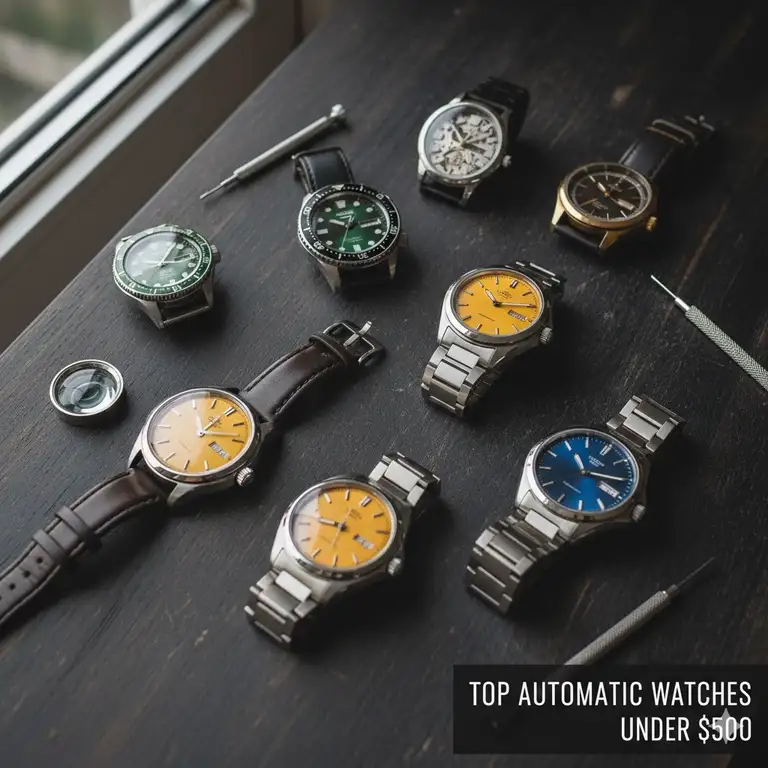
To give you a real sense of what your money buys, I have meticulously analyzed seven genuinely available, highly-regarded automatic watches. These products represent the best value and quality across the budget and mid-range spectrum, answering the question of how much should you spend on your first automatic watch with tangible examples.
| Product Name & Model | Price Range | Origin | Style | Why It’s on the List |
| Seiko 5 Sports SRPD55 | Budget | Japan | Diver/Sport | Unbeatable value; legendary reliability. |
| Orient Bambino V2 (FAC00008W0) | Budget | Japan | Dress/Classic | Incredible domed crystal aesthetic for the price. |
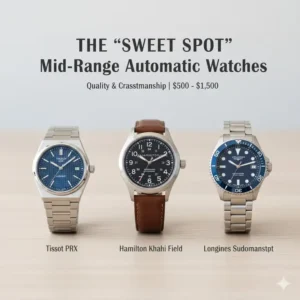
| Tissot PRX Powermatic 80 (T1374071104100) | Mid-Range | Swiss | Integrated Bracelet | Modern style icon; 80-hour power reserve. |
| Hamilton Khaki Field Automatic 38mm (H70455733) | Mid-Range | Swiss | Field/Military | True heritage; robust, utilitarian design. |
| Certina DS Action Diver (C0324071105100) | Mid-Range | Swiss | Professional Diver | High-spec dive watch with impressive ISO certifications. |
| Citizen NJ0150-81Z Tsuyosa | Budget | Japan | Integrated Bracelet/Casual | Bright, fun dials and solid build quality at an entry price. |
| Laco Aachen 42 Type A Dial (861690) | Mid-Range | German | Pilot/Flieger | Authentic historical design; high legibility. |
1. Seiko 5 Sports SRPD55
The Seiko 5 line is often considered the definitive answer to what is the best first automatic watch. The modern Seiko 5 Sports SRPD55 continues this legacy, offering phenomenal first automatic watch value.
-
Detailed Technical Specifications:
-
Movement: Seiko 4R36 Automatic (Hacking and Hand-winding capable)
-
Case Material: Stainless Steel
-
Case Diameter: 42.5mm
-
Crystal: Hardlex (Seiko’s proprietary hardened mineral crystal)
-
Water Resistance: 100 meters (10 bar)
-
Power Reserve: Approximately 41 hours
-
Bezel: Unidirectional Rotating Bezel
-
-
Customer Review Analysis: Reviewers universally praise the durability and reliability of the 4R36 movement. Many note that the watch feels much more expensive than its price tag suggests. Common minor complaints center on the Hardlex crystal being more prone to scratching than sapphire, and some finding the 42.5mm size a bit large for smaller wrists. The overall sentiment is that it’s a must-have first automatic watch.
-
Pros/Cons Analysis:
-
✅ Pros: Legendary in-house reliability; hacking seconds function; excellent lume; wide availability of aftermarket parts for modification.
-
❌ Cons: Hardlex crystal; 100m water resistance is adequate but not professional-grade; sometimes has a slightly misaligned bezel (a common Seiko QC quirk).
-
2. Orient Bambino V2 (FAC00008W0)
For those looking for a sophisticated, classic aesthetic, the Orient Bambino V2 (FAC00008W0) is an extraordinary choice. It delivers a dress watch experience at a truly entry-level price point.
-
Detailed Technical Specifications:
-
Movement: Orient Caliber F6724 (Hacking and Hand-winding capable)
-
Case Material: Stainless Steel
-
Case Diameter: 40.5mm
-
Crystal: Domed Mineral Crystal
-
Water Resistance: 30 meters
-
Power Reserve: Approximately 40 hours
-
Aesthetics: Domed dial and crystal; very slender hands.
-
-
Customer Review Analysis: The Orient Bambino is lauded for its stunning, vintage-inspired domed crystal, which reviewers say gives it an incredibly premium look. The simple, clean dial is a huge draw. The primary drawback mentioned is the 30m water resistance, making it unsuitable for swimming, and the common replacement of the stock leather strap.
-
Pros/Cons Analysis:
-
✅ Pros: Unbeatable dress watch looks; in-house hacking and hand-winding movement; perfect 40.5mm case size.
-
❌ Cons: Very low water resistance (30m); thick domed crystal can be prone to catching bumps; the strap often needs upgrading.
-
3. Tissot PRX Powermatic 80 (T1374071104100)
The Tissot PRX Powermatic 80 has become a modern icon, capitalizing on the integrated bracelet trend of the 1970s. It offers a Swiss-made, high-end movement technology that radically improves the automatic watch ownership experience.
-
Detailed Technical Specifications:
-
Movement: Powermatic 80.111 Automatic (Based on ETA 2824)
-
Case Material: 316L Stainless Steel
-
Case Diameter: 40mm
-
Crystal: Sapphire Crystal
-
Water Resistance: 100 meters (10 bar)
-
Power Reserve: 80 hours (Triple the standard 40-hour reserve)
-
-
Customer Review Analysis: The standout feature, according to almost every review, is the incredible 80-hour power reserve. This means you can take it off Friday evening and it will still be running on Monday morning. Reviewers also love the finishing of the case and the seamlessly integrated bracelet. Some users note the relatively flat case shape, which can feel a little different on the wrist.
-
Pros/Cons Analysis:
-
✅ Pros: Industry-leading 80-hour power reserve; scratch-resistant sapphire crystal; high-quality Swiss movement; exceptional integrated bracelet design.
-
❌ Cons: The integrated bracelet means strap changes are limited and proprietary; the unique design may not appeal to everyone.
-
4. Hamilton Khaki Field Automatic 38mm (H70455733)
The Hamilton Khaki Field Automatic 38mm is a quintessential field watch with genuine military heritage, making it a rugged and respectable choice. It’s often recommended when discussing the best automatic watch for beginners.
-
Detailed Technical Specifications:
-
Movement: H-10 Automatic (Extended power reserve)
-
Case Material: Stainless Steel
-
Case Diameter: 38mm (Ideal for many wrists)
-
Crystal: Sapphire Crystal
-
Water Resistance: 100 meters (10 bar)
-
Power Reserve: 80 hours
-
-
Customer Review Analysis: This watch is beloved for its perfect 38mm sizing, which fits a wider range of wrists comfortably. The legibility is outstanding, a testament to its military roots. The 80-hour power reserve is another huge plus. A recurring minor complaint is the loudness of the rotor (the weight that winds the watch), a common trait of the H-10 movement.
-
Pros/Cons Analysis:
-
✅ Pros: Historic design; fantastic legibility; highly versatile look; comfortable 38mm size; 80-hour power reserve.
-
❌ Cons: The stock strap is often criticized as stiff; the rotor can be slightly noisy.
-
5. Certina DS Action Diver (C0324071105100)
If you’re looking for a serious dive watch that meets genuine ISO standards without a luxury price tag, the Certina DS Action Diver is one of the best choices. It offers exceptional specifications for a quality automatic watch purchase.
-
Detailed Technical Specifications:
-
Movement: Powermatic 80.111 Automatic (Extended power reserve)
-
Case Material: 316L Stainless Steel
-
Case Diameter: 43mm
-
Crystal: Sapphire Crystal
-
Water Resistance: 300 meters (30 bar)
-
Key Feature: ISO 6425 certified dive watch; DS (Double Security) system for extra shock protection.
-
-
Customer Review Analysis: Reviewers are overwhelmingly positive about the watch’s build quality, often comparing it favorably to dive watches costing significantly more. The 300m water resistance and ISO certification provide great peace of mind. The main point of contention is the 43mm size, which is quite large.
-
Pros/Cons Analysis:
-
✅ Pros: True ISO 6425 dive watch certification; 300m water resistance; excellent finishing; 80-hour Powermatic movement; sapphire crystal.
-
❌ Cons: Large 43mm case might be too imposing for smaller or average wrists; the bezel action, while secure, is sometimes described as less refined than higher-end competitors.
-
6. Citizen NJ0150-81Z Tsuyosa
A vibrant and playful option, the Citizen NJ0150-81Z Tsuyosa is a new entry that answers the call for a stylish, integrated-bracelet affordable automatic watch.
-
Detailed Technical Specifications:
-
Movement: Caliber 8210 Automatic
-
Case Material: Stainless Steel
-
Case Diameter: 40mm
-
Crystal: Mineral Crystal with Cyclops lens
-
Water Resistance: 50 meters
-
Aesthetics: Bright, sunburst yellow dial; integrated bracelet.
-
-
Customer Review Analysis: Customers love the bright, fun dials and the impressive fit and finish of the integrated bracelet. It wears comfortably and draws attention. The primary criticism is the use of a simple Caliber 8210 movement, which is non-hacking (meaning the second hand doesn’t stop when setting the time).
-
Pros/Cons Analysis:
-
✅ Pros: Highly fashionable and colorful; great bracelet feel for the price; excellent 40mm size; a unique look.
-
❌ Cons: Non-hacking movement; low 50m water resistance; mineral crystal.
-
7. Laco Aachen 42 Type A Dial (861690)
For those interested in history and a distinctive aesthetic, the Laco Aachen 42 Type A Dial (861690) offers an authentic German Flieger (Pilot’s) watch experience. It’s an example of where a first automatic watch cost can bring genuine heritage.
-
Detailed Technical Specifications:
-
Movement: Laco 21 Automatic (Miyota 821A base)
-
Case Material: Sandblasted Stainless Steel
-
Case Diameter: 42mm
-
Crystal: Sapphire Crystal
-
Water Resistance: 50 meters
-
Aesthetics: Baumuster A dial (cleaner version); historically accurate finishing.
-
-
Customer Review Analysis: Owners appreciate the historical accuracy and the superb legibility of the sterile dial. The sandblasted case gives it a genuine, non-blingy, utilitarian feel. Complaints often focus on the movement, which is not a top-tier performer (no hacking function), but it is a solid and reliable workhorse.
-
Pros/Cons Analysis:
-
✅ Pros: Authentic WWII German pilot watch design; large, easy-to-read dial; anti-reflective sapphire crystal; genuine heritage.
-
❌ Cons: Non-hacking movement; 42mm is a large pilot watch size; 50m water resistance is low for a modern watch.
-
🚨 Action Point: Ready to Upgrade Your Wrist Game?
Your first automatic watch is an investment in both style and mechanics. Don’t settle for less than the best value.
💬 Just one click – help others make better buying decisions too!😊
🔬 Technical Specifications Matrix: First Automatic Watch Cost vs. Features
When grappling with how much should you spend on your first automatic watch, it’s crucial to understand what upgrades you get as you move up the price ladder. This comparison highlights the technical step-ups that justify the price increase.
| Specification | Seiko 5 Sports SRPD55 | Orient Bambino V2 | Tissot PRX Powermatic 80 | Hamilton Khaki Field | Certina DS Action Diver | Citizen Tsuyosa | Laco Aachen 42 |
| Price Tier | Budget | Budget | Mid-Range | Mid-Range | Mid-Range | Budget | Mid-Range |
| Movement | 4R36 (Hacking) | F6724 (Hacking) | Powermatic 80 (Hacking) | H-10 (Hacking) | Powermatic 80 (Hacking) | 8210 (Non-Hacking) | Laco 21 (Non-Hacking) |
| Crystal | Hardlex | Domed Mineral | Sapphire | Sapphire | Sapphire | Mineral | Sapphire |
| Water Resist. | 100m | 30m | 100m | 100m | 300m (ISO) | 50m | 50m |
| Power Reserve | 41 Hours | 40 Hours | 80 Hours | 80 Hours | 80 Hours | 40 Hours | 40 Hours |
| Origin | Japan | Japan | Switzerland | Switzerland | Switzerland | Japan | Germany |
| Case Size | 42.5mm | 40.5mm | 40mm | 38mm | 43mm | 40mm | 42mm |
📈 Key Feature & Benefits Comparison: Why Pay More?
It’s natural to ask: Why should I spend more on my first mechanical watch? The answer lies in the tangible and intangible benefits that come with higher-quality movements, materials, and construction.
The Mechanism of Durability and Quality
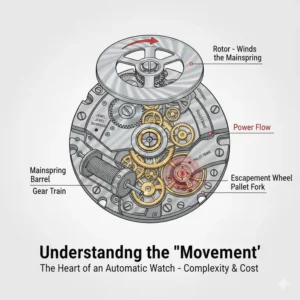
When we talk about an automatic watch, we’re primarily focused on the movement inside. Japanese movements (like those from Seiko and Orient) are renowned for being robust and simple—they are the pickup trucks of the watch world. They are often less expensive to produce and service.
Conversely, stepping up to Swiss movements (like the ETA/Powermatic 80 in the Tissot PRX Powermatic 80 and Hamilton Khaki Field Automatic 38mm) introduces increased finishing, tighter tolerances, and frequently, higher-tech innovations. The Powermatic 80, for example, achieves its 80 hours of power reserve through a re-engineered escapement and a lower beat rate, a significant technical achievement. The lower beat rate reduces wear and tear, contributing to a longer service interval—a key factor when evaluating the long-term cost of an automatic watch.
Crystal Clear Differences: Hardlex vs. Sapphire
A major upgrade for a slightly higher first automatic watch cost is the crystal material.
-
Mineral/Hardlex: This is a hardened glass. It’s affordable, shatter-resistant, but will scratch relatively easily.
-
Sapphire: This is synthetically produced sapphire (corundum), ranking 9 on the Mohs hardness scale—second only to diamond (10). It is virtually scratch-proof in daily life. All our mid-range choices (Tissot PRX Powermatic 80, Hamilton Khaki Field Automatic 38mm, Certina DS Action Diver, and Laco Aachen 42 Type A Dial) feature this, which dramatically improves the watch’s longevity and aesthetic retention.
| Feature/Benefit | Budget Automatic (e.g., Seiko 5) | Mid-Range Automatic (e.g., Tissot PRX) | Traditional Quartz Watch |
| Scratch Resistance | Fair (Mineral/Hardlex) | Excellent (Sapphire) | Fair (Mineral/Hardlex) |
| Power Reserve | ≈ 40 hours | 80 hours (or more) | Constant until battery dies |
| Perceived Prestige | Good (Enthusiast Choice) | Very High (Swiss Heritage) | Low (Commonplace) |
| Service Cost | Lower (Simple Movement) | Moderate (Complex/Specialized) | Low (Battery Change) |
| Hacking Seconds | Available on most | Standard Feature | N/A |
🧭 The Ultimate Automatic Watch Buying Guide
Deciding how much should you spend on your first automatic watch is simplified by following a structured buying process.
Step 1: Define Your Purpose (The ‘What’) ⌚
The first factor to determine first automatic watch value is the environment the watch will live in.
-
Dress/Formal: (Think Orient Bambino V2 (FAC00008W0)). Focus on thinness, simple dials, and elegant finishing. Lower water resistance is acceptable.
-
Sport/Diver: (Think Seiko 5 Sports SRPD55 or Certina DS Action Diver). Must have high water resistance (100m minimum, 200m+ preferred), a robust case, and a rotating bezel.
-
Field/Everyday: (Think Hamilton Khaki Field Automatic 38mm). Focus on legibility, durability, and versatility to pair with different straps/outfits.
Step 2: Set Your Financial Boundary (The ‘How Much’) 💵
Only after defining the purpose should you budget. A great way to think about how much should you spend on your first automatic watch is to use a percentage of your monthly income (e.g., 5-10%). This prevents “watch fever” from taking over your rational financial planning. Remember to also account for automatic watch maintenance cost. An inexpensive initial purchase might incur higher repair costs down the line if the parts are hard to find. For a quality automatic watch purchase, allocate a small annual fund for eventual service.
Step 3: Prioritize Features (The ‘Must-Haves’) ✅
Rank the following features in order of importance to you:
-
Sapphire Crystal: High on the list for scratch resistance.
-
Power Reserve: 80 hours vs. 40 hours makes a huge difference if you rotate watches.
-
Water Resistance: 100m for daily wear, 200m+ for swimming/diving.
-
Hacking: Essential if you want to set the time precisely (synchronizing the seconds hand).
-
Size (Diameter/Thickness): Crucial for comfort. A 38mm automatic watch is universally comfortable; a 43mm (Certina DS Action Diver) requires a larger wrist.
By prioritizing, you can see if the higher first automatic watch cost aligns with getting the features you actually need.

💰 Budget vs. Premium: The Ultimate Value Proposition
The concept of value in watch collecting isn’t just about the lowest price; it’s about the ratio of quality, features, and heritage to cost. When evaluating how much should you spend on your first automatic watch, this table breaks down the spending logic.
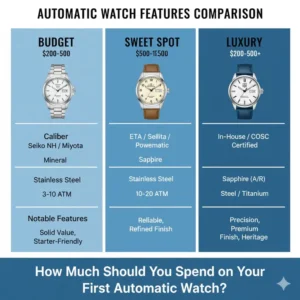
| Category | Budget (Under $500) | Mid-Range ($500 – $2,000) | Premium (Above $2,000) |
| Example Models | Seiko 5 Sports SRPD55, Orient Bambino V2 | Hamilton Khaki Field, Tudor Black Bay 58 | Rolex Submariner, Omega Seamaster |
| Typical Movement | Reliable, often mass-produced Japanese or base Swiss (e.g., Miyota, Seiko 4R36). | High-quality Swiss (ETA/Sellita) or high-spec in-house with modifications (e.g., Powermatic 80). | Top-tier, COSC-certified, often completely in-house movements. |
| Fit and Finish | Good, utilitarian, tool-like finishing. Stamped clasps. | Excellent case finishing; detailed dials; solid end-links on bracelets. | Exceptional, hand-finished components; precious metals, meticulous details. |
| Value Proposition | Unbeatable Value: Low cost, high reliability. The perfect entry point to test the waters. | Sweet Spot: Best balance of heritage, tech, and quality for the money. Lifetime keeper. | Prestige/Investment: Brand recognition, potential for investment value, and ultimate craftsmanship. |
| Target Buyer | The curious beginner, the student, the person with a limited first automatic watch budget. | The committed enthusiast, the professional looking for a signature piece. | The affluent collector, the milestone purchaser. |
The Power of Heritage and Brand Recognition
Part of how much should you spend on your first automatic watch is the brand’s story. Brands like Hamilton Khaki Field Automatic 38mm and Tissot PRX Powermatic 80 offer Swiss heritage that dates back over a century, which adds an intangible layer of value. You are buying into a history of craftsmanship. Even Japanese brands like Seiko and Citizen have incredible histories of innovation (Seiko is credited with making the first quartz watch and the first automatic chronograph). This history makes a watch feel less like a product and more like a piece of history on your wrist. To read more about the history of mechanical watchmaking, I highly recommend visiting an authoritative source like the Federation of the Swiss Watch Industry FH website: https://www.fhs.swiss/eng/.
✨ Don’t Miss These Exclusive Deals!
🔍 Take your watch collection to the next level with these carefully selected products. Click on any highlighted item like the Hamilton Khaki Field Automatic 38mm or the Tissot PRX Powermatic 80 to check current pricing and availability. These timepieces will help you start a journey you’ll love! ➡️

🌟 Conclusion: Making the Final Decision
So, after all the details, research, and analysis—how much should you spend on your first automatic watch?
The definitive advice is to spend what is financially comfortable for you, but aim for the sweet spot where quality automatic watch purchase meets value. If you can stretch your budget to the $500-$1,000 range, you unlock the superior materials (sapphire crystal, better finishing) and the advanced mechanics (80-hour power reserves, Swiss movements) that truly define a watch you can cherish for a lifetime. The Hamilton Khaki Field Automatic 38mm or the Tissot PRX Powermatic 80 are excellent examples of this perfect balance.
Don’t treat this as a one-time purchase, but as the first chapter in a fascinating journey. Choose the watch that speaks to you, reflects your style, and provides the best first automatic watch value for your budget. You won’t regret the switch to the timeless beauty of a mechanical movement.
FAQs
✅ You can find genuinely reliable automatic watches starting around $100-$150, but the sweet spot for a quality, long-lasting piece from a reputable brand (like Seiko or Orient) begins closer to $250. This threshold ensures you receive a stainless steel case, a dependable movement, and adequate water resistance for daily wear...
✅ No, a watch winder is not essential for your first automatic watch, especially if it's your only one. Winders are primarily for collectors who own multiple automatic watches and want to keep all of them running simultaneously. For a single watch, simply wearing it daily or manually winding it every couple of days is sufficient...
✅ The typical service cost for an entry-level automatic watch from a reputable brand like Seiko or Hamilton ranges from $150 to $300, needed every 5 to 10 years. Service involves cleaning, oiling, and regulating the movement. Higher-end or in-house movements may cost more, but this periodic maintenance is critical for longevity...
✅ While not strictly mandatory, a sapphire crystal is highly recommended for your first automatic watch as it dramatically increases scratch resistance and maintains the watch's appearance over time. If your budget is tight, a quality mineral crystal (like Seiko's Hardlex) is acceptable, but prioritize sapphire if you can afford the slight price increase...
✅ For your very first automatic watch, I recommend buying brand new from an authorized dealer. This guarantees the manufacturer's warranty, ensuring any initial defects are covered, and you have peace of mind. While pre-owned can offer better value, it's safer to learn the ropes of ownership with a new model... ❓ What is the lowest price for a reliable automatic watch?
❓ Do I need to buy a watch winder for my first automatic watch?
❓ What is the typical service cost for an entry-level automatic watch?
❓ Should my first automatic watch have a sapphire crystal?
❓ Is it better to buy a brand new or pre-owned first automatic watch?
Recommended for You
- Seiko vs Citizen Which Is Better: 7 Best Models Compared for Performance & Value [2025]
- Affordable Mechanical watches under 200: 8 Amazing Picks (2025)
- How to Choose the Right Watch for Your Wrist Size: The Ultimate 2025 Guide ⌚
Disclaimer: This article contains affiliate links. If you purchase products through these links, we may earn a small commission at no additional cost to you.
✨ Found this helpful? Share it with your friends! 💬🤗