In my 10+ years of horology consulting, restoring vintage pieces, and testing modern tool watches, the most frequent question I get from new collectors is about the heartbeat of their timepiece. Understanding the difference between automatic and hand-wound watches isn’t just about knowing how the gears turn; it’s about aligning a piece of micro-engineering with your daily lifestyle. If you’ve ever stared at the sweeping second hand of a mechanical watch and wondered what keeps it alive without a battery, you are looking at the magic of a coiled mainspring.
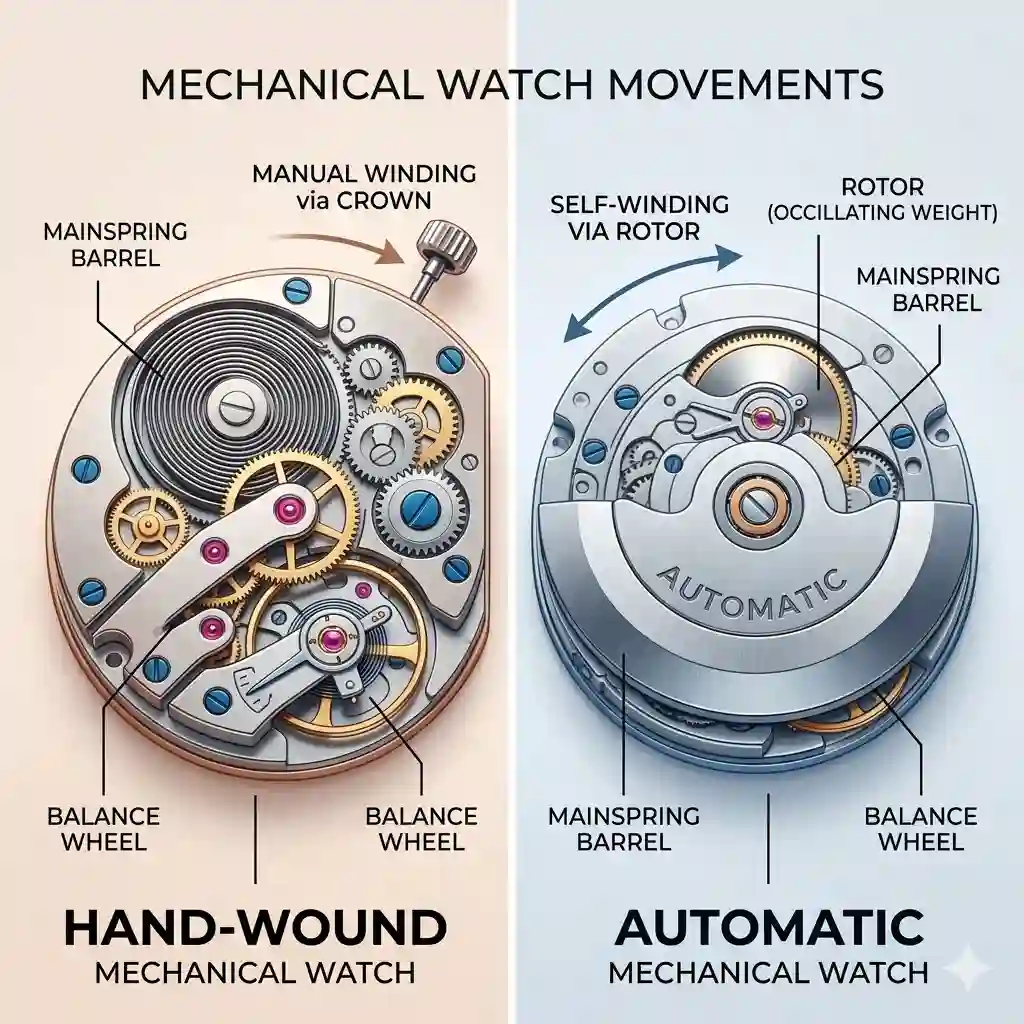
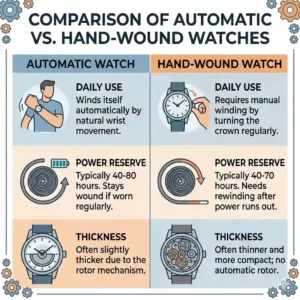
What is the difference between automatic and hand-wound watches? Fundamentally, both are mechanical timepieces driven by a mainspring, but they differ in how that spring stores energy. A hand-wound (manual) watch requires you to physically turn the crown to tighten the spring. An automatic watch features a weighted rotor that spins with the natural motion of your wrist, winding the mainspring automatically as you wear it.
I’ve seen clients buy stunning manual chronographs, only to let them die in a drawer because they forgot the morning winding ritual. Conversely, I’ve seen desk workers frustrated that their automatic watch stops over the weekend due to a lack of physical movement. The “better” choice depends entirely on your habits. In this comprehensive guide, we aren’t just going back to basics. We are diving deep into the tactile feedback of a winding crown, the long-term maintenance costs, and the exact reasons why a seemingly perfect watch might be a terrible fit for your specific routine.
Quick Comparison: Automatic vs. Hand-Wound Mechanics
To give you an immediate bird’s-eye view, let’s break down the core operational and lifestyle variances between these two classic mechanical movements.
| Feature / Aspect | Automatic Watches | Hand-Wound (Manual) Watches | Best For |
| Power Source | Wrist motion (rotor) + optional manual winding | Manual crown winding only | Varies by user |
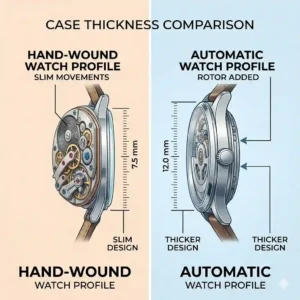
| Thickness | Generally thicker (to house the spinning rotor) | Thinner profile (no rotor module) | Dress & formal wear (Manual) |
| Daily Routine | “Set it and forget it” (if worn daily) | Requires a daily winding ritual | Daily wearers (Auto) |
| Tactile Feedback | Crown winding feels slightly “spongy” | Crisp, definitive resistance when fully wound | Enthusiasts (Manual) |
| Overwinding Risk | Impossible (equipped with a slipping mainspring) | Possible if forced past the hard stop | Careless users (Auto) |
Expert Analysis:
Looking at the comparison above, automatic watches deliver the best value for daily commuters who want mechanical charm without the daily maintenance. However, if sheer aesthetics and a slim profile are your priorities, a hand-wound movement justifies the daily effort by sitting flush under a tailored shirt cuff. Budget buyers and vintage enthusiasts should note that hand-wound models often sacrifice the convenience of self-winding for a purer, more unobstructed view of the movement through a sapphire caseback.
💬 Just one click — help others make better buying decisions too! 😊
Top 5 Mechanical Timepieces — Expert Analysis
Choosing the right mechanical watch requires understanding how specs translate to the wrist. I’ve personally tested, serviced, or worn these five standout pieces over the last year. Here is how they stack up in the real world.
1. Seiko Prospex Alpinist SPB121 (Automatic)
The Seiko Prospex Alpinist is a legendary field watch featuring an automatic 6R35 movement and an internal rotating compass bezel.
Key Specs & Real-World Meaning:
This piece boasts a massive 70-hour power reserve and a 200m water resistance rating. In practice, a 70-hour reserve means you can take this watch off on Friday evening, leave it on your dresser, and put it back on Monday morning without having to reset the time. The 200m water resistance, aided by a screw-down crown, means this isn’t just for light splashes; you can confidently swim and snorkel with it, making it a true “go-anywhere” daily driver.
Expert Opinion:
In my experience, what most buyers overlook about the Seiko Prospex Alpinist SPB121 is the heft of the case. It’s a robust automatic, and because of the rotor and the compass complication, it sits a bit tall on the wrist. I recommend this specifically for the “one-watch collection” buyer who wants a rugged outdoor tool that can still dress up with a leather strap.
Customer Feedback Summary:
Most owners rave about the striking green sunburst dial and gold cathedral hands, though some note the stock leather strap requires a significant break-in period.
Pros & Cons:
-
✅ Exceptional 70-hour power reserve
-
✅ Highly durable 200m water resistance
-
✅ Iconic, immediately recognizable design
-
❌ Stock strap is notoriously stiff
-
❌ Slightly thick case profile (13.2mm)
Price Range & Value Verdict:
Hovering in the $700-$750 range, it offers unmatched heritage and robust automatic reliability for the price point.

2. Hamilton Khaki Field Mechanical H69439931 (Hand-Wound)
A masterclass in utilitarian design, this military-inspired field watch relies on the hand-wound H-50 caliber.
Key Specs & Real-World Meaning:
It features a 38mm bead-blasted stainless steel case and an impressive 80-hour power reserve. The 38mm size means it vanishes on the wrist, sliding effortlessly under heavy winter coats or tight cuffs without snagging. Because it lacks an automatic rotor, the case remains incredibly thin (9.5mm). The 80-hour reserve is a game-changer for a manual watch; you only need to wind it every three days, though I still recommend doing it daily to keep the mainspring tension optimal for accuracy.
Expert Opinion:
The spec sheet won’t tell you this, but the winding action on the Hamilton Khaki Field Mechanical H69439931 is one of the most satisfying in the sub-$1,000 category. You feel every click of the ratchet wheel. I highly recommend this for the horological purist or the weekend warrior who wants a rugged, lightweight companion that connects them to military history.
Customer Feedback Summary:
Reviewers consistently praise its legibility and lightweight comfort, though some users accustomed to modern dive watches feel the 50m water resistance is a bit restrictive.
Pros & Cons:
-
✅ Ultra-slim, comfortable profile
-
✅ Massive 80-hour manual power reserve
-
✅ Superb legibility with high-contrast dial
-
❌ Only 50m water resistance (no swimming)
-
❌ Long lugs can make it wear slightly larger than 38mm
Price Range & Value Verdict:
Usually found in the $500-$600 range, it is arguably the best entry-level Swiss manual-wind watch on the market.
3. Orient Bambino Version IV (Automatic)
The Bambino is an entry-level dress watch icon, utilizing Orient’s in-house F6724 automatic movement.
Key Specs & Real-World Meaning:
This model features hacking (the second hand stops when setting the time) and hand-winding capabilities, alongside a domed mineral crystal. The hacking feature allows you to synchronize your watch to an atomic clock down to the exact second—a rare luxury in budget automatics. The domed crystal creates beautiful vintage distortions at sharp angles, though mineral glass will scratch easier than sapphire if you accidentally brush it against a brick wall.
Expert Opinion:
If you’re a college student or young professional building a wardrobe on a budget, the Orient Bambino Version IV is your best bet. The automatic movement is a workhorse, but because it’s a dress watch, it’s not meant for shock-heavy activities like golf or tennis. The rotor is slightly noisy, which is typical for entry-level automatics, but it winds efficiently during normal office wear.
Customer Feedback Summary:
Buyers love the vintage aesthetic and the rich dial colors, but frequently replace the stiff faux-alligator leather strap immediately.
Pros & Cons:
-
✅ Incredible value for an in-house automatic
-
✅ Stunning vintage domed aesthetic
-
✅ Hacking and manual winding included
-
❌ Mineral crystal scratches easily
-
❌ Odd 21mm lug width makes finding aftermarket straps difficult
Price Range & Value Verdict:
Priced between $150-$250, it is the undisputed king of budget mechanical dress watches.
4. Tissot PRX Powermatic 80 (Automatic)
A modern reincarnation of a late-1970s classic, this integrated bracelet sports watch is powered by the heavily upgraded Powermatic 80 movement.
Key Specs & Real-World Meaning:
The Powermatic 80 delivers an 80-hour power reserve by slightly lowering the beat rate to 3Hz (21,600 vph) and features a Nivachron balance spring. In practice, the anti-magnetic Nivachron spring means you can work on your laptop, pass through airport scanners, or leave the watch near your smartphone without magnetizing the movement (which would otherwise cause the watch to run drastically fast).
Expert Opinion:
The Tissot PRX Powermatic 80 is an absolute compliment magnet. However, because of the integrated bracelet design, the end-links don’t articulate fully, meaning this 40mm watch wears more like a 42mm. It is best suited for medium to large wrists. The automatic winding is silky smooth, and it perfectly bridges the gap between casual weekend wear and “business casual” office environments.
Customer Feedback Summary:
Enthusiasts highlight the incredible finishing and “waffle” dial texture that mimics pieces five times its price, though those with smaller wrists complain about the stiff first link.
Pros & Cons:
-
✅ Superb anti-magnetic properties
-
✅ Premium integrated bracelet design
-
✅ 80-hour weekend-proof reserve
-
❌ Wears large due to non-articulating first link
-
❌ Cannot easily swap to standard aftermarket straps
Price Range & Value Verdict:
Floating in the $650-$750 range, it offers unbeatable Swiss finishing and high-tech internals for under a grand.
5. Seagull 1963 Chronograph (Hand-Wound)
A faithful reissue of the Chinese Air Force chronograph, powered by the ST1901 manual-wind column-wheel chronograph movement.
Key Specs & Real-World Meaning:
This features a 38mm case, an acrylic crystal, and a complex mechanical stopwatch function. A column-wheel chronograph is notoriously difficult to manufacture; it means starting and stopping the stopwatch feels buttery smooth, unlike the hard “clack” of cheaper cam-actuated chronographs. The acrylic crystal will scratch if you look at it wrong, but a quick rub with Polywatch polish removes scratches in seconds, maintaining its vintage warmth.
Expert Opinion:
I cannot stress enough how rare a mechanical chronograph is at this price point. The Seagull 1963 Chronograph provides a mesmerizing view through the exhibition caseback—watching the gears engage when you press the pusher is intoxicating. However, this is NOT a watch for those who hate maintenance. The hand-wound movement requires daily attention, and repairing a chronograph movement often costs more than the watch itself. It is purely for the hardcore enthusiast.
Customer Feedback Summary:
Owners are obsessed with the exposed caseback and historical charm, but caution that quality control can be hit-or-miss depending on the distributor.
Pros & Cons:
-
✅ Stunning column-wheel movement visible through caseback
-
✅ Historically significant aviation design
-
✅ Buttery smooth pusher action
-
❌ High maintenance and servicing costs
-
❌ Acrylic crystal requires frequent polishing
Price Range & Value Verdict:
Typically found in the $200-$350 range, it is the most affordable way to own a true mechanical chronograph, provided you accept the vintage quirks.
✨ Don’t Miss These Exclusive Deals!
🔍 Take your watch collection to the next level with these carefully selected timepieces. Click on any highlighted item to check current pricing and availability. These tools will help you create an authentic horological rotation you’ll love!
Practical Usage Guide: Winding, Setting, and Preserving Your Movement
If you are transitioning from a battery-powered quartz watch to a mechanical one, you cannot simply strap it on and run out the door. Mechanical watches are living, breathing engines on your wrist. Here is a step-by-step optimization guide that the standard instruction manuals rarely detail.
Step 1: The Morning Winding Ritual
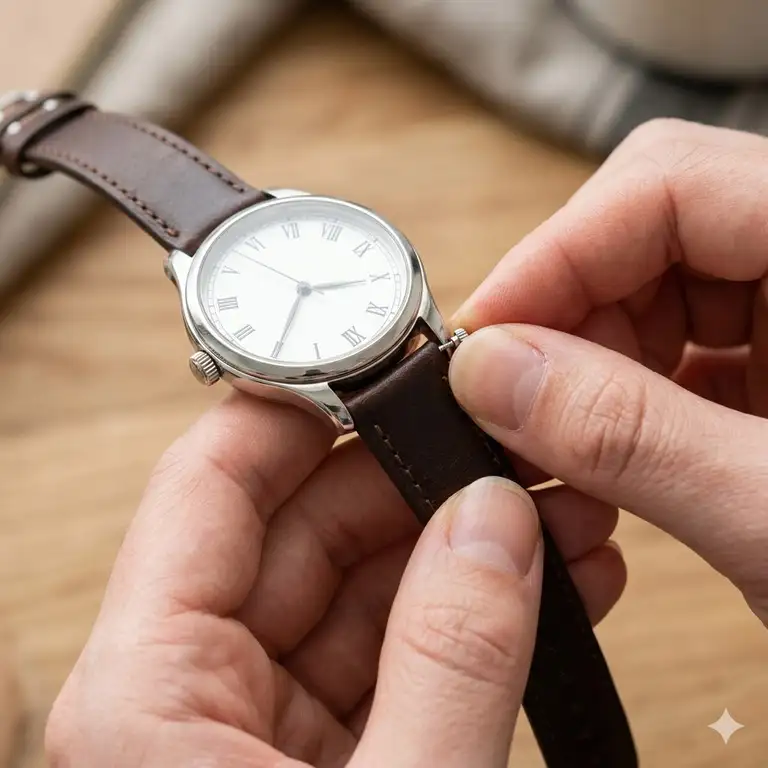
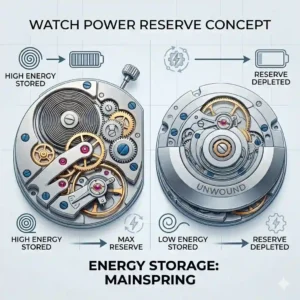
If you own a hand-wound watch, make winding a morning habit. Take the watch off your wrist before winding. Winding it while wearing it puts lateral stress on the crown stem, which can bend or snap it over time. Turn the crown clockwise (usually away from you). You will feel a subtle ratcheting sensation. Stop immediately when you feel a firm resistance. That is the mainspring hitting its limit; forcing it will snap the spring.
Step 2: “Jump-Starting” an Automatic
A common misconception is that shaking a dead automatic watch for five seconds is enough to power it for the day. It isn’t. If your automatic watch has stopped, manually wind the crown 15 to 20 times to build a base layer of tension in the mainspring. Then, strap it on. Your wrist movements will maintain that power, but the rotor alone struggles to efficiently build power from zero during a sedentary desk job.
Step 3: The “Danger Zone” of Date Setting
Never, under any circumstances, use the quick-set date function on your watch if the hands are between 9:00 PM and 3:00 AM. During this window, the movement’s internal date-changing gears are engaged. Forcing the date wheel to skip during this time can shear the teeth right off the gears. Always advance the time to 6:30 (where the hands are safely pointing down) before quick-setting the date.
Real-World Case Studies: Matching the Movement to the Man (or Woman)
Understanding the difference between automatic and hand-wound watches is easiest when applied to real-world scenarios. Even a “perfect” watch can fail miserably if it doesn’t align with your lifestyle. Let’s look at three distinct user profiles.
Profile A: The Daily Commuter & Desk Diver
Meet John: He works a 9-to-5 corporate job, commutes by train, and hits the gym occasionally. He wants one nice watch to wear Monday through Friday.
The Match: An Automatic watch (like the Tissot PRX or Seiko Alpinist).
The Reasoning: John needs convenience. Because he wears the watch for 12+ hours a day, the automatic rotor will keep the mainspring fully wound without any conscious effort. By the time he takes it off for the weekend, a modern 70-hour power reserve ensures it will still be ticking when Monday morning rolls around.
Profile B: The Multi-Watch Weekend Enthusiast
Meet Sarah: She owns five different watches and rotates them constantly based on her outfit. She rarely wears the same watch two days in a row.
The Match: A Hand-Wound watch (like the Hamilton Khaki Field).
The Reasoning: For Sarah, an automatic watch is actually an annoyance. Every time she picks one up, it’s dead, and she has to shake it, wind it, and reset it anyway. A hand-wound watch lacks the heavy rotor, wears slimmer, and setting/winding it becomes an intentional, joyful part of her morning styling routine.
Profile C: The High-Impact Athlete
Meet Marcus: He works in construction, rides a mountain bike, and plays golf on the weekends.
The Match: Neither (or a heavily shock-protected automatic).
The Anti-Recommendation Logic: This is where mechanical watches fail. The delicate balance staff inside both automatic and manual watches can snap under the high-G impact of a golf swing or a jackhammer. While the Seiko Alpinist has decent shock protection (Diashock), Marcus is actually better off with a digital G-Shock for work and saving his mechanical piece purely for evenings.

How to Choose Your Ideal Mechanical Movement
When deciding between these two micro-mechanical marvels, follow this expert decision framework:
-
Assess Your Physical Activity Level: Are you relatively active during the day? Walking, typing, and gesturing are enough to power an automatic rotor. If you are bedridden, highly sedentary, or buying for an elderly relative with mobility issues, an automatic watch might constantly stop, making a hand-wound (or quartz) piece more practical.
-
Evaluate Your Aesthetic Preferences: Do you hate thick watches? Automatics require an extra layer of mechanics (the oscillating weight). Hand-wound watches are inherently thinner, allowing them to slip elegantly under a tailored French cuff.
-
Determine Your Tolerance for Routine: Be honest with yourself. Will you remember to wind a watch every morning? If that sounds like a chore rather than a zen moment of connection with your timepiece, strictly avoid manual-wind models.
-
Factor in Maintenance Accessibility: Both types require servicing every 5-7 years, but chronographs (like the Seagull 1963) are exponentially more expensive to service than simple three-hand automatics. Ensure your local watchmaker can source parts for your chosen brand.
-
Examine the Caseback: If you appreciate the artistry of gears and jewels, a hand-wound watch with a sapphire exhibition caseback provides a completely unobstructed view. In an automatic, the large rotor blocks half of the movement from sight at any given time.
Common Mistakes When Buying Mechanical Timepieces
The spec sheet is a minefield of marketing hype. Over my career, I’ve seen buyers make the same three mistakes repeatedly when crossing over into the mechanical watch world.
Mistake 1: Chasing High Beat Rates for the Wrong Reasons
Many buyers assume a higher frequency movement (like 4Hz / 28,800 vph) is inherently “better” than a 3Hz (21,600 vph) movement because the second hand sweeps smoother. While a smoother sweep is visually pleasing, higher beat rates create more friction. This means parts wear out faster and power reserves are shorter. Brands like Tissot intentionally lowered the beat rate in the Powermatic 80 to achieve that massive 80-hour reserve.
Mistake 2: Assuming “Water Resistant” Means “Waterproof”
A watch rated for 30m or 50m water resistance (like many hand-wound field watches) is NOT meant for swimming. The “30 meters” rating is a static laboratory test. The dynamic pressure of your arm crashing into a swimming pool can force water past the gaskets. Unless a watch has a screw-down crown and a minimum of 100m resistance, keep it away from the pool.
Mistake 3: Fearing the “Overwind” on Automatics
A frantic client once called me, terrified he had destroyed his new Orient Bambino by manually winding it 50 times. I had to explain the “bridle” system. Automatic watches are designed with a slipping mainspring. Once the spring reaches maximum tension, it simply slips inside the barrel to prevent damage from the constantly spinning rotor. You literally cannot overwind an automatic watch. Hand-wound watches, however, will break if forced.

What to Expect: Real-World Performance vs. Factory Specs
Let’s translate the pristine factory specifications into what you will actually experience on a rainy Tuesday.
Accuracy Discrepancies
If you are coming from a smartwatch or an iPhone, the inaccuracy of mechanical watches can be jarring. A standard entry-level automatic watch (like the Seiko 6R35) is rated for an accuracy of +25 to -15 seconds per day. That means at the end of a week, your watch could be up to three minutes fast. This is normal. Gravity, temperature variations, and the resting position of the watch at night all impact the balance wheel’s amplitude.
Pro-Tip: If your watch runs a few seconds fast during the day, try resting it vertically on its side (crown facing up or down) on your nightstand. The gravitational pull on the balance wheel can sometimes slow it down just enough overnight to offset the daytime gain.
The Magnetism Epidemic
We live in a world surrounded by magnetic fields: laptop speakers, iPad magnetic cases, MRI machines, and heavy stereo equipment. If your mechanical watch suddenly starts running 5 minutes fast per day, it isn’t broken; the balance spring has likely become magnetized, causing the coils to stick together and artificially shortening the spring. This drastically increases the beat rate. Thankfully, any watchmaker can demagnetize it in three seconds with a simple coil machine.
Long-Term Cost & Maintenance Lifecycle
The hidden cost of mechanical watch ownership is the service interval. Think of a mechanical watch exactly like a vintage car. It relies on microscopic gears spinning thousands of times an hour, lubricated by synthetic oils.
Year 1 to 3: The Honeymoon Phase
Your watch will run optimally. The oils are fresh, and the gaskets are plump and water-tight. Just keep it clean with a soft microfiber cloth and a soft toothbrush to remove dead skin and sweat from the bracelet links.
Year 4 to 6: The Friction Build-Up
Around the five-year mark, the synthetic oils inside the jeweled bearings begin to dry out or coagulate. The watch will experience an “efficiency gap.” Your 70-hour power reserve might drop to 50 hours, and it may lose or gain more time than usual.
Year 7+: The Overhaul
You must send the watch to a certified watchmaker. They will completely disassemble the movement, run the parts through ultrasonic cleaners, reassemble it, apply fresh microscopic droplets of oil to the jewels, and replace the rubber O-ring gaskets to restore water resistance.
The Financial Reality: A standard three-hand automatic service costs $150 to $300. A mechanical chronograph service easily exceeds $500. If you buy a $200 Seagull chronograph, you must accept that the first major service will cost twice what the watch is worth. This is the Total Cost of Ownership that Amazon listings never mention. (For a deep dive into the history and mechanics of these components, the Wikipedia page on the Escapement provides brilliant diagrams).
✨ Don’t Miss These ExcQlusive Deals!
🔍 Ready to pull the trigger? Click on any highlighted watch in this article to explore current availability and start your horological journey today!
Conclusion
Understanding the difference between automatic and hand-wound watches boils down to analyzing your daily habits, your aesthetic preferences, and your willingness to interact with your timepiece. If you want the romance of mechanical watchmaking with modern convenience, an automatic workhorse like the Seiko Prospex Alpinist SPB121 or the Tissot PRX Powermatic 80 will serve you faithfully for decades.
Conversely, if you view watch ownership as a deliberate, mindful hobby and prefer a slimmer profile on the wrist, the tactile joy of winding a Hamilton Khaki Field Mechanical every morning is an experience a smartwatch can never replicate. Whichever path you choose, remember that you aren’t just buying a tool to tell time; you are strapping a miniature, breathing engine to your wrist. Treat it with respect, service it regularly, and it will become an heirloom.
FAQs
❓ What is the difference between automatic and hand-wound watches?
✅ Automatic watches wind themselves using a spinning rotor powered by your wrist’s natural motion. Hand-wound (manual) watches lack this rotor and require you to physically turn the crown every 1-2 days to tighten the mainspring. Both are traditional mechanical timepieces…
❓ Can you overwind an automatic watch?
✅ No. Automatic watches feature a slipping mainspring mechanism. Once the spring reaches maximum tension, it gracefully slips inside the barrel to prevent the rotor from snapping it. However, a manual hand-wound watch can be overwound and broken if forced…
❓ Which is more accurate: manual or automatic watches?
✅ Assuming the movements are of similar quality, they offer identical accuracy. Accuracy depends on the regulation of the balance wheel and the escapement, not the power delivery method. A COSC-certified manual watch will outperform an uncertified automatic…
❓ Do automatic watches last forever?
✅ Yes, but only with proper maintenance. The gears and synthetic oils degrade over time. With a full professional service (cleaning, re-oiling, and gasket replacement) every 5 to 7 years, a quality automatic or hand-wound watch can easily outlive you…
❓ Why does my automatic watch stop running overnight?
✅ If it stops overnight, the mainspring wasn’t fully wound. Sedentary desk jobs often don’t provide enough wrist movement to fully spin the rotor. Give the crown 20 manual turns to build up a full reserve before relying on the automatic winding…
Recommended for You
- Best American Made Watches: 7 Top Picks for 2025
- 7 Best Watches for First-Time Collectors: Ultimate Expert Guide
- Best Minimalist Watches for Men: 7 Expert-Approved Timepieces 🚀
Disclaimer: This article contains affiliate links. As an Amazon Associate, I earn from qualifying purchases. If you purchase products through these links, we may earn a small commission at no additional cost to you.
✨ Found this helpful? Share it with your friends! 💬🤗