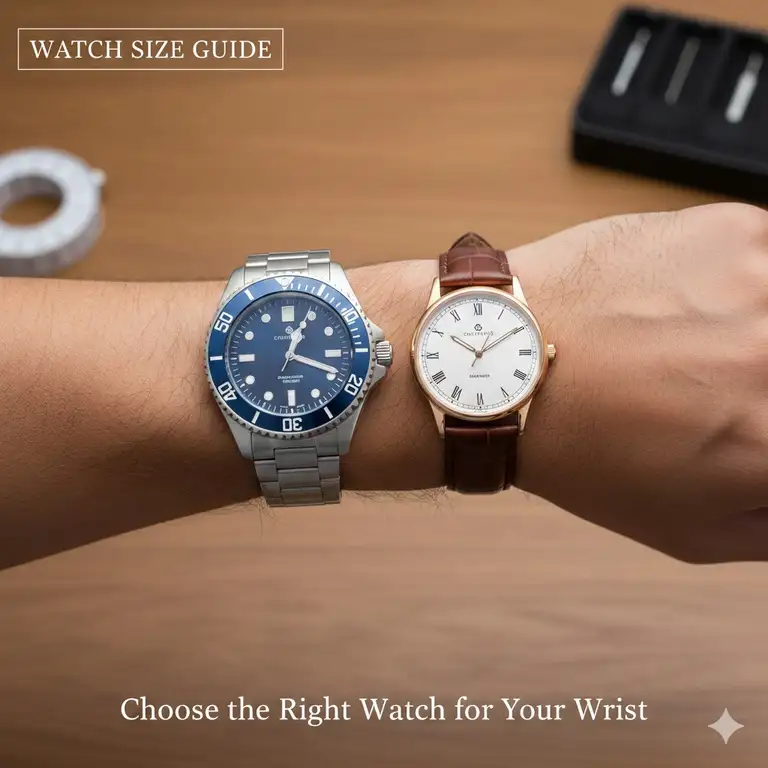
You’ve finally decided to invest in a great timepiece—a mechanical masterpiece, a sleek smartwatch, or a rugged diver. Congratulations! But here’s the thing: buying a watch isn’t just about the brand name or the movement inside; it’s about the fit. The most common mistake I see people make, especially those new to the watch world, is choosing a size that simply overpowers or gets lost on their wrist. It completely throws off the look and, frankly, ruins the whole vibe. This essential guide on how to choose the right watch for your wrist size is your definitive playbook for achieving that perfect, harmonious balance.
✨Was this helpful? Spread the word! 🚀
Choosing the right watch for your wrist size isn’t just about aesthetics; it’s about comfort and making a statement that looks intentional, not accidental. A watch that fits well speaks volumes about attention to detail. So, before you click “Add to Cart,” let’s dive into the core measurements that define the perfect fit. We’ll explore case diameter, lug-to-lug distance, and the crucial role of strap material, ensuring you know exactly how to choose the right watch for your wrist size every single time.
📏 Essential Watch Sizing Terminology: Your Core Vocabulary
To figure out the best size for your wrist, you need to understand the language of watch sizing. These are the key metrics that determine how a watch wears.
-
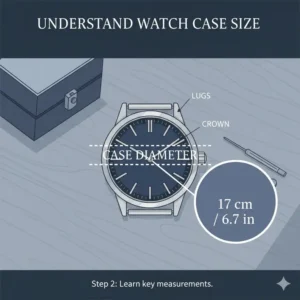
Case Diameter (CD): This is the width of the watch case, measured horizontally across the dial, excluding the crown. Most men’s watches fall between 38mm and 42mm.
-
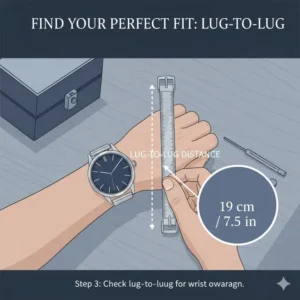
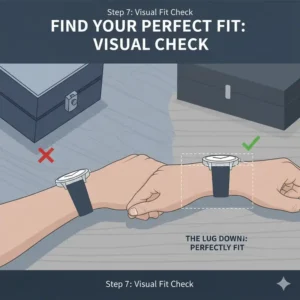
Lug-to-Lug (L2L): Arguably the most critical dimension for fit, this is the distance from the top tip of the upper lug to the bottom tip of the lower lug. If the lug-to-lug measurement exceeds the width of your wrist, the watch will overhang, look awkward, and wear uncomfortably.
-
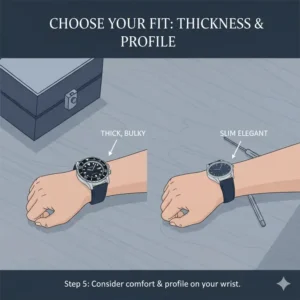
Case Thickness (or Height): How thick the watch sits on your wrist. This is especially important if you plan on wearing the watch with dress shirts, as a thick case (over 12mm-13mm) can struggle to slip under a cuff.
-
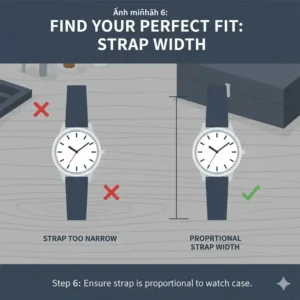
Strap/Lug Width: This is the measurement of the gap between the lugs, which determines the width of the band you can fit. Standard sizes are 18mm, 20mm, and 22mm.
| Watch Measurement | Definition | Impact on Fit | Common Range (Men’s) |
| Case Diameter (CD) | Width of the case (excluding the crown). | Affects perceived size and visual balance. | 38mm to 42mm |
| Lug-to-Lug (L2L) | Vertical distance between the two farthest lug ends. | CRITICAL: Must be less than your wrist width. | 46mm to 50mm |
| Case Thickness | Height of the case off the wrist. | Affects comfort and cuff clearance. | 8mm (Slim) to 14mm+ (Tool/Diver) |
| Lug Width | Distance between the lugs (strap width). | Determines strap options; wider straps can make a watch feel larger. | 18mm, 20mm, 22mm |
🔍 How to Measure Your Wrist for the Perfect Fit
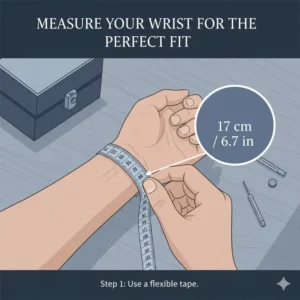
You can’t know how to choose the right watch for your wrist size without first measuring your wrist! It’s super simple.
-
Grab a Tool: Use a flexible measuring tape (the kind tailors use). If you don’t have one, use a strip of paper or string and a ruler.
-
Locate the Spot: Wrap the tape around your wrist just below the wrist bone—this is where your watch will sit.
-
Note the Size: Pull the tape snug, but not tight, and note the measurement. If you’re using paper/string, mark where it overlaps and measure that length against a ruler.
-
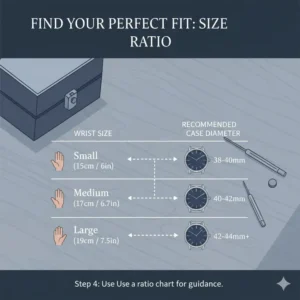
Small Wrist: Under 6.5 inches (approx. 16.5 cm)
-
Medium Wrist: 6.5 inches to 7.5 inches (approx. 16.5 cm to 19 cm)
-
Large Wrist: Over 7.5 inches (approx. 19 cm)
This measurement is the anchor point for your entire selection process. Knowing your wrist size is step one in making a great purchase.
🎯 The Golden Ratio: Matching Case Diameter to Wrist Size
Now for the magic formula: matching the watch’s dimensions to your anatomy. The goal is for the watch face to take up about 50% to 75% of the visible surface area on the top of your wrist.
| Your Wrist Size | Recommended Case Diameter (CD) | Max Lug-to-Lug (L2L) | Ideal Watch Style |
| < 6.5 inches (Small) | 34mm – 38mm | Under 45mm | Dress, Vintage, Classic Field |
| 6.5 – 7.5 inches (Medium) | 38mm – 42mm | 46mm – 49mm | Everyday, Diver, Pilot, Chronograph |
| > 7.5 inches (Large) | 42mm – 46mm+ | 50mm and up | Large Diver, Military/Tool, Oversized Pilot |
-
The Crucial Lug Rule: Remember the L2L rule: The lugs must not extend past the edges of your wrist! If they do, the watch looks like a dinner plate strapped on, and no one wants that look. A 40mm watch with an L2L of 48mm will wear very differently from a 40mm watch with an L2L of 52mm. Always check the L2L, which is why it is so important in figuring out how to choose the right watch for your wrist size.
📊 Top 7 Timepieces: Expert Analysis for Diverse Wrist Sizes
To truly understand how case dimensions translate into real-world wear, I’ve scoured the market for seven exceptional timepieces across various categories. This analysis will demonstrate how different case sizes, lug-to-lug distances, and thicknesses are optimized for various wrist sizes.
| Product Type | Product Name | Case Diameter (CD) | Lug-to-Lug (L2L) | Case Thickness | Best For Wrist Size |
| Classic Field | Hamilton Khaki Field Mechanical H69439931 | 38mm | 47mm | 9.5mm | Small to Medium (6.0″-7.0″) |
| Everyday Dress | Seiko SARB033 (Discontinued – Highly Relevant) | 38mm | 44.5mm | 11.2mm | Small to Medium (5.5″-6.75″) |
| Mid-Size Diver | Longines HydroConquest L3.781.4.56.6 | 41mm | 51mm | 11.9mm | Medium to Large (7.0″ and up) |
| Entry-Level Smart | Garmin Forerunner 255S | 41mm | 41mm | 12.4mm | Small/Active (5.5″-6.5″) |
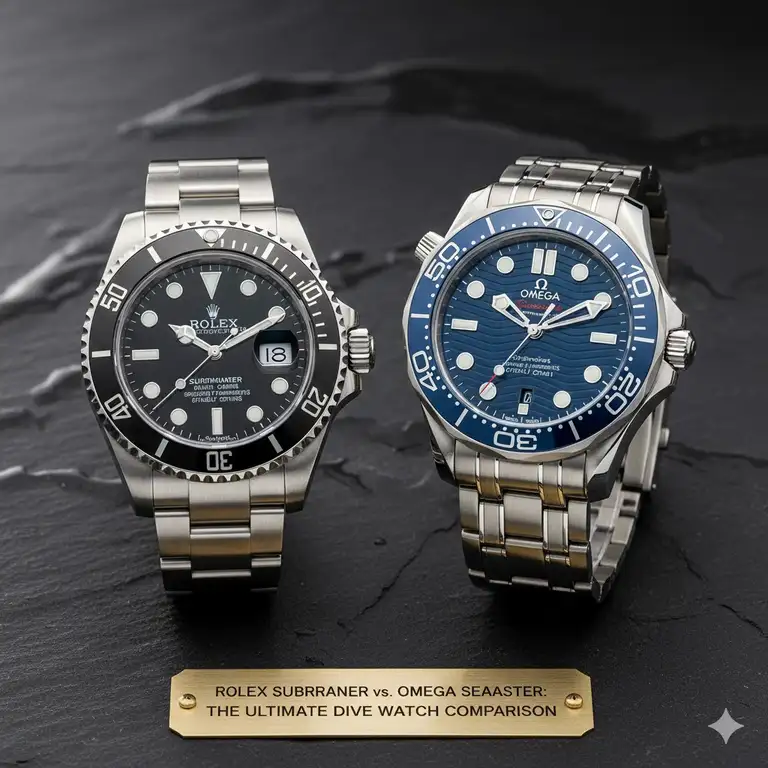
| Iconic Diver | Omega Seamaster Diver 300M 210.30.42.20.01.001 | 42mm | 49.9mm | 13.6mm | Medium to Large (6.75″-7.5″) |
| Large Tool Watch | Citizen Promaster Dive Automatic NY0150-51A | 44mm | 50mm | 13.1mm | Large (7.5″ and up) |
| Modern Pilot | *Laco Aachen 39 (Pilot) | 39mm | 46.5mm | 11.5mm | Small to Medium (6.0″-7.25″) |
Product Deep Dive: Specifications, Analysis, and Fit
1. Hamilton Khaki Field Mechanical H69439931 (Field Watch)
-
Detailed Technical Specifications: Featuring a 38mm matte stainless steel case, this classic field watch is powered by the manual-wind H-50 movement with an impressive 80-hour power reserve. It has a super-slim profile at just 9.5mm thickness and a versatile 47mm lug-to-lug distance, making it incredibly wearable. It comes on a NATO strap, which slightly increases perceived thickness but adds to its rugged charm. Water resistance is 50m.
-
Customer Review Analysis: Reviewers consistently praise its “perfect vintage sizing” and comfortable fit. Many users with smaller 6.0-6.5 inches wrists specifically cite the 47mm L2L as the sweet spot, confirming it doesn’t overhang. A common observation is its incredible legibility.
-
Pros/Cons Analysis:
-
✅ Pros: Ideal compact sizing for smaller wrists, long power reserve, highly legible, excellent value.
-
❌ Cons: Manual wind (may be a con for some), 50m water resistance is limited for true diving.
-
-
Warranty: Hamilton offers a 2-year international warranty.
2. Seiko SARB033 (Everyday Dress/Discontinued)
-
Detailed Technical Specifications: Though discontinued and now commanding premium prices on the secondary market, the Seiko SARB033 remains a benchmark for universal sizing. Its 38mm case diameter, coupled with a remarkably short 44.5mm lug-to-lug and 11.2mm thickness, makes it one of the most perfectly proportioned everyday watches ever made. It runs on the automatic 6R15 caliber.
-
Customer Review Analysis: This watch is affectionately nicknamed the “Baby Grand Seiko” for its high-quality finishing and versatile wearability. The L2L is the main talking point, ensuring it sits beautifully centered even on the slimmest wrists. Feedback highlights its exceptional balance.
-
Pros/Cons Analysis:
-
✅ Pros: Perfect universal sizing (especially for smaller wrists), superb finishing for the price, timeless aesthetic.
-
❌ Cons: Discontinued (difficult to find new), bracelet can be a “hair-puller” according to some reviews.
-
-
Warranty: Standard Seiko international warranty (when purchased new from an authorized dealer, though mostly aftermarket now).
3. Longines HydroConquest L3.781.4.56.6 (Mid-Size Diver)
-
Detailed Technical Specifications: This model hits the sweet spot for a modern diver at 41mm in diameter. However, its 51mm lug-to-lug is substantial, pushing it toward the larger wrist category. It features a ceramic bezel, a screw-down crown, and 300m water resistance, powered by the automatic L888 movement. The thickness is a reasonable 11.9mm, keeping it sleek for a diver.
-
Customer Review Analysis: Owners with wrists closer to 7.5 inches rave about the “commanding presence” without feeling clownish. Those with smaller wrists (sub-7 inches) caution that the 51mm L2L feels quite large and near the limit for comfortable wear. The finishing is widely praised.
-
Pros/Cons Analysis:
-
✅ Pros: Excellent build quality, ceramic bezel durability, true diver capability (300m).
-
❌ Cons: Long lug-to-lug means it won’t suit smaller wrists, 41mm diameter may be polarizing.
-
-
Warranty: Longines offers a 5-year international warranty.
4. Garmin Forerunner 255S (Entry-Level Smart/GPS)
-
Detailed Technical Specifications: This ‘S’ (Small) variant of a popular GPS running watch measures 41mm in diameter. Crucially for fitness trackers, the case is nearly circular and the lug-to-lug is effectively 41mm, matching the diameter due to its integrated strap design. It weighs just 39g, features a transflective memory-in-pixel display, and offers multi-band GPS.
-
Customer Review Analysis: The “S” designation is universally loved by athletes with smaller wrists (especially women) who appreciate that it doesn’t flop around or look massive. The low weight and compact L2L are cited as major advantages for active use. The main complaint is that the display is smaller than the larger Garmin Forerunner 255 model.
-
Pros/Cons Analysis:
-
✅ Pros: Extremely compact and light, excellent for small, active wrists, industry-leading GPS accuracy.
-
❌ Cons: Smaller display may be harder to read mid-run, plastic build feels less premium than steel.
-
-
Warranty: Garmin provides a 1-year limited warranty.
5. Omega Seamaster Diver 300M 210.30.42.20.01.001 (Iconic Diver)
-
Detailed Technical Specifications: A modern classic, the Omega Seamaster Diver 300M has a 42mm diameter, but its unique twisted lugs give it a wearable 49.9mm lug-to-lug that often wears smaller than the number suggests. The case thickness is a notable 13.6mm due to the Co-Axial Master Chronometer movement and helium escape valve. It boasts an incredible 300m water resistance.
-
Customer Review Analysis: This watch is known for its excellent wrist presence. Owners with wrists in the 6.75-7.25 inches range find it a superb fit. The thickness is occasionally mentioned as a slight issue for tight cuffs, but the overall comfort and iconic wave dial are always praised.
-
Pros/Cons Analysis:
-
✅ Pros: Master Chronometer certified (superior accuracy and anti-magnetism), iconic design, excellent L2L despite the 42mm size.
-
❌ Cons: High price point, quite thick (13.6mm), polished sections attract micro-scratches.
-
-
Warranty: Omega offers an industry-leading 5-year international warranty.
6. Citizen Promaster Dive Automatic NY0150-51A (Large Tool Watch)
-
Detailed Technical Specifications: This is a serious tool watch. The Citizen Promaster Dive Automatic NY0150-51A features a large 44mm diameter, but its clever, integrated, asymmetric case design manages to keep the lug-to-lug relatively compact at 50mm. It has 200m water resistance and is powered by the automatic 8204 movement. The watch has a substantial feel, typical of true diving equipment.
-
Customer Review Analysis: Buyers with large wrists (7.5 inches and up) love the “bold and chunky” look, which is what they were searching for. It’s often recommended as a great value option for those needing a big, legible diver. The 44mm size is considered necessary for its purpose.
-
Pros/Cons Analysis:
-
✅ Pros: True large-wrist presence, robust build, ISO-compliant diver specifications, compact L2L for a 44mm case.
-
❌ Cons: Too large for average or small wrists, basic movement compared to premium options.
-
-
Warranty: Citizen provides a 5-year limited warranty (with registration).
7. *Laco Aachen 39 (Pilot)
-
Detailed Technical Specifications: Pilot watches are known for being large, but this 39mm variant of the classic Flieger design is a welcome change. The Laco Aachen 39 has a very manageable 46.5mm lug-to-lug and a slim 11.5mm case. It features the distinctive high-contrast Type B dial and is powered by a reliable automatic movement.
-
Customer Review Analysis: Enthusiasts with small-to-medium wrists (6.0-7.0 inches) celebrate this specific Laco Aachen 39 size for allowing them to wear an authentic pilot watch without the bulk. The German-made quality and historical accuracy are frequently highlighted. The L2L is considered ideal for most users.
-
Pros/Cons Analysis:
-
✅ Pros: Excellent, versatile size for a pilot watch, strong historical heritage, high legibility.
-
❌ Cons: The ‘heritage’ look might be too niche for some buyers, lume is good but not best-in-class.
-
-
Warranty: Laco provides a 2-year warranty.
💬 Just one click – help others make better buying decisions too!😊
🧵 The Importance of Strap and Bracelet Fit
The case dimensions are only half the battle. The bracelet or strap is what holds the watch to your wrist, and an ill-fitting one can make even a perfectly sized case feel uncomfortable. How to choose the right watch for your wrist size also means mastering the strap game.
Bracelet vs. Strap
| Feature | Metal Bracelet | Leather/NATO Strap | Rubber Strap |
| Aesthetics | Formal, robust, adds visual weight. | Classic, versatile, vintage, can be dressy or casual. | Sporty, rugged, best for water activities. |
| Adjustment | Micro-adjustments on the clasp, requires links to be removed. | Simple hole/tang system, continuous adjustability. | Usually simple hole/tang, but high-end often have folding clasps. |
| Perceived Size | Makes the watch appear larger and more substantial. | Tends to make the watch wear true to size or slightly smaller. | Often adds thickness but conforms well to the wrist. |
| Best For | Medium to large wrists, professional settings. | Small to medium wrists, dress/casual wear. | All wrist sizes, especially during exercise or summer. |
-
Straps for Small Wrists: If you have a smaller wrist, a thick, stiff leather strap can hold the watch too high and make it feel top-heavy. Look for thinner, more flexible straps, or consider a NATO strap which, while adding a slight height, helps to anchor the watch securely across the wrist’s surface. Furthermore, how to choose the right watch for your wrist size with a strap means ensuring the holes align for a perfect fit, not too tight or too loose.
-
The Crucial First Link: On metal bracelets, how the first link articulates (moves) is vital. If the first link is stiff or hangs straight down from the lug, it forces the effective L2L distance to be much longer. Conversely, articulated or “female” end-links allow the bracelet to immediately hug the wrist, improving comfort on smaller wrists, even for watches with a long L2L.
👓 Different Watch Styles and Their Fit Characteristics
Not all 40mm watches are created equal. The style of a watch dramatically impacts its perceived size and how it actually sits on the wrist.
1. Dive Watches 🌊
Dive watches (like the Omega Seamaster Diver 300M) are inherently thicker (13mm+) and often have larger diameters (40-44mm) to accommodate water resistance gaskets and robust movements. The rotating bezel adds visual bulk, which means you can often wear a dive watch a millimeter or two smaller than your usual preference for balance.
2. Dress Watches 🎩
These prioritize sleekness. They should be thin (under 10mm) to slide easily under a cuff. Their diameters are typically smaller, often 34mm to 38mm, which is a key consideration when learning how to choose the right watch for your wrist size for formal occasions. The absence of a bezel makes the dial look larger, so a 38mm dress watch can look as substantial as a 40mm dive watch.
3. Pilot/Flieger Watches ✈️
Historically large (up to 55mm in WWII!), modern pilot watches often range from 39mm (like the Laco Aachen 39) to 42mm. Their main characteristic is a large, highly legible dial with minimal bezel, which increases the “dial-to-bezel ratio.” This makes them wear quite large, demanding attention to the L2L.
4. Chronographs ⏱️
These typically have busy dials and multiple pushers, leading to a larger footprint (40mm to 44mm). Their thickness is also a factor due to the complication. Due to the visual complexity, they can be overwhelming on a small wrist, so for small wrists, look for a compact chronograph L2L.
🔎 Advanced Factors for Choosing the Right Size
Beyond the raw measurements, several design elements play tricks on the eye, affecting the perceived size and the answer to the question: how to choose the right watch for your wrist size?
| Design Element | Effect on Perceived Size | Example |
| Dial-to-Bezel Ratio | High ratio (thin bezel) makes the watch look larger. | Dress watches, Seiko SARB033. |
| Bezel Thickness | Thick bezel makes the watch look smaller. | Dive watches, like the Longines HydroConquest. |
| Dial Color | Dark dials (black, blue) tend to make the watch look smaller. | Black dial of the Hamilton Khaki Field Mechanical. |
| Case Shape | Cushion or square cases often wear smaller than their diameter suggests due to short lugs. | Many vintage racing chronographs. |
| Crystal | Domed crystals add visual height but reduce visual footprint. Flat crystals add to the “plate” look. | Often seen on vintage-inspired pieces. |
Wrist Shape: Flat vs. Round
This is the ultimate secret weapon for a good fit. Two people can have the same 7-inch wrist size, but one has a flat, wide wrist top, and the other has a very round, cylindrical wrist.
-
Flat Wrist: A flat wrist can handle a longer lug-to-lug (L2L) measurement because the watch sits squarely on the surface. You have more “real estate.”
-
Round Wrist: A round wrist requires a shorter L2L, as the case needs to wrap around the curve immediately. A long L2L will cause the lugs to visibly flare out over the edge, making the watch look ill-fitting and causing discomfort.
Therefore, for round wrists, prioritize the L2L above the case diameter when deciding how to choose the right watch for your wrist size.
💲 Budget vs. Premium: Feature Comparison
Whether you’re spending a few hundred dollars or several thousand, the principles of proper sizing remain the same. However, higher-end watches often have design features that enhance wearability regardless of size.
| Feature | Budget Watches ($100 – $500) | Premium Watches ($3,000+) | Impact on Fit/Wearability |
| Lug Design | Often straight, simple, long lugs. | Highly articulated, curved, or “twisted” lugs (e.g., Omega Seamaster Diver 300M). | Curved lugs conform better to the wrist curve, minimizing L2L discomfort. |
| Case Finishing | Simple stamping, uniform thickness. | Tapered sides, complex multi-part cases. | Tapered sides visually reduce the case thickness and weight. |
| Bracelet Quality | Stiff end-links, stamped clasp. | Flexible, female end-links, machined clasp with micro-adjustments. | Superior bracelets and micro-adjustments offer the ability to fine-tune the fit perfectly. |
| Case Thickness | Thicker movements necessitate a thicker case (12mm+). | Slim, highly-engineered movements allow for thinner profiles (8mm-11mm). | Thinner cases slip under cuffs easier, improving day-to-day comfort. |
💡 Your Buying Checklist: Choosing the Right Watch
To simplify the process of figuring out how to choose the right watch for your wrist size, follow this simple checklist:
-
✅ Measure Your Wrist: Determine your size (Small: <6.5″, Medium: 6.5″-7.5″, Large: >7.5″).
-
✅ Define Your Max L2L: Measure the top flat part of your wrist. This is your absolute maximum lug-to-lug distance.
-
✅ Select By Style: A Diver (e.g., Longines HydroConquest) can be slightly smaller than your comfort zone; a Dress Watch (e.g., Seiko SARB033) should be on the smaller side.
-
✅ Prioritize L2L: Never let the watch’s L2L exceed your wrist width. This is the single most important rule.
-
✅ Check Thickness: If wearing under shirts is a priority, keep the thickness under 12mm.
This structured approach ensures you’re not just guessing. This is the difference between an informed purchase and a regrettable impulse buy.
🌐 The Future of Sizing: Ergonomics and Smartwatches
The rise of the smartwatch, such as the Garmin Forerunner 255S, has added new layers to the sizing conversation. While traditional watch sizing focuses on aesthetics, smartwatches must also consider sensor performance. A watch that is too loose will not read your heart rate or track your sleep accurately. Therefore, the fit of smartwatches becomes less about visual proportion and more about functional ergonomics.
-
Ergonomics Check: Ensure the case back (where the sensors are) maintains consistent contact with your skin without digging in. This usually means choosing a smaller, more contoured case for active wear, like the ‘S’ variants offered by many brands.
-
Case Shape: Smartwatches often have shorter, integrated lugs (like the Garmin Forerunner 255S) or no traditional lugs at all, which keeps the L2L very close to the case diameter, making them surprisingly wearable even at larger sizes.
🌟 Don’t Miss Out on the Perfect Timepiece! 🌟
Ready to find the watch that truly belongs on your wrist? Click on the links for the Hamilton Khaki Field Mechanical H69439931, the Omega Seamaster Diver 300M, or the Citizen Promaster Dive Automatic NY0150-51A to see current deals and secure your expertly sized watch today! 🛍️
📝 Conclusion: Your Perfectly Proportioned Wrist
Finding the perfect watch is a deeply personal journey, but a flawless fit is non-negotiable. Now that you understand the critical relationship between your wrist size, the case diameter, and, most importantly, the lug-to-lug measurement, you are equipped with the expertise of a seasoned watch collector. Never again will you have to wonder how to choose the right watch for your wrist size. By applying the L2L rule and considering the crucial style and strap factors, you can confidently navigate the vast world of horology and find a watch that not only tells time but also truly fits you.
Don’t let an ill-fitting watch compromise your style or comfort. Take the plunge and invest in a piece that you’ll be proud to wear for years to come!
Frequently Asked Questions
✅ The most critical measurement is the Lug-to-Lug (L2L) distance. This measurement determines how far the watch extends across the top of your wrist. The lugs must not overhang the edges of your wrist for a proper and comfortable fit. For instance, a small wrist should aim for an L2L under 45mm...
✅ You cannot rely on case diameter alone because the Lug-to-Lug distance and case thickness also heavily influence the perceived size. A good rule of thumb is that the case should occupy roughly 50%-75% of the visible surface area on your wrist. A 40mm dress watch (thin bezel) will look larger than a 40mm dive watch (thick bezel)...
✅ For a 6.5-inch wrist, the ideal case diameter range is 38mm to 40mm, provided the lug-to-lug distance is kept under 47mm. Watches like the 38mm Hamilton Khaki Field Mechanical or the now-discontinued Seiko SARB033 are often cited as perfect fits for this common small-to-medium wrist size...
✅ Yes, the strap material significantly affects wearability. Metal bracelets, especially with stiff end-links, can make a watch feel bulkier. Conversely, thin, flexible leather or NATO straps (like those often paired with the Laco Aachen 39) generally help a watch wear smaller and conform better, which is crucial when learning how to choose the right watch for your wrist size...
✅ While wrist size is often measured in inches (or centimeters) in the US (e.g., 7.25 inches), all watch dimensions (case diameter, lug-to-lug, thickness) are measured in millimeters (mm). Therefore, knowing your wrist size in both is useful, but you'll primarily be matching your wrist width (in mm) to the watch’s L2L (in mm) to find the perfect fit... ❓ What is the most important measurement for ensuring a watch fits my wrist?
❓ How can I tell if a watch is too big just by looking at the case diameter?
❓ What case diameter should a man with a 6.5-inch wrist look for?
❓ Does the watch strap material impact how the watch wears on the wrist?
❓ Should my wrist be measured in inches or millimeters for finding the right watch size?
Recommended for You
- Top Luxury Watch Brands for Investment 2025
- Affordable Mechanical watches under 200: 8 Amazing Picks (2025)
- Rolex Submariner vs Omega Seamaster Comparison: 7 Key Models for 2025 Leading the Luxury Dive Watch World
Disclaimer: This article contains affiliate links. If you purchase products through these links, we may earn a small commission at no additional cost to you.
✨ Found this helpful? Share it with your friends! 💬🤗