
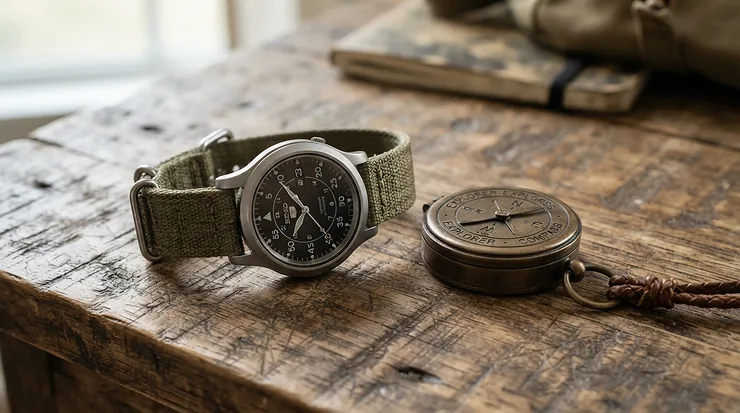
Start with a mid-priced ballistic-nylon NATO and only move up when your watch forces the issue. That is the short verdict on nato watch straps heading into 2027, and the reasoning is mostly arithmetic: Task & Purpose puts the average good NATO at about $25 and says they rarely cost more than $35, so a wrong guess is cheap while a mismatch with your lug gap is annoying.
The format itself is older than the “NATO” label. It began as a 20mm grey nylon strap in British Defence Standard 66-15, dated 30 November 1973, and the name came later from the NATO stock numbers attached to it, as Watches by SJX lays out. The picks below are reasoned from roundups at Task & Purpose, Gear Patrol and The Modest Man, owner threads and maker pages; nothing was bench-tested here, and each recommendation is tied to a situation instead of a ranking.
What the best NATO watch straps have in common
Layers under the case come first, because they decide how tall the watch sits. A true NATO threads one long piece through the spring bars and adds a second, shorter piece beneath the case. Task & Purpose notes that the two layers make the watch noticeably taller, while a single-pass strap is slimmer but lets the watch slide along the band. Zulu straps keep the idea and swap the thin rectangular hardware for thicker, rounder rings. Gear Patrol also flags that some popular “NATO” picks, such as Haveston’s Invasion A2, are single pass-through straps and not double-pass NATOs at all.
Thickness against the lug gap is the second filter, and it is where most fit problems start. The Modest Man’s roundup lists Crown & Buckle’s seatbelt-style nylon at about 1.4mm and warns that it may not clear tight spring bars, while another line in the same roundup gives 1.25mm for the collection. Sources disagree on that figure, so go by the number on the product page you actually order from.
Hardware is third. Gear Patrol’s guide says buckle and keeper quality varies significantly from strap to strap, and it marks down one otherwise solid strap for a wobbly buckle. A strap is only as secure as the pin that holds it shut.
Weave and edges come next. Gear Patrol observes that originals tend to be stiff, whereas modern premium straps often feel like soft seatbelts. The 1973 specification called for heat-welded joints and heat-sealed ends, and Watches by SJX explains that stitched canvas would not have met it. Heat-sealed ends still matter today, since a cut nylon edge is where fraying begins.
Length is the last detail. NATOs run long because the British originals were designed to fit over clothing and gear, Gear Patrol says, so many wrists end up tucking the tail or trimming it. FashionBeans lists Barton’s nylon at 283mm and its leather version at 285mm, which is typical territory.
Quick match: situation, strap, trade-off
| Situation | Strap | Main trade-off |
|---|---|---|
| First NATO, no strong opinion | Barton Ballistic Nylon NATO Style Strap | Long tail; two layers under the case |
| Heavy diver, or a watch that deserves better hardware | Crown & Buckle Supreme NATO Strap | About 1.25–1.4mm thick; may not clear tight spring bars |
| A drawer of colors for several watches | Ritche 4-Pack Ballistic Nylon NATO Watch Straps | Lower-end nylon, per The Modest Man |
| A resin G-Shock | Barton G-Shock NATO Strap Conversion Kit | Added height; kit contents unverified |
| Pilot or field watch with a dressier look | Barton Leather NATO Strap | Some owners find the leather thin |
The table is a starting point, not a ranking. The first and fifth rows differ by material, the second by build quality, the third by quantity and the fourth by one specific watch family. Which trade-off you can live with depends on your lug gap more than on any rating.
Matching the strap to the watch on your wrist
1. Barton Ballistic Nylon NATO Style Strap — a low-risk first strap
Task & Purpose and FashionBeans both reach for Barton when the question is a first NATO. Task & Purpose names it Best Value and calls the price a great one. FashionBeans lists it as Best Budget, in 18–24mm widths at 283mm long, with 11 colors, a stainless steel clasp, heavy-duty stitching and a Y-strap build that swaps in without tools. FashionBeans also noted an Amazon’s Choice badge when it wrote the review; that label changes over time.
The tail deserves a second look. Gear Patrol’s trimming walkthrough says to try tucking the extra length into the keeper before cutting anything, and that advice matters more on a small wrist.
Barton also publishes its own answer for watches where the strap will not slide between spring bar and case. Its blog says the likely cause is lug holes drilled close to the case, and that curved spring bars give the strap the room it needs; Barton adds that it keeps spares and helps customers who write in.
Pros:
- ✅ Eleven colors and 18–24mm widths cover most lug sizes
- ✅ Swaps without tools, per FashionBeans
Cons:
- ❌ Long tail needs tucking or trimming on smaller wrists
- ❌ Two layers add height under the case, a trade-off Task & Purpose names for dual-pass straps
Check current colors and sizes on Amazon.com.
2. Crown & Buckle Supreme NATO Strap — seatbelt nylon for heavy divers
Thickness is the thing to settle before buying this one. Where the lugs have room, the material earns strong marks: Gear Patrol ranks it first in its guide, describing tight, thick seatbelt-style nylon, bevelled keepers and a buckle that stays thin yet feels sturdy, and it credits that hardware with separating the strap from similar seatbelt types. Task & Purpose, for its part, picks the Matte Supreme Coyote as its best military strap.
Owners are less uniform. On a 2020 Omega Forums thread, the original poster called it “very high quality, thick, soft, flexible and well made,” then admitted he disliked the bulk of cloth under the wrist. Several members said they cut off the bottom layer and wear NATOs as pass-throughs, and one reversed the rings so the melted edge sat away from his skin. That is a single thread, so read it as a preference signal and not a verdict. The Modest Man adds that the nylon is stiff at first and lists brushed or black PVD hardware for the collection.
Price lands between about $28 and $34 in the two guides that listed it, so it sits near the top of the range Task & Purpose considers normal for a good NATO.
3. Ritche 4-Pack Ballistic Nylon NATO Watch Straps — four colors to rotate
Budget multipacks make sense when the goal is a drawer of colors for several watches, and this is the pack The Modest Man’s roundup includes for that job. Its entry describes ballistic nylon, black-coated stainless hardware, several colors and sizes, and glued adjustment holes, then states the drawback plainly: lower-end nylon. The roundup priced the four-pack at around $20 to $25, but it dates from 2022, so check the current price on Amazon.com.
Break-in is the quieter issue. An Omega Forums poster described cheap pass-through nylon as scratchy, and another said a pricier Crown & Buckle strap felt scratchy until it softened, which suggests texture gets better with wear at any tier. Hardware is the part to inspect on arrival, since Gear Patrol says buckle and keeper quality varies widely.
If you want a single strap with a larger Amazon following, FashionBeans names the Archer Watch Straps Classic Military Nylon its best NATO on Amazon. It describes the nylon as soft and lighter than standard, offered in 18–24mm with a wide color range, and cites more than 8,000 Amazon buyers without giving a formal rating. Some buyers found it a bit long.
4. Barton G-Shock NATO Strap Conversion Kit — a fix for resin-band irritation
Resin G-Shocks are the one group where a strap swap solves a named problem, which is why Task & Purpose crowned this kit its Best Overall. The reasoning was audience: many of its readers wear a G-Shock, and the kit is aimed at the wrist rash the article ties to the resin bands that come on most of them. The article gives no widths or price, and no other page consulted covers the contents of the box, so read the listing for what is included before ordering.
Height is the thing to plan around. One reader on Strapsco’s NATO-versus-Zulu post said a double-layer NATO lifted a G-Shock too high and they preferred a single pass. Strapsco sells straps and the comment is anecdotal, but it fits the physics Task & Purpose describes for two-layer builds. The Modest Man‘s author prefers a single loop on thick divers and aviation watches because it leaves one layer of nylon under the case, though he notes it takes some dexterity to thread.
5. Barton Leather NATO Strap — a softer look for pilot and field watches
Leather changes the personality of a NATO more than any color swap does. FashionBeans lists this as its best leather pick: top-grain leather including the retainer loops, 18–24mm widths at 285mm long, five colors, a stainless buckle and premium stitching. Its one caution is that some owners find the strap thin. The Modest Man points out that only the buckle is metal and that the strap suits pilot watches, while also saying it can look plain.
For a nato field watch strap that moves between a desk and a weekend trail, that restraint is the appeal. Thickness cuts the other way, though. Task & Purpose warns that leather NATOs need to be thicker to survive hard use, which can cause fitment problems on some watches, so thin leather buys clearance at the expense of durability. Barton’s curved spring bar advice applies here as well.
Pros:
- ✅ Top-grain leather with leather keepers, per FashionBeans
- ✅ Five colors in 18–24mm widths
Cons:
- ❌ Some owners find it thin
- ❌ Can look plain, according to The Modest Man
Spotted a color you like? Take a closer look on Amazon.com.
Double loop or single loop: how the wear method changes the fit
The same strap can sit very differently depending on how you thread it, which makes the choice between wear methods as important as the choice between brands. In the double loop, you pass the long end through the keeper on the shorter piece, which keeps the watch from sliding and leaves two nylon layers between wrist and case back; The Modest Man says this suits thinner watches. In the single loop, you put the watch on your wrist before threading the long end through the short piece’s keeper, leaving one layer. That author finds it more comfortable and uses it for thicker divers and aviation watches.
There is a third route that owners talk about often: cutting off the under keeper and melting the end. Everest’s blog calls the extra piece rarely needed and credits Hodinkee’s James Stacey with popularizing the modification, which removes a layer of nylon and one metal keeper. Omega Forums members describe the same trick. Do it to a spare strap first, because a melted edge is permanent, and remember that a nato strap watch setup with the underside removed behaves like a single-pass strap and gives up the sliding-resistance of the original design.
NATO watch straps reviews: the complaints that keep repeating
Scratchy nylon turns up in nearly every source consulted. Gear Patrol describes the classic G10-style strap as thin, densely woven and slightly rough, and it calls one budget-priced classic less comfortable than the rest of its list. Owners on Omega Forums say the same about cheap pass-through nylon. A strap that feels coarse on day one may soften, but the evidence for that is a handful of owner reports, not a controlled test.
Tight spring-bar clearance is next. In an Omega Forums thread on drilled lugs, owners report that some thick NATOs will not slip under a standard spring bar. One suggested bending a straight bar that is 1mm longer than the lug width and said it works fine; another warned that bending weakens the bar unless you avoid the ends. Barton’s own page points to curved bars instead, which is the safer reading of the same problem.
Hardware is third. Gear Patrol found the buckle on the Worn & Wound ADPT wobbly despite dense, hard-wearing nylon, a reminder that strong cloth does not guarantee a strong clasp.
The most argued point is whether a NATO keeps the watch on your wrist if a spring bar gives way. Everest’s seller blog describes a heavy impact that popped one spring bar and says the one-piece design kept the watch attached; it is a promotional source, and one anecdote. Commenters under Strapsco’s comparison dispute which layer provides the backup, with one saying the single pass of both styles does the work and another saying a Zulu’s double-ring lock shifts stress away from the spring bars. Treat “it can’t fall off” as a claim with limits.
Length rounds out the list. FashionBeans reports some Archer buyers found it a bit long, and Gear Patrol built a whole trimming guide around the fact that NATOs arrive too long for most wrists. Matching the width to your lugs, picking a thickness your spring bars can handle and checking the buckle on arrival will head off most of these complaints.
Spring bars, Zulu confusion, and trimming: quick answers
❓ What is the difference between a NATO strap and a Zulu strap?
✅ A NATO has thin rectangular hardware and a second piece of nylon under the case, while a Zulu uses thicker, rounder rings and may have one layer or two. Task & Purpose calls Zulu hardware more durable but bulkier, and notes Zulus often cost more.
❓ Why is it called a NATO strap?
✅ The British Ministry of Defence issued it under Def Stan 66-15 in 1973, and the strap carried NATO stock numbers, which gave it the nickname. Watches by SJX says 'G10' refers to the order form soldiers needed to requisition one.
❓ Can a NATO strap lose an expensive watch?
✅ Sources disagree. A seller blog says the one-piece design kept a watch attached after a spring bar popped, while forum commenters dispute which layer does the work. Thick straps on tight lugs can strain spring bars, so confirm the fit before trusting any strap.
❓ How do you shorten a NATO strap that is too long?
✅ Tuck the tail into the keeper first. If it still sticks out, mark your length, clamp the strap with a key ring or two coins, cut, then lightly singe the edge with a butane lighter so the nylon seals and stops fraying, as Gear Patrol describes.
❓ What strap width do I need?
✅ Measure between the lugs and match it; common widths run 18mm to 24mm. Owners on Omega Forums report a 20mm strap sitting in 19mm lugs with a tiny gap, but results vary. If the strap is too thick behind the spring bar, curved bars may help.
Which NATO strap to buy first
If you want one answer, choose by lug gap. Roomy lugs on a diver or field watch can take the thick seatbelt weave of the Crown & Buckle Supreme NATO Strap; tight or unknown lugs call for the thinner, cheaper Barton Ballistic Nylon NATO Style Strap and a few curved spring bars if needed. A G-Shock owner should read the Barton G-Shock NATO Strap Conversion Kit listing for contents and watch the added height, and anyone with a pilot watch can try the Barton Leather NATO Strap for a calmer look. A multipack like the Ritche 4-Pack Ballistic Nylon NATO Watch Straps is a fair way to find out whether you like the style at all.
The best NATO straps are the ones that fit the gap between your lugs and feel acceptable against your wrist after a week, and with nato watch straps that is a cheap thing to find out. Compare the exact width and thickness before you buy.
Recommended for You
- 7 Best NATO Straps for Field Watches in 2026: Rugged and Stylish Picks
- Tag heuer strap replacement: What Suits Your Watch and Budget
- Leather vs metal strap which looks better? Top 7 Pro Picks for 2026
Disclaimer: This post contains affiliate links. As an Amazon Associate, I earn from qualifying purchases made through these links, at no additional cost to you.
Measure your lug width first, and the rest of the choice gets easy.