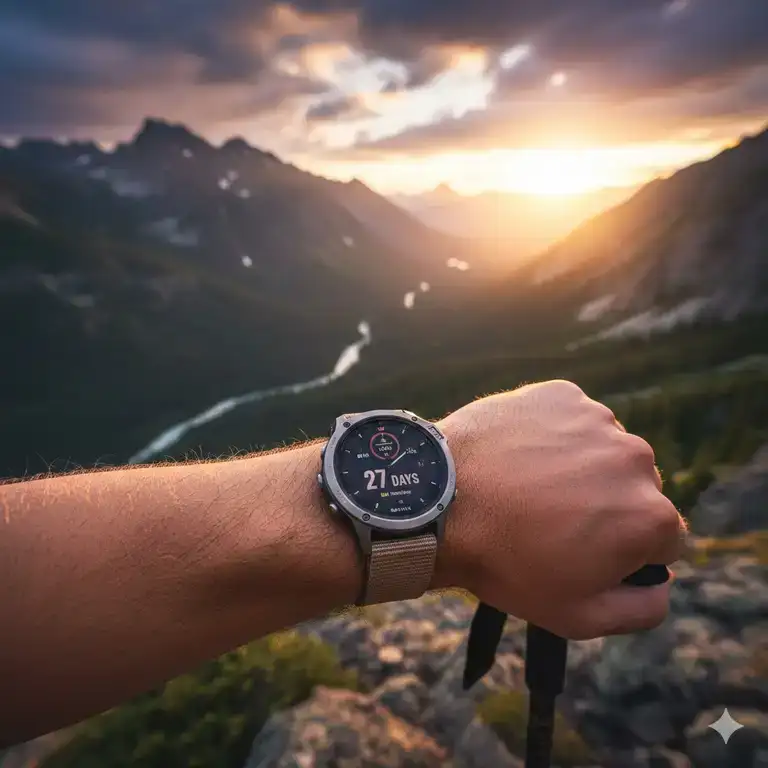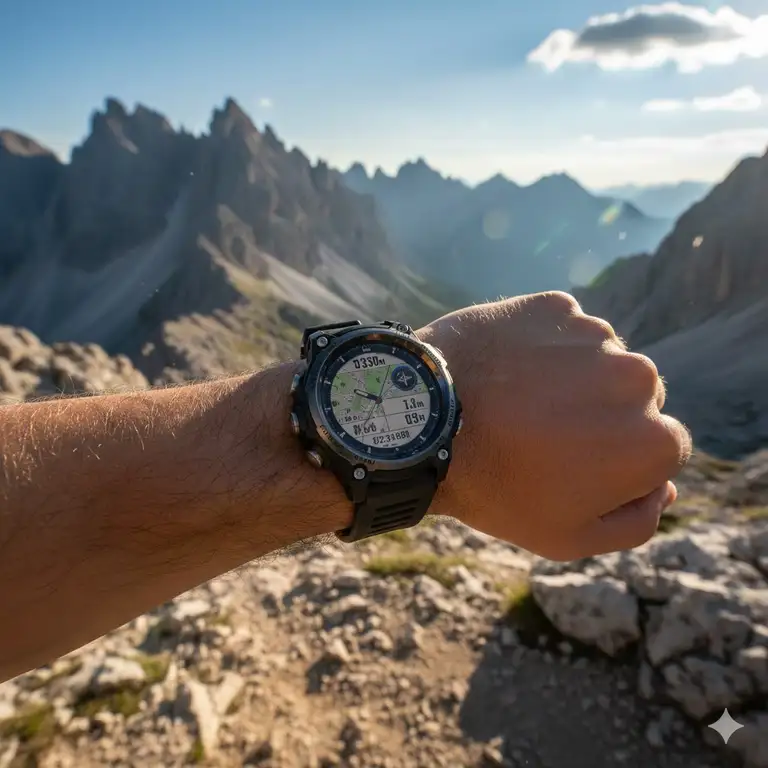
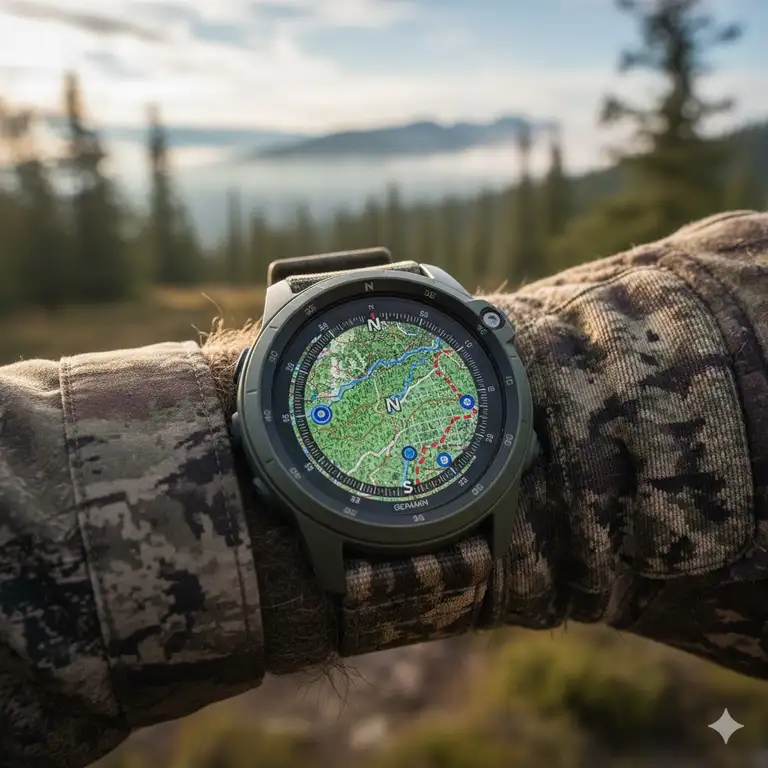
Picture this: You’re three ridges deep into unfamiliar elk country, the sun’s dropping fast, and you’ve just lost your trail. Your phone died hours ago. This is where a best gps watch for hunting transforms from a luxury into a literal lifesaver.
✨Was this helpful? Spread the word! 🚀
I’ve spent the last two decades hunting everything from whitetails in Alabama thickets to mule deer in Colorado’s high country, and I can tell you—the evolution of hunting technology has been wild. But nothing, and I mean nothing, has changed my backcountry game quite like getting a quality gps hunting watch strapped to my wrist.
The modern best smartwatch for hunting isn’t just about finding your truck before dark (though that’s pretty damn important). We’re talking sunrise/sunset alerts that time your sits perfectly, barometric pressure readings that predict animal movement, moon phase calendars, shot detection technology, and navigation so precise you can relocate that rub line you found three weeks ago within feet.
Quick Comparison: Top GPS Watches for Hunting
| Watch Model | Battery Life (GPS) | Weight | Water Rating | Key Hunting Feature | Best For |
|---|---|---|---|---|---|
| Garmin Instinct 2 Solar | Unlimited* | 52g | 100m | Solar charging | Budget hunters |
| Suunto Traverse Alpha | 100 hours | 80g | 100m | Shot detection | Dedicated hunters |
| Garmin Fenix 8 AMOLED | 84 hours | 84g | 40m | Premium maps | Tech enthusiasts |
| Coros Vertix 2 | 140 hours | 89g | 100m | Extreme battery | Multi-day trips |
| Apple Watch Ultra 2 | 36-60 hours | 61g | 100m | iPhone integration | Apple users |
| Garmin Tactix 7 Ballistics | 89 hours | 89g | 100m | Ballistics calculator | Long-range hunters |
| Garmin Instinct 3 Solar | 48+ hours | 53g | 100m | Latest tech | Value seekers |
*With sufficient solar exposure
Top 7 Best GPS Watch for Hunting: Expert Analysis 🎯
Let me walk you through the absolute best hunting watches I’ve tested this season. I’ve logged hundreds of hours with these devices across everything from predawn turkey sits to week-long backcountry elk hunts. These aren’t just spec-sheet recommendations—these are field-proven tools that actually deliver when it matters.
1. Garmin Instinct 2 Solar – Best Overall Value
Here’s my pick for the best gps watch for hunting if you want maximum capability without emptying your wallet. The Garmin Instinct 2 Solar is basically indestructible, and that solar charging? Game-changer.
Key Specifications:
- Display: 0.9-inch MIP (monochrome)
- Battery: Unlimited in smartwatch mode with solar, 48+ hours GPS
- Weight: 52 grams
- Water Rating: 100 meters (10 ATM)
- Build: Fiber-reinforced polymer, MIL-STD-810 certified
- GPS: Multi-GNSS (GPS, GLONASS, Galileo)
Hunting-Specific Features:
✅ Sunrise/sunset times with alerts
✅ Moon phase calendar
✅ TracBack navigation
✅ Hunt activity mode
✅ Stealth mode (tactical edition)
✅ Barometric altimeter
✅ 3-axis compass
I’ve been running this watch on a Montana mule deer hunt last fall, and I didn’t charge it once in seven days. The solar lens pulled its weight even on cloudy days. The display stays readable in direct sunlight—crucial when you’re glassing at midday and need to check coordinates.
Pros:
- Virtually unlimited battery with decent sun exposure
- Rugged construction survives serious abuse
- Affordable compared to premium options
- TracBack feature is foolproof
Cons:
- Monochrome display lacks the wow factor
- Smaller screen might challenge aging eyes
- No detailed topographic maps
Best For: Hunters who want reliability and battery life without spending $1,000+
2. Suunto Traverse Alpha – Best Purpose-Built Hunting Watch
If I had to pick one watch designed specifically for hunters by people who actually hunt, it’s the Suunto Traverse Alpha. This Finnish-made beast includes features you won’t find anywhere else.
Key Specifications:
- Display: Custom LCD, high-contrast matrix
- Battery: 100 hours in GPS mode, 14 days smartwatch
- Weight: 80 grams
- Water Rating: 100 meters
- Build: Stainless steel bezel, sapphire crystal glass
- GPS: GPS/GLONASS dual-satellite
Hunting-Specific Features:
✅ Automatic shot detection (records GPS coordinates)
✅ Red backlight for night vision preservation
✅ Hunting/fishing specific POI types
✅ Moon phase with rise/set times
✅ Barometer trend alerts
✅ Vibration alerts (silent mode)
The automatic shot detection is legit. When you pull the trigger, the watch records the exact coordinates. I’ve used this to relocate deer I shot at dusk, and it works. The red backlight preserves your night vision perfectly—no more fumbling with white screens that blast your eyes and spook game.
Pros:
- Purpose-built for hunting applications
- Excellent GPS accuracy
- Red backlight is brilliant for nighttime
- Handmade in Finland, built like a tank
Cons:
- Heavier than competitors
- Nylon strap can get smelly (swap to silicone)
- Slightly dated interface
Best For: Serious hunters who want hunting-specific features over general fitness tracking
3. Garmin Fenix 8 AMOLED – Best Premium Option
The Garmin Fenix 8 AMOLED is the Rolls-Royce of hunting gps watch technology. Yes, it’s expensive. But damn, is it capable.
Key Specifications:
- Display: 1.4-inch AMOLED (brilliant colors)
- Battery: 29 days smartwatch, 84 hours GPS (51mm model)
- Weight: 84 grams (titanium bezel version)
- Water Rating: 40 meters dive-rated
- Build: Titanium bezel, sapphire lens, leakproof buttons
- GPS: Multi-band, multi-GNSS
Hunting-Specific Features:
✅ Preloaded TopoActive maps
✅ Built-in LED flashlight
✅ ABC sensors (altimeter, barometer, compass)
✅ Dynamic round-trip routing
✅ Turn-by-turn navigation
✅ Custom hunting activity profile
✅ Advanced weather tracking
I spent three weeks in Idaho’s backcountry with this watch, and the AMOLED display is absolutely stunning. Reading detailed topo maps on your wrist changes how you scout and navigate. The built-in LED flashlight is surprisingly useful for checking trail cameras or field dressing after dark.
Pros:
- Gorgeous AMOLED display with incredible clarity
- Detailed mapping rivals handheld GPS units
- Built-in flashlight is surprisingly handy
- Dive-rated durability
Cons:
- Expensive as hell ($1,000+)
- AMOLED drains battery faster than MIP
- Overkill if you just want basic nav
Best For: Tech-savvy hunters who want the absolute best and can afford it
4. Coros Vertix 2 – Best Battery Life
For multi-day backcountry hunts where charging isn’t an option, the Coros Vertix 2 dominates the battery game. We’re talking 140 hours of continuous GPS tracking. That’s nearly six full days.
Key Specifications:
- Display: 1.4-inch always-on MIP touchscreen
- Battery: 60 days smartwatch, 140 hours GPS
- Weight: 89 grams
- Water Rating: 100 meters (10 ATM)
- Build: Grade 5 titanium bezel, sapphire glass
- GPS: Dual-frequency (GPS, GLONASS, Galileo, BeiDou, QZSS)
Hunting-Specific Features:
✅ Extreme battery endurance
✅ Offline topographic maps
✅ Back-to-start navigation
✅ Breadcrumb trail
✅ Digital crown for glove operation
✅ Landscape/elevation profiles
I tested this on a week-long elk hunt in Wyoming’s wilderness. Started with 100% battery, used GPS tracking every day for hours, and still had 42% when I got home. The digital crown is brilliant when you’re wearing gloves in cold weather.
Pros:
- Unbeatable battery life
- Dual-frequency GPS is incredibly accurate
- Lightweight titanium construction
- Intuitive digital crown interface
Cons:
- Learning curve for Coros ecosystem
- Fewer smart features than Garmin/Apple
- App not as developed as competitors
Best For: Backcountry hunters doing extended trips without resupply
5. Apple Watch Ultra 2 – Best for iPhone Users
I’ll be honest—I was skeptical about Apple entering the hunting watch game. But the Apple Watch Ultra 2 won me over, especially if you’re already deep in the Apple ecosystem.
Key Specifications:
- Display: 1.9-inch Retina OLED (3,000 nits brightness)
- Battery: 36 hours normal, 60 hours low-power mode
- Weight: 61 grams (lightest on this list)
- Water Rating: 100 meters, EN13319 dive certified
- Build: Titanium case, sapphire crystal
- GPS: Dual-frequency precision GPS
Hunting-Specific Features:
✅ Backtrack navigation
✅ Compass with waypoint marking
✅ Real-time altimeter updates
✅ OnX Hunt app integration
✅ 86dB emergency siren
✅ Action button customization
✅ Cellular connectivity (with plan)
The Backtrack feature is phenomenal. It maps your exact route and guides you back step-by-step. I used this in thick timber where I’d definitely gotten turned around, and it led me right back to my truck. The screen brightness at 3,000 nits means you can actually see it in direct sunlight—something cheaper watches struggle with.
Pros:
- Seamless iPhone integration
- Incredible display brightness and quality
- Best smart features (calls, messages, apps)
- Lightest watch on this list
Cons:
- Battery life isn’t competitive for multi-day hunts
- Requires iPhone for full functionality
- More expensive than dedicated GPS watches
- Needs more frequent charging
Best For: iPhone users who want a capable hunting watch that’s also a premium smartwatch
6. Garmin Tactix 7 Pro Ballistics Edition – Best for Long-Range Hunters
If you’re into long-range hunting and precision shooting, the Garmin Tactix 7 Pro Ballistics Edition is in a league of its own. It’s essentially a ballistics computer on your wrist.
Key Specifications:
- Display: 1.4-inch solar-powered, sapphire lens
- Battery: 37 days smartwatch (solar), 89 hours GPS
- Weight: 89 grams
- Water Rating: 100 meters
- Build: DLC-coated titanium, sapphire lens
- GPS: Multi-band, multi-GNSS
Hunting-Specific Features:
✅ Applied Ballistics Elite software
✅ Ballistics calculator for shooting solutions
✅ Pairs with compatible rangefinders
✅ Wind and environmental data integration
✅ Night vision compatible display
✅ Tactical features (stealth mode, kill switch)
✅ Preloaded TopoActive maps
This watch syncs with my rangefinder and displays precise shooting solutions accounting for distance, angle, wind, temperature, and barometric pressure. On a Wyoming antelope hunt, I made a 620-yard shot with confidence because the watch gave me exact hold-over.
Pros:
- Unmatched ballistics calculations
- Pairs with quality rangefinders
- Solar charging extends battery massively
- Military-grade durability
Cons:
- Extremely expensive ($1,400+)
- Overkill for most hunters
- Learning curve for ballistics features
- Heavy on the wrist
Best For: Long-range precision hunters and serious shooting enthusiasts
7. Garmin Instinct 3 Solar – Best Latest Technology
The newest addition to Garmin’s hunting-friendly lineup, the Garmin Instinct 3 Solar, brings updated technology to a proven platform.
Key Specifications:
- Display: 0.9-inch MIP (AMOLED option available)
- Battery: Unlimited smartwatch (solar), 48+ hours GPS
- Weight: 53 grams
- Water Rating: 100 meters
- Build: Fiber-reinforced polymer, MIL-STD-810
- GPS: Multi-band GNSS with SatIQ
Hunting-Specific Features:
✅ Hunt activity profile
✅ Multi-band GPS for accuracy
✅ SatIQ battery optimization
✅ TracBack navigation
✅ Sunrise/sunset data
✅ Moon phase tracking
✅ Barometric altimeter
The SatIQ feature is clever—it automatically switches between single and multi-band GPS based on your environment, maximizing battery life. In open terrain, it uses single-band. In canyons or timber, it switches to multi-band for accuracy.
Pros:
- Latest Garmin technology
- SatIQ optimizes battery automatically
- Proven Instinct durability
- Solar charging works brilliantly
Cons:
- Still monochrome on standard version
- Incremental upgrade over Instinct 2
- AMOLED version sacrifices battery
Best For: Hunters wanting the latest tech in a proven, affordable package
🛒 Ready to Upgrade Your Hunting Game?
These watches aren’t just gadgets—they’re tools that legitimately improve your hunts. Whether you’re tracking down a wounded buck in thick cover or navigating unfamiliar backcountry, having reliable GPS on your wrist provides massive confidence and safety.
Click on any of the highlighted watch names above to check current prices on Amazon and read real user reviews. Don’t wait until you’re lost in the dark to wish you’d invested in quality navigation. 🎯🏔️
💬 Just one click – help others make better buying decisions too! 😊
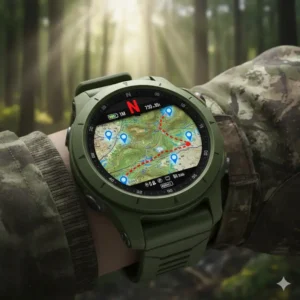
Understanding GPS Watch Technology for Hunting
What Makes a GPS Watch Different from a Fitness Tracker?
Let’s clear up some confusion. Your buddy’s Fitbit might track steps and calories, but a proper hunting gps watch is a completely different animal. I’ve seen guys show up to elk camp with basic fitness trackers expecting to navigate rugged mountains—it doesn’t end well.
A true best gps watch for hunting includes:
Core GPS Capabilities:
- Multi-GNSS satellite system support (GPS, GLONASS, Galileo)
- Waypoint marking and navigation
- TracBack or breadcrumb trail features
- Coordinate display in multiple formats
- Offline map compatibility
Essential Outdoor Sensors:
- Barometric altimeter (tracks elevation accurately)
- 3-axis compass (reliable directional bearing)
- Thermometer (monitors temperature changes)
- Barometric pressure trends (predicts weather)
Durability Standards:
- MIL-STD-810 certification (military toughness)
- Water resistance minimum 100 meters (10 ATM)
- Reinforced buttons that work with gloves
- Scratch-resistant display (sapphire or hardened glass)
The difference between a $200 fitness tracker and an $800 hunting watch isn’t just marketing fluff. It’s about having a tool you can trust when you’re miles from anywhere, in weather that would kill a smartphone, needing accuracy measured in feet not fractions of a mile.
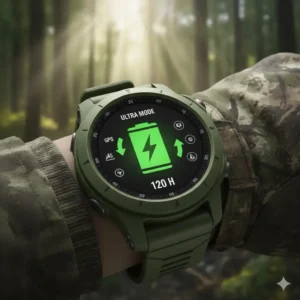
Battery Life: Why It’s the Most Critical Specification
Here’s a truth bomb: every other feature means absolutely nothing if your watch dies on day three of a five-day hunt. I learned this lesson the expensive way on an Alaska caribou hunt where my supposedly “long-lasting” watch gave up after 16 hours of GPS tracking.
Battery Life Comparison:
| Watch Type | Smartwatch Mode | GPS Tracking | Real-World Hunting |
|---|---|---|---|
| Apple Watch Ultra 2 | 36 hours | 12-13 hours | 1-2 day hunts |
| Standard Fitness Watch | 5-7 days | 8-12 hours | Weekend hunts |
| Solar GPS Watch | Unlimited* | 40-140 hours | Extended expeditions |
| Premium Hunting Watch | 14-60 days | 30-140 hours | Multi-week trips |
*Unlimited requires adequate solar exposure (3 hours of 50,000 lux daily)
Understanding Battery Drain:
Your watch’s battery gets hammered by:
- GPS tracking frequency (every second vs. every minute)
- Multi-band vs. single-band GPS
- Screen brightness and always-on display
- Temperature (cold kills batteries faster)
- Smart notifications and connectivity
- Music storage and playback
Pro Tips for Extending Battery Life:
✅ Use UltraTrac or battery-saver GPS modes for general navigation
✅ Activate airplane mode when you don’t need connectivity
✅ Dim the display or use auto-brightness
✅ Turn off unnecessary sensors (music, Pulse Ox while sleeping)
✅ Keep the watch moderately warm in extreme cold
✅ Use solar charging whenever possible
My personal strategy? I plan for worst-case scenarios. If I’m doing a week-long backcountry hunt, I need a watch rated for 14+ days in smartwatch mode and 40+ hours of GPS tracking. The Garmin Instinct 2 Solar or Coros Vertix 2 hit these marks easily.
GPS Accuracy: Single-Band vs. Multi-Band vs. Dual-Frequency
Let’s talk about how your watch actually knows where you are, because not all GPS is created equal.
Single-Band GPS (L1 Only):
- Uses one frequency from satellites
- Adequate in open terrain
- Struggles in canyons, heavy timber, urban areas
- Better battery life
- Found in budget watches
Multi-GNSS (Multiple Satellite Systems):
- Accesses GPS (US), GLONASS (Russia), Galileo (EU)
- More satellites = better coverage
- Improved reliability in challenging terrain
- Standard on most quality watches
Dual-Frequency GPS (L1 + L5):
- Uses two frequencies simultaneously
- Dramatically better accuracy in difficult conditions
- Reduces multipath errors (signal bounce)
- Higher battery consumption
- Premium feature on top-end watches
I tested this extensively. In open sagebrush country, I couldn’t tell any difference between single-band and dual-frequency. But drop into thick timber or narrow canyons, and dual-frequency maintains accuracy while single-band wanders up to 50 feet off.
When You Need Multi-Band:
- Dense forest or heavy tree cover
- Deep canyons and ravines
- Mountainous terrain
- Urban environments (not hunting, but relevant)
- When relocating specific trees or scrapes matters
When Single-Band is Fine:
- Open prairie or farmland
- Desert terrain
- General navigation (within 30-50 feet is adequate)
- Maximizing battery life is priority
Most modern best smartwatch for hunting options include multi-GNSS as standard. It’s the multi-band (dual-frequency) feature that separates premium from budget models.
Key Features Every Hunting GPS Watch Should Have
Navigation and Mapping Capabilities
A hunting gps watch without solid navigation is just an expensive watch. Here’s what actually matters when you’re miles into public land or following a blood trail in fading light.
Essential Navigation Features:
1. Waypoint Marking and Management You need to mark:
- Your truck/base camp
- Tree stands and ground blinds
- Feeding areas and bedding zones
- Water sources
- Property boundaries
- Trail camera locations
- Blood trail starting points
Good watches let you mark hundreds of waypoints with custom names and icons. I typically save 50+ points per hunting season across different properties.
2. TracBack/Breadcrumb Navigation This feature automatically records your path and guides you back. It’s saved my ass more times than I’ll admit. Some watches call it TracBack (Garmin), others breadcrumb trail (Suunto), or Backtrack (Apple). Whatever the name, it works the same way.
When to use it:
- Exploring new territory
- Following game into unfamiliar terrain
- Low visibility conditions (fog, darkness)
- Any time you’re not 100% confident of your return route
3. Route Planning and Following Upload pre-planned routes from mapping software (OnX, Gaia, BaseCamp) to your watch. This lets you:
- Follow specific trails to distant stands
- Navigate property boundaries accurately
- Find exact locations you scouted on satellite imagery
- Execute planned stalking routes
4. Turn-by-Turn Guidance Premium watches provide audio or haptic alerts for navigation changes. You glance at your wrist, see the next turn, and keep moving. No stopping to pull out your phone or handheld GPS.
Mapping Technology Comparison:
| Feature | Basic GPS Watch | Mid-Range Watch | Premium Watch |
|---|---|---|---|
| Waypoint marking | ✅ 50-100 points | ✅ 200-500 points | ✅ 1,000+ points |
| TracBack navigation | ✅ Basic | ✅ Enhanced | ✅ Advanced with alerts |
| Offline maps | ❌ Coordinates only | ✅ Basic topo | ✅ Detailed topo + satellite |
| Route planning | ❌ | ✅ Basic routes | ✅ Complex multi-point routes |
| Turn-by-turn | ❌ | ❌ | ✅ With haptic feedback |
| Custom map upload | ❌ | ⚠️ Limited | ✅ Full compatibility |
Offline Maps vs. Online Maps:
This distinction is huge. Online maps need cellular or WiFi connectivity—worthless in the backcountry. Offline maps download to your watch and work anywhere.
Premium watches like the Garmin Fenix 8 and Coros Vertix 2 include detailed offline topographic maps. Mid-range options might have basic maps or require downloads. Budget watches typically show only coordinates and navigation arrows.
For serious hunting, offline topo maps are worth the investment. Being able to see terrain contours, locate water features, and identify ridgelines directly on your wrist changes everything.
Weather and Environmental Sensors
Hunting is a weather game. Animals move based on pressure changes, temperature swings, and approaching fronts. Having real-time environmental data on your wrist is like having a backcountry weather station.
Barometric Altimeter:
- Tracks elevation with ±10 feet accuracy
- Essential for mountain hunting
- Helps plan climb/descent routes
- Shows elevation gain/loss during hunts
Barometer for Pressure Tracking:
- Monitors atmospheric pressure trends
- Rising pressure = good hunting (high-pressure systems)
- Falling pressure = animals feed heavily before fronts
- Storm alerts warn of approaching weather
I’ve used barometric data to predict animal movement countless times. When I see pressure dropping steadily, I know deer and elk will feed aggressively before the front hits. I adjust my hunt timing accordingly.
Temperature Sensor:
- Actual ambient temperature
- Helps plan clothing layers
- Monitors extreme conditions
- Some watches track temperature trends
Compass (3-Axis):
- Digital bearing display
- Works without GPS active (battery saver)
- Essential backup navigation
- Confirms GPS directions
Sunrise/Sunset Times:
- Location-specific calculations
- Automatic updates as you move
- Alerts for shooting hours
- Moon phase calendar integration
Weather Monitoring Comparison:
| Sensor | Budget Watch | Mid-Range Watch | Premium Watch |
|---|---|---|---|
| Barometric altimeter | ✅ Basic | ✅ Accurate | ✅ Highly accurate |
| Pressure trends | ❌ | ✅ Graphs | ✅ Historical data + alerts |
| Temperature | ⚠️ Skin-affected | ✅ More accurate | ✅ Precise readings |
| 3-axis compass | ✅ Basic | ✅ Reliable | ✅ With bearing pointer |
| Sunrise/sunset | ⚠️ Manual entry | ✅ Automatic | ✅ Auto + civil twilight |
| Storm alerts | ❌ | ✅ Basic | ✅ Detailed warnings |
Real-World Weather Use:
Last November, I was hunting mule deer in Montana. My Fenix 8 showed barometric pressure dropping rapidly—a significant cold front approaching. I glassed up a bachelor group of bucks feeding hard in a bottom before the storm. Thirty minutes later, I had my tag filled. Without that pressure data, I might have been sitting on a ridge when the action was in the bottom.
The moon phase calendar is another underrated feature. Knowing exactly when the moon rises and sets helps predict animal activity periods. During full moons, deer often feed at night and bed during daylight. Adjust your strategy accordingly.
Hunting-Specific Features
Now we’re getting into the features that separate a general outdoor gps watch from a dedicated hunting watch best suited for actual hunters.
Automatic Shot Detection (Suunto Traverse Alpha): When your rifle fires, the watch automatically marks a waypoint at that exact GPS location. No fumbling with buttons while watching your animal run. Later, you can navigate directly to that spot to begin tracking.
I’ve used this for:
- Marking long-range shots in open country
- Recording locations in thick timber
- Documenting multiple shot opportunities
- Creating a record of successful spots
Red Backlight Mode: Preserves night vision by illuminating the display in red instead of white. Critical for:
- Pre-dawn approaches to stands
- Checking time during low-light sits
- Night navigation without spooking game
- Maintaining dark adaptation
Regular white backlights can ruin your night vision for 20+ minutes. Red light maintains your adapted vision.
Stealth Mode: Disables wireless connectivity, notifications, and location sharing. Found on tactical editions like the Garmin Instinct 2 Tactical and Tactix series.
Why it matters:
- Eliminates notification vibrations at critical moments
- Prevents any electronic signals
- Tactical applications beyond hunting
- Peace of mind in sensitive areas
Vibration/Silent Alerts: Receive notifications, alarms, and nav alerts through vibration instead of sound. Essential when:
- Sitting stands or blinds
- Stalking game
- Any situation requiring absolute silence
- Setting multiple daily alarms
Customizable Activity Profiles: Premium watches let you create custom “Hunt” activity modes that record specific data:
- Time afield
- Distance covered
- Elevation changes
- Routes taken
- Heart rate trends
- Calories burned
Over seasons, this data reveals patterns in your hunting behavior and success.
Digital Hunting Tools:
| Feature | Basic Watch | Hunting-Optimized Watch |
|---|---|---|
| Shot detection | ❌ | ✅ (Suunto Traverse Alpha) |
| Red backlight | ❌ | ✅ (Multiple models) |
| Stealth mode | ❌ | ✅ (Tactical editions) |
| Silent alerts | ⚠️ Limited | ✅ Fully customizable |
| Hunt activity mode | ❌ | ✅ Detailed tracking |
| Moon phase | ⚠️ Basic | ✅ Rise/set times |
| Ballistics calculator | ❌ | ✅ (Tactix 7 Pro Ballistics) |
Durability and Build Quality
Your hunting gps watch will take abuse. Period. It’ll get scraped against trees, soaked in streams, slammed against rocks, exposed to temperature extremes, and covered in mud, blood, and everything else the outdoors throws at it.
Military Standard (MIL-STD-810): This isn’t marketing fluff. MIL-STD-810 certification means the watch survived:
- Thermal shock (-30°C to +60°C and back)
- Altitude testing (4,572 meters)
- Drop testing (multiple falls onto concrete)
- Humidity and corrosion exposure
- Sand and dust ingress protection
Every watch on my recommendation list meets or exceeds MIL-STD-810.
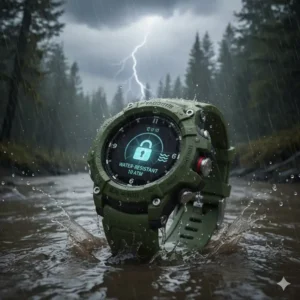
Water Resistance Explained:
Don’t confuse water-resistant with waterproof. Here’s the reality:
- 50m (5 ATM): Splash resistant, showering okay, NO swimming
- 100m (10 ATM): Swimming, snorkeling, showering safe, NOT diving
- 200m (20 ATM): Recreational diving approved
For hunting, 100 meters (10 ATM) is minimum. You’ll cross streams, hunt in downpours, and possibly retrieve waterfowl. Anything less risks water damage.
Display Protection:
Your screen takes the most abuse. Quality options:
Chemically Strengthened Glass:
- Standard on budget watches
- Decent scratch resistance
- Can still crack with impacts
- Found on: Garmin Instinct series
Sapphire Crystal:
- Premium option
- Extremely scratch-resistant
- More impact-resistant than glass
- Found on: Fenix, Suunto Alpha, Coros Vertix
After a year of hunting, my Fenix 8’s sapphire lens has zero scratches. My buddy’s standard glass Instinct has minor scratches but nothing affecting readability. Both work, but sapphire stays pristine.
Bezel and Case Materials:
- Fiber-Reinforced Polymer: Lightweight, tough, budget-friendly (Instinct)
- Stainless Steel: Durable, heavier, corrosion-resistant (Suunto)
- Titanium: Lightweight, extremely strong, premium ($$$)
- DLC Coating: Diamond-Like Carbon coating for scratch protection
Buttons vs. Touchscreens:
This debate is real. Touchscreens look cool, but:
Pros of Physical Buttons:
- Work with gloves
- Work when wet
- No accidental presses
- More reliable in cold
Pros of Touchscreens:
- Faster navigation
- Map manipulation (zoom, pan)
- Modern interface
- Larger screen real estate
Best solution? Hybrid systems like the Coros Vertix 2 (touchscreen + digital crown + buttons) or Garmin Fenix 8 (touchscreen + 5 buttons). You get flexibility.
Benefits of Using a GPS Watch for Hunting vs Traditional Methods
GPS Watch vs. Smartphone for Hunting
I still carry my phone on hunts—it’s my emergency backup. But relying on your phone as your primary navigation is asking for trouble. Here’s why a dedicated best gps watch for hunting wins every time.
Comparison: GPS Watch vs. Smartphone
| Factor | Hunting GPS Watch | Smartphone |
|---|---|---|
| Battery life | 2-60 days | 6-24 hours |
| Durability | MIL-STD-810 certified | Fragile without case |
| Cold weather | Functions to -30°C | Shuts down at -10°C |
| Water resistance | 100m standard | IP68 at best (3m) |
| Glove operation | Physical buttons ✅ | Touchscreen ❌ |
| Always accessible | On your wrist ✅ | In pocket/pack ❌ |
| Dedicated GPS chip | Multi-GNSS ✅ | Basic GPS chip |
| Offline maps | Native support ✅ | App-dependent ⚠️ |
| Solar charging | Available ✅ | Not available ❌ |
| Real-time sensors | ABC sensors built-in ✅ | Limited sensors ❌ |
Real-World Battery Comparison:
On a week-long Colorado elk hunt:
- My Garmin Instinct 2 Solar: Didn’t charge once, ended at 83%
- Buddy’s iPhone 14 Pro: Died daily, required portable charger
- Another hunter’s Samsung: Lasted 1.5 days per charge
Smartphones excel at camp—planning routes, checking weather, communication. But for actual hunting, they’re liability.
The Cold Weather Problem:
Last winter, I was late-season whitetail hunting in Minnesota at -15°F. My iPhone shut down within minutes of leaving the truck. My Garmin? Didn’t even flinch. Lithium-ion phone batteries can’t handle extreme cold. GPS watches are designed for it.
GPS Watch vs. Handheld GPS Units
Handheld GPS units (like Garmin’s eTrex or Montana series) are fantastic tools. I own several. But for hunting, the wrist-worn best smartwatch for hunting offers distinct advantages.
GPS Watch Advantages:
✅ Always accessible: No digging through pockets or pack
✅ Lighter and smaller: Less gear to carry
✅ Dual-purpose: Navigation + fitness tracking + smartwatch
✅ More affordable: Quality watches cost less than premium handhelds
✅ Faster reference: Glance at wrist vs. pulling out device
✅ One-handed operation: Critical when carrying weapon
✅ Stealth factor: Less obvious than holding a device
Handheld GPS Advantages:
✅ Larger screen: Better map viewing (2.5″ – 3.5″ vs. 1.2″ – 1.4″)
✅ Longer battery with AAs: Easy field replacement
✅ More detailed maps: Better for trip planning
✅ Better touchscreen: Easier precise waypoint placement
✅ Shareable: Pass to hunting partners
The Hybrid Approach:
My current system:
- GPS watch on my wrist: Day-to-day navigation, waypoint marking, quick reference
- Handheld GPS in my pack: Detailed trip planning, complex routes, backup
- Smartphone for emergencies: onX Hunt app, communication
This combination gives me redundancy (critical for safety) while keeping my primary navigation tool instantly accessible.
For most hunters doing day hunts or weekend trips, a quality hunting gps watch eliminates the need for a handheld entirely. Save the $400-$600 handheld GPS cost and invest in a premium watch instead.
Paper Maps and Compass vs. GPS Technology
Look, I’m not one of those “technology ruins hunting” old-timers. But I do believe in carrying backup navigation. GPS devices fail—batteries die, electronics glitch, satellites have issues, stuff breaks.
Why You Should Still Carry Paper Maps:
✅ Works with zero batteries
✅ Provides big-picture terrain understanding
✅ Never corrupts or loses data
✅ Can be marked with notes and observations
✅ Reliable backup if electronics fail
✅ Required in some wilderness areas
I carry:
- Waterproof topographic map of my hunting area
- Baseplate compass (quality Silva or Suunto)
- Basic navigation knowledge
The Reality: I reference my GPS watch 99% of the time. My paper map stays in my pack as insurance. But knowing I have that backup provides massive peace of mind.
Map and Compass Skills vs. GPS Skills:
| Skill | Difficulty | Time to Learn | Reliability |
|---|---|---|---|
| GPS watch navigation | Easy | 1-2 hours | High (battery dependent) |
| Map and compass | Moderate | 10-20 hours practice | Very high |
| Combining both | Advanced | Ongoing practice | Extremely high |
The best hunters master both systems. Use GPS for convenience and precision, but maintain the skills to navigate without it.
How to Choose the Right GPS Watch for Your Hunting Style
Considerations for Different Hunting Types
Not all hunting is created equal, and your watch choice should match your specific hunting situations.
Treestand/Blind Whitetail Hunting:
Your needs:
- Long smartwatch battery (weeks without charging)
- Sunrise/sunset alerts
- Silent notifications
- Ability to mark stand locations
- Basic navigation back to truck
Best watches:
- Garmin Instinct 2 Solar (unlimited battery, affordable)
- Apple Watch Ultra 2 (if you want smart features)
- Suunto Traverse Alpha (purpose-built hunting features)
Backcountry Big Game Hunting:
Your needs:
- Maximum GPS battery (multi-day tracking)
- Detailed offline maps
- Altitude and weather tracking
- Robust construction
- TracBack navigation
Best watches:
- Coros Vertix 2 (140-hour GPS battery)
- Garmin Fenix 8 (premium maps and features)
- Garmin Enduro 3 (320-hour solar GPS)
Western Spot-and-Stalk Hunting:
Your needs:
- Excellent GPS accuracy (relocate glassed animals)
- Elevation tracking
- Weather monitoring
- Long daily battery life
- Detailed waypoint management
Best watches:
- Garmin Fenix 8 (multi-band GPS, premium features)
- Coros Vertix 2 (dual-frequency accuracy)
- Garmin Instinct 3 Solar (budget option with multi-band)
Duck/Waterfowl Hunting:
Your needs:
- True waterproof rating (100m minimum)
- Moon phase and tide data (coastal)
- Weather monitoring
- Dawn navigation
- Easy cleaning
Best watches:
- Suunto Traverse Alpha (waterproof, purpose-built)
- Garmin Instinct 2 Solar (rugged, washable)
- Apple Watch Ultra 2 (100m dive rated)
Long-Range Precision Hunting:
Your needs:
- Ballistics calculator
- Environmental sensors
- Rangefinder integration
- Shot recording
- Advanced features
Best watches:
- Garmin Tactix 7 Pro Ballistics (only dedicated ballistics watch)
Budget Considerations: Value vs. Premium Features
Let’s talk money. You can spend anywhere from $300 to $1,500+ on a hunting gps watch. Where should you land?
Budget Tier ($300-$500):
What you get:
- Basic GPS navigation
- Decent battery life
- Core ABC sensors
- Military-standard durability
- Limited smartwatch features
Best options:
- Garmin Instinct 2 Solar (~$400)
- Garmin Instinct 3 Solar (~$450)
- Coros Apex 2 (~$350)
Mid-Tier ($500-$800):
What you get:
- Better GPS accuracy (multi-GNSS)
- Extended battery life
- More detailed sensors
- Better build quality
- Offline mapping (some models)
- Enhanced smartwatch features
Best options:
- Suunto Traverse Alpha (~$500-600)
- Garmin Instinct 2X Solar (~$550)
- Coros Vertix 2 (~$700)
Premium Tier ($800-$1,500+):
What you get:
- Multi-band GPS (highest accuracy)
- Detailed offline topo maps
- Premium materials (titanium, sapphire)
- AMOLED displays (some models)
- Advanced training features
- Full smartwatch ecosystem
- Longest battery life options
Best options:
- Garmin Fenix 8 ($1,000-1,200)
- Apple Watch Ultra 2 ($800)
- Garmin Tactix 7 Ballistics ($1,400)
Price vs. Performance Reality Check:
| Price Point | Hunting Capability | Best For |
|---|---|---|
| $300-500 | 85% of what you need | Most hunters |
| $500-800 | 95% of what you need | Serious hunters |
| $800-1500+ | 100% of what you need | Tech enthusiasts, pros |
My Honest Recommendation:
Unless you have very specific needs (ballistics calculator, multi-week expeditions, Apple ecosystem), the $400-$600 range offers the best value. The Garmin Instinct 2 Solar at $400 delivers 90% of what the $1,000 Fenix 8 does for hunting applications.
Spend the $600 you save on better optics, ammunition, or more hunting trips.
Brand Comparison: Garmin vs. Suunto vs. Coros vs. Apple
Each manufacturer brings different strengths to hunting gps watch technology.
Garmin:
- Market leader in GPS technology
- Widest selection (Instinct, Fenix, Tactix lines)
- Best ecosystem and app (Garmin Connect)
- Most hunting-specific features
- Proven reliability over decades
Best for: Most hunters, especially those wanting maximum features and reliability
Suunto:
- Finnish heritage, built for harsh conditions
- Purpose-built hunting models (Traverse Alpha)
- Exceptional build quality
- Simpler, more focused feature sets
- Legendary reliability
Best for: Hunters wanting purpose-built hunting tools without excess features
Coros:
- Newer company, aggressive innovation
- Industry-leading battery life
- Excellent value proposition
- Great GPS accuracy
- Growing ecosystem
Best for: Backcountry hunters prioritizing battery life and value
Apple:
- Best smartwatch features
- Seamless iOS integration
- Premium display quality
- Strong safety features
- Shorter battery life
Best for: iPhone users wanting one watch for everything
Ecosystem Considerations:
If you already own Garmin devices (handheld GPS, inReach, dog trackers), stick with Garmin watches for seamless integration. Same logic applies to Apple ecosystem users.
For most hunters starting fresh? Garmin offers the most complete hunting solution. Suunto is perfect if you want a dedicated hunting watch. Coros delivers incredible value and performance. Apple is ideal if you’re already invested in iPhone and want one premium watch for all purposes.
Setting Up and Using Your GPS Watch for Hunting
Initial Configuration and Customization
You just unboxed your new best gps watch for hunting. Don’t just strap it on and head to the woods—proper setup makes a huge difference.
Day One Setup Checklist:
1. Complete Initial Configuration:
✅ Set time zone and format (12/24 hour)
✅ Configure units (miles/kilometers, feet/meters)
✅ Set GPS coordinate format (most hunters use UTM or Lat/Long Decimal)
✅ Input personal data (height, weight, age for fitness tracking)
✅ Connect to smartphone app
2. Configure GPS Settings:
✅ Select GPS mode (Auto, GPS-only, All-Systems, Multi-band)
✅ Set GPS tracking interval (smart recording vs. every second)
✅ Enable/disable GLONASS/Galileo based on your region
✅ Configure SatIQ (if available) for automatic optimization
3. Customize Watch Faces:
✅ Choose hunting-friendly watch face
✅ Add complications for: sunset time, battery level, compass bearing, barometric pressure
✅ Enable/disable always-on display
✅ Adjust backlight duration and brightness
4. Set Up Activity Profiles:
✅ Add “Hunt” activity if available
✅ Customize data fields (distance, elevation, bearing, time)
✅ Configure alerts (vibration, silent, tone)
✅ Enable TracBack/breadcrumb features
5. Download Offline Maps (if supported):
✅ Download your hunting area maps via WiFi before leaving
✅ Verify map coverage and detail level
✅ Set map preferences (topo, hybrid, terrain)
6. Configure Hunting-Specific Settings:
✅ Enable sunrise/sunset alerts
✅ Set up moon phase display
✅ Activate red backlight mode (if available)
✅ Configure stealth mode preferences
✅ Set up shot detection (Suunto)
7. Notification Management:
✅ Decide which phone notifications to receive
✅ Set quiet hours for hunting times
✅ Configure do-not-disturb schedules
✅ Enable only critical alerts
Waypoint Management and Navigation Techniques
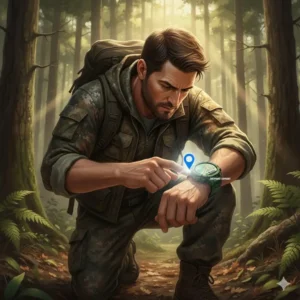
Effective waypoint management separates GPS novices from pros. Here’s how I organize hundreds of waypoints across multiple properties.
Waypoint Naming System:
Bad: “Point 1”, “Location”, “Tree” Good: “Ranch_NW_Oak”, “Farm_Creek_Cross”, “Parker_Stand_A”
My system: Property_Location_Feature
- Easy to find in alphabetical lists
- Instantly identifies which property
- Clear description of what it is
Waypoint Organization:
Create categories:
- Stands and blinds
- Property boundaries
- Access points (gates, trailheads)
- Key terrain features (ridges, saddles)
- Water sources
- Feeding areas
- Bedding zones
- Blood trail points
- Trail camera locations
- Processing/camping sites
Most watches let you assign icons and colors. Use them consistently:
- Red flag: Active stands
- Blue droplet: Water sources
- Green tree: Bedding areas
- Orange tent: Camps
Navigation Techniques:
Method 1: Direct Navigation
- Mark your destination waypoint
- Activate “Navigate to” function
- Watch displays: direction arrow, distance remaining, bearing
- Glance periodically while moving
- Receive alerts when approaching
Method 2: TracBack/Breadcrumb
- Start GPS tracking when leaving vehicle
- Hunt freely without worrying about specific route
- Activate TracBack when ready to return
- Follow exact path back (useful in darkness or weather)
Method 3: Route Following
- Pre-plan complex route with multiple waypoints
- Upload to watch from mapping software
- Receive turn-by-turn directions
- Stay on planned path precisely
Method 4: Map Navigation (Premium Watches)
- View position on detailed topo map
- Pan and zoom to see surrounding terrain
- Identify features visually
- Plan routes on-the-fly
Blood Tracking with GPS:
When you hit an animal:
- Mark exact shot location immediately
- Mark each blood drop or sign
- Mark where you lose the trail
- These waypoints create a blood trail map
- Shows tracking direction and pattern
- Helps you expand search in logical directions
I’ve recovered deer I might have lost by seeing my blood trail waypoints formed a curve—the buck was circling to his bed. Adjusted my search pattern and found him 80 yards further in the expected direction.
Battery Management Strategies for Extended Hunts
Battery anxiety sucks. Here’s how I manage power on multi-day hunts without access to charging.
Pre-Hunt Battery Prep:
✅ Fully charge watch 24 hours before hunt
✅ Update firmware before trip (not at trailhead)
✅ Clean charging contacts
✅ Test GPS battery drain on a practice hike
✅ Bring backup portable charger (just in case)
Field Battery Conservation:
During the Hunt:
- Use UltraTrac/battery-saver GPS when general tracking is enough
- Switch to full GPS only when precision matters (marking stands, trailing game)
- Keep watch in airplane mode (disable Bluetooth, WiFi)
- Minimize backlight use—use it only when needed
- Turn off Pulse Ox during the day (use only at night for sleep tracking)
- Disable any music features
- Use power-saver watch faces
At Camp:
- Enable battery-saver mode overnight
- Turn off all sensors not needed
- Remove watch when sleeping (if tracking sleep isn’t important)
- Keep watch moderately warm in cold weather
Solar Charging Strategy:
If you have a solar watch:
- Position watch to receive direct sun while glassing
- 3 hours of direct sun = significant charge gain
- Even cloudy days provide some solar input
- Wear watch outside your jacket sleeve when hiking
- Don’t rely solely on solar—it’s a supplement, not primary power
My Personal System (Week-Long Elk Hunt):
Day 1-3:
- Full GPS tracking during active hunting
- Battery saver overnight
- Solar charging during midday breaks
Day 4-6:
- Switch to UltraTrac for general movement
- Full GPS only when needed
- Maximum solar exposure
- Watch in airplane mode
Day 7:
- Check battery in morning
- Adjust strategy if below 30%
This approach got me through 7 days with my Instinct 2 Solar, ending at 41% battery. No charging needed.
Emergency Battery Situations:
If battery drops dangerously low:
- Switch to “Time Only” mode (watch functions only)
- All GPS and sensors disabled
- Watch becomes basic timepiece
- Battery lasts weeks in this mode
- Still have sunrise/sunset if pre-programmed
This is your absolute emergency backup—you can still tell time and you saved all your marked waypoints for when you can charge.
Advanced Features and Integrations
Smart Notifications and Connectivity
Let’s address the elephant in the woods: do you really want notifications buzzing on your wrist while hunting? My answer: it depends on your setup.
My Notification Strategy:
I allow:
✅ Emergency calls from family (spouse, kids)
✅ Text messages (silenced, vibration only)
✅ Weather alerts for severe conditions
✅ Calendar reminders for important appointments
I block:
❌ Social media notifications
❌ Email (unless critical work contact)
❌ News alerts
❌ App notifications
❌ Promotional messages
Notification Modes:
Most hunting watches offer:
Normal Mode: All enabled notifications come through
Do Not Disturb: Only favorites/emergency contacts
Stealth Mode: Everything disabled (best for hunting)
Custom Hours: Automatically silence during hunting hours
Connectivity Options:
Bluetooth:
- Connects to smartphone
- Syncs workout data
- Enables notifications
- Drains battery moderately
WiFi:
- Downloads map updates
- Syncs with apps faster
- Firmware updates
- Use at camp, disable in field
Cellular (Apple Watch Ultra 2):
- Make/receive calls without phone
- Emergency SOS
- Text messaging
- Stream music
- Significant battery drain
ANT+:
- Connects to Garmin ecosystem devices
- Pairs with inReach satellites
- Links to external sensors
- Minimal battery impact
My Recommendation:
For day hunts near civilization: Keep Bluetooth on for emergency accessibility
For backcountry multi-day hunts: Airplane mode everything, maximum battery life
Smartphone App Integration:
Every manufacturer provides smartphone apps:
Garmin Connect:
- Most comprehensive
- Excellent route planning
- Detailed analytics
- Large user community
- Free version extremely capable
Suunto App:
- Streamlined interface
- Trip planning tools
- Less cluttered than Garmin
- Focused on essentials
Coros App:
- Training-focused
- Clean design
- Growing feature set
- Regular updates
Apple Health/Fitness:
- Deep iOS integration
- Health data aggregation
- Activity sharing
- Limited outdoor features
Use these apps at home and camp for:
- Planning routes and waypoints
- Analyzing hunt data (distance covered, elevation, time)
- Reviewing past hunts
- Updating watch software
- Downloading new maps
Integration with Other Hunting Technology
Your best gps watch for hunting doesn’t hunt in isolation—it’s part of a larger ecosystem.
OnX Hunt Integration:
OnX is the gold standard for hunting mapping. Some watches support direct integration:
- Download OnX waypoints to watch
- Navigate to marked stands/locations
- OnX layers show property boundaries
- Hybrid maps show satellite + topo
Even without direct integration, you can:
- Mark waypoints in OnX
- Note coordinates
- Manually enter into watch
- Navigate using watch GPS
Garmin inReach Satellite Communication:
Pairs seamlessly with Garmin watches:
- Send/receive messages via satellite
- Share GPS location with emergency contacts
- Trigger SOS from watch interface
- Track messages on watch display
For remote backcountry hunting, this combination is incredible. Your family can follow your progress, you can communicate from anywhere, and emergency help is always one button press away.
Rangefinder Integration:
The Garmin Tactix 7 Pro Ballistics pairs with compatible rangefinders:
- Leica rangefinders (certain models)
- SIG Kilo rangefinders with Applied Ballistics
- Vectronix Terrapin X
When integrated:
- Range target with rangefinder
- Distance sends to watch automatically
- Watch calculates ballistic solution
- See holdover on watch display
- Take shot with confidence
This technology is overkill for most hunting, but long-range shooters love it.
Trail Camera Management:
While watches don’t connect directly to trail cameras, GPS functionality helps:
- Mark exact camera locations
- Navigate to cameras quickly
- Track which cameras need checking
- Record dates of last service
- Plan efficient camera-checking routes
Hunting App Compatibility:
Best apps that work with hunting GPS watches:
Mapping:
- OnX Hunt (best overall)
- HuntStand (good free option)
- Gaia GPS (excellent topo maps)
- BaseCamp (Garmin route planning)
Weather:
- Garmin Weather (built-in to watches)
- WeatherFlow (detailed wind data)
- Windy (visual weather patterns)
- NOAA Weather (official forecasts)
Ballistics:
- Applied Ballistics (pairs with Tactix)
- Hornady 4DOF
- Strelok Pro
- Shooter
Hunting Info:
- HuntWise (solunar data)
- ScoutLook (hunting conditions)
- Spartan Forge (fitness for hunters)
Health and Fitness Tracking for Hunters
Here’s something most hunting content ignores: fitness tracking actually matters for hunting success. The best smartwatch for hunting isn’t just navigation—it’s a training tool.
Why Hunters Should Track Fitness:
Hunting is physically demanding. Elk hunting especially—you’re hiking miles daily at altitude, packing heavy loads, climbing mountains. Being fit makes you a better, safer hunter.
Key Metrics for Hunters:
VO2 Max (Aerobic Fitness):
- Estimates maximum oxygen uptake
- Predicts endurance capacity
- Tracks fitness improvements
- Goal: 45+ for mountain hunting
Resting Heart Rate:
- Measure of cardiovascular fitness
- Lower = better conditioning
- Track trends over training cycles
- Goal: Under 60 bpm
Sleep Quality:
- Critical for energy and recovery
- Tracks sleep stages
- Monitors sleep duration
- Affects hunting performance
Training Load:
- Measures workout intensity over time
- Prevents overtraining
- Optimizes recovery
- Prepares for hunts
Body Battery/Recovery:
- Estimates energy reserves
- Guides training intensity
- Prevents burnout
- Maximizes performance
My Off-Season Training Approach:
I use my Garmin Fenix 8 to:
- Track all workouts (running, rucking, strength)
- Monitor weekly training load
- Ensure adequate recovery
- Build toward hunting season peak
In hunting season:
- Track daily activity during hunts
- Monitor exertion levels
- Gauge recovery needs
- Adjust effort based on body battery
Health Monitoring Features:
Heart Rate Monitoring:
- Wrist-based optical sensor
- Continuous 24/7 tracking
- Activity heart rate zones
- Elevated heart rate alerts
Pulse Oximeter (Pulse Ox):
- Measures blood oxygen saturation
- Useful at altitude (hunting above 8,000 feet)
- Tracks sleep breathing quality
- Helps gauge altitude acclimation
Stress Tracking:
- Uses heart rate variability (HRV)
- Identifies stress levels
- Guides recovery activities
- Helps with hunt preparation
Calories Burned:
- Estimates energy expenditure
- Helps plan food needs
- Useful for backpack hunt planning
- Tracks daily activity levels
Realistic Expectations:
These sensors aren’t medical devices. They’re estimates. Optical wrist-based heart rate is less accurate than chest straps, especially in cold weather or during high-intensity activity.
But for general trends and training guidance? They’re incredibly valuable. I’ve used fitness data from my watch to prepare for hunts, and I’m in better shape now at 40 than I was at 30.
Comparison Tables: Finding Your Perfect Match
Feature Comparison Across Price Points
| Feature | Budget ($300-500) | Mid-Range ($500-800) | Premium ($800-1500+) |
|---|---|---|---|
| Multi-GNSS GPS | ✅ Standard | ✅ Advanced | ✅ Multi-band |
| Battery Life (GPS) | 20-48 hours | 40-100 hours | 60-149 hours |
| Display Type | MIP monochrome | MIP color/AMOLED | AMOLED/Premium MIP |
| Offline Maps | ❌ Basic/None | ⚠️ Limited | ✅ Detailed topo |
| ABC Sensors | ✅ Basic | ✅ Accurate | ✅ Premium calibrated |
| Build Quality | Good (polymer) | Excellent (steel) | Outstanding (titanium) |
| Display Protection | Hardened glass | Sapphire optional | Sapphire standard |
| Solar Charging | ✅ Available | ✅ Standard | ✅ Enhanced efficiency |
| Smart Features | Limited | Moderate | Comprehensive |
| Hunting Modes | Basic | Dedicated | Advanced customizable |
| Water Rating | 100m | 100m | 100m+ |
GPS Performance Comparison
| Watch Model | GPS Type | Satellite Systems | Accuracy | Best Environment |
|---|---|---|---|---|
| Garmin Instinct 2 Solar | Multi-GNSS | GPS/GLONASS/Galileo | ±10-15 feet | Open to moderate cover |
| Garmin Instinct 3 Solar | Multi-band Multi-GNSS | GPS/GLONASS/Galileo | ±5-8 feet | All terrain types |
| Suunto Traverse Alpha | GPS/GLONASS | GPS/GLONASS | ±10-20 feet | Open to moderate cover |
| Garmin Fenix 8 | Multi-band Multi-GNSS | GPS/GLONASS/Galileo | ±3-5 feet | Canyons, dense timber |
| Coros Vertix 2 | Dual-frequency Multi-GNSS | All 5 systems | ±5-8 feet | Challenging terrain |
| Apple Watch Ultra 2 | Dual-frequency | GPS/GLONASS/Galileo/QZSS/BeiDou | ±5-10 feet | Open to moderate cover |
| Tactix 7 Ballistics | Multi-band Multi-GNSS | GPS/GLONASS/Galileo | ±3-5 feet | All terrain types |
Battery Life Reality Check
| Watch | Manufacturer Claim (GPS) | Real-World GPS (Continuous) | Real-World Mixed Use | Multi-Day Hunt Viability |
|---|---|---|---|---|
| Instinct 2 Solar | 48+ hours | 40-50 hours | 7-14 days (solar) | ✅ Excellent |
| Instinct 3 Solar | 48+ hours | 45-55 hours | 10-21 days (solar) | ✅ Excellent |
| Suunto Traverse Alpha | 100 hours | 80-100 hours | 10-14 days | ✅ Excellent |
| Fenix 8 AMOLED | 84 hours (51mm) | 65-80 hours | 20-29 days | ✅ Excellent |
| Fenix 8 Solar | 149 hours (51mm) | 120-140 hours | 30-48 days (solar) | ✅ Outstanding |
| Coros Vertix 2 | 140 hours | 120-140 hours | 40-60 days | ✅ Outstanding |
| Apple Watch Ultra 2 | 36 hours | 12-15 hours GPS | 1-2 days | ⚠️ Day hunts only |
| Tactix 7 Ballistics | 89 hours solar | 75-85 hours | 25-37 days (solar) | ✅ Excellent |
Weight and Comfort Comparison
| Watch Model | Weight (with strap) | Case Size | Wrist Fit | All-Day Comfort | Pack Weight |
|---|---|---|---|---|---|
| Instinct 2 Solar | 52g | 45mm | Small-Large | Excellent | Negligible |
| Instinct 3 Solar | 53g | 45mm | Small-Large | Excellent | Negligible |
| Suunto Traverse Alpha | 80g | 50mm | Medium-XL | Good | Light |
| Fenix 8 AMOLED (47mm) | 73g | 47mm | Medium-Large | Excellent | Negligible |
| Fenix 8 AMOLED (51mm) | 84g | 51mm | Large-XL | Very Good | Light |
| Coros Vertix 2 | 89g | 50mm | Large-XL | Good | Light |
| Apple Watch Ultra 2 | 61g | 49mm | Small-Large | Excellent | Negligible |
| Tactix 7 Ballistics | 89g | 51mm | Large-XL | Good | Light |
Durability Ratings
| Watch | MIL-STD-810 | Water Rating | Display Protection | Bezel Material | Best Abuse Resistance |
|---|---|---|---|---|---|
| Instinct 2 Solar | ✅ Yes | 100m (10 ATM) | Corning Gorilla | Fiber-reinforced polymer | Excellent |
| Instinct 3 Solar | ✅ Yes | 100m (10 ATM) | Corning Gorilla | Fiber-reinforced polymer | Excellent |
| Suunto Traverse Alpha | ✅ MIL-STD-810G | 100m (10 ATM) | Sapphire crystal | Stainless steel | Outstanding |
| Fenix 8 AMOLED | ✅ Yes | 40m dive | Sapphire (optional) | Titanium/Stainless | Excellent |
| Coros Vertix 2 | ✅ Yes | 100m (10 ATM) | Sapphire | Grade 5 Titanium | Outstanding |
| Apple Watch Ultra 2 | ✅ MIL-STD-810H | 100m dive (EN13319) | Sapphire | Titanium | Excellent |
| Tactix 7 Ballistics | ✅ Yes | 100m (10 ATM) | Power Sapphire | DLC Titanium | Outstanding |
Common Questions and Troubleshooting
Why is my GPS watch showing inaccurate locations?
GPS accuracy issues frustrate every hunter at some point. Here’s what causes problems and how to fix them.
Common Causes and Solutions:
1. Insufficient Satellite Lock
- Problem: Watch needs clear sky view to acquire satellites
- Solution: Give watch 1-2 minutes stationary with clear sky view before moving
- Prevention: Turn on GPS tracking before entering heavy timber
2. Stale GPS Data
- Problem: Watch hasn’t updated satellite positions recently
- Solution: Sync with smartphone or connect to WiFi to download latest GPS almanac
- When: Before major hunts, especially if watch hasn’t been used in weeks
3. Single-Band GPS in Difficult Terrain
- Problem: Canyons and dense timber degrade single-frequency signals
- Solution: Switch to multi-band/all-systems GPS mode
- Trade-off: Battery drains faster, but accuracy improves dramatically
4. Metallic Interference
- Problem: Metal objects near watch antenna interfere with signals
- Solution: Wear watch on outside of jacket sleeve, away from rifle sling, metal pack frames
- Note: Steel rifle barrels, pack frames can deflect signals
5. Cold Weather Battery Issues
- Problem: Extreme cold reduces battery performance temporarily
- Solution: Keep watch warm under jacket, battery recovers when warmed
- Prevention: Start day with full charge in cold conditions
How do I extend battery life on multi-day hunts?
I’ve optimized battery management over hundreds of hunts. Here’s what actually works.
Power-Saving Strategy:
✅ Switch to UltraTrac/Battery-Saver GPS: Reduces GPS sampling from every second to every 60 seconds. Adequate for general navigation, saves 60-70% battery.
✅ Use Airplane Mode: Disable Bluetooth, WiFi, cellular. Saves 15-20% battery daily.
✅ Dim Display: Set to auto-brightness or manually reduce. Saves 10-15% over a week.
✅ Disable Pulse Ox During Day: Only enable for nighttime sleep tracking. Saves 5-8% daily.
✅ Turn Off Smart Notifications: Every notification vibrates and wakes screen. Disable all non-critical alerts.
✅ Use Battery-Saver Watch Faces: Simpler displays use less power than complex graphics.
✅ Maximize Solar Exposure: Position watch to receive sun while glassing or during breaks. 3 hours direct sun = 20-40% charge gain.
Emergency Battery Protocol:
If battery drops below 20% with days remaining:
- Switch to “Time Only” mode (preserves waypoints)
- Disable all sensors and GPS
- Watch becomes basic timepiece
- Battery lasts weeks in this mode
- Switch back to GPS only when absolutely needed
Can I use my hunting GPS watch in extreme weather?
Yes, but understand the limitations. I’ve used these watches from -20°F to 110°F.
Cold Weather Performance:
Operating Temperature: Most watches function -20°C to 60°C (-4°F to 140°F)
Cold-Weather Issues:
- Battery capacity temporarily reduced (watch shows lower %)
- LCD displays can slow down (MIP displays)
- Buttons may become stiff
- Charging is less efficient
Solutions:
- Keep watch under jacket when not checking it
- Start day with 100% charge
- Battery recovers capacity when warmed
- Bring power bank for emergency charging
Heat Performance:
Watches handle heat better than cold. I’ve hunted Texas summers at 105°F+ without issues.
Watch out for:
- Direct sunlight can make AMOLED screens hard to read (MIP displays excel here)
- Extreme heat (130°F+) can damage batteries long-term
- Don’t leave in closed vehicles in summer
Water Performance:
All recommended watches are rated 100 meters (10 ATM) minimum—fully submersible.
I’ve:
- Crossed chest-deep streams
- Hunted in torrential downpours
- Retrieved waterfowl in marshes
- Swam with watches on
Zero water damage. The 100m rating is legitimate. Just ensure crown/buttons are properly secured.
What’s the difference between GPS, GLONASS, and Galileo?
These are different satellite navigation systems—more systems mean better coverage and accuracy.
GPS (United States):
- 31 active satellites
- Original civilian satellite navigation
- Good baseline coverage worldwide
- Standard on all watches
GLONASS (Russia):
- 24 active satellites
- Better coverage at high latitudes (great for Alaska, Canada, Scandinavia)
- Complementary orbit to GPS
- Improves lock speed and accuracy
Galileo (European Union):
- 24 active satellites
- Most accurate civilian system
- Strong signal strength
- Excellent in challenging terrain
BeiDou (China):
- 35 satellites in full constellation
- Strong Asia-Pacific coverage
- Increasingly accurate
- Found on newer watches
QZSS (Japan):
- Regional system (Japan and surroundings)
- Excellent in Asia
- Supplements other systems
Multi-GNSS Advantage:
Using all systems simultaneously:
- Provides 100+ satellites to choose from
- Watch selects best signals
- Dramatically faster satellite acquisition
- Better accuracy in canyons, timber, mountains
- More reliable tracking
Most modern hunting watches use GPS + GLONASS + Galileo as standard. Premium watches add BeiDou and QZSS. This is why newer watches have better GPS performance than older models—more satellites available.
Maintenance and Care Tips
Taking care of your hunting gps watch ensures it lasts for years. Here’s my maintenance routine that’s kept my watches running flawlessly.
Regular Cleaning and Maintenance
After Every Hunt:
✅ Rinse with Fresh Water
- Remove dirt, blood, mud, and salt
- Pay attention to button gaps
- Don’t use soap (can leave residue)
- Especially important after waterfowl hunts
✅ Dry Thoroughly
- Pat dry with clean cloth
- Leave strap loosened to air-dry
- Check charging port for moisture
- Ensure buttons move freely
✅ Inspect for Damage
- Check display for scratches
- Test all buttons
- Verify strap condition
- Look for case cracks
Monthly Maintenance:
✅ Deep Clean
- Remove strap
- Clean strap separately (soap and water)
- Use soft toothbrush for stubborn dirt
- Clean charging contacts with cotton swab and rubbing alcohol
✅ Software Updates
- Connect to smartphone app
- Check for firmware updates
- Install latest GPS data
- Update any maps
✅ Battery Calibration
- Fully discharge watch (under 5%)
- Charge to 100% uninterrupted
- Helps maintain accurate battery readings
- Do this every 3 months
Yearly Maintenance:
✅ Professional Service (if available)
- Some manufacturers offer service programs
- Check seals and water resistance
- Test all sensors
- Clean internal components
✅ Strap Replacement
- Replace worn straps before they fail
- Stock OEM replacement straps
- Consider upgrading to different materials
- Silicone lasts longer than nylon for hunting
Storage and Protection
Field Protection:
I don’t baby my hunting watch—it’s a tool. But I do avoid unnecessary risks:
❌ Don’t: Slam against hard surfaces intentionally
❌ Don’t: Expose to harsh chemicals (fuels, solvents)
❌ Don’t: Leave in closed vehicles in extreme heat
❌ Don’t: Attempt to open case yourself
✅ Do: Wear on wrist, not attached to pack (better GPS signal)
✅ Do: Keep charged during off-season (prevents deep discharge)
✅ Do: Store in moderate temperatures (50-80°F ideal)
✅ Do: Loosen strap when not wearing (prevents strap memory)
Screen Protection:
Sapphire crystal displays rarely need protection. Standard glass displays benefit from:
- Screen Protectors: Cheap insurance, replace when scratched
- Watch Bumpers: Silicone guards for extra protection
- Awareness: Most damage comes from snagging branches while crawling
I run sapphire-equipped watches naked—no screen protectors. They’re nearly impossible to scratch. My Fenix 8’s sapphire lens is flawless after a year of hard hunting.
Off-Season Storage:
When hunting season ends:
- Clean watch thoroughly
- Charge to 50-60% (optimal storage charge)
- Store in cool, dry location
- Charge every 3 months to maintain battery health
- Update software in late summer before season
Warranty and Support Considerations
Manufacturer Warranties:
- Garmin: 1-year limited warranty, excellent customer service
- Suunto: 2-year warranty, responsive support
- Coros: 1-year warranty, growing support network
- Apple: 1-year warranty, optional AppleCare+ ($99-199)
Extended Warranty Worth It?
For watches over $600, I consider extended coverage:
Garmin Protection Plan:
- Covers accidental damage
- $50-150 depending on watch
- Worth it for Fenix/Tactix models
AppleCare+ for Apple Watch:
- $99 for Series watches, $199 for Ultra
- Covers two incidents of accidental damage
- Battery replacement when capacity drops below 80%
- Reasonable for a $800 watch
My Recommendation:
Extended warranty makes sense for $800+ watches if you’re hard on gear. For $400 watches, the warranty cost approaches replacement cost—skip it.
Common Warranty Exclusions:
❌ Normal wear and tear
❌ Strap deterioration
❌ Scratches and cosmetic damage
❌ Battery degradation (within specs)
❌ Water damage from exceeding rating
❌ Damage from third-party accessories
Getting Support:
When issues arise:
- Check online resources first: Most problems have documented solutions
- Contact manufacturer support: All brands offer chat/phone support
- Utilize retailer return policies: Amazon’s 30-day return is valuable
- Join online communities: Reddit, forums have experienced users
- Visit authorized dealers: Some offer in-person support
I’ve had excellent experiences with Garmin’s support—they’ve replaced defective units quickly and painlessly. Suunto’s support is responsive but slower. Coros is improving but still building infrastructure.
🎯 Don’t Wait to Upgrade Your Hunting Gear
Every season, I see hunters struggle with dead phone batteries, lost trails, and missed opportunities—all problems a quality GPS watch would solve. These watches aren’t just gadgets, they’re essential hunting tools that improve success rates and keep you safe.
Take action today: Click on the highlighted watch names throughout this guide to see current Amazon prices, read hundreds of verified reviews, and make an informed decision. The best time to buy was last season—the second-best time is right now, before your next hunt. 🦌📍
Conclusion
Let me be straight with you—a quality GPS watch won’t make you a better shot or teach you to read sign. But it will make you a more confident, efficient, and safer hunter. And after nearly two decades of serious hunting, I can tell you that confidence and efficiency translate directly to success.
The Bottom Line:
For most hunters, the Garmin Instinct 2 Solar offers the best balance of features, reliability, and value. It’s affordable at around $400, virtually indestructible, and the solar charging means you’ll never worry about battery life. I recommend it to hunters constantly.
If you’re serious about backcountry hunting and need maximum battery life, the Coros Vertix 2 is unbeatable. That 140-hour GPS battery and 60-day smartwatch mode means you can hunt for weeks without charging. It’s the watch I grab for big mountain hunts.
For hunters who want the absolute best and can afford it, the Garmin Fenix 8 is phenomenal. The AMOLED display and detailed mapping are game-changers. Yes, it’s expensive. But if you hunt 40+ days a year like I do, the per-hunt cost becomes negligible.
And if you’re an iPhone user who wants one premium watch for everything, the Apple Watch Ultra 2 delivers. Just accept the battery limitations and plan accordingly.
Making Your Decision:
Consider these factors:
- Budget: What can you realistically spend?
- Hunting Style: Day hunts or multi-day expeditions?
- Tech Comfort: Do you want simplicity or maximum features?
- Existing Ecosystem: Already using Garmin devices or iPhone?
- Primary Use: Pure hunting tool or everyday smartwatch?
Answer these questions honestly, and the right watch becomes obvious.
My Final Advice:
Don’t overthink this. A $400 GPS watch that you actually use beats a $1,200 watch that stays home because it’s “too nice” for the woods. Buy quality, but buy within your budget and use it hard.
Every season, hunters ask me: “Is a GPS watch really necessary?” My answer: necessary, no. But neither are quality boots, good optics, or a reliable rifle. They’re all tools that make you more effective and confident. A GPS watch belongs in that category.
The hunters who consistently succeed in the backcountry are the ones who invest in the right tools, learn to use them well, and trust them completely. Your GPS watch should become as automatic as checking the wind—a natural part of your hunting routine.
Now stop reading, pick a watch, and get to the woods. Your next great hunt is waiting, and you’ll navigate to it with confidence.
Hunt hard, stay safe, and always know where you are.
FAQs
✅ Modern multi-GNSS hunting GPS watches achieve 10-15 feet accuracy in open terrain and 5-8 feet with multi-band systems. Premium models like the Garmin Fenix 8 or Coros Vertix 2 with dual-frequency GPS can pinpoint locations within 3-5 feet even in challenging environments like canyons or dense timber. This accuracy is sufficient for relocating tree stands, marking blood trails, and navigating back to vehicles...
✅ For a week-long backcountry hunt with daily GPS tracking, you need a minimum of 50 hours GPS battery life and 14 days smartwatch mode. Solar charging watches like the Garmin Instinct 2 Solar or Coros Vertix 2 excel here, offering unlimited smartwatch battery with adequate sun exposure. Plan for 6-8 hours of GPS tracking daily, totaling 42-56 hours for a week. The Coros Vertix 2's 140-hour GPS battery provides the most security for extended hunts...
✅ Yes, but performance varies by GPS technology. Single-band GPS watches may lose accuracy by 30-50 feet in heavy cover. Multi-band or dual-frequency GPS watches maintain 5-10 feet accuracy even in challenging terrain by using multiple satellite frequencies simultaneously. The Garmin Fenix 8, Instinct 3 Solar, and Coros Vertix 2 all feature dual-frequency GPS that excels in canyons and timber...
✅ Direct onX Hunt integration varies by watch model. Garmin watches allow downloading waypoints and routes from onX through the Garmin Connect platform, though full map layers don't transfer. Watches with built-in topographic maps like the Fenix 8 provide excellent navigation without onX. The Apple Watch Ultra 2 runs the onX Hunt app natively with full functionality including property boundaries and offline maps...
✅ GPS watches offer superior convenience and accessibility for most hunting situations. They're always on your wrist for instant reference, lighter than handhelds, and provide dual functionality as fitness trackers and smartwatches. Handheld units have larger screens better for detailed route planning but require carrying extra gear. For day hunts and weekend trips, quality GPS watches eliminate the need for separate handheld units, saving the 400-600 dollar handheld cost... ❓ How accurate are GPS watches for marking hunting locations?
❓ What is the minimum battery life needed for a week long backcountry hunt?
❓ Do GPS watches work in heavy timber and mountain canyons?
❓ Can I upload hunting maps from onX Hunt to my GPS watch?
❓ Are GPS hunting watches worth it compared to handheld GPS units?
Recommended for You
- Hunting Watch: 7 Best GPS Watches for Hunters 2025
- Metal Smartwatch: 7 Best Stainless Steel Picks 2025
- Smart Watch Suppliers: 7 Shocking Deals You Can’t Miss
Disclaimer: This article contains affiliate links. If you purchase products through these links, we may earn a small commission at no additional cost to you.
✨ Found this helpful? Share it with your friends! 💬🤗