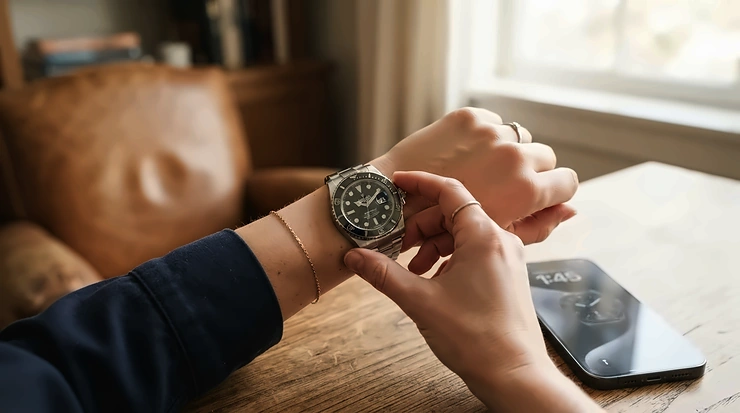
A Seiko 5 Sports GMT SSK001 and a Bulova Oceanographer GMT 96B405 both show a second time zone for under $1,000, yet they ask for opposite habits: on the Seiko you pull the crown and scroll a red 24-hour hand, while on the Bulova you jump the local hour hand forward the moment you land. That split is the most useful thing to understand before shopping for gmt watches in 2027, because it decides whether a model suits a desk job with a colleague in Singapore or a month of airports.
The five watches below each fit a different travel habit, with price bands, case sizes, movements and owner reports side by side. Maker spec pages, Timex’s own Q&A, a Citizen instruction sheet and hands-on pieces from Worn & Wound, GearJunkie, HiConsumption and Time+Tide supply the details; no watch was worn for this guide, so every remark about feel belongs to a named reviewer, and the price bands may differ from what Amazon.com shows today.
Caller or flyer: the choice that shapes every shortlist
A GMT watch adds a fourth hand that turns half as fast as the regular hour hand and reads against a 24-hour scale, so the second zone never gets mixed up between day and night, as Gear Patrol’s explainer lays out. The idea dates to 1954, when Pan Am asked Rolex for a watch for long-haul pilots. It has since split into two designs.
On a caller (or office) GMT, the 24-hour hand is the one you set on its own. The second zone changes from the crown while local time stays put, a layout named for people at home placing calls abroad. The trade-off, per Time+Tide: change the main time and the GMT hand moves with it, and the date only advances in one direction.
On a flyer (also called true or traveler) GMT, the independent hand is the local hour hand. It jumps in one-hour steps as you land, and the date follows in both directions. Flyers once cost far more, though Time+Tide notes that cheaper ones now exist and that either style can serve either lifestyle once you get used to it.
Before any ranking of the best gmt watches, four details separate the picks. The GMT type comes first. Crystal material follows, since the Seiko 5 Sports GMT SSK001 uses Hardlex while the others here use sapphire. Then comes the movement: roughly 41 hours of reserve on the Seiko-based automatics, 80 hours on a Powermatic, and no winding at all on a solar quartz. Last is geometry, because lug-to-lug length decides whether a 41 mm case sits flat on your wrist.
Gmt watches under 1000: what each price band buys
The cheapest mechanical entry here sits around $450 to $500, titanium and sapphire push a caller to roughly $630 to $730, and a quartz flyer lands in between. HiConsumption’s tested list of sub-$1,000 models shows how deep the flyer pool runs at the microbrand level too: the Lorier Hyperion and the Traska Venturer GMT, both on Miyota’s 9075, sit roughly between $600 and $735 there.
Model
GMT type
Movement
Case width / lug-to-lug
Crystal
Water resistance
Price band
Seiko 5 Sports GMT SSK001
Caller
Seiko 4R34 automatic
42.5 mm / about 46 mm
Hardlex
100 m
Around $450 to $500
Timex Expedition Pioneer Titanium Automatic GMT
Caller
Seiko NH34 automatic
41 mm / 48 mm
Sapphire
200 m
Around $630 to $730
Citizen Promaster Land GMT BJ7150-50W
Flyer
Citizen B878 Eco-Drive (solar quartz)
39.5 mm / not listed
Sapphire
200 m
Around $450 to $600
Bulova Oceanographer GMT 96B405
Flyer
Miyota 9075 automatic
41 mm / 45.2 mm
Sapphire
200 m
Around $800 to $1,000
Certina DS Action GMT Powermatic 80
Flyer
Powermatic 80.661 automatic
41 mm / 49.5 mm
Sapphire
200 m
Just above $1,000
Two patterns show up. The solar Citizen Promaster Land GMT BJ7150-50W is the only flyer priced near the Seiko 5 Sports GMT SSK001, and it gets there by giving up winding and a rotating bezel. Among the gmt watches under 1000, only the Seiko gives up sapphire, which helps explain its lower price.
Spotted a model that matches your route? Take a closer look at its listing below.
Best gmt watches for the trips you actually take
Each pick starts from a travel habit and works back to the watch.
Around $450 to $500 is the range across Dappered, Worn & Wound and Designer Optics, which makes this the cheapest way into a mechanical GMT here. Inside is the 4R34, which Caliber Corner lists with hacking, hand winding and about 41 hours of reserve, rated by Seiko at plus 45 to minus 35 seconds a day. It is a caller: a Two Broke Watch Snobs review confirms there is no jumping hour, only the 24-hour hand moves from the crown.
Size is where sources disagree. The case is 42.5 mm wide with a lug-to-lug of about 46 mm, but thickness is 13.6 mm in WatchClicker and Dappered and 14.5 mm in Worn & Wound. That Worn & Wound owner, on a 6.25-inch wrist, found it wore large and gave way to other watches after a couple of days, while seeing it as better under a jacket cuff.
Pros:
Hand winding and hacking seconds on a sub-$500 automatic
A 24-hour bezel on top of the 24-hour hand, so a third zone is possible
Same case and movement in the Seiko 5 Sports GMT SSK003 and Seiko 5 Sports GMT SSK005 colorways, per Exquisite Timepieces
Cons:
Hardlex crystal instead of sapphire
WatchClicker’s reviewer received a sample with a misaligned GMT hand, calling it a sign of Seiko’s ongoing quality-control issues (one reviewer, one sample), though the friction-fit bezel at least spins back into place
Date only, with a cyclops that some reviewers dislike
For smaller wrists, a retailer listing for the Field-series Seiko 5 Sports SSK023 gives 39.4 mm with the same 4R34. Caliber Corner relays Seiko’s guidance that 4R34 watches should be cleaned at a service center every two to three years, a cost worth budgeting.
Seiko 5 Sports GMT SSK001See current price, sizes and reviews on Amazon.
Weight is the argument here. Timex lists 119.34 grams for the 41 mm grade 2 titanium case, which works out to roughly 25 to 29 grams lighter than the 144 to 148 grams reported for the Seiko 5 Sports GMT SSK001 on its bracelet (my arithmetic). Other specs on Timex’s page: 13.5 mm thick, 48 mm lug-to-lug, a sapphire crystal, 200 meters with a screw-down crown, and a Seiko NH34 caller movement with a 24-hour bi-directional bezel.
Pricing depends on the strap. Timex’s pages put the fabric and silicone versions near the low end and this titanium bracelet reference (TW2Y63500) near the top, so plan on roughly $630 to $730.
Buyer feedback on Timex’s own page averages 4.76 out of 5 from 17 reviews, and the written notes are useful: reviewers mention the bracelet has no micro-adjustment or half links and that the bezel can feel loose. For longer-term evidence, GearJunkie tested the sibling Timex Expedition North GMT Titanium, which HiConsumption’s review identifies as an NH34 caller, and logged 26 seconds lost per day, plus a strap end that slipped from its keeper. The same reviewer noted that some buyers dislike the caller style. That is one tester on a related model, so treat it as a pointer rather than a verdict on the Pioneer.
The page also says there is no quartz version and that the watch is not ISO shock-rated.
Timex Expedition Pioneer Titanium Automatic GMTSee current price, sizes and reviews on Amazon.
A solar quartz removes winding and battery swaps from the equation, which is the case for the Citizen Promaster Land GMT BJ7150-50W. Its B878 Eco-Drive is powered by any light, the case is 39.5 mm with a domed anti-reflective sapphire crystal and 200 m of water resistance, and Citizen backs it with a five-year limited warranty. Citizen’s own pages put it at around $450 to $600 depending on the promotion running that week.
The setting method makes it a flyer. Citizen’s abbreviated instruction sheet for the B876/B877/B878 family says to pull the crown to position 1 and turn clockwise to move the hour hand in one-hour steps, independently of the 24-hour hand, while watching the date change to confirm AM or PM.
Owner reports show a learning curve. A verified reviewer on a reviews platform for a sibling reference praised the true GMT behavior and the lack of battery changes, while saying the usual routine keeps the 24-hour hand on home and the main hands on local time, and that reversing it is trickier. One buyer on Citizen’s US listing wrote that two attempts at setting it still left the time wrong, which fits a setting routine that rewards reading the sheet once.
Citizen’s page describes a fixed 24-hour bezel, so unlike the rotating-bezel watches here it cannot give you a third zone.
Citizen Promaster Land GMT BJ7150-50WSee current price, sizes and reviews on Amazon.
A flyer under $1,000 with a bracelet and a sapphire box crystal is the pitch of this Bulova. Bulova’s page gives 41 mm, 20 mm lugs, a blue-and-red bidirectional 24-hour bezel, 200 m with a screw-down crown and caseback, and a Miyota 9075 with a 42-hour reserve. Hodinkee adds that the 9075 hacks, hand-winds, beats at 28,800 vibrations an hour, and corrects the date forward and back after midnight when you jump the hour. All three Oceanographer GMT versions share 14.6 mm thickness and a 45.2 mm lug-to-lug.
The price on Bulova’s page was around $800 after a sizable markdown, and HiConsumption says the family often sells for under $1,000. Bulova’s reviews average 4.8 from 8, with a verified buyer valuing the true GMT function and calling the time accurate.
Pros:
Flyer-style hour jump on a rotating 24-hour bezel
Sapphire box crystal and a five-link bracelet at this price
A Pepsi-style bezel that makes third-zone reading easy
Cons:
14.6 mm thick for a 41 mm case, per HiConsumption
Heavy bezel action and a date cyclops that HiConsumption calls divisive
One caution from StrapHabit about the lume-dial diver version, the Bulova Oceanographer GMT 98B407: the 24-hour scale sits on the dial and the GMT hand resembles the seconds hand, so the second zone takes more effort to read. The 24-hour bezel on the 96B405 should ease that. Either way, the 42-hour reserve means a watch left off the wrist for two days will have stopped.
Bulova Oceanographer GMT 96B405See current price, sizes and reviews on Amazon.
This is the stretch pick, landing just above $1,000 in HiConsumption’s price listing, so it sits outside the gmt watches under 1000 group. What the extra money buys is a Swiss Powermatic 80.661 with an 80-hour reserve, a Nivachron balance spring and a true GMT setup. WatchGecko lists 41 mm by 14 mm with a 49.5 mm lug-to-lug, a flat sapphire crystal and a bi-directional bezel, and HiConsumption gives 200 m.
Wearers who rotate watches benefit most from that reserve, since the watch can sit through a weekend and keep running. Fratello’s hands-on frames it as a rare big-brand affordable flyer.
HiConsumption’s cons are specific: some users report bezel alignment issues, and the clasp has no tool-less micro-adjust. Time+Tide adds that the movement is not COSC-certified, a detail worth knowing before comparing it with pricier Swiss flyers.
Certina DS Action GMT Powermatic 80See current price, sizes and reviews on Amazon.
Gmt watches for men and every wrist: size, weight and strap checks
Case widths in this guide run from 39.5 mm (Citizen Promaster Land GMT BJ7150-50W) to 42.5 mm (Seiko 5 Sports GMT SSK001), but lug-to-lug length tells more about fit. The Timex Expedition Pioneer Titanium Automatic GMT and the Certina DS Action GMT Powermatic 80 measure 48 mm and 49.5 mm, while the Bulova Oceanographer GMT 96B405 is 45.2 mm and the Seiko is about 46 mm. On a wrist near 6.25 inches, Worn & Wound’s owner found the Seiko big, so the Field-series 39.4 mm variants and the Citizen are the more compact paths.
Strap adjustment matters too. Timex’s reviewers report no micro-adjust or half links on its bracelet, HiConsumption flags the Certina clasp for lacking tool-less micro-adjust, and it lists that feature as a plus on microbrand flyers such as the Traska Venturer GMT. A watch that cannot be sized finely may sit loose or tight whatever its case dimensions say.
Gmt watches how to use: setting each type without confusion
Crown positions are numbered differently across sources, so follow your manual if it disagrees with the steps below.
For a caller such as the Seiko 5 Sports GMT SSK001 or the Timex Expedition Pioneer Titanium Automatic GMT:
Wind the watch by crown or by wearing it; both the 4R34 and NH34 hand-wind.
Pull the crown to the second click and set local time on the hour and minute hands, since the GMT hand follows the main hands in this position, per Worn & Wound and Time+Tide.
Pull to the first click and turn clockwise to move the GMT hand in one-hour steps to your home or second zone; counterclockwise changes the date, per Caliber Corner.
Read local time from the regular hands and the second zone from the GMT hand on the 24-hour scale.
For a flyer such as the Citizen Promaster Land GMT BJ7150-50W or the Bulova Oceanographer GMT 96B405, leave the 24-hour hand on home time and, after you land, pull the crown and jump the local hour hand forward, checking AM or PM against the date. Citizen’s sheet adds that you should not change the date while the watch shows roughly 9 PM to 1 AM.
For a third zone, turn a rotating bezel to line up the zone you want against the GMT hand, as Gear Patrol describes. One slip to avoid, reported by The Watch Connect: confusing the GMT hand with the ordinary hour hand.
Gmt watches vs Titan: a brand and a metal
Searches combining the two terms can mean Titan the watchmaker or titanium the metal, and both turn up here.
The Titan Automatic Dualis GMT (reference 10076) is a flyer-style automatic. Its product pages describe an in-house Vetra Calibre 7A37 with a 40-hour reserve, a red 24-hour hand over an internal rotating 24-hour ring set from a crown at 2 o’clock, sapphire with three-layer anti-reflective coating, and local-time changes without pausing the movement. They show about $660 to $730 across references and a 24-month warranty on the movement. Those figures come from what the search listings displayed. A pre-booking note on the pages also means availability and shipping to the US need checking before you plan around it.
Compared with the watches above, the Titan moves the second-zone adjustment to an internal ring, unlike the outer rotating bezels on four of the five picks. On the titanium side, the Timex Expedition Pioneer Titanium Automatic GMT is the lightweight option, with the weight savings shown earlier.
What gmt watches reviews say about accuracy, service and straps
Rated accuracy and owner results differ. Seiko’s 4R34 rating is plus 45 to minus 35 seconds a day, Designer Optics’ product page summarizes owner reports at plus 4 to plus 20, and GearJunkie’s test of a related Timex lost 26 seconds a day. The reviewer said quartz suits anyone who prioritizes accuracy, which is where the solar Citizen Promaster Land GMT BJ7150-50W fits.
Service costs vary by movement type. Caliber Corner relays a two-to-three-year service interval from Seiko for 4R34 watches, Timex’s Q&A says the NH34 holds about 41 hours and may stop if left idle for around a day, and Citizen’s page says the Eco-Drive removes battery replacement.
Straps are the recurring small expense. The loose bezel and missing micro-adjust on the Timex, the keeper that slipped on its sibling, and the Certina’s clasp each show up in sourced reports, so a spare strap or a trip to a watchmaker belongs in the total cost.
Straight answers on 24-hour hands, third zones and accuracy
What does a GMT watch do that a plain dual-time watch does not?
A GMT watch adds a hand that circles the dial once every 24 hours, so the second zone shows day versus night. Many dual-time watches use a 12-hour sub-dial with no AM or PM cue, which makes the other zone easier to misread.
Is a caller or a flyer GMT better for frequent flying?
A flyer lets you jump the local hour hand at landing without touching the home reference, which Gear Patrol calls easier on the move. Time+Tide adds that either style works once you learn it, so a caller suits tracking one fixed second zone.
Can a GMT watch track three time zones?
Yes, when the watch has a rotating 24-hour bezel. Set the GMT hand to the second zone, then turn the bezel to match a third, as Gear Patrol describes. A fixed bezel limits you to two zones, so check the bezel before buying.
How accurate are budget automatic GMT watches?
Seiko rates the 4R34 at plus 45 to minus 35 seconds a day. GearJunkie's test of a Timex using a related movement lost 26 seconds daily, and the reviewer pointed to quartz for tighter timekeeping. Treat those as ranges, not promises.
Is Titan a brand or a metal when people compare GMT watches?
Both exist. Titan is an Indian watchmaker that sells an automatic GMT with an in-house movement, while titanium is a case metal that cuts weight. Check which one a listing means before comparing prices.
The decision rule: how often you change time zones
If you mostly stay put and glance at one other zone, a caller is enough, and the Seiko 5 Sports GMT SSK001 is the lower-cost way to start while the Timex Expedition Pioneer Titanium Automatic GMT adds sapphire and a light case. If you fly regularly, a flyer saves the resetting: the Bulova Oceanographer GMT 96B405 if you like a rotating bezel, the Citizen Promaster Land GMT BJ7150-50W if you want solar quartz, or the Certina DS Action GMT Powermatic 80 if you can stretch past $1,000. For a first purchase, the Seiko is the pick for its price and the Bulova for anyone who lands in a new zone every month. Whichever of these gmt watches you choose, lug-to-lug length and strap fit decide daily comfort as much as the movement does.
Found a GMT that fits your route? Take a closer look at its listing, and confirm the exact reference there.
WatchWiseHub is an independent buying-guide site for watches, smartwatches, straps and accessories. Our editorial team compares gear using manufacturer specifications, independent tests from specialist watch media, owner reports and retailer listings. We do not claim to have tested the watches ourselves; see How We Choose Gear for our method.