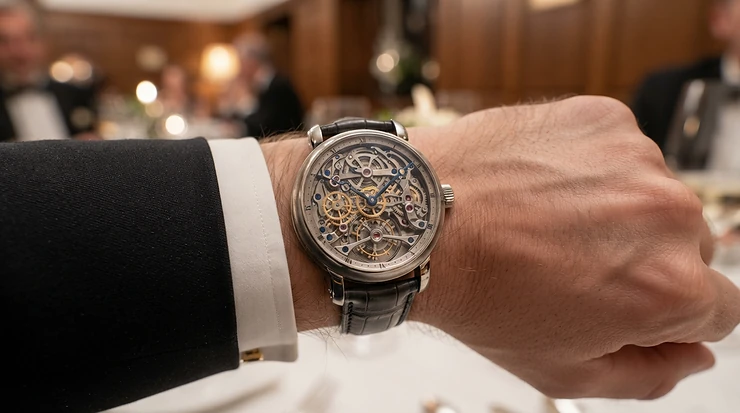
The Orient Bambino Open Heart shows one moving part, the balance wheel, through a single window at 9 o’clock. The Bulova Classic Sutton 96A187 opens nearly the whole dial. That gap is the first decision to settle with skeleton watches, because it drives legibility, price and how often you end up checking the time twice.
For 2027, this guide turns that decision into five quick checks, then matches four real models to them, from a leather-strapped open heart to a ladies’ semi-skeleton with a 30.5 mm case. The findings rest on maker spec pages from Orient, Orient Star and Bulova, review text on those brands’ own US stores and a few specialist write-ups; no watch was worn for this article, so every comment about comfort or readability belongs to a named source.
Prices below are ranges taken from brand and dealer pages, so check the current price on Amazon.com before you decide.
Five checks that sort skeleton watches before price matters
Run a candidate through these in order. Most rejections happen at the second or third.
Decide how much of the movement you want to see
Open-heart, semi-skeleton and full-skeleton designs are three different watches. An open heart cuts one window, usually over the balance wheel, and leaves the rest of the dial intact. A semi-skeleton such as the Orient Star RE-AV0004N00B adds recessed sub-dials for power reserve and seconds around its window. A full skeleton such as the Bulova Classic Sutton 96A187 removes most of the dial, so the mainspring barrel and gear train sit in plain view.
The more you open, the more the hands compete with hardware. That leads straight to the next check.
Test whether you can read the time in a second
Gear Patrol’s case for legible watches argues that contrast between hands and background belongs near the top of any buying list, and it calls skeletonized dials “notoriously difficult” to read because hands get lost against the movement.
Look for three things: hands wider than the gear train behind them, indices or numerals bold enough to anchor the eye, and lume for evenings. Two Broke Watch Snobs credits the Sutton’s very bold Roman numerals with answering the legibility complaint, and a buyer on Bulova’s own store says the blue numerals make the time easy to read. A more delicate design fares worse: The Gadgeteer’s reviewer found that a Tissot with skeletonized hands loses some legibility in low light.
Count the power reserve against your week
Reserve is how long the watch keeps running once fully wound and taken off. The four models below list about 40, 42, 50 and 40 hours. Take each off at 6 p.m. on Friday and the 40-hour Orient Bambino Open Heart stops around 10 a.m. Sunday, the 42-hour Bulova Classic Sutton 96A187 around noon Sunday, and the 50-hour Orient Star RE-AV0004N00B around 8 p.m. Sunday (my arithmetic).
A stopped automatic is not damaged; it just needs winding. Orient lists hand winding for both its F6T22 and F6F44 movements, and IWC’s care guide adds one habit worth copying: do not wind a watch while it is on your wrist, because that strains the crown stem.
Skeleton watches with leather strap: match lugs, size and care
Lug width is the number that trips up strap swaps. The Orient Bambino Open Heart takes 21 mm straps, Serious Watches lists 21 mm lugs for the Orient Star RE-AV0004N00B, the Bulova Classic Sutton 96A187 takes 22 mm, and the ladies’ Orient Star RE-ND0010G takes 14 mm. A 21 mm strap is a specialty size, so find one before you plan a swap.
Leather also changes the character of a busy dial; it generally calms it down compared with a steel bracelet. IWC’s care guide says to keep leather straps dry, avoid soap, and use a springbar tool rather than a knife when changing straps, working from the back of the watch, since careless swaps are a common cause of lug scratches.
Case size deserves the same scrutiny. The men’s models here run from 40.5 to 43 mm across, but Orient lists 49 mm from lug to lug on the Orient Star RE-AV0004N00B, and that figure is the one to hold against your wrist.
Read the water rating as a splash rating first
Ratings here are 30 m on the Orient Bambino Open Heart, 50 m on the ladies’ Orient Star RE-ND0010G and 100 m on the other two. Mr Porter’s care guide treats 30 m as splash-proof and 50 m as fine for a pool, though not for the shower, where hot water and soap can attack seals.
Gaskets also age. IWC’s guide notes that seals can dry out even on a highly rated watch and suggests a yearly water-resistance check if you swim or shower in it.
Skeleton watches under 1000: where four real models land
Each model below passes a different check best. The table puts the numbers side by side.
Model
How much you see
Power reserve
Water rating
Strap and lugs
Price band
Orient Bambino Open Heart (RA-AG0005L30B)
One window at 9 o’clock
About 40 hours
30 m
Blue leather, 21 mm
Roughly $290 to $320
Bulova Classic Sutton 96A187
Full skeleton
42 hours
100 m
Steel bracelet, 22 mm
Around $495 to $525
Orient Star RE-AV0004N00B
Semi-skeleton plus power-reserve dial
50 hours
100 m
Steel bracelet, 21 mm lugs
Around $650
Orient Star RE-ND0010G
Partial window
40 hours
50 m
Brown leather, 14 mm
Roughly $500 to $550
Price tracks three things: crystal, reserve and how much dial is cut away. The three skeleton watches for men here span 40.5 to 43 mm, and the step from the cheapest to the Bulova Classic Sutton 96A187 costs roughly $200 more for a much more open dial. Moving up to the Orient Star RE-AV0004N00B adds another $125 to $155 or so and buys sapphire glass with anti-reflective coating plus eight more hours of reserve than the Sutton (my arithmetic). The Bulova and the Bambino use mineral crystal.
Above $1,000 the Swiss options begin. The Gadgeteer’s roundup lists the Certina DS-1 Skeleton in a band that straddles $1,000 and the Hamilton Jazzmaster Skeleton (H42535780) near $1,500, both with 80 hours of reserve and a Nivachron hairspring. Under the line, expect 40 to 50 hours and Japanese or Miyota movements instead.
Skeleton watches reviews: what buyers and testers keep reporting
Brand-hosted reviews are self-selected, so treat the ratings as a floor on enthusiasm, not a measurement. Bulova’s store shows 4.9 out of 5 across 82 reviews for the Bulova Classic Sutton 96A187, and Orient’s US store shows 4.81 out of 5 across 36 reviews for the Orient Bambino Open Heart in blue leather.
What they actually say is more useful. Individual Sutton buyers on Bulova’s store report easy reading, a good fit on a larger wrist and very accurate timekeeping, with one owner reporting variation of under half a second. On Orient’s store one buyer calls the Bambino’s fit comfortable and another says accuracy sits within specification, while a third notes the blue strap looks almost black.
Accuracy is the least comparable claim. Orient publishes static accuracy windows, +25 to -15 seconds a day for the F6F44 and +40 to -30 for the 55C22, while buyers post single-owner results that cannot be checked against those figures.
The Gadgeteer’s six-watch roundup, based on its author’s three-month rotation, adds two durability notes. It warns that the mineral crystal on the gold-tone Sutton it reviewed may scratch, and it says the Orient Star’s sapphire crystal with anti-reflective coating is something Bulova and Seiko skip at this tier. One owner on Bulova’s Canadian page, writing about a brown-leather Sutton, wished the reserve ran longer but said the strap kept its shape and color after years of on-and-off wear.
Why skeleton dials get sent back, and how to avoid it
Three patterns explain most disappointment, and each has a fix.
Buying from a hero photo comes first. Photos show a watch lit evenly, with hands in sharp contrast; your office at 4 p.m. is less kind. Check the hands and indices against the Gear Patrol criteria above, and confirm the seller’s return window before you wear it outdoors.
The second is treating a skeleton dial as a swim watch. A 30 m rating means splashes, and gaskets age, which is why IWC’s watch-care tips recommend a yearly check for anyone who swims or showers in a watch.
The third is expecting a week of running from a drawer. With 40 to 50 hours of reserve, a watch left alone over a weekend will be stopped by Monday. Wind it with the crown and set it before you leave the house.
The best skeleton watches for each check: four models
Lists of the best skeleton watches tend to shuffle open hearts, semi-skeletons and full skeletons into one ranking. These four are tied instead to the check each passes most cleanly. Spotted one you like in the table? Take a closer look at its listing below.
A first mechanical watch that you want to read at a glance is the job this one does best. The blue-leather reference RA-AG0005L30B cuts a single aperture at 9 o’clock for the balance wheel and drops the date; WristWatchReview’s launch coverage notes the date display gave way to the open-heart portion.
Orient lists a 40.5 mm stainless case with 21 mm lugs, a domed mineral crystal and the F6T22 automatic, which hacks and can be hand-wound, with about 40 hours of reserve. Orient’s US store adds a three-year warranty and shows roughly $290 to $320 across colorways. That 21 mm lug width is uncommon, so a strap swap means shopping for that exact size.
The limit is water: 30 m is a splash rating, and IWC’s guidance on aging gaskets applies in full. Its 40 hours of reserve also sits at the short end of this group.
Orient Bambino Open HeartSee current price, sizes and reviews on Amazon.
Around $495 to $525 buys the most open dial in this group. Bulova lists a 43 mm steel case, the 8N24 automatic with 42 hours of reserve, a 100 m rating, a mineral crystal and an exhibition caseback, on a steel bracelet with a push-button deployant clasp. Blue Roman numerals do the work of anchoring the eye over the skeleton movement.
Real-use reports lean positive: individual Bulova buyers praise the readability and fit, and The Gadgeteer’s reviewer flags the mineral crystal on a sibling Sutton as a scratch risk.
Pros:
Full skeleton with bold numerals that keep the time readable
100 m rating, the most generous at this price
Cons:
42-hour reserve is on the short side for a weekend off the wrist
Mineral crystal may scratch
This reference ships on a bracelet, so the leather route means a sibling. The Bulova Sutton 97A161 pairs the same 8N24 movement, 42-hour reserve and 100 m rating with a blue alligator-textured leather strap, and Bulova’s store showed it a little above $500. References differ in case color, strap and even water rating; Bulova lists the Bulova Sutton 97A187 at just 30 m, so match the reference to the rating you need.
Bulova Classic Sutton 96A187See current price, sizes and reviews on Amazon.
If a longer reserve and a harder crystal matter more than the lowest price, this is where the budget stretches, at around $650. The F6F44 movement carries 24 jewels, hacks, can be hand-wound and powers a 12 o’clock reserve indicator, a small seconds dial at 6 and an open-heart window at 9. Orient quotes 50 hours, a static accuracy of +25 to -15 seconds a day and a 100 m rating.
The case measures 41 mm across, about 12 mm thick, with 49 mm lug to lug and a screw-down caseback. The Gadgeteer’s reviewer calls the bracelet better finished than its price suggests and notes no drawbacks. Its 21 mm lugs also mean a leather swap is possible, at the cost of the bracelet.
Pros:
Sapphire crystal with anti-reflective coating
50 hours of reserve with an indicator on the dial
Cons:
Around $650 is about double the cheapest model here
A 49 mm lug-to-lug span needs checking against your wrist
Orient Star RE-AV0004N00BSee current price, sizes and reviews on Amazon.
For skeleton watches for women, the case is the first filter, and this Orient Star measures 30.5 mm across and 36.6 mm lug to lug at 11 mm thick. Orient Star’s global store prices it between roughly $500 and $550 and describes a window offering a partial view of the 55C22 movement, 20 jewels, 40 hours of reserve and 50 m of water resistance.
The strap is brown leather, 14 mm wide, with a three-fold pusher clasp. Orient’s own text pitches it as an ideal first mechanical watch. Gnomon’s roundup also covers a 36 mm Hamilton Jazzmaster Open Heart Lady (H32215141) at close to the $1,000 ceiling, with 80 hours of reserve, as the larger step up.
Static accuracy is listed at +40 to -30 seconds a day, wider than the F6F44’s window. Availability of this exact reference varies between Orient’s global store and US sellers.
Orient Star RE-ND0010GSee current price, sizes and reviews on Amazon.
Most are automatic, so wrist motion keeps them running. Orient's F6T22 and F6F44 movements also accept hand winding through the crown, which helps after a weekend in a drawer, since reserves here run only about 40 to 50 hours.
Are skeleton watches harder to read than regular watches?
They can be. Gear Patrol warns that hands can vanish against an exposed movement, and The Gadgeteer's reviewer saw skeletonized hands cost some low-light legibility. Bold numerals, luminous hands and a chapter ring all help.
How often should a skeleton watch be serviced?
IWC's watch-care guide gives no fixed interval; its author services a watch when symptoms appear: running fast or slow, stopping, or not holding its wind. An authorized dealer can say whether a full overhaul is needed, and warranty terms may set their own schedule.
Can you wear a skeleton watch in the pool or shower?
Only if the rating allows it. A 30 m rating means splashes only, while 50 m and 100 m give more room, yet IWC's guide suggests a yearly water-resistance check if you swim or shower, because gaskets can dry out.
Are there skeleton watches for women with small cases?
Yes. Orient Star's ladies semi-skeleton line uses 30.5 mm cases with a 40-hour reserve, and Gnomon's roundup lists a 36 mm Hamilton open-heart model with 80 hours. Both show the movement through a partial window rather than a full skeleton dial.
Which skeleton dial to start with
Start with how much of the movement you want to see, then let legibility and reserve decide the rest. For a first pair of skeleton watches, the better choice is the Orient Bambino Open Heart: one window, a clean dial, leather and a price near $300. If you want the full skeleton look, the Bulova Classic Sutton 96A187 delivers it with a 100 m rating, and the Orient Star RE-AV0004N00B is the one to stretch to for sapphire and 50 hours. For a small wrist, the Orient Star RE-ND0010G keeps the case at 30.5 mm.
Whichever you choose, hold its hands against the movement and its lug width against your strap plans before you commit. If one of these dials already reads clearly to you, its listing is the next stop.
WatchWiseHub is an independent buying-guide site for watches, smartwatches, straps and accessories. Our editorial team compares gear using manufacturer specifications, independent tests from specialist watch media, owner reports and retailer listings. We do not claim to have tested the watches ourselves; see How We Choose Gear for our method.