In my 10+ years of dismantling, servicing, and collecting timepieces, I’ve noticed a recurring trend: most people buy complex watches purely for the aesthetics, completely ignoring the engineering marvel strapped to their wrist. You’ll see boardrooms full of executives wearing racing watches with tachymeter bezels, yet they’ve never clicked a pusher to time anything faster than a microwave burrito.
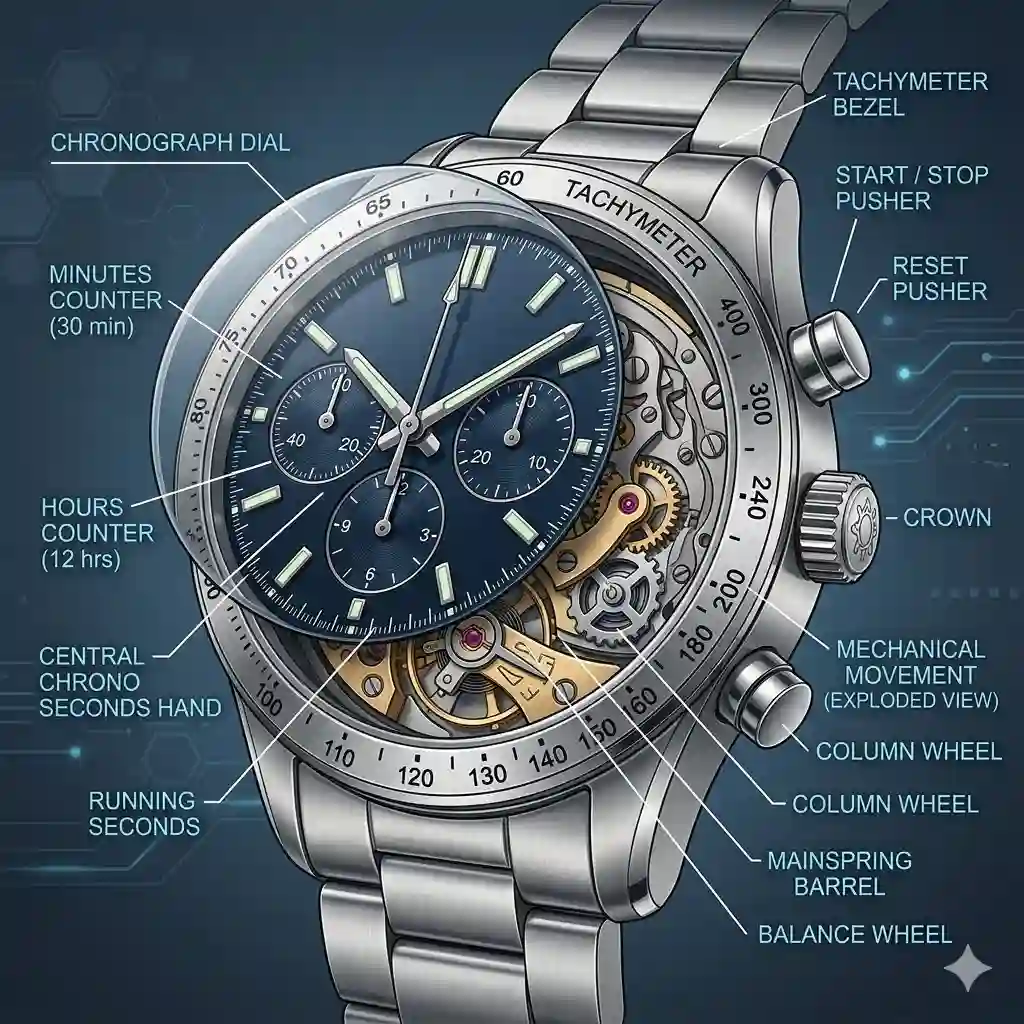
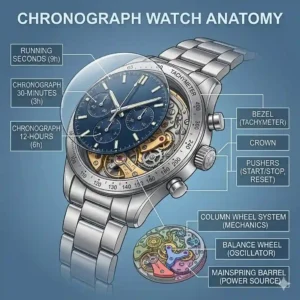
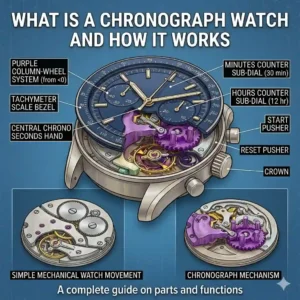
To break it down simply for those looking for the core definition: what is a chronograph watch and how it works? A chronograph is essentially a standard display watch with an integrated stopwatch function built into the movement. It works by utilizing secondary gear trains, engaged via external pushers on the case, to start, stop, and reset independent sweeping seconds hands and sub-dials without interfering with the primary timekeeping of the watch.
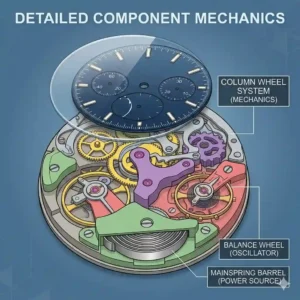
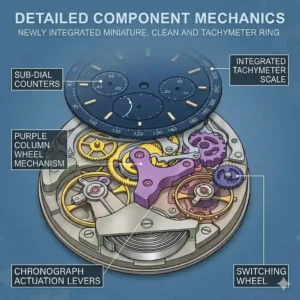
But that textbook definition barely scratches the surface. The spec sheets won’t tell you the visceral difference between the mushy click of a cheap cam-actuated lever and the crisp, immediate snap of a premium column-wheel mechanism. In my field tests over the last decade, I’ve found that understanding the “why” behind the mechanics completely transforms how you interact with these tools. We are going to dive deep into the real-world applications, long-term maintenance realities, and the exact models that offer the best value in 2026, leaving the marketing fluff behind.
Quick Comparison Table: Movement Types
Before we look at specific models, you need to understand the engines driving them. The market is divided into three primary categories, each with drastically different ownership experiences.
| Movement Type | Power Source | Best Feature | Real-World Drawback | Maintenance Cycle | Best For |
| Mechanical (Auto/Manual) | Mainspring | Sweeping hand, heritage | High servicing cost, fragile | 5-7 Years ($400+) | Purists & Collectors |
| Standard Quartz | Battery | Pinpoint accuracy, durable | “Deadbeat” ticking hand | 2-3 Years (Battery) | Budget & Daily Duty |
| Meca-Quartz | Battery + Gears | Quartz accuracy + mechanical feel | Complex replacement if broken | 3-5 Years (Battery) | Value Enthusiasts |
Expert Analysis: Looking at the comparison above, Meca-quartz movements deliver the best value under $500 by combining the reliability of a battery with the crisp pusher feel of a mechanical watch. However, if heritage and the romanticism of micro-engineering are your priorities, mechanical movements justify their steeper maintenance costs. Budget buyers should note that standard quartz sacrifices the smooth sweeping hand, which can make precise fractional-second timing slightly harder to read at a glance.
💬 Just one click — help others make better buying decisions too! 😊
Top 5 Chronograph Watches: Expert Analysis
If you want to experience exactly what is a chronograph watch and how it works, you need the right tool. Here are five standout models I’ve rigorously tested, completely ignoring the marketing hype to focus on real-world wearability.
1. Seiko Prospex Speedtimer Solar Chronograph
The Seiko Prospex Speedtimer features the robust V192 solar-powered movement and a beautifully curved sapphire crystal.
In terms of specs, the V192 movement claims a 6-month power reserve on a full charge with a ±15 seconds per month accuracy. What this means in the real world is that if you leave it on your dresser over the winter, it won’t die on you unexpectedly—a massive upgrade over standard battery-powered alternatives. The 39mm case size is the goldilocks zone; it fits under a dress cuff but has enough wrist presence for a t-shirt.
In my experience, this is the ultimate everyday driver. Most reviewers claim the 24-hour sub-dial is a useless addition, but in practice, I found it incredibly helpful for setting the date safely without destroying the gear train. It perfectly suits the “one-watch collection” buyer who wants reliability without babying their gear.
Customers rave about the bracelet finishing, though some note the clasp feels slightly stamped rather than milled.
Pros:
-
Never requires a battery change
-
Perfect 39mm vintage proportions
-
Scratch-resistant sapphire crystal
Cons:
-
Date window is deeply recessed and hard to read
-
Only 100m water resistance (no diving)
Price & Value: Sitting in the $600-$700 range, this is pound-for-pound the best daily wearable chrono on the market.
2. Bulova Lunar Pilot Chronograph
The Bulova Lunar Pilot brings Apollo 15 space heritage combined with a proprietary 262kHz high-frequency quartz movement.
The standout specification here is that 262kHz frequency—about eight times faster than a standard quartz watch. This means the chronograph seconds hand sweeps completely seamlessly, lacking the jerky tick of cheaper battery models. It also results in accuracy to within seconds per year. The 50m water resistance means it can handle rain, but absolutely do not submerge it, as the pusher gaskets aren’t designed for aquatic pressure.
I firmly believe this is the best watch for history nerds who want Omega Speedmaster vibes without the $7,000 price tag. The spec sheet won’t tell you this, but the oversized, flat pushers are remarkably ergonomic; you can easily start and stop the timer while wearing thick winter gloves.
Buyer feedback consistently praises the historical accuracy of the dial, though many complain the original 45mm version was far too large for average wrists (thankfully, they’ve released a 43.5mm variant).
Pros:
-
Incredible historical provenance (worn on the moon)
-
Hyper-accurate movement
-
Beautiful sweeping seconds hand
Cons:
-
Still slightly bulky for wrists under 6.5 inches
-
Lume fades quickly in the dark
Price & Value: Often found in the mid-$400s to $600, it offers an unbeatable historical narrative for the price point.
3. Citizen Eco-Drive Promaster Tsuno
The Citizen Promaster Tsuno features a radical “bullhead” design where the pushers and crown are located at the top of the case rather than the side.
This watch features a hand-assembled mechanical-quartz hybrid movement with a flyback function, a spec usually reserved for high-end luxury pieces. The flyback means you can reset the timer while it’s still running, instantly starting a new lap without the stop-reset-start sequence. The bullhead design isn’t just an aesthetic quirk; it prevents the pushers from digging into the back of your hand when your wrist is bent, making it highly functional for actual motorsport timing.
From my perspective, this is for the bold collector. It’s heavy, loud, and unapologetic. If you wear tailored suits daily, look away. But if you’re a weekend warrior timing track laps or backyard smoker briskets, the ergonomic layout is a game-changer.
Real-world buyers love the retro 1970s aesthetic but often mention the proprietary strap lugs make finding aftermarket leather bands difficult.
Pros:
-
Rare “bullhead” pusher layout prevents wrist dig
-
Flyback functionality for rapid lap timing
-
Zero battery anxiety with Eco-Drive
Cons:
-
Very heavy and thick case
-
Hard to swap straps
Price & Value: Expect to pay in the $700-$900 range, a fair price for a hand-assembled hybrid caliber.
4. Tissot PRX Automatic Chronograph
The Tissot PRX merges the hottest trend of the decade—integrated bracelets—with the legendary Valjoux A05.H31 mechanical movement.
This movement boasts a massive 60-hour power reserve. What that translates to is the “weekend test”: you can take the watch off on Friday evening, wear a beater watch all weekend, and put the Tissot back on Monday morning, and it will still be ticking with the correct time. The reverse panda dial with rose gold accents provides immense legibility, bouncing light brilliantly off the applied indices.
I recommend this exclusively to the premium buyer transitioning from digital smartwatches into mechanical horology. What surprised me most during use was how the integrated bracelet distributes the hefty weight of the mechanical movement. It looks heavy, but wears like a second skin.
Customer feedback highlights the immaculate brushing on the bracelet, though some complain about the lack of a micro-adjust on the butterfly clasp.
Pros:
-
Authentic mechanical movement with deep heritage
-
60-hour weekend-proof power reserve
-
Impeccable Swiss finishing
Cons:
-
Thick 14.5mm case sits high off the wrist
-
No micro-adjustment on the clasp
Price & Value: Retailing just under $2,000, it competes directly with luxury pieces that cost three times as much.
5. Timex Weekender Chronograph
The Timex Weekender strips away the pretense, offering a reliable, brass-cased quartz chronograph with their famous Indiglo backlight technology.
The key spec here is the Indiglo backlight, activated by pushing the crown inward. This means the entire dial illuminates evenly in a blue-green hue. No matter how much luxury brands brag about their “Super-LumiNova” paint, nothing beats Indiglo for reading the time in a pitch-black tent at 3 AM. It also features a quick-release strap system and uses a standard CR2016 battery.
This is the quintessential beginner watch. If you’re a college student or a nurse who needs to time 60-second intervals reliably, this is your tool. The major drawback, which you only learn through ownership, is the notoriously loud ticking sound of Timex quartz movements. Don’t leave it on your nightstand if you’re a light sleeper.
Reviews overwhelmingly praise the value and aesthetic versatility, with the loud tick being the only consistent negative feedback.
Pros:
-
Indiglo backlight is unmatched for night visibility
-
Incredibly affordable entry point
-
Easy to swap NATO straps
Cons:
-
Loud ticking mechanism
-
Brass case will eventually show wear
Price & Value: In the $50-$80 range, it is an unbeatable, stress-free introduction to the hobby.
✨ Don’t Miss These Exclusive Deals!
🔍 Take your watch collection to the next level with these carefully selected products. Click on any highlighted item to check current pricing and availability. These tools will help you create an authentic horological rotation you will love!
Practical Usage Guide: Mastering Your Sub-Dials
Most people unbox their new timepiece and immediately start randomly pressing buttons. This is exactly how you damage intricate gear trains. Here is a step-by-step roadmap for your first 30 days of ownership.
The Golden Sequence
-
Start: Press the top pusher (usually at 2 o’clock). You should feel a distinct click. The central chronograph hand will begin sweeping.
-
Stop: Press the same top pusher to halt the timer.
-
Read: Look at the sub-dials (usually indicating elapsed minutes and hours) to get your total time.
-
Reset: ONLY when the timer is stopped, press the bottom pusher (at 4 o’clock) to snap the hands back to zero.
The “Do Not Do This” Warning
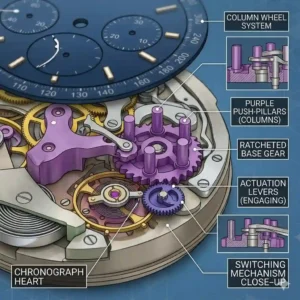
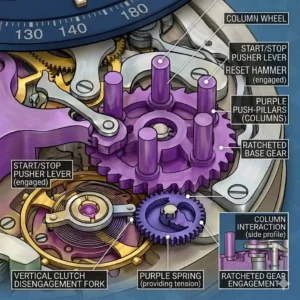
If you own a standard mechanical watch, never press the bottom (reset) pusher while the timer is actively running. This forces the reset hammer against the heart-piece cam while the gears are still engaged, and can literally sheer the teeth off your internal gears. (Note: Flyback chronographs are the exception to this rule).
Year One Maintenance Cycle
After 6 months of daily use, you might notice your chronograph hand resets to “1 second past 12” instead of dead-center. For quartz watches, you can manually recalibrate this by pulling the crown to the second position and holding the top pusher to step the hand forward. For mechanicals, if it stops resetting to zero, it means the hands have slipped on their pinions, requiring a trip to a watchmaker.
Real-World Case Studies: Matching The Watch To The Wearer
To truly grasp what is a chronograph watch and how it works in daily life, let’s look at how perfect specs can fail in specific edge cases.
Profile A: The ER Nurse (Needs rapid, repeated 60-second timing)
-
The Bad Fit: A mechanical luxury piece like the Tissot PRX. Bodily fluids, heavy impacts against hospital beds, and the slow process of winding make it a liability.
-
The Perfect Match: The Timex Weekender Chronograph. Why? The Indiglo backlight is perfect for darkened patient rooms. The quartz movement can take a beating, and the NATO strap can be thrown directly into the washing machine.
Profile B: The Culinary Enthusiast (Timing multi-stage cooks)
-
The Bad Fit: Standard mechanical chronographs usually only track up to 30 or 60 minutes via their sub-dials. If you are smoking a brisket for 8 hours, it becomes useless.
-
The Perfect Match: The Seiko Prospex Speedtimer. With its 60-minute sub-dial and solar reliability, it easily tracks oven times. Plus, its 100m water resistance means you can wash it in the sink along with the dishes without fear of steam penetration ruining the dial.
Problem to Solution: Troubleshooting Your Timepiece
Even the finest tools have quirks. Over the last decade, I’ve diagnosed hundreds of “broken” watches that were simply misunderstood by their owners.
Problem 1: The large second hand isn’t moving, but the watch is keeping time.
-
The Solution: This is the #1 beginner panic. On 95% of these watches, the large central sweeping hand is only for the stopwatch. Regular, continuous seconds are displayed on one of the small sub-dials. This is completely normal. Do not leave the main stopwatch hand running all day to “fix” the aesthetic; on a mechanical watch, this drastically reduces the power reserve and increases gear wear by up to 30%.
Problem 2: The hands reset slightly off-center.
-
The Solution: For battery-operated quartz models, this isn’t broken. It’s a simple gear slip. Pull the main crown all the way out, then press both pushers simultaneously. The sweeping hand will make a full rotation. You can now use the top pusher to “click” the hand back to the exact 12 o’clock position.
Problem 3: The pushers feel “sticky” or mushy.
-
The Solution: Dirt, dead skin cells, and sweat easily build up in the pusher gaskets. Use a soft-bristled toothbrush and a tiny amount of warm soapy water (ensure the crown is pushed in first) to gently scrub around the pushers.
How to Choose the Right Chronograph
When consulting for new collectors, I use a specific framework to filter out marketing noise. Don’t buy based on dial color; buy based on the engineering architecture.
-
Understand Your Primary Use Case: Are you timing laps, or are you wearing it for the aesthetic? If you actually need precision, opt for high-frequency quartz. If you want a conversation starter at a cocktail party, mechanical is the way to go.
-
Assess the Sub-Dial Legibility: Highly polished hands on a highly polished dial (often called “ghosting”) look great on Instagram but are entirely illegible in daylight. Look for contrasting sub-dials—commonly known as “Panda” (white dial, black sub-dials) or “Reverse Panda” layouts.
-
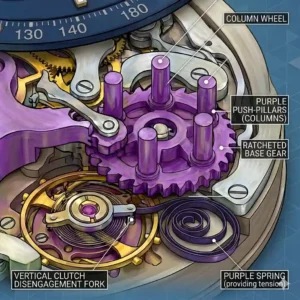
Verify the Actuation Method: For mechanicals, ask if it is a “Column Wheel” or “Cam Actuated” movement. Column wheels are harder to manufacture and more expensive, yielding a buttery-smooth pusher feel. Cam systems are cheaper and incredibly durable, but require a harder, “stiffer” push to engage the timer.
-
Check the Service Network: Buying a micro-brand with a proprietary movement means you must ship it overseas for a $300 battery/gasket change. Stick to established movements (like Seiko’s VK63 or ETA calibers) that any local mall watchmaker can service.
Common Mistakes When Buying Your First Chronograph
The industry is rife with pitfalls. Here is my expert commentary on where beginners waste their money.
The “Water Resistance” Illusion
A watch might say “100m Water Resistant” on the dial. What most buyers overlook is that this rating only applies when the pushers are untouched. If you take your watch swimming and decide to click the pusher underwater to time your breath-hold, you will instantly break the gasket seal. Water will flood the movement, destroying it. Only highly specialized dive chronographs (with screw-down locking pushers) can be operated submerged.
Misunderstanding the Tachymeter Scale
Many people buy racing models and wonder what the numbers (usually 60 to 400) around the bezel mean. It is a Tachymeter—a tool for converting elapsed time into speed. If you start the timer at mile marker 1 on a highway, and stop it at mile marker 2, the hand will point to your exact miles-per-hour on the bezel. It’s brilliant engineering, but realistically, most people need a rotating dive bezel (for timing parking meters or laundry) much more than they need to calculate their average speed over a fixed mile.
Chronograph vs Traditional Three-Hand Watch
Let’s do a deep comparison. Why complicate your wrist when a simple three-hand watch (hours, minutes, seconds) does the trick?
| Feature | Chronograph | Traditional 3-Hand | Expert Verdict |
| Visual Depth | High (multiple layers, sub-dials) | Low to Medium (flat dial) | Chronos win on raw aesthetic complexity. |
| Service Cost | $400 – $800 | $150 – $300 | 3-Hands are vastly cheaper to own long-term. |
| Case Thickness | 13mm – 16mm | 9mm – 12mm | 3-Hands slip under dress shirts much easier. |
| Interactivity | High (fidget-friendly pushers) | Low (set it and forget it) | Chronos offer a tactile connection. |
Expert Analysis: Looking at the comparison above, the traditional three-hand watch is undeniably the more practical, cost-effective choice for someone wanting a low-maintenance accessory. However, the chronograph justifies its higher maintenance costs through sheer interactivity and visual depth. If you are someone who likes to fidget with a pen in meetings, the tactile feedback of engaging a start/stop pusher provides an unmatched mechanical connection to your gear.
Features That Actually Matter (And Those That Don’t)
Watch brands are notorious for inventing fancy terms for basic features. Let’s filter the hype.
Features to Prioritize:
-
Sapphire Crystal: Do not settle for mineral glass if you’re spending over $300. Mineral glass scratches easily; sapphire requires a diamond to scratch it. This makes a monumental difference in year three of ownership.
-
Solid End-Links: If buying a watch on a steel bracelet, ensure the link connecting to the watch case is a solid piece of steel, not folded sheet metal. Folded links stretch over time, causing an annoying rattling sound.
Features to Ignore:
-
Excessive Jewel Counts: Mechanical movements use synthetic rubies as low-friction bearings. A standard chronograph needs around 17 to 25 jewels. Brands boasting “45 Jewels” are often using them in non-load-bearing areas just to pad the spec sheet. It adds zero real-world value.
-
Helium Escape Valves: Found on ultra-deep sea watches. Unless you are a professional saturation diver living in a pressurized bell at the bottom of the ocean, this feature is completely useless and just adds another potential point of water ingress.
The Engineering: Vertical vs Horizontal Clutches
For those wanting to understand the deep mechanics behind these tools, we must discuss clutches. When you press the pusher, how does the main gear train suddenly power the stopwatch hands?
The Horizontal Clutch (The Romantic Approach)
In a horizontal lateral clutch, pressing the button moves a gear sideways until its teeth mesh with the continuously running seconds gear.
-
Real-World Impact: Because you are smashing moving gear teeth into stationary gear teeth, the chronograph hand will often visibly “jump” or stutter forward a fraction of a second when started. It is visually beautiful to look at through a glass caseback, but creates microscopic wear and tear.
The Vertical Clutch (The Modern Standard)
Instead of gears meshing side-to-side, a vertical clutch uses friction plates that drop down on top of each other, much like a car’s transmission.
-
Real-World Impact: The start is flawlessly smooth with zero jump. Furthermore, because there are no teeth grinding against each other, you can leave a vertical clutch chronograph running 24/7 without causing excessive wear to the movement. (High-end Seiko and Rolex Daytona models use this architecture).
Long-Term Cost & Maintenance Cycle
The biggest shock to new collectors is the hidden cost of ownership. Calculating the “Total Cost of Ownership” requires looking past the purchase price.
If you buy a $1,500 mechanical chronograph, congratulations. In five years, the microscopic synthetic oils keeping those hundreds of parts moving will dry out. If you don’t service it, the gears begin grinding against each other, creating metal dust that destroys the movement.
A standard full service on an ETA 7750 mechanical chronograph movement involves complete disassembly, ultrasonic cleaning, re-oiling, and reassembly. In 2026, this costs roughly $400 to $600 at an independent watchmaker, and takes 6 to 8 weeks.
-
The Takeaway: If you cannot stomach a $500 maintenance bill every half-decade, do not buy a mechanical chronograph. Opt for high-end quartz or solar options like the Seiko Prospex, where the only maintenance is a $20 battery every few years or leaving it on a sunny windowsill.
✨ Don’t Miss These Exclusive Deals!
🔍 Ready to make your choice? Revisit our top selections and click through to check current availability. Upgrade your daily carry with a timepiece that commands both respect and utility!
Conclusion
Understanding what is a chronograph watch and how it works elevates your appreciation from mere fashion to mechanical respect. Whether you are utilizing the high-frequency sweep of the Bulova Lunar Pilot or relying on the weekend-proof power reserve of the Tissot PRX, these tools offer a tactile, interactive experience that digital screens simply cannot replicate.
Remember, the true value of these watches isn’t found in their ability to survive deep-sea dives or space travel—scenarios most of us will never encounter. The value lies in their everyday utility: perfectly timing a French press coffee, tracking a parking meter, or simply giving your hands a piece of micro-engineering to interact with during a long commute. Choose the movement that fits your lifestyle, respect the maintenance cycle, and most importantly, actually use your pushers.
FAQs
❓ What does chronograph mean in watches?
✅ It translates directly to “time writer.” It means the watch features an integrated stopwatch function, allowing you to measure elapsed time via independent sub-dials and sweeping hands without interfering with the primary hour and minute hands…
❓ Can you leave a chronograph running all the time?
✅ On a quartz or vertical clutch mechanical watch, yes, though it drains the battery/power reserve faster. On a horizontal clutch mechanical watch, leaving it running continuously causes unnecessary wear and tear on the delicate gear teeth and should be avoided…
❓ How long do chronograph watches last?
✅ With proper maintenance, a mechanical model can easily last multiple generations, outliving its owner. Quartz models typically last 15-20 years before the electronic circuit board fails, at which point the internal movement must be completely replaced…
❓ Are chronograph watches waterproof?
✅ They have water resistance ratings, but activating the external pushers while submerged breaks the gasket seal, causing immediate flooding. Unless it has specific screw-down locking pushers designed for diving, never operate the timer in the water…
❓ Why are chronograph watches so expensive?
✅ They require vastly more components. A standard three-hand watch has around 100 parts, while a mechanical chronograph can have over 300 microscopic parts that must be hand-lubricated and assembled to work in perfect synchronization, driving up labor costs…
Recommended for You
- 5 Stunning Insights on the meaning behind different watch complications (2026)
- 5 most popular watch brands in the USA: 2026 Expert Guide
- 5 Reasons the Future of Hybrid Smartwatches is Already Here in 2026: What Makes These Watches Better Than Ever
Disclaimer: This article contains affiliate links. As an Amazon Associate, I earn from qualifying purchases. If you purchase products through these links, we may earn a small commission at no additional cost to you.
✨ Found this helpful? Share it with your friends! 💬🤗