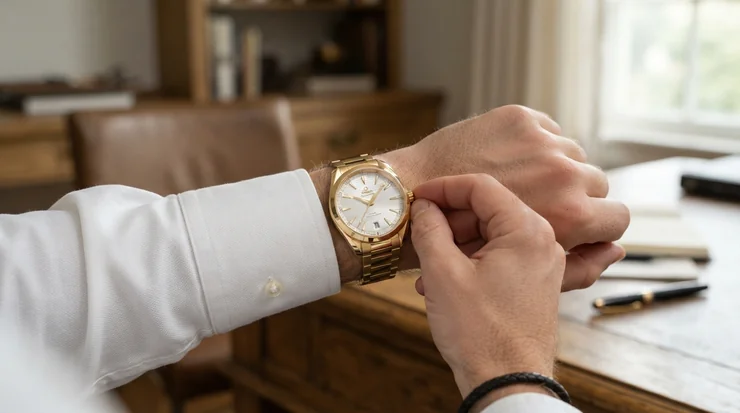
The words gold watch on a product page promise a color, not a metal. Casio’s own page for the Casio A168WG-9 uses that same shorthand for a gold-colored digital, while retailer spec sheets describe a gold-tone finish over resin and steel parts. It is ordinary retail language, which is exactly why decoding it is the real shopping problem.
The stakes are practical. A watch that is gold-colored and a watch that is gold throughout age very differently: according to one appraisal guide, plating wears through at the lugs, the caseback edge and the crown, and the metal underneath looks cooler, greyer or pinkish. Buy the wrong kind and you find out in a year, not on day one.
I haven’t worn or handled any watch below. This is research: the FTC’s published jewelry rules, spec pages, an appraisal guide and two watch-press reviews, with a flag wherever listings disagree with each other.
Here is the plan. First, what a listing can mean by “gold.” Then six steps for buying one, how real gold watches announce themselves, the mistakes that end in returns, and three affordable picks that each solve a different part of the problem.
Four things a listing can mean by “gold”
The legal side is clearer than the marketing side. The FTC’s revised Jewelry Guides, as published in the Federal Register, treat the unqualified word “gold” as misleading unless the item is 24-karat throughout. Solid alloys carry a karat mark right before the word, as in “14K Gold.” Anything coated has to say so.
What the listing says
What it is
Rule of thumb from the FTC guides
Fits you if
“14K gold,” “18K gold”
A gold alloy all the way through
Karat mark must come before the word “gold”
You want a keepsake and the budget that goes with it
“Gold filled”
A thick bonded gold layer
Gold must be at least 1/20th of the article’s metal weight
You want a heavier layer than plating, without solid-gold cost
“Gold plated,” “gold electroplate”
A thin coating
Roughly 0.175 microns of fine gold minimum; “heavy” means roughly 2.5 microns or more
You want the look on a budget and accept wear
“Gold-tone”
A color description
The summary doesn’t define it, so treat it as color only
You want the look and nothing more
Watch cases get no special leniency. The guides’ list of exempt parts for filled and rolled-plate goods specifically leaves watch cases out, which is a useful thing to know when a listing is vague about the case.
Six steps from “I want something gold” to the right order
Decide how much gold you’re paying for. If you want the metal itself, you are shopping for solid gold, and the price universe is entirely different from the three watches below. If you want the look, you are shopping for plated or gold-tone pieces, and everything else on this page applies. Settle this first because every other step depends on it.
Read the qualifiers, not the title. Titles are written to be found by shoppers, so they say “gold.” The description is where “gold-tone,” “plated” or a karat mark appears. A karat number placed before the word “gold” is a content claim. “Tone” is a color claim. Treat them differently.
Pick the movement you’ll live with. A digital quartz like the Casio A168WG-9 needs nothing for years. An automatic like the Seiko 5 SNK574J1 runs on wrist motion, so it wants regular wear. A hand-wound watch like the Timex Marlin Hand-Wound 34mm wants a daily wind, and Timex itself says so. The movement is the part you interact with every day, and it is rarely the part shoppers think about.
Size it before you color-match it. The three watches here run from 34 mm to about 38.6 mm across, and they wear very differently even though all of them read as “gold” in photos. Check lug-to-lug distance and strap width if a small wrist or a swap-the-strap habit matters to you.
Verify the exact reference and the water rating. Listings for gold-tone watches love near-identical siblings. Match the model number on the page to the manufacturer’s own page, and read the water-resistance line literally. “Water resistant” with no depth is a splash rating, not a swim rating.
Plan for wear. Plated and gold-tone surfaces are thinnest at edges. A soft cloth is enough for cleaning; abrasive polish is the thing to skip. If the watch is a gift, an adjustable bracelet or a buckle strap forgives sizing mistakes.
How real gold watches announce themselves
If you are looking at a used piece, a family heirloom, or a listing that claims solid metal, the proof is stamped on the watch. According to a watch-appraisal guide, solid gold carries karat or fineness marks: 9K or 375, 10K or 417, 14K or 585, and 18K or 750. The marks usually sit on the caseback or inside the case.
The warning signs are just as stamped. The same guide treats GF, RGP, HGE, GP, “Gold Tone” and “Stainless Steel Back” as signs the case is not solid gold. It also reminds buyers to check the bracelet separately, since a gold case on a plated bracelet is normal and the bracelet carries its own marks.
Two cautions. A magnet test can rule out steel, but it can’t prove gold, because brass and copper aren’t magnetic either. And the guide advises against acid or scratch tests on unidentified watches, since they can permanently damage value. Leave those to a jeweler.
One more point on value. Solid gold sets a floor based on metal weight, yet the guide notes that scrap buyers quote melt value, which can sit far below what a collector would pay. A recognized brand or movement often matters more than the karat count.
Where orders go wrong, and how to recover
Trusting the title. The word “gold” in a listing’s headline is the least reliable part of the page. Recovery: read the bullet points and the spec table before you pay, and if the watch arrives and doesn’t match what you read, check the return window on the listing before you do anything else.
Treating gold-filled as solid. Filled is thicker than plated, but the FTC guide’s threshold is one-twentieth of the article’s metal weight, not the whole watch. Recovery: if you’re buying for resale or heirloom value, look for a karat stamp rather than a “GF” mark.
Forgetting the bracelet. A solid gold case can ship on a plated bracelet, and the reverse can happen on cheaper pieces. Recovery: ask what each part is made of, and read the marks on both.
Gifting one blind. If the plan is a golden watch for a retirement, graduation or milestone birthday, you won’t know the wrist size or how the person will wear it. Recovery: lean toward a bracelet with an adjustable or fold-over clasp, which both the Casio A168WG-9 and Seiko 5 SNK574J1 use according to the listings.
Reaching for an acid kit. Testing a watch you can’t identify with acid or a scratch plate risks damaging it, per the appraisal guide above. Recovery: stop, photograph the marks, and let a jeweler read them.
Why a single list of the best gold watches can’t exist
Type “watch gold awesome” into a search box and you are really asking for one thing: a piece that looks expensive without being priced like it. Whether that’s possible depends entirely on step one. If “gold” means solid metal, no list of the best gold watches under a few hundred dollars can honestly help you. If it means the look, a plated or gold-tone watch can deliver it, and the question shifts to movement, size and wear.
That is why the three picks below are not ranked. Each one answers a different step.
Three affordable gold watches, each tied to a step
All three are gold-tone or gold-accented, not solid gold. They are a good fit when the look matters and you’ve already settled step one.
Weight is the first thing to notice. A retailer page lists the Casio A168WG-9 at 49 grams, with a case of 38.6 × 36.3 × 9.6 mm, a stainless steel band with an adjustable clasp, and an estimated seven-year battery life on a CR2016 cell. Functions are an alarm, a stopwatch and an EL backlight. That page showed it at around $80.
Casio’s US product page offers marketing copy and points spec questions to its manual lookup, so the dimensions and materials here come from retailers, and they disagree. One lists a resin case and bezel; others list stainless steel, and one lists a case diameter of 28.6 mm. Check the listing you’re buying from.
Pros:
Very light, so the gold look comes without wrist weight
Quartz digital with no winding or setting rituals
Cons:
Water rating is listed only as splash protection on the page
Retailer specs conflict on case material and size
Look elsewhere if you want visible metal heft or plan to swim in it. Compare the exact model number before buying.
Casio A168WG-9See current price, sizes and reviews on Amazon.
If you like the idea of a watch that runs off your wrist, start here. The Seiko 5 SNK574J1 pairs a gold-tone stainless steel case and bracelet with a gold-tone dial and a see-through caseback. A retailer listing gives the movement as Seiko’s 7S26 automatic with 21 jewels, a mineral crystal, 30 meters of water resistance, day and date display, and a fold-over clasp. It is listed as made in Japan.
Sizing needs care. That listing gives about 35 mm across and 11 mm thick, while another retailer lists 36 mm. Seiko also sells several gold-tone 5 references that look alike in photos but are not the same watch. One retailer lists the SNKN62 at 43 mm with a 50-meter rating, which is a much larger watch.
The trade-off is the movement itself. An automatic wants regular wear, and the 11 mm thickness will sit higher under a cuff than a slim quartz. The listing page showed no customer rating, so there is no review sentiment to report. No current price is confirmed either, so check the current price on Amazon.com and match the reference SNK574J1 exactly.
Seiko 5 SNK574J1See current price, sizes and reviews on Amazon.
This one is for readers who want gold as an accent, not a statement. A Blog to Watch’s review of the Timex Marlin Hand-Wound 34mm (reference TW2V44700ZV) describes a silver sunburst dial with gold hands and applied markers, a gold-tone nested crown, and a case that blends gold-tone and chrome finishes. It measures 34 mm wide and 10 mm thick, with a 41 mm lug-to-lug and 18 mm lugs.
The reviewer calls the size objectively small and measured roughly plus or minus ten seconds a day. Complaints included a tiny crown that is hard to grip for winding, mediocre lume and rough movement finishing. The domed acrylic crystal adds vintage charm and also scratches more easily than mineral glass, which is a general trait of the material. Gear Patrol’s earlier write-up of the Marlin hand-wound line says Timex requires winding once per day, and reports the original run selling out before a restock. That article dates to 2017, so availability may have changed.
Listings conflict here too. A Timex catalog page for the same reference lists a blue dial, 50 meters of water resistance and a quartz movement, while the review describes a silver dial and a hand-wound movement. Confirm the dial color and movement on the page you buy from. The reviewer listed the price at $199 at launch, so expect something near $200 as a reference point, and check the current price on Amazon.com.
It’s the wrong tool if you want gold across the whole case or a lume that glows. Compare the reference number to the manufacturer’s page before buying.
Timex Marlin Hand-Wound 34mmSee current price, sizes and reviews on Amazon.
What is the difference between gold-plated and gold-filled?
Plating is a thin coating, with the FTC's electroplating floor at roughly 0.175 microns of fine gold. Gold-filled is a thicker bonded layer that must be at least one-twentieth of the article's metal weight. Both are still surface layers over a base metal.
Can a seller call a plated watch 'gold'?
Not without qualifiers. The FTC guides treat an unqualified 'gold' as misleading unless the item is 24-karat throughout, and coated items need wording that shows the gold is only a surface layer. Look for 'plated,' 'filled' or a karat mark in the description.
Will a gold-tone watch lose its color?
Plating is only microns thick, and the appraisal guide says it wears through first at the lugs, the caseback edge and the crown. No sourced timeline is available, so rather than guess at months or years, inspect those edges on any used or older piece.
Does a magnet prove a watch is real gold?
No. Gold isn't magnetic, so a pull means steel is present, but a lack of pull proves nothing because brass and copper are non-magnetic too. Check the stamped karat or fineness marks instead, and let a jeweler handle anything unclear.
Are budget gold-tone pieces fine for daily wear?
Yes, if you match the watch to the day. The three here carry different water ratings, from a splash-only description to 30 meters on the Seiko listing, and they need different care. Read the rating, accept the plating's wear, and pick a movement you'll actually maintain.
Decide the kind of gold first, the model second
If you want a gold watch that is gold all the way through, the stamp matters more than the photo, and the price universe is a different one. If you want the look at a friendly cost, the Casio A168WG-9 is the lightest and simplest, the Seiko 5 SNK574J1 is the one with a mechanical heart, and the Timex Marlin Hand-Wound 34mm is the quietest, with gold as an accent.
Whichever you choose, read the qualifier words, confirm the exact reference against the manufacturer’s page, and check the water rating before it goes near a sink.
WatchWiseHub is an independent buying-guide site for watches, smartwatches, straps and accessories. Our editorial team compares gear using manufacturer specifications, independent tests from specialist watch media, owner reports and retailer listings. We do not claim to have tested the watches ourselves; see How We Choose Gear for our method.