Does a moon window on a dial earn its place, or is it a pretty cutout you stop noticing after a week? For moon phase watches, the answer depends on what drives the little disc. A plain 59-tooth gear drifts out of step every two and a half to three years, according to Two Broke Watch Snobs and The Slender Wrist, while Citizen’s radio-controlled Tsuki-yomi calculates the phase itself and Casio’s digital G-Lide shows moon age for any date. This 2027 shortlist sorts six moon phase watches, from a quartz Timex to a Swiss automatic Glycine, by wrist size, setting effort and money.
The findings rest on maker spec pages, specialist write-ups from Teddy Baldassarre, Monochrome and Dappered, and buyer reviews posted on Citizen’s own store pages, which is also where the setup complaints come from. Amazon.com stock and exact prices could not be confirmed from those sources, so cost appears as a range only where an opened page gave one.
Four ways a watch can know the moon
Every moon window is answering the same question, and the answer comes from four very different places. NASA’s moon phases page says the cycle repeats about every 29.5 days. A standard gear-driven display copies that with a 59-tooth disc carrying two moons, a close but imperfect match to the real average of about 29.53 days, as The Slender Wrist explains.
The first route is a quartz movement with that gear-driven disc: the Timex Marlin Moon Phase 40mm, the Fossil Neutra Moon Phase and the Citizen Calendrier BU0057-54E all work this way. You set the moon by hand, and a battery or solar cell keeps it moving. The second is an automatic with the same disc, the Glycine Combat 6 Classic Moonphase, where a stopped watch means setting the moon again. The third is Citizen’s radio route in the Citizen Tsuki-yomi A-T BY1010-57L, and the fourth is Casio’s digital readout in the Casio G-Shock GBX-100.
One mix-up sits outside all four. The Slender Wrist warns that Orient’s popular Sun & Moon is often mistaken for a moon phase watch, when it actually has a day and night indicator built from an alternating sun and moon subdial. A real moon phase shows a disc cycling through crescent, half and full moon over a month; read the listing for exactly that wording.
Size, power and setting effort across the shortlist
Case size decides comfort more than any complication does, and this shortlist runs from 40 mm to nearly 51 mm. Power and setting effort come next, because they decide how often the watch asks for attention.
Watch
Case
Power
How the moon is handled
Water resistance
Timex Marlin Moon Phase 40mm
40 mm
Quartz, battery
Set by hand
5 bar, per a UK retailer
Fossil Neutra Moon Phase
42 mm, 13 mm thick
Quartz (Miyota 6P20), battery
Set by hand
5 ATM
Casio G-Shock GBX-100
50.9 × 46 × 14.7 mm
CR2032, about 2 years
Moon age and phase shown for a chosen date
200 m
Glycine Combat 6 Classic Moonphase
40 mm, 12.2 mm thick
Automatic, 38-hour reserve
Set by hand; a stop means a reset
50 m
Citizen Calendrier BU0057-54E
44 mm
Eco-Drive solar quartz
Set by hand
100 m
Citizen Tsuki-yomi A-T BY1010-57L
43 mm, 10.9 mm thick
Eco-Drive solar, radio-controlled
Calculated and radio-synced
100 m
Only two of the six remove the setting chore, and they sit at opposite ends of the style range: a titanium dress-sport watch and a 66 g resin G-Shock. The Glycine is the one that punishes neglect, since its 38-hour reserve means a weekend in a drawer stops it. For anyone shopping among moon phase watches for men with average or larger wrists, 40 to 44 mm covers five of the six picks. The best moon phase watches are the ones whose setting routine matches how much attention you are willing to give them.
Best moon phase watches for men: six real options by money and mechanism
The entries run from an inexpensive true moon disc to the most automated one, and each notes where its evidence is thin.
Around $170 to $210 buys one of the two cheapest true moon discs on this list, going by Timex’s own listings and a 2024 stock alert from Dappered. The movement is quartz, the case is 40 mm, and the dial carries a moon disc alongside day, date and month sub-dials, with the month set by a pusher at 2 o’clock.
Dappered’s editor found the watch quite nice in person, noted that it runs without the loud tick of cheaper Timex quartz, and called 40 mm wearable for most people, though traditionalists wanting a dressier fit may prefer 38 mm. The leather strap is the weak point; the same write-up says it “doesn’t feel the most impressive.” That is one editor’s view, but it echoes strap complaints elsewhere in this guide.
Stock is the other issue. Dappered reported the first batch selling out right after release and the restock vanishing within hours. Timex lists several dial and strap versions under different references, such as TW2W51000 (green dial, leather) and TW2W51300 (blue dial, steel bracelet), so confirm the exact reference in the listing; the bracelet version sidesteps the leather complaint entirely. Check current availability on the Amazon listing for the dial you want.
Owner reports specific to this moon phase version are thin, so the case for it rests on spec sheets and on what buyers say about its Neutra siblings. Two Broke Watch Snobs prices the 42 mm quartz model at around $170 to $190 and likes the clean, tight design, with a dial that has room to breathe. Fossil’s own listing for the FS5905 adds a sunray dial, 5 ATM water resistance and a 22 mm strap, and a retailer spec sheet puts the case at 13 mm thick.
Strap quality draws the complaints. On the Neutra chronograph pages at Macy’s and Marks & Spencer, individual buyers describe a strap holder breaking within a month, a strap falling apart after about the same time, and a watch stopping after a week, and Macy’s review summary flags a small number of band or function problems. Those are different Neutra models, and a handful of reviews is a hint, not a failure rate, but the leather is where the evidence points.
Pros:
✅ Steel case with a 5 ATM rating
✅ Day and date sub-dials sit beside the moon
Cons:
❌ A 13 mm case is thick for a quartz dress watch
❌ Strap problems reported on sibling Neutra models
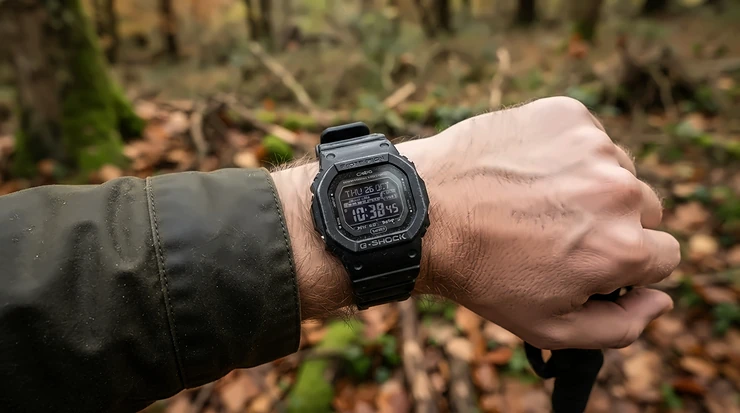
Nobody sets the moon on this one, because there is no disc to set. Casio’s listing for the GBX-100NS-1 shows moon age and moon phase for a chosen date, next to a tide graph covering about 3,300 ports through the phone app and sunrise and sunset times. That makes it the quickest of the six for a look at the moon phase today or next Saturday.
The case measures 50.9 × 46 × 14.7 mm, weighs 66 g and is rated to 200 m. A CR2032 lasts about two years, Casio says, and time syncs with a phone over Bluetooth, with accuracy of plus or minus 15 seconds a month when the link is off. Casio also notes that the display blanks for three hours a day to save power and calls the tide, moon and sun data reference-only.
Martin Green, writing for WatchTime US via webChronos, found the sibling GBX-100S-1 worth owning even for people who don’t surf, called it light and comfortable, and named no clear drawbacks. G-Central’s launch coverage is more cautious: the watch cannot show tide levels for a specific future time, and only one port is active at once. G-Central also notes a launch price of about $160. The trade-off is style, since a 50.9 mm resin sports case is not a dress watch, and none of these sources describes it as one.
Street pricing for this Swiss automatic swings widely: The Slender Wrist saw it as low as about $360 in holiday sales, while Two Broke Watch Snobs puts it around $600 to $620. Monochrome’s review describes a 40 mm case 12.2 mm thick, a domed sapphire crystal with multiple anti-reflective coatings, 50 m water resistance with a guarded but unscrewed crown, and a GL280 movement, a modified Sellita SW280 beating at 4 Hz with a 38-hour reserve.
The reviewer notes that the 22 mm lugs make the watch wear larger than 40 mm suggests, and replaced the stiff stock strap right away. The same review puts the moon phase at about 8.8 hours of gain a year, a figure that holds only while the mainspring stays wound.
That 38-hour reserve has a consequence. Leave the watch off the wrist for two days and it stops, and The Slender Wrist notes that restarting an automatic moon phase means setting the moon again. One Drop buyer measured about four seconds a day of gain over a week and found the blue dial far darker than the photos, a single reviewer’s data. A Drop community member also mentions a 36 mm version, which matters if wide lugs on a 40 mm case feel like too much.
Battery-free, analog, and loaded with calendar information: that is the pitch of Citizen’s Calendrier. The US listing gives a 44 mm steel case with a black dial, a spherical mineral crystal raised within the bezel, 100 m water resistance, an Eco-Drive 8730 movement showing month, day and date plus the moon, a deployment clasp and a five-year limited warranty.
Two Broke Watch Snobs reviewed the sibling BU0050-02L, which shares the 8730 movement and 44 mm case, and liked the function-first moon window with no decorative moon face. Its price range there runs from about $250 to $575, a spread that likely tracks sale timing. The same review warns that the watch is large for smaller wrists, so try it on first.
Setting is by hand, and buyer reports on Citizen’s store pages are mixed. One reviewer of a related Calendrier reference said that setting the day, time, month and moon took a while because no instructions came in the box and the manual had to be downloaded from Citizen’s site. Another, on the women’s version, said it was not hard once the manual was downloaded. Citizen’s manuals for its Eco-Drive moon phase calibers add that the display only indicates the phase and does not depict the moon’s actual shape, and that setting at a new or full moon gives the most accurate result.
Pros:
✅ 100 m rating with solar charging and no battery swaps
✅ Month, day, date and moon in one analog dial
Cons:
❌ A 44 mm case runs large for slim wrists
❌ Moon and calendar are set by hand, with the manual a separate download for one reference
The appeal of this watch is a moon phase that never needs the corrector. Mark Bernardo’s Teddy Baldassarre review calls it the first light-powered watch with a fully analog moon disc, positioned at 6 o’clock, and the first moon phase needing no manual adjustment. Citizen’s H874 movement receives six multi-band transmitters, is accurate to plus or minus 15 seconds a month, and also runs a perpetual calendar. Citizen’s H874 manual describes the moon phase as calculated by an original algorithm from the watch’s time and date, with a switch for the northern or southern hemisphere.
The BY1010-57L is the blue version. The case is 43 mm across and 10.9 mm thick, in Citizen’s Super Titanium with a Duratect surface treatment, on a three-link bracelet. Citizen’s Canadian page lists 100 m water resistance and a five-year warranty. The dial is translucent sapphire with a lunar-landscape pattern, the subdial at 12 shows the day, a charge indicator and the hemisphere setting toggled by pulling the crown, and an AM/PM indicator sits at 9. Bernardo places it in a sub-$1,000 tier without naming a figure, and the review does not state a power reserve.
Real-use evidence is encouraging but not uniform. Bernardo says the light titanium offsets the size, yet warns that 43 mm would dominate a thinner wrist; a reader comment says it wears closer to 40 to 41 mm. The Citizen store reviews opened here are favorable overall, with one owner advising 30 minutes to an hour for first-time setup, another wishing for more setup videos, and a third on the red version reporting that the moon dial is adjusted by the radio signal and sets itself as long as the watch receives one. Stock varies by dial color across the blue, gray and red versions, so see what is currently available on Amazon.com.
When the budget stretches: where Orient Star fits
The mechanical step up is the Orient Star Classic Moon Phase RE-AY0106S, and its inclusion here comes with a caution. Orient’s page lists the in-house F7M62 automatic movement at plus 15 to minus 5 seconds a day with a reserve of over 50 hours, in a 41 mm case rated to 50 m. Two Broke Watch Snobs prices it well below the figure on Orient Star’s own US store page, and that store stopped online purchasing from June 1, 2026. With prices and US stock this inconsistent, it stays off the six until a current Amazon listing is confirmed.
Moon phase watches reviews: what buyers and testers keep reporting
Taken together, moon phase watches reviews point to four recurring frictions, and each one changes what to buy.
Setting effort comes first. Several Citizen store buyers describe setup as slow or under-documented, though not unanimously, which makes the radio-synced model more attractive for anyone who dislikes manuals. Size is second: Teddy Baldassarre, Two Broke Watch Snobs and Monochrome each flag a case or lug width that wears large, so the wrist measurement matters more than the dial color.
Straps are the third, and the pattern is consistent across three sources. Dappered calls the Timex leather unimpressive, Monochrome’s reviewer replaced the stiff Glycine strap immediately, and buyers of sibling Neutra models report breakage. On budget and mid-price pieces, the stock strap is where money tends to leak, so it deserves a line in the budget.
Drift is the fourth, and it is the mildest of the four. A 59-tooth display needs a correction every two and a half to three years, which The Slender Wrist and Two Broke Watch Snobs both state. Gray & Sons, a repair shop, advises that a moon display that drifts quickly after correct setting, or whose corrector resists, should be inspected, not reset again and again.
Checking the moon phase today, tonight and after a stop
To set any hand-set watch, start with the current moon phase. NASA links to a Current Moon Phase tool and a Daily Moon Guide for exactly this, and any lunar calendar gives the date of the last full moon. The Slender Wrist’s routine is to set the hands to 6:30, advance the moon display to the correct phase, set the date one day behind, then set the time while cycling through a full day so AM and PM are right; Citizen’s manuals suggest working from a new or full moon.
Reading the moon phase tonight from the wrist is a different matter, and hemisphere matters. The Tsuki-yomi has a switch for the northern or southern view, while the other analog models show a single fixed orientation, and Citizen’s own manuals describe the indicator as a reference, not a picture of the moon.
After a stop, expect to reset. Gray & Sons notes that when the power reserve runs out, the display stays at the last phase until someone resets it. That applies to the Glycine Combat 6 Classic Moonphase and to a dead battery in the Timex Marlin Moon Phase 40mm or the Fossil Neutra Moon Phase.
Setting, drift and size: moon phase watch answers
❓ How do you set a moon phase watch?
✅ Find the current moon phase online, then advance the moon disc with the corrector or crown position your manual names until it matches. Citizen's manuals suggest setting at a new or full moon for better accuracy, and The Slender Wrist advises setting the time to 6:30 first.
❓ How often does a moon phase watch need correcting?
✅ A standard 59-tooth display drifts out of step roughly every two and a half to three years, according to The Slender Wrist and Two Broke Watch Snobs. Radio-calculated and digital models avoid this, and a watch that drifts quickly after setting deserves a repair shop's inspection.
❓ Can a watch show the moon phase tonight without any setting?
✅ Two on this list can. Citizen's radio-controlled Tsuki-yomi calculates the moon from synced time and date, with a hemisphere switch, and Casio's G-Lide displays moon age and phase on screen. Both rely on correct time, so a stopped or unsynced watch needs attention first.
❓ Is a Sun and Moon watch the same as a moon phase watch?
✅ No. The Slender Wrist explains that Orient's Sun and Moon uses an alternating sun and moon subdial as a day and night indicator, not a true lunar display. For a real moon phase, look for a disc that cycles through crescent, half and full moon over about 29.5 days.
❓ Which moon phase watch suits a smaller wrist?
✅ Look for a 40 mm case or smaller. The Timex and Glycine are both 40 mm, and a Drop member mentions a 36 mm Glycine. Citizen's 43 mm titanium model is light, with one reader saying it wears like 40 to 41 mm; the 44 mm Calendrier runs large.
Which moon phase watch to buy: a short decision rule
Choose by wrist, routine and tolerance for setting. The Timex Marlin Moon Phase 40mm is an inexpensive true moon disc and the sensible first try, and the Glycine Combat 6 Classic Moonphase is the automatic for anyone who accepts a stopped watch and a stiff strap. Anyone who dislikes manuals should look at the Citizen Tsuki-yomi A-T BY1010-57L or the Casio G-Shock GBX-100, which never need the moon adjusted by hand.
If one name goes on the wishlist, make it the Tsuki-yomi when a 43 mm titanium case fits the wrist, and the Timex when it does not. Whichever of these moon phase watches you pick, set a hand-set one at a new or full moon and expect a correction every few years. Current availability and sizes appear on each Amazon listing; compare them against your wrist measurement before ordering.
Disclaimer: This post contains affiliate links. As an Amazon Associate, I earn from qualifying purchases made through these links, at no additional cost to you.
Tonight’s moon is already up there, so the only job left is getting your wrist to agree with it. 🌙
At WatchWiseHub, we specialize in providing expert insights, reviews, and buying guides on the finest watches. Whether you're looking for luxury timepieces, smartwatches, or everyday wear, our team ensures you make the best choice.