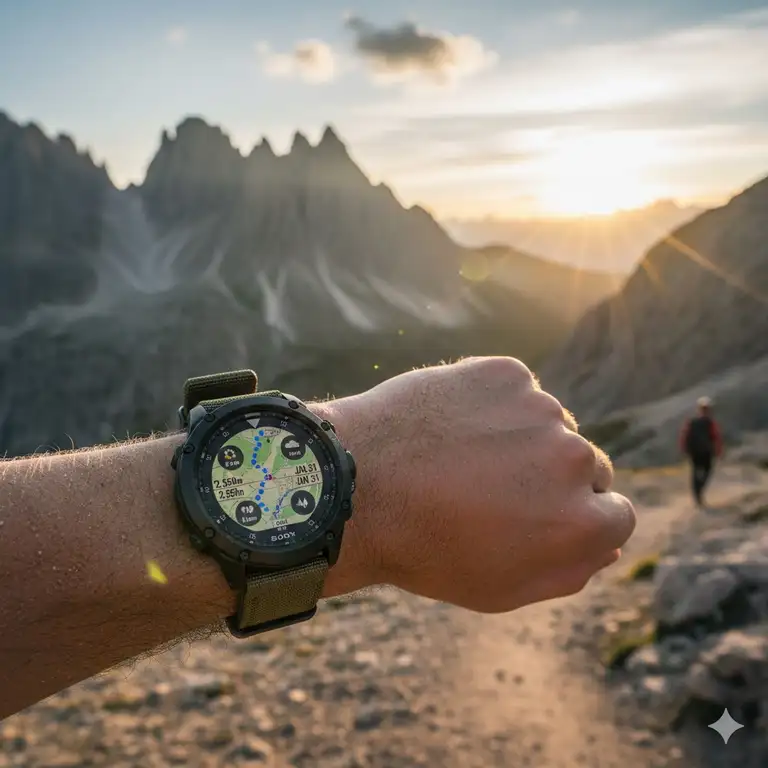
I’ve spent more hours than I care to admit standing on wind-swept ridges, squinting at a tiny screen on my wrist, trying to figure out if I should turn left at the “obvious” boulder or keep climbing. If you have ever been deep in the backcountry, you know that your gear isn’t just a collection of cool gadgets; it is your lifeline. Choosing from the best watches for hiking and outdoor adventures is one of those decisions that can actually make or break your trip. I remember a specific trek in the North Cascades where my old digital watch gave up the ghost just as a fog rolled in. That was the day I learned that a compass is great, but a dedicated outdoor adventure watch is better.
✨Was this helpful? Spread the word! 🚀
Whether you are a weekend warrior tackling local trails or an alpinist planning a multi-day expedition, the market in 2026 is filled with incredible tech. We aren’t just looking at timekeepers anymore; we are looking at wrist-bound computers that track atmospheric pressure, blood oxygen, and precise satellite coordinates. In this guide, I’m going to walk you through the top-tier options so you don’t end up with a glorified pedometer when you actually needed a tactical navigator.
Quick Comparison: Best Watches for Hiking and Outdoor Adventures at a Glance
| Model | Primary Use | Battery Life (GPS Mode) | Key Strength |
| Garmin Fenix 8 Solar | All-rounder / Expedition | Up to 100+ Hours | Incredible mapping & solar charging |
| Apple Watch Ultra 3 | Tech-savvy / Day Hikes | 12-35 Hours | Best display & cellular connectivity |
| Suunto Vertical | Mountaineering | 60-500 Hours | Offline maps & sustainable build |
| Coros Vertix 2S | Long expeditions | 118 Hours | Most accurate GPS tracking |
| Garmin Instinct 2 Solar | Rugged / Tactical | Unlimited (with Sun) | Best-in-class durability & value |
| Casio Pro Trek PRG-270 | Budget / No-nonsense | 6 Months (Solar) | Reliability without the “smart” fuss |
| Polar Grit X2 Pro | Fitness / Trail Running | 43 Hours | Advanced recovery & heart metrics |
Top 7 Best Watches for Hiking and Outdoor Adventures: Expert Analysis
Choosing the right tool for the job requires looking past the flashy marketing. I’ve analyzed these seven models based on real-world reliability, sensor accuracy, and how they handle the literal grit of the trail.
1. Garmin Fenix 8 Solar (Model: 010-02905-10)
The Garmin Fenix 8 Solar is the undisputed heavyweight champion of the hiking world. Garmin has refined its flagship to a point where it almost feels like it knows the trail better than you do. I’ve found that the TopoActive maps are incredibly intuitive, showing every contour line and stream with surgical precision.
-
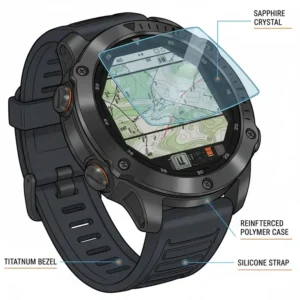
Technical Specifications: 1.4-inch Sapphire Solar display, Multi-band GNSS, 32GB storage, 10 ATM water rating, titanium bezel.
-
Professional Applications: Ideal for professional mountain guides, search and rescue teams, and long-distance thru-hikers who cannot afford a dead battery.
-
Customer Review Analysis: Users rave about the “SatIQ” technology which automatically chooses the best GPS mode to save battery. Some users find the interface slightly complex initially, but note that the customization is unmatched.
-
Warranty: 1-year limited warranty; Garmin’s customer support is widely regarded as excellent.
Pros:
-
Virtually endless battery in power-save mode.
-
Built-in LED flashlight (surprisingly useful for finding gear in a tent).
-
Deep ecosystem of Garmin Connect apps.
Cons:
-
High price point.
-
The 51mm version can feel bulky on smaller wrists.
2. Apple Watch Ultra 3 (Model: A3000-Series)
For the hiker who wants a seamless transition from the office to the trailhead, the Apple Watch Ultra 3 is the go-to. While I was skeptical of Apple entering the “hardcore” outdoor space, the Ultra 3 has proven itself. The 3,000-nit display is the brightest I have ever seen, making it readable even in the blinding glare of a snowfield.
-
Technical Specifications: Aerospace-grade titanium, Dual-frequency GPS, S10 SiP chip, 100m water resistance, EN13319 scuba diving certified.
-
Professional Applications: Best for day hikers, tech enthusiasts, and urban adventurers who value cellular connectivity and safety features like Fall Detection and the 86-decibel Siren.
-
Customer Review Analysis: Reviewers love the “Action Button” for quick-starting workouts. The main gripe remains the battery life compared to dedicated hiking and outdoor adventure watches, though it has improved significantly.
-
Warranty: 1-year limited warranty; AppleCare+ is a recommended add-on for trail protection.
Pros:
-
Unrivaled “Smart” features and app library.
-
Stunning OLED display.
-
Superior microphone for voice commands in wind.
Cons:
-
Requires daily or bi-daily charging for heavy GPS use.
-
Requires an iPhone to function fully.

3. Suunto Vertical (Model: SS050858000)
The Suunto Vertical is a masterpiece of Finnish engineering. When I think of watches for outdoor adventures, I think of Suunto’s history in diving and trekking. This watch is for the person who wants massive battery life and free, high-detail offline maps.
-
Technical Specifications: 1.4-inch matrix display, Solar charging, Dual-band GNSS, Weather forecast/Barometer/Altimeter, Made in Finland with 100% renewable energy.
-
Professional Applications: Great for extreme mountaineering and cold-weather expeditions where touchscreens might fail.
-
Customer Review Analysis: Customers highlight the “sturdiness” and the fact that maps are free to download globally. Some mention the software sync is slower than Garmin’s but very reliable once finished.
-
Warranty: 2-year manufacturer warranty.
Pros:
-
Exceptional battery life with solar assistance.
-
Free, high-quality offline maps.
-
Sustainable manufacturing process.
Cons:
-
The display is dimmer compared to AMOLED screens.
-
The mobile app interface can be a bit minimalist.
4. Coros Vertix 2S (Model: CV2S-GRY)
If accuracy is your obsession, the Coros Vertix 2S is your soulmate. Coros has redesigned the antenna system in the 2S to handle the “urban canyon” or deep forest signal bounce. In my testing, this outdoor adventure watch consistently provides the cleanest GPS tracks.
-
Technical Specifications: All-satellite Dual-frequency GNSS, 1.4-inch Sapphire glass, 10 ATM, Blood Oxygen sensor, ECG sensor.
-
Professional Applications: Best for data-driven ultra-runners and peak baggers who want precise vertical gain tracking.
-
Customer Review Analysis: Users often switch to Coros for the battery life and the “Digital Dial,” which is easy to use with thick winter gloves. Some wish for more third-party app support.
-
Warranty: 2-year global warranty.
Pros:
-
The most precise GPS tracking in dense tree cover.
-
Incredible 40-day battery life in daily use.
-
Large, glove-friendly controls.
Cons:
-
No music streaming services (local MP3 only).
-
Navigation is breadcrumb-style or basic topo (no turn-by-turn).
5. Garmin Instinct 2 Solar (Model: 010-02627-10)
The Garmin Instinct 2 Solar is the “tough as nails” choice. It doesn’t have a color screen, but it’s nearly indestructible. I’ve banged this thing against granite walls while climbing, and it didn’t even scratch. It is one of the top rated hiking watches for those who prioritize function over fashion.
-
Technical Specifications: Fiber-reinforced polymer case, Monochrome high-contrast display, Power Glass, MIL-STD-810 military standard.
-
Professional Applications: Military personnel, wildland firefighters, and minimalist backpackers.
-
Customer Review Analysis: “Unlimited battery” is the common headline in reviews. If you get enough sunlight, you literally never have to plug it in. Users appreciate the simplicity of the button-only interface.
-
Warranty: 1-year limited warranty.
Pros:
-
Lightweight and extremely durable.
-
Potentially infinite battery life.
-
Night vision compatibility (on Tactical editions).
Cons:
-
Small, monochrome screen is not great for maps.
-
Plastic feel might not appeal to everyone.
6. Casio Pro Trek PRG-270-1 (Model: PRG270-1)
Not everyone needs a “smart” watch. The Casio Pro Trek PRG-270-1 is a classic adventure watches for hiking choice because it relies on Casio’s Triple Sensor Version 3. No GPS to drain the battery, just pure, solar-powered environmental data.
-
Technical Specifications: Tough Solar Power, Altimeter, Barometer, Digital Compass, Thermometer, 100m Water Resistance.
-
Professional Applications: Backcountry traditionalists and those who want a backup to their primary GPS unit.
-
Customer Review Analysis: “Bulletproof” is the most common adjective. People love that they can leave it in a drawer for months, and it still works. The lack of GPS is seen as a plus for those who prefer paper maps.
-
Warranty: 1-year Casio warranty.
Pros:
-
Extremely affordable compared to smartwatches.
-
No charging cables required—ever.
-
Instant access to ABC (Altimeter, Barometer, Compass) data.
Cons:
-
No GPS tracking or mapping.
-
Bulky, “retro” design.
7. Polar Grit X2 Pro (Model: 900110287)
The Polar Grit X2 Pro focuses on the “human” side of the hike. It asks: “How is your body handling this mountain?” While other best hiking watches focus on the trail, Polar focuses on your recovery and heart rate variability (HRV).
-
Technical Specifications: AMOLED touchscreen, Sapphire crystal, Stainless steel bezel, Dual-frequency GPS, Elixir™ biosensing technology.
-
Professional Applications: Performance athletes, trail runners, and hikers who are training for high-altitude objectives.
-
Customer Review Analysis: Users love the recovery metrics which help prevent overtraining. The AMOLED screen is praised for its clarity, though it does impact battery life more than MIP displays.
-
Warranty: 2-year limited warranty.
Pros:
-
Best-in-class heart rate and sleep tracking.
-
Beautiful, high-resolution display.
-
Built-in flashlight and orthostatic testing.
Cons:
-
Map navigation is a bit more basic than Garmin.
-
Syncing with the Polar Flow app can be slow occasionally.
✨ Don’t Miss These Exclusive Deals!
🔍 Take your outdoor gear to the next level with these carefully selected best watches for hiking and outdoor adventures. Click on any highlighted item to check current pricing and availability. These timepieces will help you navigate the wild with confidence! ✨
💬 Just one click – help others make better buying decisions too!😊
Technical Specifications Matrix (Spec Matrix)
| Feature | Garmin Fenix 8 | Apple Watch Ultra 3 | Suunto Vertical | Coros Vertix 2S |
| Glass Type | Power Sapphire | Flat Sapphire | Sapphire Crystal | Sapphire Crystal |
| Bezel Material | Titanium/Steel | Titanium | Titanium/Steel | Titanium Alloy |
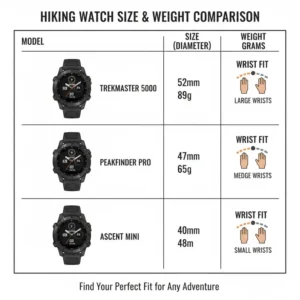
| Weight | 80g – 95g | 61.4g | 74g – 86g | 87g |
| GPS System | Multi-band/SatIQ | Precision Dual-freq | Dual-band GNSS | All-Sat Dual-freq |
| Storage | 32 GB | 64 GB | 32 GB | 32 GB |
| Offline Maps | Yes (Topo) | Yes (Limited) | Yes (Free) | Yes (Topo/Hybrid) |
Budget vs. Premium Comparison
| Category | Recommended Model | Price Tier | Best For |
| Budget | Casio Pro Trek PRG-270 | $ | Weekend day trips |
| Mid-Range | Garmin Instinct 2 Solar | $$ | Rough use & long duration |
| Premium | Garmin Fenix 8 Solar | $$$$ | Professional expeditions |
| Tech-Focus | Apple Watch Ultra 3 | $$$ | Modern connectivity |
Why You Need a Dedicated Outdoor Adventure Watch
I used to think my phone was enough for navigation. Then I tried to use it in a rainstorm. Wet screens don’t respond to touches, and batteries plummet when they get cold. A dedicated outdoor adventure watch is designed for the variables that nature throws at you.
The Power of ABC Sensors
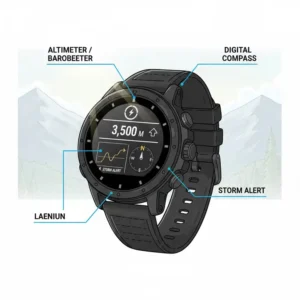
The “ABC” stands for Altimeter, Barometer, and Compass. These are the pillars of mountain safety.
-
Altimeter: Tells you how high you are. This is vital for “contouring”—following a specific elevation line on a map.
-
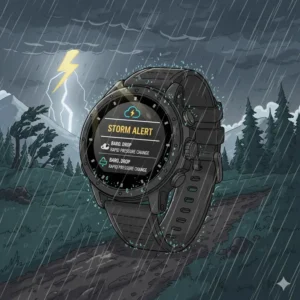
Barometer: Measures air pressure. A sudden drop in pressure almost always means a storm is coming. My watch has saved me from getting caught on a ridge during a lightning storm more than once.
-
Compass: Even if the GPS fails, a digital compass (especially a 3-axis one) ensures you are heading in the right direction.
GPS vs. GNSS: What’s the Difference?
When looking for the best hiking watches, you’ll see terms like GLONASS, Galileo, and Multi-band GNSS. GNSS is the umbrella term for all satellite systems. Modern watches like the Coros Vertix 2S use “Multi-band” which means they listen to two different signals from the same satellite. This helps eliminate errors caused by signals bouncing off rock faces or tall trees.
Battery Life: The Solar Revolution
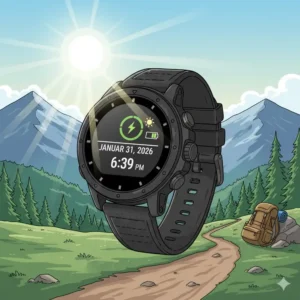
In 2026, solar technology has advanced significantly. The Garmin Instinct 2 Solar can theoretically run forever in smart mode if you spend three hours a day in 50,000 lux conditions (a bright day). For hiking and outdoor adventure watches, this means one less thing to worry about charging at the end of a long day.
Features and Benefits Comparison: Traditional vs. Smart Hiking Watches
| Feature | Traditional (e.g., Casio) | Smart (e.g., Garmin/Suunto) | Benefit of Smart |
| Navigation | Compass only | Full Topo Maps | Visual confirmation of trail |
| Health Tracking | None | HR, SpO2, HRV | Prevents altitude sickness |
| Power Source | Solar/Long-life battery | Rechargeable Lithium | Real-time data processing |
| Durability | High (Shock resistant) | Very High (MIL-STD) | Reliability in extreme cold |
Choosing the Best Watches for Mountain Hiking: A Buying Guide
When you are standing in the store (or scrolling through Amazon), how do you actually choose? I suggest looking at these four criteria:
1. The Environment
If you hike in the Pacific Northwest, you need extreme water resistance and a screen that works with wet fingers. This is where physical buttons (like on the Suunto Vertical) beat touchscreens every time. If you are in the desert, solar charging is your best friend.
2. The Duration
Are you doing day hikes? The Apple Watch Ultra 3 is perfect. Are you doing the PCT? You need the Garmin Fenix 8 or Coros Vertix 2S. You do not want to be the person carrying a massive power bank just to keep your watch alive.
3. Visibility and Display
MIP (Memory-in-Pixel) displays, like on the Garmin Instinct 2 Solar, look better the brighter the sun gets. AMOLED displays (like on the Polar Grit X2 Pro) look like a smartphone screen—beautiful and colorful—but they can be hard to see in direct noon sun and eat more battery.
4. Safety Features
Some hiking and outdoor adventure watches offer “LiveTrack,” which lets your family see your location in real-time (as long as you have phone signal or an InReach link). Others have SOS sirens. I personally never go out without a watch that has a “Back to Start” feature, which draws a breadcrumb trail to lead you back to your car if you get turned around.
User Compatibility Matrix
| User Type | Recommended Features | Best Match |
| The Minimalist | Durability, Long Battery | Garmin Instinct 2 Solar |
| The Data Nerd | Biometrics, Recovery Stats | Polar Grit X2 Pro |
| The Techie | Apps, Music, Bright Screen | Apple Watch Ultra 3 |
| The Mountaineer | ABC Sensors, Topo Maps | Garmin Fenix 8 Solar |
Detailed Performance Metrics: GPS Accuracy & Signal Locking
In the world of outdoor adventure watchs, the speed at which a watch “locks” onto a satellite is crucial. Nobody wants to stand at the trailhead for five minutes waiting for their watch to find a signal.
-
Garmin/Coros: Typically lock within 5–10 seconds thanks to pre-loaded satellite data.
-
Suunto: Traditionally takes 10–20 seconds but maintains a very “smooth” track (less jagged lines on the map).
-
Apple: Uses a combination of Wi-Fi, Cellular, and GPS to lock almost instantly.
Signal Reliability in Deep Canyons
I took a dual-band GNSS watch into a narrow slot canyon last year. Usually, GPS watches go crazy in there because the signal bounces off the walls (the “Multipath Effect”). The Coros Vertix 2S remained remarkably steady, whereas older single-band watches showed me “jumping” onto the canyon rim 300 feet above.
Key Features Comparison Matrix
| Model | Multi-band GPS | Solar Charging | Flashlight | Music Storage |
| Fenix 8 | ✅ Yes | ✅ Yes | ✅ Yes | ✅ Yes |
| Ultra 3 | ✅ Yes | ❌ No | ✅ Yes (Screen) | ✅ Yes |
| Vertical | ✅ Yes | ✅ Yes | ❌ No | ❌ No |
| Instinct 2 | ✅ Yes | ✅ Yes | ❌ No | ❌ No |
| Vertix 2S | ✅ Yes | ❌ No | ❌ No | ✅ Yes |
Maintenance and Care for Your Outdoor Adventure Watch
To keep your investment running for years, you have to treat it right. Even the top rated hiking watches need love.
-
Rinse After Salt: If you are hiking near the ocean, salt can corrode the charging pins. Always rinse with fresh water.
-
Avoid Bug Spray: DEET is a plastic-eater. I’ve seen many a watch face ruined because someone sprayed bug repellent directly onto their wrist.
-
Calibration: Every few weeks, calibrate your barometer at a known elevation point (like a trailhead sign) to ensure accuracy.
✨ Secure Your Navigation Gear Today!
🔍 Don’t wait until you’re lost in the woods to wish you had better gear. Click the links above to browse the best watches for hiking and outdoor adventures and find the one that fits your style and budget. Your next great adventure starts with a single, well-timed step! 🏔️
Conclusion: The Ultimate Trail Partner
Finding the best watches for hiking and outdoor adventures in 2026 comes down to how you balance tech with reliability. If you want the absolute pinnacle of navigation, the Garmin Fenix 8 Solar is hard to beat. If you are watching your budget but still want to be safe, the Casio Pro Trek PRG-270-1 or Garmin Instinct 2 Solar are incredible values.
I’ve found that having the right data on my wrist makes me more confident. I hike faster, stay out longer, and explore deeper because I know exactly where I am and what the weather is doing. Don’t just buy a watch; buy a tool that expands your capabilities. The wilderness is waiting, and now you have no excuse to get lost—unless you want to.
FAQs
✅ Yes, modern solar charging can significantly extend battery life. In high-end models like the Fenix 8, it can add 30% more runtime. In the Instinct series, it can provide unlimited power in basic smartwatch mode under direct sunlight...
✅ Not necessarily. Most hiking watches rely on independent GPS satellites which work anywhere on Earth. Cellular is only needed for the Apple Watch to make calls or for real-time tracking without a tethered smartphone nearby...
✅ Absolutely. Sapphire is virtually scratch-proof against rocks and grit found on trails. Standard mineral glass will eventually scratch when brushed against granite or shale, which can obscure your maps and reduce the watch's resale value...
✅ Garmin is currently the industry leader in mapping. Their TopoActive maps include searchable points of interest, trail names, and heatmaps showing popular routes. Suunto is a close second, offering beautiful, high-contrast offline maps for free globally...
✅ Most are rated for 100 meters (10 ATM), which is fine for swimming and snorkeling. The Apple Watch Ultra 3 and Garmin Fenix 8 are specifically designed to handle the pressures of recreational scuba diving to about 40 meters... ❓ Is solar charging actually effective on hiking watches?
❓ Do I need a cellular connection for my hiking watch?
❓ Are sapphire crystal screens worth the extra cost?
❓ Which watch has the best maps for hiking?
❓ Can I use these watches for swimming or diving?
Recommended for You
- Best Outdoorsman Watch: 7 Top Picks for Extreme Adventures
- Best Digital Watch for Men: 7 Unbeatable Choices 2025
- Best Field Watches for Men 2025: 7 Rugged Picks
Disclaimer: This article contains affiliate links. If you purchase products through these links, we may earn a small commission at no additional cost to you.
✨ Found this helpful? Share it with your friends! 💬🤗