A two-pack of the Abanen Hook and Loop Quick Dry Watch Band costs about half as much as a single Garmin UltraFit Nylon Strap, according to an August 2025 Tom’s Guide piece by a writer who tests Garmin watches for a living. A gap that wide makes it tempting to buy garmin watch bands on price alone, and in 2027 that habit still ends in returns. Garmin builds its watches around several widths and more than one attachment system, so a band that matches the width can still refuse to click in.
Because none of these bands passed through my hands, the fit and durability notes below are credited to Garmin’s manuals, threads on Garmin’s own forum and the reviewers who wore them. Whichever Garmin smart watch you own, a fenix, a Forerunner or a Venu, two checks come before color or material: the band width in millimeters, and the connector that holds it to the case.
In short: QuickFit watches such as the fenix 7 and fenix 8 take a clip-on band by hand, spring-bar models such as the Venu 3 take a different 22 mm band, and the four picks near the end cover each case. The Garmin QuickFit 22 Silicone Watch Band suits a QuickFit watch, the Garmin UltraFit Nylon Strap and the Abanen Hook and Loop Quick Dry Watch Band are the two fabric routes, and the Garmin Charging/Data Cable handles the lost-or-frayed-charger problem that tends to surface at the same time.
Garmin watch band: how to change it in five steps
Swapping takes about a minute once the right band is in hand. The five steps below cover the three connector styles that Garmin’s manuals describe.
Read the width off the band, then check it against the case
QuickFit bands come in 20, 22 and 26 mm, while standard quick-release bands typically come in 18, 20 and 22 mm, according to the band retailer WatchBand.Direct. A tiny label inside the band near the watch face usually gives the number, per Road ID’s Garmin sizing guide. With no old band to read, measure the gap between the lugs and round down, a rule the band seller StrapsCo spells out with a 20.8 mm reading becoming a 20 mm order.
Case size and width travel together on bigger families. For the fenix 8, band retailers and a dive shop’s spec page agree that the 43 mm case takes 20 mm, the 47 mm takes 22 mm and the 51 mm takes 26 mm. Garmin’s own Venu 3 manual states that the Venu 3S has 18 mm bands and the Venu 3 has 22 mm bands.
Name the connector: QuickFit, spring bar or watch pin
Width alone does not decide fit. StrapsCo notes that QuickFit 22 and standard 22 mm quick-release bands use different connectors, and both width and connector have to match. Garmin’s manuals back that up: the fenix 7 series manual describes a latch on a QuickFit band, the Venu 3 manual describes a quick-release pin on a spring bar, and the Forerunner 970 manual describes pushing in a watch pin with a pin tool while listing QuickFit 22 bands as compatible.
Release the old band
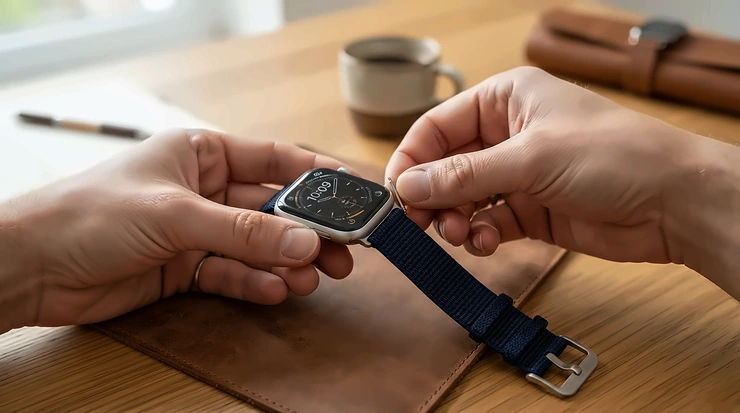
On a QuickFit watch, slide the latch on the band and lift the band off the case, as Garmin’s fenix 7 manual lays out. On a spring-bar watch such as the Venu 3, slide the quick-release pin on the spring bar instead. Pin-style watches work differently again: the Forerunner 970 manual calls for a pin tool, and Garmin’s Instinct Solar Tactical manual says a paper clip will push the pin in. Repeat on the other side.
Seat the new band and test the latch
Line the new band up, press it into place and confirm the latch closes over the watch pin, which is Garmin’s own wording for QuickFit bands. Give it a firm tug before leaving the house. When a Forerunner 970 owner moves to a QuickFit 22 band, the manual says to take the watch pin out of the old band and put it into the watch. A reviewer on a retailer mirror of an Amazon listing for a QuickFit-style 22 mm band made the same point from the other direction, urging buyers to keep the Garmin pins.
Set the fit, then rotate two bands
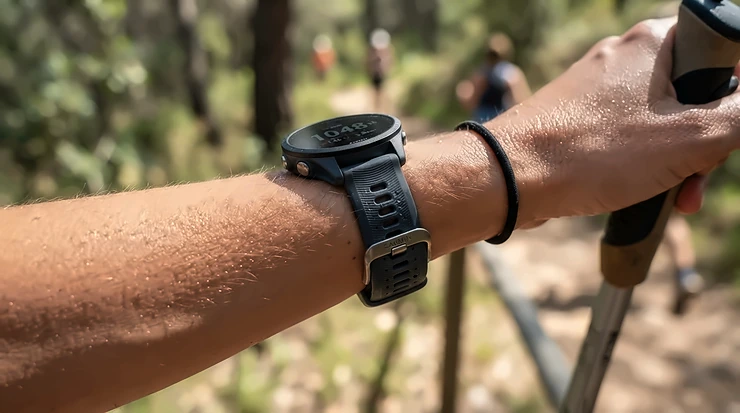
Tom’s Guide points out that nylon bands can be pulled to any tightness while silicone depends on fixed holes, and it suggests owning two bands so one can dry after a shower. The same writer still wears a chest strap when heart-rate accuracy matters. One buyer on a retailer page loosened a stock silicone band to sleep more comfortably, found the readings went off, and settled on a nylon band instead. That is a single report, but it explains why sensor contact belongs in the fit decision.
Widths and connectors for five Garmin smart watch families
The table pulls the manual-backed facts together with the retailer-reported widths, so you can see which source stands behind each row.
Watch
Band width
Connector
Where it comes from
fenix 7 and 7 Pro (47 mm)
22 mm
QuickFit
Garmin fenix 7 manual; band retailers
fenix 8 (43, 47 and 51 mm)
20, 22 and 26 mm
QuickFit
Band retailers; a dive shop’s spec page
Forerunner 970
22 mm
Pin-style, accepts QuickFit 22
Garmin Forerunner 970 manual
Forerunner 265 and 265S
22 and 18 mm
Quick-release spring bar
Band retailers, several in agreement
Venu 3 and 3S
22 and 18 mm
Quick-release spring bar
Garmin Venu 3 manual
Whichever model you rate as the best Garmin watch for your training, the band follows case size and connector, not price tier. The Forerunner 970 row is the unusual one, since a pin-style watch still accepts QuickFit 22 bands under Garmin’s manual. StrapsCo makes the opposite point for another Forerunner: a Venu 3’s 22 mm quick-release band will not fit a Forerunner 965 even though the width matches. Suffix letters such as S and X are where mix-ups start, so match the exact model name against Garmin’s manual for it before ordering.
Four ways a Garmin band order goes wrong, and what owners did about it
Ordering by width and ignoring the connector
A 22 mm label says nothing about whether the end of the band is a QuickFit latch or a spring bar. The recovery is the changing-the-bands page of your own watch’s manual, which names the system and the width in one place.
Trusting any clip-on band to hold
Garmin’s forum shows how mixed the evidence is. In a locked thread on fenix 6 bands coming off, one owner reported losing a fenix 6X while surfing, another lost a watch after hitting lane ropes in swim training, and a third had used twelve bands without trouble. Posters never settled whether genuine or third-party bands were the weak point. A separate fenix 6X thread has an owner whose genuine band kept popping off; he said it “just unclips itself at the quickfit” when his wrist brushed something. Three other posters in that thread reported no such problems with genuine QuickFit bands, so the evidence is thin in both directions.
A Forerunner 935 thread leans harder on cheap clones. One owner reported that two of six inexpensive QuickFit-style bands popped off under slight pressure even when worn tight, calling them stiff and poorly made, and another said cheap online versions were not reliable. Several posters there countered that wrist tension keeps the hooks engaged. Both threads agree on one habit, which is checking that the latch seats fully. One poster in the fenix 6X thread moved to a hook-and-loop nylon band and noted that if its fastening loosens, the band stays closed around the wrist.
Forcing a loop-through band onto a QuickFit watch
A fenix 7 thread on Garmin’s forum shows the learning curve. One poster found a third-party strap fit perfectly because only the end without the plastic piece had to be threaded through, while another advised against removing the watch’s pins at all and called threading the intended method. A third poster’s fabric straps from other Garmin watches had ends too thick to pass through the fenix 7 pins. Thewearify’s roundup of UltraFit models also flags pin removal and fiddly pin seating on several of them, though the site says it analyzed reviews and spec sheets rather than wearing the straps. The practical fix is to pick bands whose listing names your exact watch and to keep the original pins.
Wearing a band past its useful life
StrapsCo sells its own FKM rubber bands and so has a stake in the answer, but its guide says bands commonly fail around 15 to 18 months of daily wear, at the keeper loop, the band body or the connector. It recommends a monthly check and rotating two bands. Treat the number as a seller’s estimate; the rotation advice matches what Tom’s Guide suggests.
Garmin watch charger: one four-pin port, with a few exceptions
A band swap often lands on the same day as a lost or frayed charger, and the cable is its own compatibility question. The Australian retailer MobileMob says most Garmin watches released since 2017 charge through one four-pin connector, covering the fenix 5 to 8 series and the Forerunner, Venu, Instinct, Epix and vivoactive ranges, and that a phone charger alone will not do because the watch end is Garmin’s own port. Older models such as the fenix 3, Forerunner 620 and original vivoactive used their own docks.
DC Rainmaker’s roundup of Garmin keyring chargers and USB-C cables, dated 2021, says its chargers suit any watch with the standard Garmin port and excludes watches that ship with clip-on chargers, such as the Forerunner 645 and the MARQ line. Its author also bought a cable from another brand that would not charge at all, so not every cheap cable works. Reviewers on retailer pages for third-party two-packs split: one said a pack charged just like the original, another that charging took about half again as long, and a Vivoactive 4 owner said a cable failed after the second charge while complaining that official cables fail quickly too.
Garmin watch bands reviews: where sources agree and where they split
The clearest agreement is price. Android Central’s Forerunner 745 guide calls Garmin’s own bands comfortable and reliable with cost as the only drawback, and Tom’s Guide describes the UltraFit as the expensive option next to third-party nylon at a fraction of the price. Material is where the sources split. Tom’s Guide favors nylon for adjustable tightness and faster drying, Thewearify’s review analysis rates one UltraFit model as drying faster than silicone while noting another stays wet after swimming, and the forum evidence above is mixed on clip reliability. None of the pages gathered for this piece includes a controlled durability test of Garmin bands against third-party ones, so every finding here is an owner or reviewer report.
Best Garmin watch bands for each job, with the trade-off on each
These four are not ranked. Each one answers a step above: a clip-on band for QuickFit watches, two fabric options, and a cable for the charger question.
Model
Attaches to
Material
Price range
Garmin QuickFit 22 Silicone Watch Band
QuickFit 22 watches, such as the fenix 7 and 47 mm fenix 8
Silicone
Around $40 to $50
Garmin UltraFit Nylon Strap
Loops around the watch pins; 20, 22 and 26 mm
Dual-layer nylon, hook-and-loop
Around $40
Abanen Hook and Loop Quick Dry Watch Band
Loops around the watch pins; 20, 22 and 26 mm versions
Woven nylon, hook-and-loop
Around $20 to $25 for a two-pack
Garmin Charging/Data Cable
Standard four-pin Garmin port
Cable with USB plug
Check the current price on Amazon.com
The two nylon options differ mostly in how many bands you get: Tom’s Guide’s comparison puts two Abanen bands at about half the cost of one UltraFit. Garmin’s silicone band is the only band here that clicks on without any threading. The cable is the one item that is not a band, and its price needs a live check on Amazon.com.
Tool-free swapping is the whole point of this band. It carries Garmin’s own QuickFit connector, so on a fenix 7 or a 47 mm fenix 8 it follows the latch-and-press routine from Garmin’s manual with nothing to thread. The 22 mm size is one of three, and retailers also sell 20 and 26 mm versions for the smaller and larger cases. Android Central’s guide and retailer pages put Garmin’s silicone bands at around $40 to $50.
Android Central’s Forerunner 745 guide calls Garmin’s own bands comfortable and reliable. Thewearify, by contrast, faults the stock silicone for trapping sweat and irritating skin, an opinion inside a review roundup rather than a wear test. On the Garmin forum, a fenix 6X owner reports a genuine QuickFit band popping off repeatedly while three other posters in the thread report none, so treat it as one bad experience until more turn up.
Pros:
✅ Clips on and off by hand, with no tool and no threading
✅ The same connector Garmin ships on its QuickFit watches
Cons:
❌ Fixed holes, so no fine adjustment between sizes
❌ Costs more than most third-party silicone bands, per Android Central
Garmin QuickFit 22 Silicone Watch BandSee current price, sizes and reviews on Amazon.
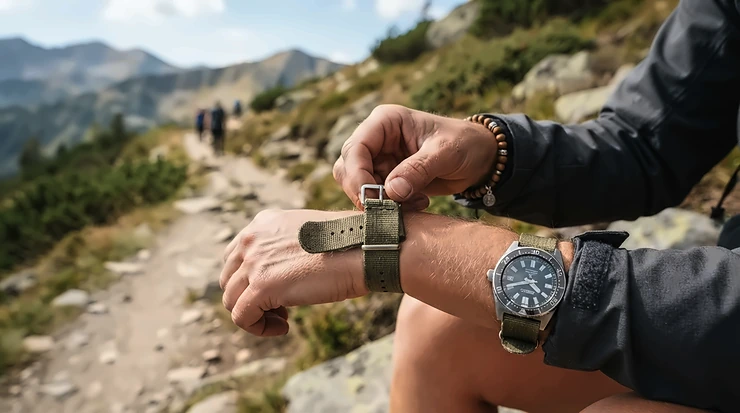
This strap threads around the watch pins instead of clicking onto them, which brings a learning curve the silicone band does not have. Garmin’s description, repeated on a retailer’s pages, calls for a dual-layer antimicrobial nylon weave closed by two sets of hook-and-loop fasteners, sold in 20, 22 and 26 mm widths. A retailer lists the length at 286 mm, and Tom’s Guide puts the price at around $40 per strap.
Thewearify’s roundup of UltraFit models says buyers report little fraying after months of wear and describes the nylon as softer and quicker to dry than silicone, while also flagging pin removal and fiddly seating on several models. That matches the fenix 7 forum thread above, where one poster warned against removing that watch’s pins. Tom’s Guide adds that Garmin ships the Enduro 3 and Venu X1 with nylon bands as standard. A retailer’s page lists a 12-month limited warranty.
Garmin UltraFit Nylon StrapSee current price, sizes and reviews on Amazon.
Price is the draw. Tom’s Guide found a two-pack at around $20 and called it almost as nice as the UltraFit, and Thewearify’s roundup puts Abanen two-packs under $25. Listing copy on a retailer mirror describes a woven nylon band with a hook-and-loop closure, a wrist range of 130 to 230 mm and machine washing, in versions for 20, 22 and 26 mm widths.
Owner evidence is mixed and specific. In the fenix 6X thread on Garmin’s forum, one poster switched to hook-and-loop nylon for comfort, another recommended a similar Abanen 26 mm band, and a third found a velcro band loosened when wet and moving. A reviewer on a retailer mirror needed a metal hook and pliers to pull a 26 mm band under the spring bar, another noted there is no quick release, which grates if you swap often, and a third valued being able to reuse Garmin’s original pins. Check current sizes and colors on Amazon.com.
Pros:
✅ Two bands in one pack at a low price
✅ Fabric holds any tightness, as Tom’s Guide notes about nylon
Cons:
❌ No quick release, and some buyers needed tools to install it
❌ Velcro loosened when wet for one forum poster
Abanen Hook and Loop Quick Dry Watch BandSee current price, sizes and reviews on Amazon.
Garmin’s own cable, part number 010-12491-01, has a charging clip on the watch end and a USB plug for a computer or an optional AC adapter, so one cable handles both charging and data. A European retailer’s compatibility list names the fenix 5 through 8 and E series, Forerunner models from 45 to 965, and the Instinct, Venu and vivoactive families, among others. Retailer specs describe a USB-A plug at the other end. USB-C cables exist from other sellers, which the DC Rainmaker roundup covers, and one retailer reviewer wished Garmin would move to a newer connector.
Reviewers on retailer pages describe the genuine cable as working consistently, and one said branded cords beat generic ones. It will not serve watches that ship with clip-on chargers. Check the current price on Amazon.com.
Garmin Charging/Data CableSee current price, sizes and reviews on Amazon.
Quick answers on Garmin band size, swapping and charging
❓ How do I change a Garmin watch band?
✅ On QuickFit watches such as the fenix 7, slide the latch, pull the band off, press the new one on and confirm the latch closes over the pin. Spring-bar models like the Venu 3 use a sliding pin, and pin-style models need a pin tool.
❓ Are QuickFit and quick-release bands interchangeable?
✅ No. A band can match your watch's width and still use the wrong connector. StrapsCo notes a Venu 3's 22 mm quick-release band will not fit a Forerunner 965, which takes QuickFit 22. Garmin's Forerunner 970 manual lists its own bands or QuickFit 22.
❓ What size band does my Garmin use?
✅ Most take 20, 22 or 26 mm bands tied to case size, and some smaller models take 18 mm. On a fenix 8, retailers say the 43 mm case takes 20, the 47 mm takes 22 and the 51 mm takes 26.
❓ Do third-party Garmin bands work as well as Garmin's own?
✅ Sources split. Tom's Guide calls a cheap nylon two-pack almost as nice as Garmin's pricier strap, while a Garmin forum owner reported two of six cheap QuickFit-style bands popping off under light pressure. Matching the connector and reading recent reviews matters more than the brand name.
❓ Can one charger charge any Garmin watch?
✅ Most Garmin watches since about 2017 share one four-pin port, so a single cable covers the fenix, Forerunner, Venu, Instinct and vivoactive families, per an Australian retailer's guide. Older models and watches that ship with clip-on chargers, such as the Forerunner 645, are exceptions.
The order to decide in: width, connector, material
Decide in the order the steps ran: width first, connector second, material last. A fenix 7 or fenix 8 owner who wants the simplest route can stay with the Garmin QuickFit 22 Silicone Watch Band in the right width. Someone who dislikes silicone against the wrist can compare the Garmin UltraFit Nylon Strap with the cheaper Abanen Hook and Loop Quick Dry Watch Band, remembering that both thread through the pins. Spring-bar watches such as the Venu 3 need their own quick-release bands, and the Garmin Charging/Data Cable covers the other half of keeping a watch running. For anyone choosing garmin watch bands this year, a band that clicks, locks and matches the stamped width beats a better color on the wrong connector. See which sizes and colors are in stock on Amazon.com.
Disclaimer: This post contains affiliate links. As an Amazon Associate, we earn from qualifying purchases made through these links, at no additional cost to you.
Read the number stamped inside the band before you read a single star rating.
WatchWiseHub is an independent buying-guide site for watches, smartwatches, straps and accessories. Our editorial team compares gear using manufacturer specifications, independent tests from specialist watch media, owner reports and retailer listings. We do not claim to have tested the watches ourselves; see How We Choose Gear for our method.