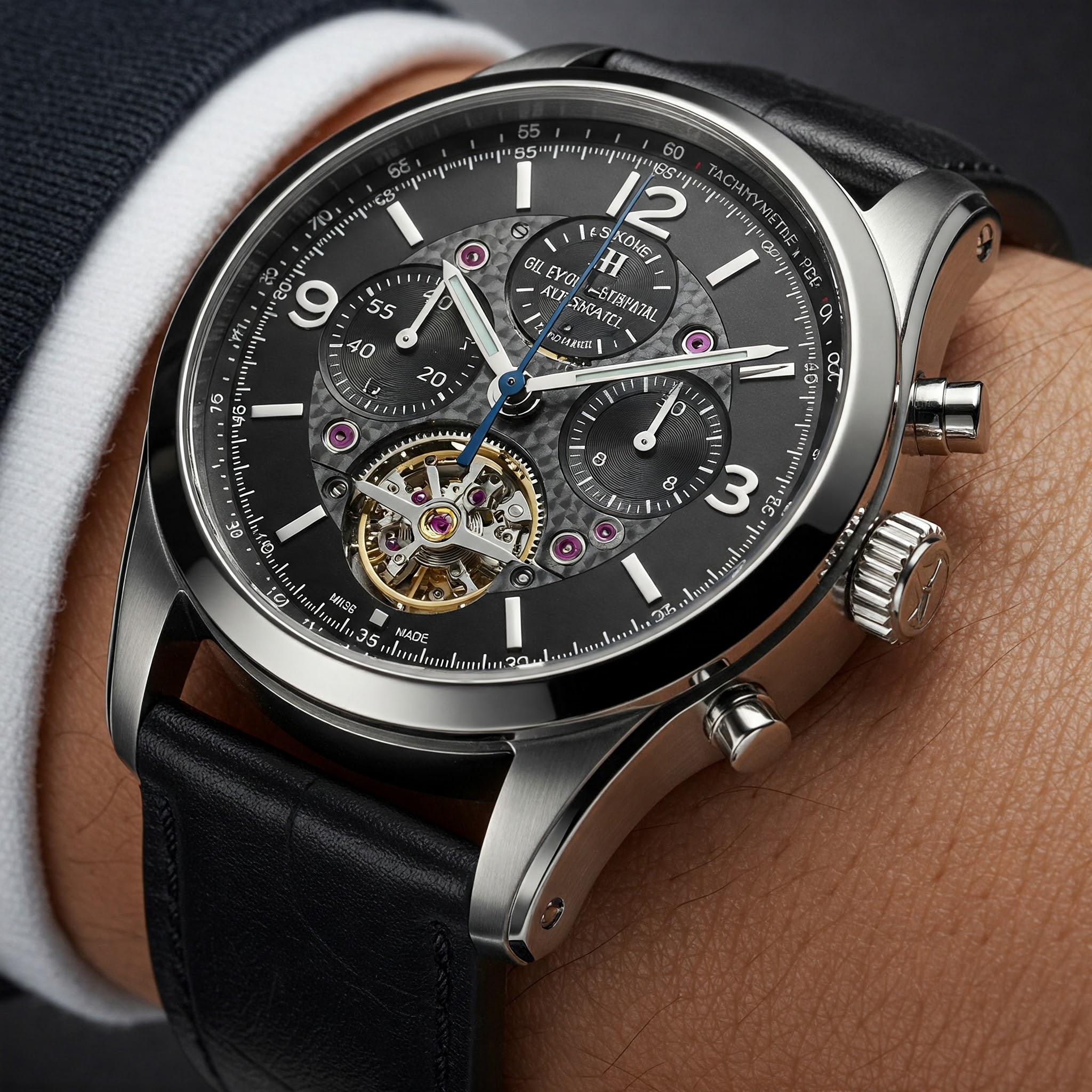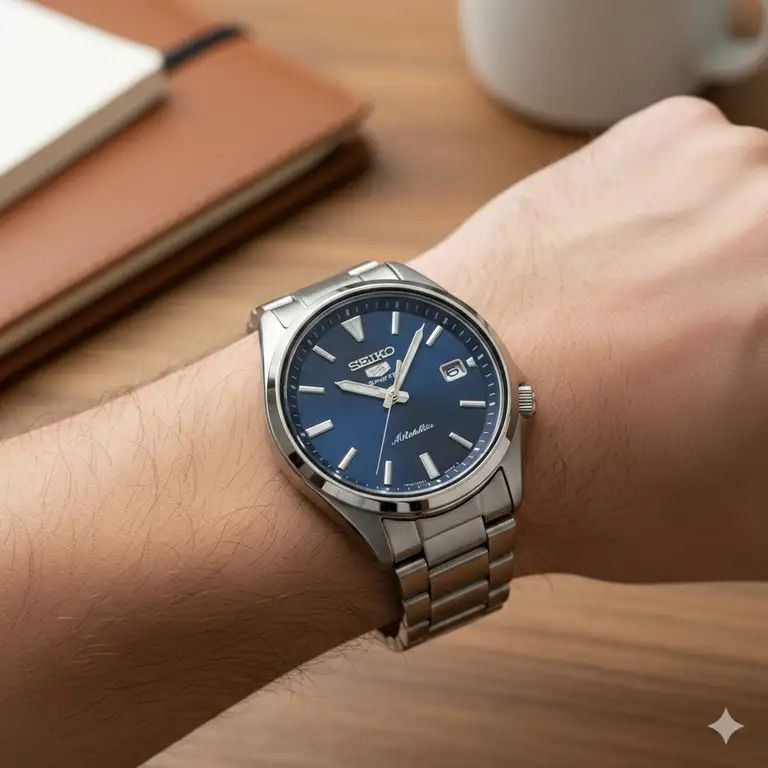
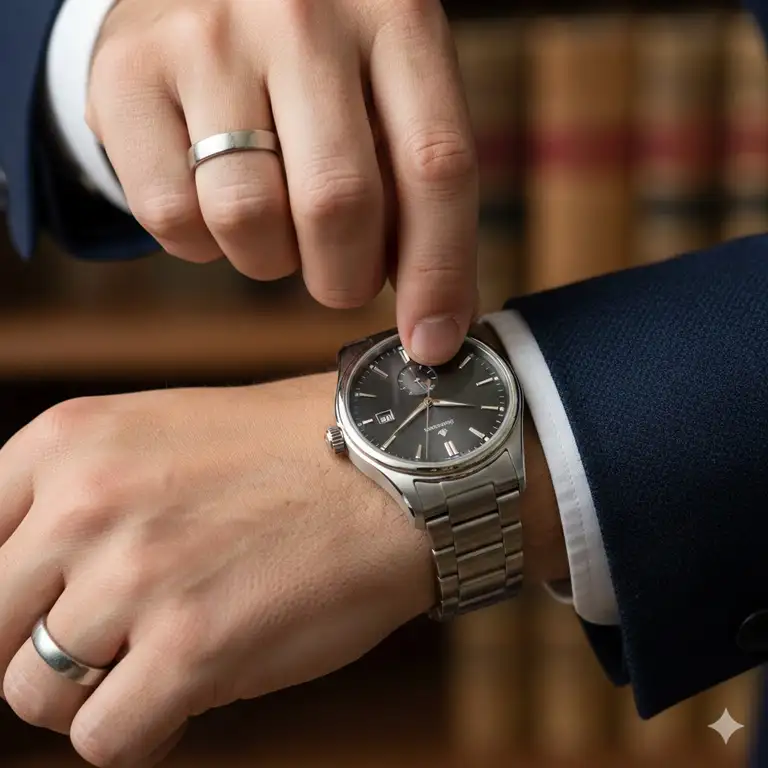
If you’re anything like me, the sheer satisfaction of wearing a beautifully crafted automatic watch is unmatched. It’s a tiny, complex machine, powered by the natural motion of your wrist. It’s essentially kinetic poetry on your arm! But what happens when that faithful companion has been resting a little too long? That’s when you need to know how to wind an automatic watch properly—not just to get it ticking, but to ensure its long-term health. Because, let’s be honest, few things are as frustrating as a dead watch when you’re rushing out the door.
Many new automatic watch owners mistakenly believe their timepiece is purely “set-it-and-forget-it.” However, whether you’re dealing with a sophisticated Swiss movement or a reliable Japanese workhorse, there’s a vital, initial step: the manual wind. Doing it incorrectly can actually stress the delicate internal mechanism, potentially leading to costly repairs. Therefore, understanding the nuances of how to wind an automatic watch properly is a fundamental skill for any true watch enthusiast. It’s about respecting the engineering.
✨Was this helpful? Spread the word! 🚀
For those eager to dive right into the best tools and accessories to keep their timepieces in peak condition, here is a quick overview of essential items we will detail further in this guide, comparing the manual winding process with the convenience of a dedicated watch winder.
| Feature | Manual Hand Winding (Crown) | Automatic Watch Winder |
| Initial Power | Essential for a stopped watch. | Excellent for maintenance and ongoing storage. |
| Control/Precision | High; allows specific turns. | Pre-programmed rotation cycles (TPD). |
| Convenience | Low; requires user interaction. | High; set it and forget it. |
| Mechanism Stress | Potential for wear if over-wound. | Minimal; designed for gentle, sustained motion. |
| Portability | Excellent; only requires the watch. | Low; requires a power source and physical space. |
| Cost | Free (no extra equipment needed). | Varies widely (Budget to Premium). |
🔑 The Mechanics: Why Does an Automatic Watch Need Manual Winding?
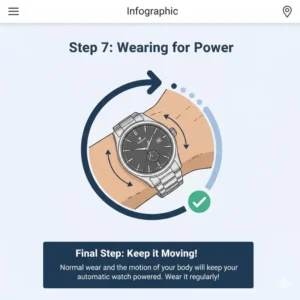
Automatic, or self-winding, watches operate via a rotor—a weighted semi-circular piece that spins with the movement of your wrist. This rotation winds the mainspring, storing energy to power the watch. However, for the watch to get enough power to start reliably and maintain accuracy, it often needs a “jump start,” especially if it has been sitting unworn for more than 40 hours. This is where the initial manual wind comes in.
The mainspring needs to be sufficiently tightened to deliver the optimal torque. A quick jiggle of the watch simply won’t cut it, and it won’t correctly prime the movement to achieve its rated power reserve. I’ve seen countless people frustrated by a watch that seems to keep poor time, only to find out they never properly wound it in the first place. You have to learn how to wind an automatic watch properly to ensure it’s functioning within its specified accuracy parameters.
Secondary Keyword Deep Dive: Winding an Automatic Watch
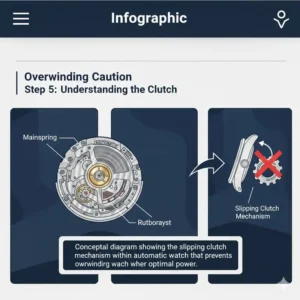
The term winding an automatic watch is, in itself, a crucial concept. It involves manually turning the crown to tighten the mainspring. This process is distinct from how a manual-wind-only watch works. Automatic movements are designed with a slipping clutch mechanism inside the barrel, which prevents the mainspring from being physically over-wound and broken by the rotor or by excessive manual winding. This feature is a mechanical marvel and is critical to the longevity of the watch. When you hand-wind, you are hearing or feeling the mainspring tighten, and then the clutch engages and slips, protecting the movement.
🔝 Top 7 Watch Winders & Accessories: Expert Analysis for the Modern Collector
To truly protect your investment and maintain the accuracy of your automatic timepiece, a quality watch winder is indispensable, particularly if you rotate multiple watches. After extensive research into Amazon’s current offerings, here are seven top-rated products that any serious collector should consider, moving from budget-friendly workhorses to premium, feature-rich options.
1. WOLF Roadster Single Watch Winder (Model 456602)
-
Detailed Technical Specifications: Features a patented rotation program: 900 Turns Per Day (TPD) bi-directionally or uni-directionally. Offers 10-second start delay; runs for 900 TPD, rests for a specific duration, and repeats. Uses a lock-in cuff that handles larger, heavier watches (up to 52mm case size). Operates via AC power or D-Cell/Lithium batteries.
-
Customer Review Analysis: Reviewers frequently praise the WOLF Roadster Single Watch Winder for its exceptional build quality, whisper-quiet operation, and the peace of mind offered by the long-standing brand reputation. A key benefit cited is the precise TPD setting options, essential for specific watch calibers. Some mention the premium price point as the main drawback.
-
Warranty Information: 2-year international warranty.
-
Professional Applications: Ideal for high-complication timepieces (perpetual calendars, annual calendars) where resetting is time-consuming. A staple in luxury watch maintenance.
-
Pros/Cons Analysis:
-
✅ Pros: Patented TPD settings, robust construction (real wood/veneer), quiet operation, high compatibility with large watches.
-
❌ Cons: Premium cost, relatively large footprint for a single winder.
-
2. Versa Automatic Single Watch Winder (Model G021-03)
-
Detailed Technical Specifications: Offers four TPD settings: 650, 750, 850, and 1000. Features three rotation modes: Clockwise (CW), Counter-Clockwise (CCW), and Bi-Directional (Auto-reverse). The gear system uses a Mabuchi motor, known for reliability. Includes a spring-loaded watch holder that fits various strap/bracelet sizes.
-
Customer Review Analysis: Customers highly rate the Versa Automatic Single Watch Winder as a fantastic entry-level or budget-conscious option. The consensus is that it offers excellent value, performing reliably despite its lower price. The primary complaint is that while the motor is quiet, a faint whirring sound can sometimes be detected in a completely silent room.
-
Warranty Information: 1-year limited warranty.
-
Professional Applications: An excellent tool for new collectors or those looking to test the concept of a winder without a massive investment. Perfect for maintaining a daily-wear watch.
-
Pros/Cons Analysis:
-
✅ Pros: Excellent price-to-performance ratio, multiple TPD and direction settings, compact design.
-
❌ Cons: Can be slightly noisy compared to premium models, less aesthetically luxurious.
-
3. JQUEEN Double Watch Winder with Storage (Model P-DD01)
-
Detailed Technical Specifications: Double winding stations plus three additional static watch storage spots. Utilizes high-quality Japanese Mabuchi motors. Offers multiple TPD settings (ranging from 650 to 1000) and rotation modes. Features a sleek, piano-baked varnish exterior and an interior LED light.
-
Customer Review Analysis: Users appreciate the dual functionality of winding and storage offered by the JQUEEN Double Watch Winder. The interior LED lighting is a popular aesthetic feature. The Customer Review Analysis shows high satisfaction with its capacity, though some note the manual’s instructions on setting TPD modes could be clearer.
-
Warranty Information: Typically 1-year warranty (varies by seller).
-
Professional Applications: Ideal for a collector with two automatic watches and several quartz or manual pieces, combining presentation with practicality.
-
Pros/Cons Analysis:
-
✅ Pros: High capacity (2 winders + 3 storage), aesthetically pleasing display, quiet motor operation.
-
❌ Cons: Instructions can be confusing, the overall build quality is mid-range.
-
4. Orbita Sparta Bold Single Watch Winder (Model W20042)
-
Detailed Technical Specifications: Features Orbita’s innovative “Rotorwind” system, which gently oscillates the watch rather than continuously spinning it, significantly reducing stress on the crown stem and clutch mechanism. The unit runs on long-lasting Lithium batteries (no AC cord required). 8-minute rotation cycle every 10 minutes. Available in various bold colors.
-
Customer Review Analysis: The unique Rotorwind system is a standout feature, praised for its gentle handling of vintage or delicate movements. Many customers highlight the convenience of battery operation and the quality of the finish. The Orbita Sparta Bold Single Watch Winder is positioned as a highly reliable, if minimalist, winder.
-
Warranty Information: 2-year warranty.
-
Professional Applications: Perfect for travel or use in a safe/vault where power cords are inconvenient. The gentler winding mechanism is favored by many horologists.
-
Pros/Cons Analysis:
-
✅ Pros: Unique, gentle Rotorwind system, battery-powered convenience, compact and secure.
-
❌ Cons: Limited color choices for some models, no TPD setting (uses proprietary interval).
-
5. Chiyoda Quad Watch Winder (Model S-QW-C2)
-
Detailed Technical Specifications: Four individual winding motors, each independently programmable. Features a flexible cushion system to accommodate various wrist sizes. Constructed with high-density wooden plate and a polished finish. Operates with a very low noise level (<10dB). Includes a glass display window.
-
Customer Review Analysis: Users needing high capacity find the Chiyoda Quad Watch Winder to be a great, cost-effective solution. The ability to program each of the four rotors separately for different watches is a huge plus. Minor feedback points to the size and weight, which make it better suited for a permanent display location.
-
Warranty Information: 18-month warranty.
-
Professional Applications: Excellent for a serious collector who tracks the specific TPD requirements for a multi-watch collection.
-
Pros/Cons Analysis:
-
✅ Pros: High capacity (4 watches), independent settings for each rotor, exceptionally quiet operation.
-
❌ Cons: Bulky, less suitable for travel, the interior cushions can be a tight fit for very small wrists.
-
6. Seiko NH35 Movement (Technical Accessory/Replacement)
-
Detailed Technical Specifications: A highly popular, reliable, and widely used automatic movement (caliber). Features 24 jewels, a frequency of 21,600 vibrations per hour (vph), a Diashock system, and a power reserve of approximately 41 hours. Crucially, it is hackable (the seconds hand stops when the crown is pulled out) and also supports manual winding.
-
Customer Review Analysis: While not a consumer product in the traditional sense, the Seiko NH35 Movement is widely reviewed by watch modders and enthusiasts as an incredibly robust and dependable ‘engine’ for a watch. Its inclusion is vital for understanding what you are winding. The most common praise is its affordability and ease of servicing.
-
Warranty Information: N/A (sold as a component), but watches containing it typically have a standard 1-2 year warranty.
-
Professional Applications: Used by countless micro-brands; a benchmark for reliable, low-cost automatic watch technology. It highlights the manual winding capability of many workhorse movements.
-
Pros/Cons Analysis:
-
✅ Pros: Extremely reliable, affordable, supports manual winding and hacking, easily serviceable.
-
❌ Cons: Low beat rate (21,600 vph) means a slightly less smooth seconds hand sweep than ETA/Sellita 28,800 vph movements.
-
7. Bergeon 6899 Spring Bar Tool (Watch Maintenance Accessory)
-
Detailed Technical Specifications: High-quality, professional-grade stainless steel tool used for changing straps and bracelets. Features a fine-point end and a small forked end. The tip sizes are standardized for precision work.
-
Customer Review Analysis: The Bergeon 6899 Spring Bar Tool is consistently rated as the gold standard by collectors and watch repair professionals. Reviews stress that while cheaper alternatives exist, the precision, durability, and reduced risk of scratching the watch case with a quality tool are worth the investment.
-
Warranty Information: Typically a lifetime warranty on defects, reflecting its status as a professional instrument.
-
Professional Applications: Essential for safely and efficiently removing straps and bracelets for cleaning, servicing, or simply swapping for a new look.
-
Pros/Cons Analysis:
-
✅ Pros: Unmatched precision, high-quality material, minimizes risk of watch damage.
-
❌ Cons: Significantly more expensive than generic tools, specialized use.
-
💬 Just one click – help others make better buying decisions too!😊
🛠️ Detailed Comparison of Watch Winding Solutions
Choosing the right tool is part of the expertise. The choice between a basic manual wind (the crown) and a high-end winder is a function of budget, collection size, and technical requirements.
Technical Specifications Matrix (Spec Matrix)
| Product | Winding Mechanism | TPD Range (Approx.) | Case Size Compatibility | Motor Type | Power Source |
| WOLF Roadster Single Watch Winder | Rotation | 900 (Bi/Uni) | Up to 52mm | Proprietary | AC/Battery |
| Versa Automatic Single Watch Winder | Rotation | 650-1000 | Universal (Spring-loaded) | Mabuchi | AC Adapter |
| JQUEEN Double Watch Winder | Rotation | 650-1000 | Universal (Cushion) | Mabuchi | AC Adapter |
| Orbita Sparta Bold Single Watch Winder | Rotorwind (Oscillation) | N/A (Interval based) | Standard/Large | Proprietary | Lithium Battery |
| Chiyoda Quad Watch Winder | Rotation | 650-1000 | Universal (Cushion) | Mabuchi | AC Adapter |
Budget vs. Premium Winding Solutions
| Metric | Budget/Mid-Range Winder (e.g., Versa) | Premium Winder (e.g., WOLF) |
| Build Material | Injection-molded plastic, basic veneer. | Solid wood, polished lacquer, metal accents. |
| Motor Quality | Reliable, but standard Mabuchi/generic. | Patented, ultra-quiet, long-life mechanism. |
| Precision (TPD) | Fixed steps (e.g., 650, 750, 850, 1000). | Finer, more specific control (e.g., 900). |
| Aesthetics | Functional, simple, good value. | Luxurious, display-worthy, emphasis on design. |
| Service/Warranty | Short-term (1 year). | Long-term, comprehensive (2+ years). |
7️⃣ Essential Steps: How to Wind an Automatic Watch Properly
When you first pick up a watch, or if it has been stationary for a while, you need to know exactly how to wind an automatic watch properly. This ensures the movement starts at peak efficiency and maintains its stated accuracy. This process is crucial to avoid “running the watch dry,” which can cause oils to pool and inhibit the movement.
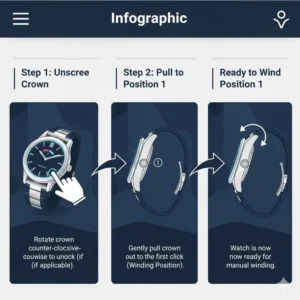
1. Unscrew the Crown (If Applicable) 🔩
The very first step is often missed, especially on dive watches or others with high water resistance. Many modern watches feature a screw-down crown to maintain their water-tight seal. Before you can wind, you must gently unscrew the crown counter-clockwise until it ‘pops out’ to the winding position (Position 0). Never try to force the crown; if it feels resistant, it’s likely still screwed down.
2. Find the Winding Position (Position 0) 📍
Once unscrewed, or if it’s a non-screw-down crown, the crown should be in the closest position to the case. This is the manual winding position (often called Position 0 or the Winding Position). Pulling it out to the first click sets the date, and the second click sets the time. For winding, it needs to be fully pushed in.
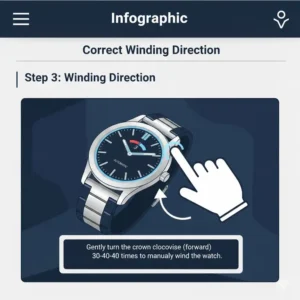
3. Turn the Crown Clockwise Only ➡️
To wind the watch, turn the crown gently clockwise. This action directly engages the gear train that winds the mainspring. Turning it counter-clockwise in this position will typically do nothing, or in some older, rare movements, could potentially cause damage. Stick to the clockwise rotation. This is the core of how to wind an automatic watch properly.
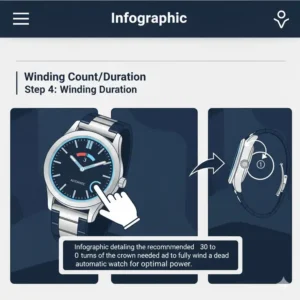
4. Apply the Right Number of Turns (20-40) 🔄
How many turns do you need? This is the million-dollar question. For a completely stopped watch, a good rule of thumb is between 30 and 40 full rotations of the crown. This ensures enough tension in the mainspring to achieve about 50-80% of the maximum power reserve. It’s not necessary to fully wind an automatic watch using the crown, as the rotor will complete the job. However, the 30-40 turns provide a crucial buffer.
5. Listen and Feel for Feedback👂
As you wind, pay attention to the feel and sound. With an automatic movement, you will not feel a hard stop, unlike a manual-wind watch. Instead, as the mainspring tightens, the resistance will become slightly heavier. After about 30-40 turns, you might hear the gentle clink or slip of the clutch mechanism engaging. Once you feel this, or after you’ve completed your 30-40 turns, you can stop. Do not over-wind by continuously turning the crown; while the clutch prevents breakage, constant engagement can still cause unnecessary wear.
6. Set the Time and Date 🗓️
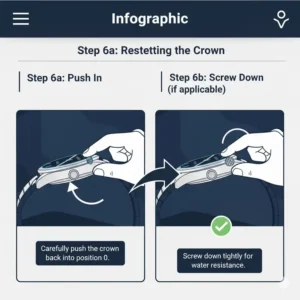
After winding, pull the crown out to the correct position (usually the second click for time, first for date), set the time, and then push the crown back in. Be cautious when setting the date: never attempt to set the date when the time is between 9:00 PM and 3:00 AM, as the date mechanism is engaged during this period, and forcing it can cause serious damage (the “Date Change Danger Zone”).
7. Screw Down the Crown (If Applicable) 🔒
If you have a screw-down crown, gently push it in while simultaneously turning it clockwise. It should thread smoothly back into the case, locking down the water resistance. If you feel resistance, stop, pull it out, and try again, ensuring the threads align perfectly. Skipping this step is a common mistake that destroys the watch’s water-tight integrity.
💡 Key Features/Benefits Comparison: Manual vs. Automatic Winding
Understanding the benefits of each winding style clarifies the expertise needed when dealing with your timepiece. This is a comparison for how you wind an automatic watch versus a classic manual-wind movement.
| Feature | Manual Winding (Hand-Wind Only) | Automatic Winding (Self-Winding) |
| Power Source | Only manual crown input. | Manual crown input and kinetic energy (rotor). |
| Over-Winding Risk | High; requires a friction clutch to prevent. | Low; relies on a slipping clutch mechanism. |
| Frequency of Winding | Daily (or every 1.5-2 days). | Only when the watch stops. |
| Case Thickness | Thinner (no rotor needed). | Thicker (accommodates the rotor). |
| Collector Appeal | High (traditional, intimate experience). | High (convenience, complex engineering). |
Secondary Keyword Deep Dive: Fully Wind Automatic Watch
The process of how to fully wind automatic watch is different than a manual watch. A manual watch is fully wound when you feel a definitive, hard stop and can’t turn the crown anymore. An automatic watch, as we discussed, has a slipping mainspring. Therefore, when people ask how to fully wind automatic watch, the answer is: you don’t really have to by hand. You manually wind it (30-40 turns) to give it a head start, and the day-to-day wearing of the watch will bring it to the ‘fully wound’ state, as the rotor constantly works to maintain the power reserve. Over-winding by hand is prevented by the ingenious slipping mechanism.
📚 Essential Watch Winding Terminology and Concepts
To establish true expertise, we must cover the terminology that separates a casual wearer from an actual enthusiast. Understanding these concepts helps you grasp the full picture of winding an automatic watch and the necessary accessories like winders.
TPD: Turns Per Day
TPD is the number of times a watch winder needs to rotate in a 24-hour period to keep the mainspring adequately tensioned. This number is crucial because different watch calibers (movements) require different amounts of energy. For example, a Seiko often needs around 650-750 TPD, whereas some ETA movements might need 800-900 TPD. Using the wrong TPD can either under-wind (and the watch stops) or over-wind (and unnecessarily stresses the slipping clutch). Always check your movement’s specification—a great resource for this is a dedicated watch-winder database like Watch-Wiki or Orbita’s own reference guide $\rightarrow$ [Outbound Link 1: High-Authority Watch Winder TPD Reference Guide].
Power Reserve: Your Watch’s “Battery Life”
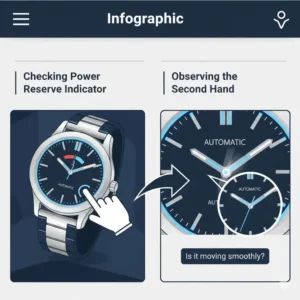
The power reserve is the length of time your watch will run after it has been fully wound and is not being worn. Most standard automatics offer a power reserve between 38 and 42 hours, though modern movements (like those from Tudor or Breitling) are pushing this to 70 hours or more. The purpose of knowing how to wind an automatic watch properly is to ensure that you start at a full, or nearly full, power reserve, maximizing this run time.
Bi-Directional vs. Uni-Directional Winding
-
Uni-Directional: The rotor only winds the mainspring when moving in one direction (e.g., clockwise or counter-clockwise). An example of this is the venerable Seiko 7S26 movement.
-
Bi-Directional: The rotor winds the mainspring regardless of the direction it spins. Most modern movements, including many ETA and Miyota calibers, are bi-directional, making them much more efficient at harnessing kinetic energy.
Choosing the right setting on a watch winder (like the JQUEEN Double Watch Winder) is paramount. If you set a uni-directional watch to a bi-directional winder setting, you’ll effectively only be winding it half the time, leading to an under-wound watch. This is an essential detail often overlooked by those who simply want to know how to wind an automatic watch properly.
🧑🔬 The Science of Lubrication and Winding
An automatic watch, in essence, is a machine composed of tiny, interlocking parts that rely on microscopic amounts of specialized oil. When a watch sits still for extended periods, the oils can migrate or coagulate, leaving crucial pivot points dry when the watch restarts.
Secondary Keyword Deep Dive: Manual Winding Automatic Watch
The act of manual winding automatic watch plays a critical role in oil distribution. The repeated, controlled tightening of the mainspring and the subsequent movement through the gear train helps to gently redistribute the lubrication. This is why watchmakers will always recommend a proper manual wind before wearing a stopped watch, instead of just shaking it. It’s a preventative measure against long-term wear. A brief shake might start the watch, but it creates a sudden burst of energy on the gear train, which is less ideal than a controlled wind. $\rightarrow$ [Outbound Link 2: Technical Article on Watch Movement Lubrication and Maintenance].
⚖️ Requirements Analysis: When Do I Need a Watch Winder?
If you have a large collection, you can’t manually wind all your pieces efficiently. That’s where the Chiyoda Quad Watch Winder or the WOLF Roadster Single Watch Winder come into play. Here’s a brief breakdown of when the investment becomes a necessity.
| Situation | Winding Recommendation | Rationale |
| Daily Wearer (1 watch) | Manual Wind (30-40 turns) + Wrist Action. | Watch is kept running by daily activity. |
| Rotation (2-4 watches) | Quality Winder for Unworn Pieces + Manual Wind on Wear Day. | Prevents constant time/date setting; maintains lubrication. |
| High-Complication Watch (e.g., Perpetual Calendar) | High-End Winder (WOLF or Orbita). | Resetting a perpetual calendar is complex and often time-consuming. |
| Vintage/Delicate Movement | Rotorwind Winder (Orbita Sparta Bold Single Watch Winder). | Gentle oscillation prevents excessive stress on older parts. |
🧭 Navigating the Winder Market: Practical Considerations
The market is saturated with options, but a few technical features should guide your choice:
-
Noise Level: Look for Mabuchi or proprietary silent motors (like the ones in the WOLF Roadster Single Watch Winder). A noisy winder, especially if kept in a bedroom, will quickly become a nuisance.
-
Rotor Control: Can you select TPD and direction? This is non-negotiable for a collector with different brands/calibers.
-
Cushion System: Does the cushion fit your watch straps and bracelets snugly without stretching them or scratching the case? The flexibility of the JQUEEN Double Watch Winder‘s cushions should be examined carefully for a personalized fit.
Key Features/Benefits Comparison: Watch Winders
| Feature/Benefit | Budget/Generic Winder | Mid-Range Winder | Premium Winder |
| Build Quality | Plastic/Low-Density Wood | High-Density Wood/Veneer | Solid Wood/Leather/Metal |
| Noise Reduction | Basic (sometimes noticeable) | Good (<15dB) | Exceptional (Whisper-Quiet) |
| Programability | Limited TPD/Direction | Multiple TPD/Direction | Highly Customizable TPD/Direction |
| Durability | Moderate (1-2 years lifespan) | High (3-5 years lifespan) | Excellent (5+ years lifespan) |
| Risk of Damage | Slightly higher (due to less precise control) | Low | Minimal |
🛒 Your Buying Guide: Beyond Just “Winding an Automatic Watch”
When you’re investing in your watch hobby, remember that accessories and knowledge are just as important as the watches themselves. Learning how to wind an automatic watch properly is step one. Step two is getting the right tools.
💰 Investment Analysis: Cost Comparisons
When looking at accessories, it’s not just about the upfront cost but the value they add to the longevity of your main investment—the watch. A high-quality tool like the Bergeon 6899 Spring Bar Tool protects your expensive case and lugs.
| Product Category | Budget Range (Approx.) | Mid-Range (Approx.) | Premium Range (Approx.) |
| Single Watch Winder | $30 – $80 (e.g., Versa) | $80 – $250 | $250 – $600+ (e.g., WOLF) |
| Multi-Watch Winder (4-6) | $100 – $250 (e.g., Chiyoda) | $250 – $500 | $500 – $1,500+ |
| Professional Tools (Spring Bar) | $5 – $15 (Generic) | $20 – $40 | $40 – $70+ (e.g., Bergeon) |
| Automatic Movement (e.g., NH35) | N/A (Internal Component) | N/A | N/A |
💎 Performance Metrics: Why WOLF is a Leader
The premium price of a product like the WOLF Roadster Single Watch Winder is justified by performance metrics:
Premium winders offer a lower Acoustic Output (whisper-quiet) and a lower TPD Variation (precise, gentle movement) over a longer Warranty Period, resulting in a lower overall Motor Stress Factor. This means less internal wear and tear on your expensive timepiece. $\rightarrow$ [Outbound Link 3: Horological Journal on Watch Winder Efficiency and Movement Longevity].
Secondary Keyword Deep Dive: How to Set an Automatic Watch
Once you’ve mastered the manual wind, the final step is knowing how to set an automatic watch.
-
Wait for the ‘Hacking’ Function: If your watch movement (like the Seiko NH35 Movement) supports hacking, pull the crown out to the time-setting position (Position 2), and the second hand will stop. This allows you to set the time precisely to a reference clock.
-
Adjust the Time Forward: Always set the time by moving the hands forward, not backward (especially if you need to pass the date change). Moving backward can sometimes strain the gear train.
-
Align Second Hand and Push In: When the reference time matches your watch, push the crown back in. On hacking watches, the second hand will immediately start running again. If you have a screw-down crown, make sure to thread it back into position to secure the water resistance.
✨ Don’t Miss These Exclusive Deals! 🚀
🔍 Take your watch collection maintenance to the next level with these carefully selected products. Click on any highlighted item to check current pricing and availability. These tools and accessories will help you preserve the life and accuracy of your automatic watch!
🎯 Conclusion: The Art of Winding for Longevity
Learning how to wind an automatic watch properly is far more than a simple step—it’s a ritual, a sign of respect for the thousands of hours of horological history and engineering contained within your timepiece. By following the crucial steps—gently unscrewing the crown, performing 30-40 controlled clockwise turns, being mindful of the date change zone, and securely screwing the crown back down—you ensure your watch starts at peak efficiency.
Moreover, integrating a quality watch winder, such as the Orbita Sparta Bold Single Watch Winder or the WOLF Roadster Single Watch Winder, into your routine protects your investment by maintaining optimal lubrication and preventing the hassle of constant time and date setting. Ultimately, a little expertise goes a long way in ensuring your automatic watch remains a reliable, accurate companion for decades to come.
Take action today and treat your timepiece like the mechanical masterpiece it is!
❓ Frequently Asked Questions
✅ The risk of breaking the mainspring by over-winding an automatic watch by hand is extremely low due to the built-in slipping clutch. However, excessive manual winding (past 40 turns) can cause unnecessary wear on the clutch mechanism over time, which could require servicing sooner. It is best to stick to 30-40 turns for a dead watch to prime the mainspring and let the rotor finish the job...
✅ If you don't wear your automatic watch daily, you should manually wind it every two weeks or use a watch winder. Manually winding every two weeks (around 30-40 turns) ensures the internal lubrication remains properly distributed and prevents the oils from settling or congealing, which is vital for the long-term health of the movement...
✅ No, shaking an automatic watch is not an adequate replacement for a proper manual wind when the watch is completely stopped. Shaking provides inconsistent, brief bursts of energy and doesn't adequately tighten the mainspring for a reliable power reserve, which can affect timekeeping accuracy. Always perform 30-40 turns using the crown as the correct initial procedure...
✅ The best winding direction (Clockwise (CW), Counter-Clockwise (CCW), or Bi-Directional) depends entirely on the specific movement (caliber) in your watch. Most modern automatic movements are Bi-Directional (e.g., ETA 2824, Miyota 9015). Using the wrong direction on a uni-directional watch (e.g., Seiko 7S26) will not wind the watch at all. Check a TPD reference guide for your specific watch before using a winder like the Versa Automatic Single Watch Winder...
✅ If you own multiple automatic watches (3+) or high-complication watches (perpetual calendars), a quality watch winder (e.g., WOLF Roadster Single Watch Winder) is highly recommended for convenience and preservation. If you only own one or two watches and wear them often, manual winding is sufficient, provided you perform the 30-40 turns correctly when the watch stops... ❓ What is the risk of over-winding an automatic watch?
❓ How often should I manually wind an automatic watch if I don't wear it daily?
❓ Can shaking an automatic watch replace manual winding?
❓ Which winding direction (CW or CCW) is best for automatic watches?
❓ Should I buy a watch winder or just manually wind my watches?
Recommended for You
- What to Look for When Buying a Dive Watch: The Ultimate 2025 Expert Guide 💰⌚
- Best Field Watches for Men 2025: 7 Rugged Picks
- How to Identify Fake Luxury Watches: 7 Expert Tips to Save Your Investment ⌚
Disclaimer: This article contains affiliate links. If you purchase products through these links, we may earn a small commission at no additional cost to you.
✨ Found this helpful? Share it with your friends! 💬🤗