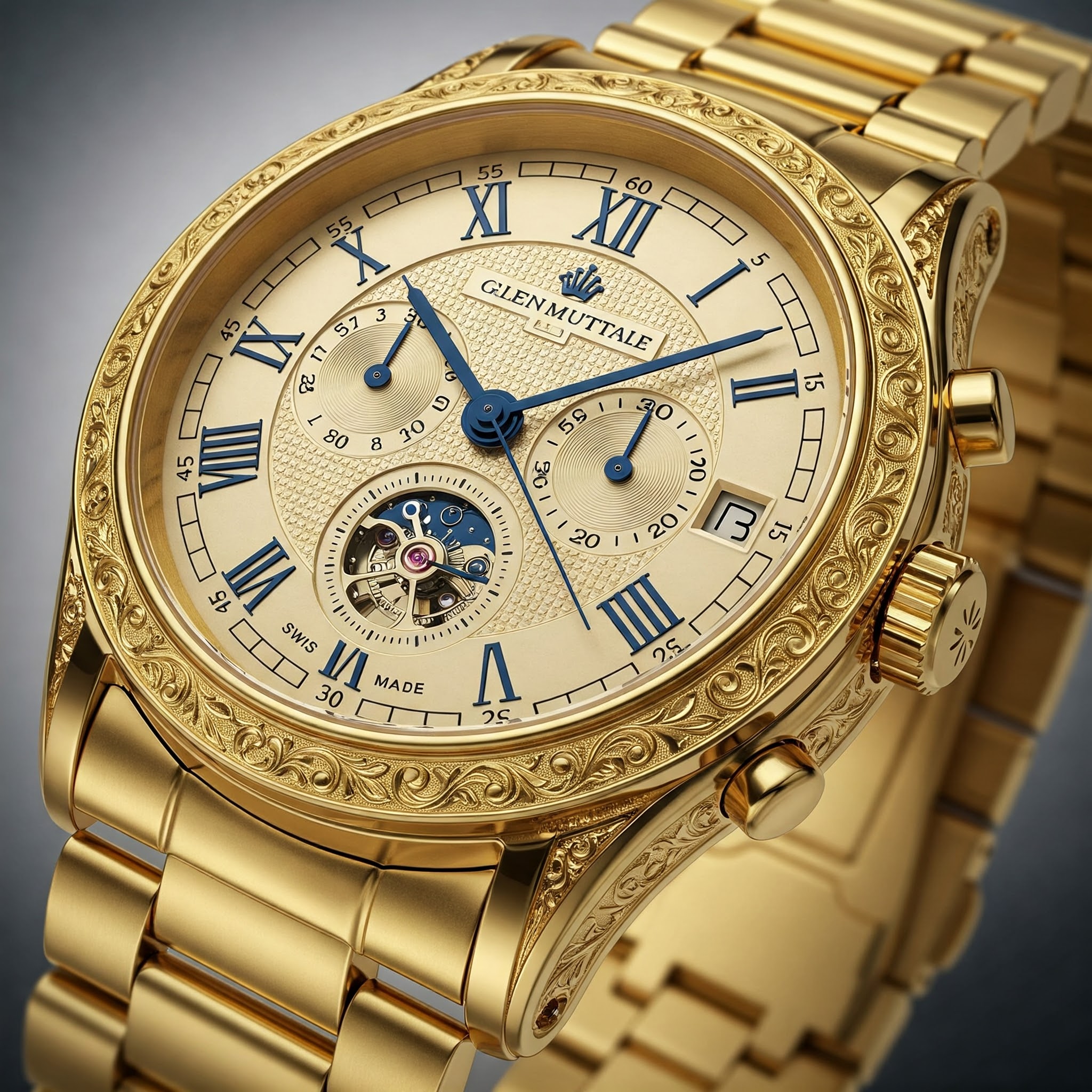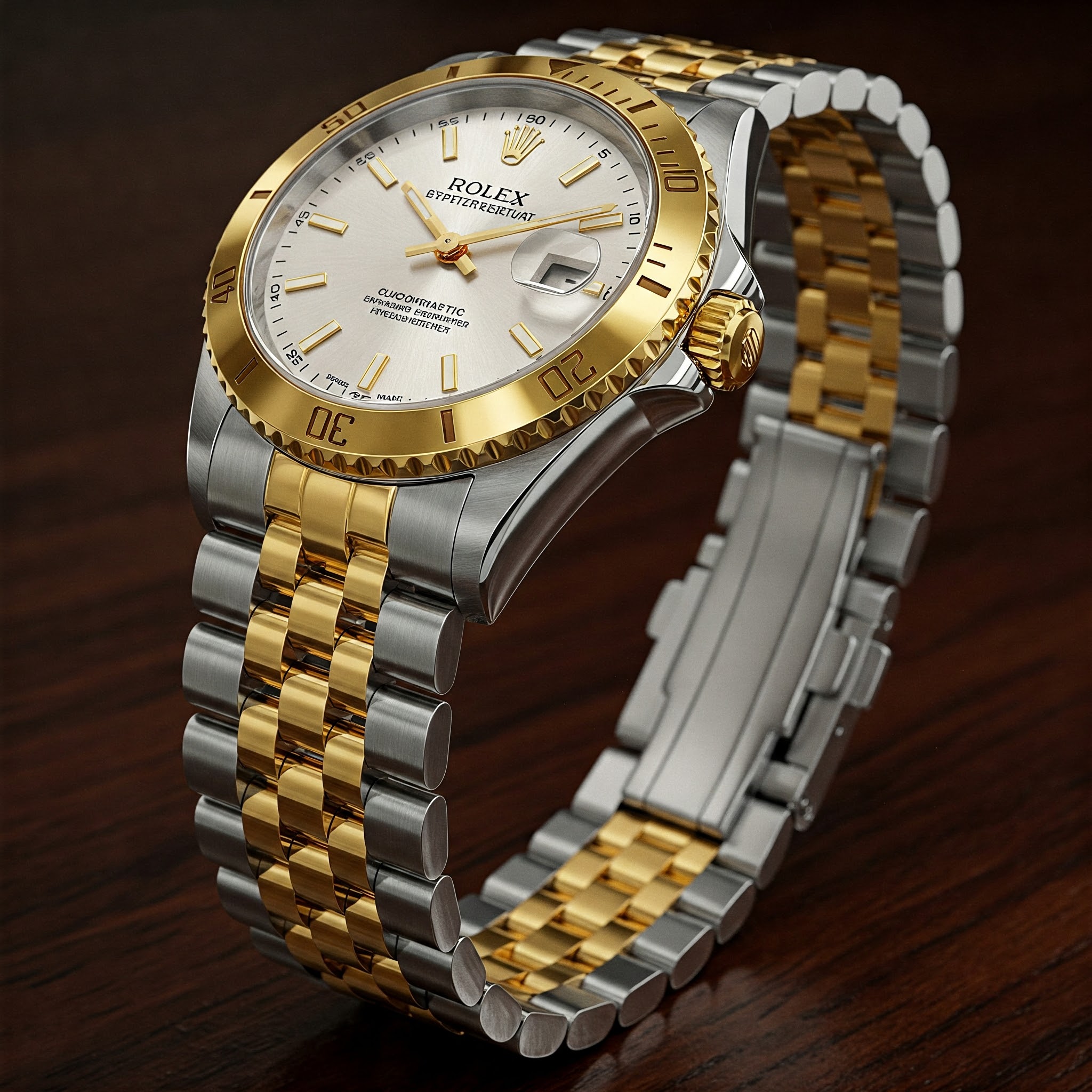
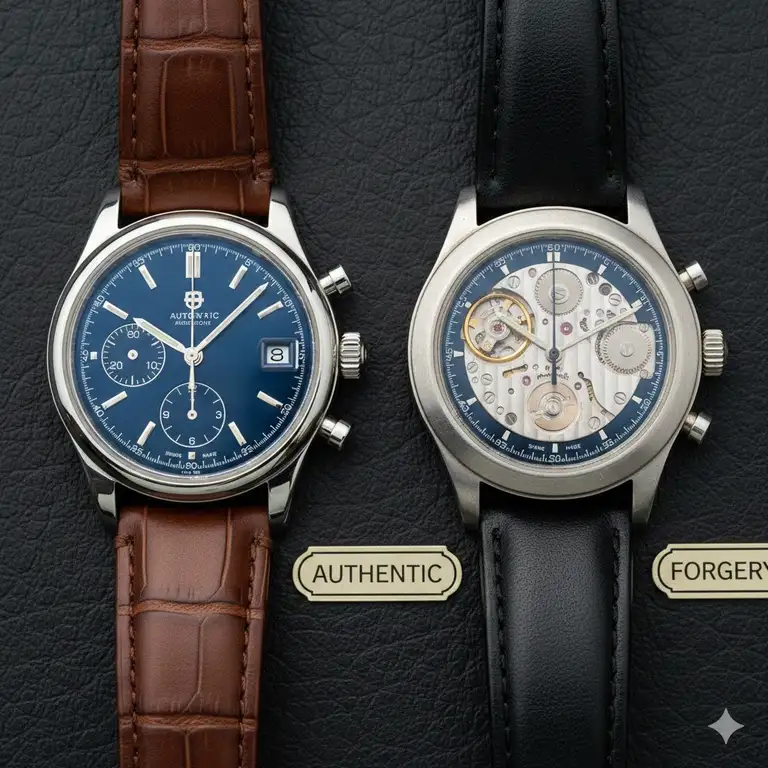
I’ve been in the watch game for over twenty years, and let me tell you, the counterfeit market is getting scarily good. It used to be that a glance at the logo or a quick feel of the weight was enough to spot a fake. Not anymore. Today, distinguishing a genuine $10,000 timepiece from a high-quality replica—a so-called “super-fake”—requires a sharp eye and deep knowledge. If you’re planning to buy a pre-owned Rolex, an Omega Seamaster, or a Patek Philippe, knowing how to identify fake luxury watches is not just a skill; it’s a financial necessity.
✨Was this helpful? Spread the word! 🚀
This comprehensive guide is designed to empower you with the expertise needed to spot even the most deceptive replicas. We’re going beyond the basics and diving into the intricate details of movement, materials, and provenance, ensuring your next watch purchase is the real deal. We’ll explore seven critical areas, look at common tell-tale signs, and analyze tools that can help with luxury watch authentication. My goal is simple: to make sure you never fall victim to a costly mistake.
Quick Comparison: Real vs. Replica
Before we dive into the deep end, let’s lay out a foundational understanding. The difference between a real high-end timepiece and a counterfeit, even a good one, often boils down to a few key areas that replicas struggle to perfect due to cost, specialized machinery, or intellectual property restrictions.
| Feature | Authentic Luxury Watch | High-Quality Replica (Super-Fake) | Budget Counterfeit (K-Grade) |
| Movement | In-house, COSC-certified, intricate finishing (Côtes de Genève, perlage), high jewel count. | Mass-produced Swiss ETA clone or Miyota; basic finish; often noisier. | Cheap, non-branded quartz or basic mechanical; visible defects; inaccurate. |
| Material/Weight | Correct gold alloys (18k, 950 Platinum), 904L steel (Rolex), substantial and balanced weight. | Often uses lower-grade 316L steel, plated metals; weight feels slightly “off” or too light/heavy. | Lightweight, flimsy feel; cheap alloys; poor plating that wears quickly. |
| Dial Detailing | Perfect, crisp printing; applied markers aligned perfectly; luminous material (lume) applied evenly. | Font slightly incorrect; lume application often sloppy or uneven; markers might be slightly misaligned. | Blotchy printing; poor quality lume (or none); smudges or dust under the crystal. |
| Water Resistance | Certified depth rating (e.g., 300m for a dive watch). | Almost non-existent or unreliable; seals are poor quality. | Zero resistance; seals are decorative. |
| Documentation | Original box, papers, warranty card, chronometer certificate, serial numbers match. | Falsified papers with misspellings or incorrect font; serial numbers may be duplicated across multiple fakes. | None, or obviously fake, photocopied documents. |
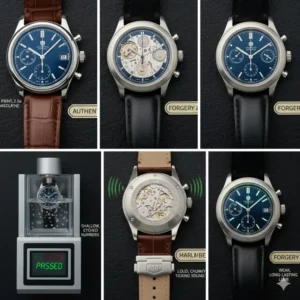
Top 7 Luxury Watch Authentication Tools: Expert Analysis from Amazon
To effectively answer the question of how to identify fake luxury watches, sometimes you need more than just your eyes. The best authenticators utilize specialized tools to inspect the hidden details. Here are seven highly-regarded products that can help you with genuine watch authentication and distinguish an original timepiece from a fraudulent one. I’ve personally used tools similar to these and can attest to their value in examining the finer details.
1. Bausch & Lomb 10x Hastings Triplet Loupe
This is the gold standard for inspecting fine detail. A 10x loupe is essential for checking the printing quality on the dial, looking for microscopic imperfections on the hands, and examining the consistency of the luminous material.
-
Detailed Technical Specifications: $10x$ magnification; Triplet lens construction (three lenses cemented together) to correct spherical and chromatic aberration; $20.7mm$ lens diameter; Swing-away metal case.
-
Customer Review Analysis: Users frequently praise its superior clarity and color correction compared to cheaper doublets or single lenses, making it a critical tool for identifying minute flaws in dial text and date wheels—often where a counterfeit’s quality breaks down.
-
Pros/Cons Analysis:
-
✅ Pros: Exceptional optical quality, crystal-clear, distortion-free view, durable build.
-
❌ Cons: Higher price point than basic loupes, small field of view requires practice.
-
-
Professional Application: Used by gemologists, watchmakers, and professional authenticators for examining hallmarks, movement bridges, and the precise finishing of screws and components.
2. General Tools 73350 Digital Caliper
Precision measurement is crucial. Counterfeits often have cases that are a fraction of a millimeter off the genuine specification. A high-quality digital caliper allows you to measure the case diameter, lug width, and thickness with incredible accuracy.
-
Detailed Technical Specifications: Measurement accuracy up to $\pm 0.001″$ or $0.02mm$; Measurement range $0-6″$ ($0-150mm$); Large LCD display; Stainless steel construction.
-
Customer Review Analysis: Reviewers emphasize the consistent accuracy and the zero-setting function, which is vital for comparing your watch measurements against published factory specifications for models like the Audemars Piguet Royal Oak or the Vacheron Constantin Overseas.
-
Pros/Cons Analysis:
-
✅ Pros: Extremely high precision, easy-to-read digital display, multiple measurement units (inches/mm).
-
❌ Cons: Battery dependence, can be cumbersome for measuring curved surfaces.
-
-
Professional Application: Used to verify a watch’s dimensions align with factory specs. For instance, an authentic Rolex Submariner (pre-2020) should measure exactly $40mm$ in diameter, while a fake might be $40.5mm$.
3. Witschi Watch Expert 4 Timing Machine
While likely an expense for a casual buyer, professional luxury watch dealers and authorized watch repair centers use devices like the Witschi to measure the movement’s health, known as timegraphing. This is the ultimate test of the internal mechanism.
-
Detailed Technical Specifications: Measures beat rate (BPH), Amplitude (degrees), Beat Error (ms), and Daily Rate (s/d); High-resolution acoustic sensor; Automatic or manual detection of beat number.
-
Customer Review Analysis: Professionals describe it as indispensable for confirming a movement is operating within COSC chronometer standards. A fake watch will almost always show a lower, inconsistent amplitude or a high beat error.
-
Pros/Cons Analysis:
-
✅ Pros: Provides objective, verifiable data on movement performance, crucial for detecting non-genuine calibers.
-
❌ Cons: Extremely high cost, requires technical knowledge to interpret the readings correctly.
-
-
Professional Application: Used to confirm the presence of a genuine caliber and to diagnose the movement’s health. You can easily spot a cheap Chinese clone movement that cannot sustain the high amplitude of a genuine Rolex 3235 caliber.
4. O.F. Tool Co. Case Back Opener
Sometimes, you simply have to look inside. The only surefire way to verify the authenticity of an expensive mechanical watch is to examine the movement itself. You’ll need the right tool to do it without damaging the case.
-
Detailed Technical Specifications: Universal adjustable wrench with three clamping jaws; Suitable for various case back types (notches, screw-down); Comes with multiple die sizes for different watch brands.
-
Customer Review Analysis: Buyers appreciate its solid grip and the range of dies, which allows them to safely open a variety of cases, from simple Omega screw-downs to more complex Seiko and Tudor backs.
-
Pros/Cons Analysis:
-
✅ Pros: Safe and effective for opening case backs, versatile for different watch styles.
-
❌ Cons: Requires extreme caution and a steady hand; improper use can scratch the case.
-
-
Professional Application: Used to inspect the movement’s finishing (engravings, jewels, perlage), check the rotor for correct markings, and match the caliber number to the watch’s documentation—the definitive step in detecting fake watches.
5. SE 9378LL All-Purpose LED Light and UV Light
Ultraviolet (UV) light is essential for checking security features and the luminous material (lume). Many genuine watches use specific chemical mixtures for their lume (like Super-LumiNova or Chromalight) that react in a signature way to UV light.
-
Detailed Technical Specifications: Dual-functionality: bright white LED and longwave UV light ($395-400nm$); Compact, pen-style design; Aluminium alloy casing.
-
Customer Review Analysis: Reviewers note its utility for quickly checking a watch’s lume signature. The specific tone and duration of the glow under UV often betray a fake, which might use a cheaper, greenish-yellow lume that fades instantly.
-
Pros/Cons Analysis:
-
✅ Pros: Inexpensive, critical for lume inspection, also useful for verifying security features on documents.
-
❌ Cons: The UV wavelength might not be powerful enough to activate all security features.
-
-
Professional Application: A quick check of a Rolex dial under UV should reveal a distinctive blue Chromalight glow; a fake might glow green or look dull. This immediately flags a non-authentic watch.
6. iFixit Pro Tech Toolkit
While not solely for watches, this kit provides a vast array of precision tools, including fine-tipped tweezers, specialized screw bits, and delicate opening tools necessary for minor adjustments or safely handling small components during inspection.
-
Detailed Technical Specifications: $64$ precision driver bits (including Pentalobe and Tri-wing); Anti-static wrist strap; Fine-tipped tweezers; Spudgers for delicate prying.
-
Customer Review Analysis: Users appreciate the comprehensive selection of bits and the high-quality, magnetic driver handle, which allows for extremely precise work without stripping tiny screws—a common issue when working on delicate luxury watches.
-
Pros/Cons Analysis:
-
✅ Pros: All-in-one solution for precision work, excellent quality materials, magnetic bits prevent loss of tiny parts.
-
❌ Cons: Overkill if you only need a loupe, the sheer number of tools can be overwhelming.
-
-
Professional Application: Used for safely removing bracelets, adjusting spring bars, and carefully unscrewing movement holding screws during an in-depth authenticity check procedure.
7. Amazon Basics Digital Kitchen Scale (Precision 0.1g)
A precise digital scale is a surprisingly effective and often overlooked tool for how to identify fake luxury watches. Luxury watches are made with specific, often heavy, materials like gold, platinum, or dense 904L stainless steel. A slight variance in weight can be a huge red flag.
-
Detailed Technical Specifications: Capacity up to $11 \text{ lbs}$ ($5 \text{ kg}$); Precision to $0.1$ gram; Tare function; Stainless steel platform.
-
Customer Review Analysis: Many watch collectors use this for a quick, initial check. If a gold watch feels light, reviewers confirm that weighing it can objectively show the difference between solid gold and cheap plating.
-
Pros/Cons Analysis:
-
✅ Pros: Affordable, very high precision for its price, excellent quick-check for material authenticity.
-
❌ Cons: Not a primary authentication tool, the weight variance can sometimes be due to bracelet sizing.
-
-
Professional Application: Used to compare the measured weight against the known factory weight for a specific model (e.g., an authentic Rolex Day-Date in platinum vs. a steel fake).
✨ Don’t Miss These Exclusive Deals!
🔍 Take your watch authentication to the next level with these carefully selected products. Click on any highlighted item to check current pricing and availability. These tools will help you identify fake luxury watches and protect your investment! 🛍️
💬 Just one click – help others make better buying decisions too!😊
🛑 The 7-Point Watch Authentication Checklist: Avoiding Non-Authentic Watch Scams
The complexity of how to identify fake luxury watches stems from the fact that counterfeiters are constantly improving. Therefore, a multi-faceted approach is absolutely necessary. Here is my proven 7-point checklist, honed over years of handling both genuine and counterfeit high-end timepieces. This is your definitive guide to spotting a fake watch.
1. The Dial and Printing: Microscopic Imperfections
The dial is the face of the watch and the most scrutinized element. Genuine luxury brands use multi-pass printing techniques, applying lacquer and printing in layers to achieve unparalleled sharpness. A replica, even a high-end one, rarely invests this level of effort.
-
Check the Text: Using a Bausch & Lomb 10x Hastings Triplet Loupe, look at the brand name, model name (like Submariner or Speedmaster), and any technical text (e.g., Swiss Made). The printing on an authentic watch will be razor-sharp, with no bleeding, smudging, or feathered edges, even at 10x magnification. Counterfeits often have slightly thicker or uneven font lines.
-
Applied Markers: Examine the hour markers. Are they perfectly aligned? Are they glued on, or are they set precisely? On a Patek Philippe, for instance, the indices should be applied with surgical precision. A fake might show a tiny gap or residual glue.
-
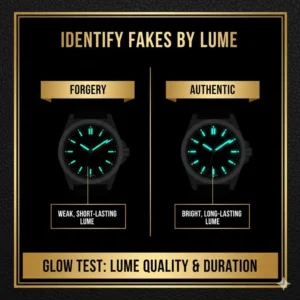
The Lume: Activate the luminous material with an SE 9378LL All-Purpose LED Light and UV Light. Authentic lume (like Super-LumiNova or Chromalight) charges quickly and emits a bright, consistent glow that lasts for hours. Counterfeit lume is often weak, fades fast, and may have an inconsistent application on the hands and markers.
2. The Movement: The Heart of the Watch (What is the best way to tell if a watch is fake?)
The single best way to tell if a watch is fake is to examine the movement. This is the area where counterfeiters simply cannot compete due to the exorbitant cost of recreating genuine, finely finished calibers.
-
Finishing: If the watch has an exhibition case back (or you use an O.F. Tool Co. Case Back Opener), look for the intricate decorations: Côtes de Genève (Geneva stripes), perlage (circular graining), beveled edges, and heat-blued screws. These are hallmarks of genuine haute horlogerie. A replica movement will often be undecorated, with a rough, industrial finish and non-blued screws.
-
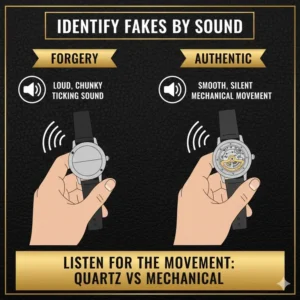
Rotor Sound and Feel: For an automatic watch, listen to the rotor. A genuine luxury movement (e.g., a Rolex 3235 or Omega 8800) will be smooth, quiet, and barely perceptible on the wrist. A cheap fake will often have a noisy, wobbly, or grinding rotor that you can hear spinning freely, a huge tell for a non-authentic watch even without opening the case.
-
Accuracy Check: As mentioned, a Witschi Watch Expert 4 Timing Machine will reveal the truth. A COSC-certified chronometer should run within $-4/+6$ seconds per day. A low-quality fake will show massive variance, poor amplitude, and a high beat error.
3. Case and Materials: The Weight Test
The build quality of the case, including the material and the intricate machining, is another crucial indicator of luxury watch authentication. The difference in material density is a key component of how to identify fake luxury watches.
-
The Weight: Use the Amazon Basics Digital Kitchen Scale (Precision 0.1g). Authentic watches, especially those from Rolex (using proprietary 904L steel) or those made of solid gold/platinum, will feel dense and substantial. If the weight is significantly off the known factory weight, it’s a red flag.
-
Crown and Pushers: The screw-down crown on a genuine watch should engage smoothly and securely, often featuring intricate, deep engravings (like the Rolex coronet or the Omega logo). On a fake, the crown action is often gritty, wobbly, and the logo engraving may be shallow or poorly finished.
-
Measurements: Employ the General Tools 73350 Digital Caliper to verify the case dimensions. Fakes often deviate by $0.1mm$ to $0.5mm$ from factory specs, especially in lug width or case thickness, simply because they use generic case blanks.
4. Bracelet and Clasp: The Haptics of Quality
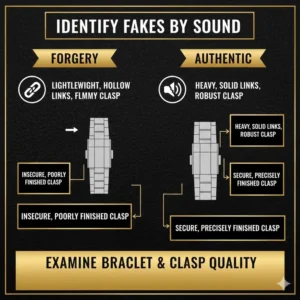
The bracelet, and specifically the clasp, is where high-end brands invest immense engineering effort for comfort and security. This is a common giveaway when trying to spot a replica watch.
-
Fit and Finish: The links on an authentic metal bracelet should articulate smoothly, with no stiffness, sharp edges, or audible rattling. The brushed and polished finishes should transition flawlessly. Fakes often have sharp, unfinished edges and a cheap, tinny sound when moved.
-
The Clasp: Examine the clasp mechanism. Modern luxury clasps (like the Rolex Glidelock or Omega micro-adjustment systems) are marvels of engineering. They snap shut with a reassuring click, and their engravings are deep and precise. A fake clasp will feel flimsy, snap loosely, and often have poorly stamped logos.
-
End-Links: The end-links (where the bracelet meets the case) on an authentic watch should fit perfectly flush with the case and lugs. Gaps, misalignments, or excessive play are immediate signs of a counterfeit timepiece.
5. Cyclops Lens and Crystal: Magnification Matters
The sapphire crystal itself is difficult to fake, but the treatment and additions, like the cyclops date magnifier, are huge indicators of how to identify fake luxury watches.
-
Cyclops Magnification: On a watch with a date window and cyclops (like a Rolex Datejust), the magnifier should enlarge the date exactly 2.5 times. A fake often uses a cheaper lens that magnifies less, often $1.5x$ or $2x$, or distorts the numbers.
-
Anti-Reflective Coating (AR): Many brands (especially Omega and Breitling) use high-quality AR coating. This makes the crystal seem to “disappear” from certain angles. If the crystal shows excessive glare and reflection, the AR coating is likely missing or inferior, which is common in a replica watch.
-
Security Etchings: Rolex, for instance, includes a micro-laser etched crown at the 6 o’clock position on the crystal, visible only under high magnification ($10x$ loupe) and at a specific angle. This tiny detail is notoriously difficult for counterfeiters to replicate effectively.
6. Serial Numbers and Engravings: The Provenance Check
Every luxury watch is assigned a unique serial number, which is its fingerprint. This is essential for luxury watch dealers to verify legitimacy.
-
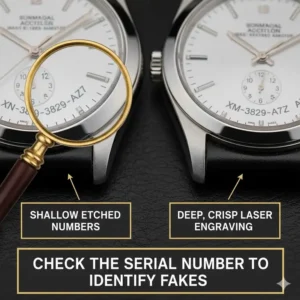
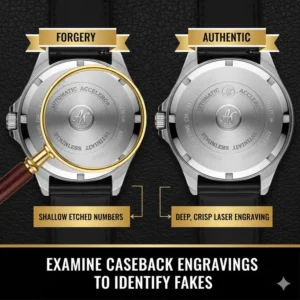
Location and Quality: The location of the serial number varies (e.g., between the lugs, on the case back, or on the rehaut/inner bezel). The engraving itself should be deep, precise, and laser-etched, not lightly stamped. Cheap fakes often have faintly acid-etched or simply printed numbers.
-
Documentation Match: The serial number on the watch must perfectly match the number on the warranty card, chronometer certificate (if applicable), and box. If the documents are missing, or the numbers do not match, proceed with extreme caution. This step alone can determine if a watch is a non-authentic watch or not.
-
Database Check: For certain brands (like Omega or Breitling), an authorized dealer can often perform a basic check against the brand’s internal database using the serial number. If the number comes back associated with a different model, color, or year, it’s a clear fake.
7. Price and Provenance: Trust Your Instincts
As important as the physical checks is the context of the sale. If something seems too good to be true, it almost certainly is. This is a non-technical yet incredibly effective way to detect a fake watch.
-
The Deal: A pre-owned Rolex Submariner selling for $4,000 when the market rate is $12,000+ is a fake, no question. Expecting to buy an authentic high-end timepiece for a fraction of its market value is naïve.
-
Seller Reputation: Always buy from reputable sources: authorized dealers, well-known watch forums with strong vetting procedures, or auction houses with guarantees. Buying a luxury watch from a street vendor or a newly created online store is a recipe for being scammed with a counterfeit timepiece.
-
Return Policy: Reputable sellers of pre-owned luxury watches offer a guarantee of authenticity and a clear return policy. If a seller is pushy, only accepts cash, or offers no warranty or return window, walk away.
📊 Feature Matrix: Spotting the Difference in Materials and Mechanisms
Understanding the subtle differences in construction and material quality is key to determining if you are dealing with a genuine article or a replica watch. The features listed below represent key areas where luxury watch manufacturers distinguish themselves from mass-market production and where counterfeiters often cut corners.
| Feature Area | Authentic Luxury Standard (Rolex, Patek, Omega) | Replica/Counterfeit Compromise | Impact on Authentication |
| Case Steel Alloy | Proprietary 904L (Rolex), or high-grade 316L; excellent corrosion resistance, high polish retention. | Standard or lower-grade 316L, sometimes lower-grade steel or plated brass; duller finish, susceptible to scratching. | Verified by X-ray fluorescence (XRF) or visible quality of polish and subtle hue difference. |
| Hairspring Material | Parachrom (Rolex), Silicon (Omega/Patek), or Nivarox. Anti-magnetic, extremely stable. | Generic alloy or older Nivarox-style; highly susceptible to magnetism and temperature variation. | Observable by timegrapher (Witschi) for beat error stability and rate change after magnetic exposure. |
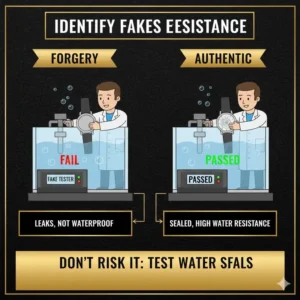
| Gasket/Seals | High-quality, durable rubber or synthetic materials; designed for prolonged water resistance. | Cheap, often silicone-based gaskets; degrades quickly, minimal actual water resistance. | Water resistance testing is definitive; fakes fail easily when exposed to pressure. |
| Hand Finish | Diamond-polished, beveled edges, multi-faceted; hands are perfectly flat and aligned. | Stamped metal, rough edges visible under magnification; hands may show slight curvature or imperfections. | Use a Bausch & Lomb 10x Hastings Triplet Loupe to inspect hand edges for machine marks. |
| Jewel Count | Higher (typically $25+$), genuine synthetic rubies, properly oiled pivots. | Lower or same count but with lower-quality synthetic jewels or decorative, non-functional jewels. | Confirmed by movement inspection via a watchmaker; essential for luxury watch authentication. |
💡 Pro-Tip: Don’t underestimate the small details! A slight difference in the finish of a screw or the beveling on a bridge is often the clearest sign you’ve encountered a non-authentic watch. Click here for a deep dive into movement finishing standards! 🛠️
💰 Budget vs. Premium Authentication: What You Can Check Yourself
While a professional authentication service or a trip to an authorized watch repair shop is the definitive way to verify a watch, there are many critical checks you can perform at home, especially if you are learning how to identify fake luxury watches.
| Check Category | Budget/DIY Check (Low Cost) | Premium/Expert Check (High Cost) | Expected Reliability in Spotting Fakes |
| Visual Inspection | Use a basic $10x$ jeweler’s loupe, check for blurry printing and misaligned markers. | Use an apochromatic $10x$ loupe (Bausch & Lomb 10x Hastings Triplet Loupe), high-resolution microscopy for logo verification. | High. Most low-quality fakes are caught here. Super-fakes require expert microscopy. |
| Material/Weight | Use a kitchen scale (Amazon Basics Digital Kitchen Scale) to verify total weight against published specs. Use a magnet for a quick steel check. | X-ray fluorescence (XRF) analysis to confirm exact steel alloy (e.g., 904L vs 316L) and gold purity. | Moderate-High. Excellent for detecting plated vs. solid gold, but less useful for high-quality steel fakes. |
| Movement Health | Listen for rotor noise; set the time and check rate consistency over 24 hours (manual check). | Use a Witschi Watch Expert 4 Timing Machine to measure amplitude, beat error, and daily rate precisely. | Very High. The most definitive, objective measure to tell if a watch is fake, as clone movements perform poorly. |
| Water Resistance | No DIY check is safe! | Pressure testing machine (e.g., $5$ Bar) to confirm seals are intact and meet factory specifications. | Very High. Fakes almost always fail a pressure test. |
| Packaging/Papers | Verify serial numbers match across all documents; check for misspellings or poor printing on the box/papers. | Cross-reference serial numbers with the brand’s official database (requires authorized access). | High. Fakes often have duplicated or incorrect serial numbers. |
🔑 Key Features and Benefits: Protecting Yourself from Counterfeiters
Understanding the features of authentic watches offers a huge benefit in luxury watch authentication. The features below are not just technical specs; they are tangible signs of a watch’s legitimacy and the rigorous quality control of a genuine manufacturer.
| Feature in an Authentic Watch | Benefit for the Owner | Comparison to a Counterfeit | Impact on Investment |
| COSC Chronometer Certification | Guaranteed timekeeping precision within $-4/+6$ seconds per day. | A replica will show erratic timing, often losing or gaining minutes per day. | Maintains high resale value; adds confidence in reliability. |
| In-House Caliber Finishing | Long-term durability, smoother operation, and intrinsic aesthetic value. | Crude, unfinished clone movement (like a non-authentic watch) reduces lifespan and looks cheap upon inspection. | Protects significant financial investment; finishing contributes to collectible value. |
| Proprietary Alloys (e.g., 904L Steel) | Superior polish retention, exceptional corrosion resistance, and specific haptics/weight. | Lower-grade 316L or plated metals dull quickly, show rust/pitting, and feel less dense. | Ensures the watch looks new for decades; confirms material authenticity and value. |
| Seamless Clasp Technology | Supreme comfort, secure fit, and micro-adjustment for seasonal changes. | Flimsy, rattling clasp that opens easily; cheap stamped components that wear out fast. | Enhances user experience; a high-quality clasp is a huge indicator of authenticity. |
| Original Box and Papers | Provides an unbroken chain of provenance; proof of purchase and warranty coverage. | Falsified papers or a missing box raises immediate suspicion and makes the watch difficult to sell later. | Essential for resale; a “full set” significantly increases the watch’s value. |
💡 Navigating the Pre-Owned Market and the Rise of “Super-Fakes”
The challenge of how to identify fake luxury watches has intensified with the advent of “super-fakes” or “high-end replica watches.” These aren’t the easily identifiable fakes of the past. They often use high-quality steel, mimic the weight, and even incorporate near-identical clone movements. They are designed explicitly to trick both novice and intermediate buyers. This is why you must go beyond external checks and become a genuine watch authentication expert yourself.
The key to detecting fake watches in this modern environment is vertical inspection. Don’t just check the dial; check the dial, then the weight, then the crown action, then the serial number font, and finally, the movement, using a comprehensive approach.
🚀 Ready to Invest with Confidence?
Click here to connect with trusted, verified dealers who guarantee authenticity and back every sale with an ironclad warranty! Your genuine timepiece awaits! 🏆
Conclusion: Protecting Your Investment in a High-End Timepiece
The journey of learning how to identify fake luxury watches is an ongoing process that requires vigilance, research, and the right tools. From the microscopic precision of the dial text—best seen with a Bausch & Lomb 10x Hastings Triplet Loupe—to the objective data provided by a Witschi Watch Expert 4 Timing Machine on the movement’s health, every detail matters. By mastering the 7-point checklist and trusting your instincts on provenance and price, you can confidently navigate the complex market and ensure your purchase is a genuine high-end timepiece.
Remember, the true value of a luxury watch isn’t just in its materials; it’s in the craftsmanship, the history, and the confidence of knowing you own the real thing. Don’t be fooled by cheap imitations. Invest wisely and authenticate thoroughly.
FAQs
✅ The most reliable way to tell if a high-end watch is fake is through a professional movement inspection, preferably using a Timegrapher. Authentic movements show correct beat rates and high, stable amplitude, whereas a non-authentic watch with a clone movement will display low or erratic amplitude and a high beat error, which clearly indicates a low-quality mechanism...
✅ You cannot check a Rolex serial number in a public database, but you can verify it by ensuring the number is deeply and cleanly engraved, not acid-etched or faint. The serial number on the watch case must perfectly match the one on the original warranty card. Any discrepancy immediately indicates a counterfeit timepiece...
✅ Yes, authentic luxury watches, especially those made of proprietary or precious metals like 904L steel, gold, or platinum, feel significantly dense and substantial. This is a critical indicator; if a watch feels too light or 'tinny,' it is a common sign you have encountered a counterfeit watch made of cheaper, less dense alloys...
✅ On the dial, look for razor-sharp, flawless printing under a 10x loupe. Check for perfect alignment of all applied markers and hands. On a fake, the text often appears slightly blurry, the luminous material is uneven, or the hands may have tool marks visible on the edges...
✅ A genuine Rolex cyclops lens should magnify the date window exactly 2.5 times (2.5x). This is a hallmark of authenticity that counterfeit watches rarely achieve, as most replicas only manage 1.5x to 2x magnification, which is a major red flag for luxury watch authentication... ❓ What is the most reliable way to tell if a high-end watch is fake?
❓ How can I check if a Rolex serial number is legitimate?
❓ Do authentic luxury watches feel heavy and dense?
❓ What should I look for on a watch's dial to spot a fake?
❓ How much magnification should a Rolex cyclops provide?
Recommended for You
- 10 Stunning Porsamo Bleu Timepieces That Will Transform Your Style in 2025
- 7 Best Vintage Ladies Rolex Watch Models For Timeless Elegance in 2025
- Cyber Monday Watch Deals 2025: 7 Expert Picks + Savings
Disclaimer: This article contains affiliate links. If you purchase products through these links, we may earn a small commission at no additional cost to you.
✨ Found this helpful? Share it with your friends! 💬🤗