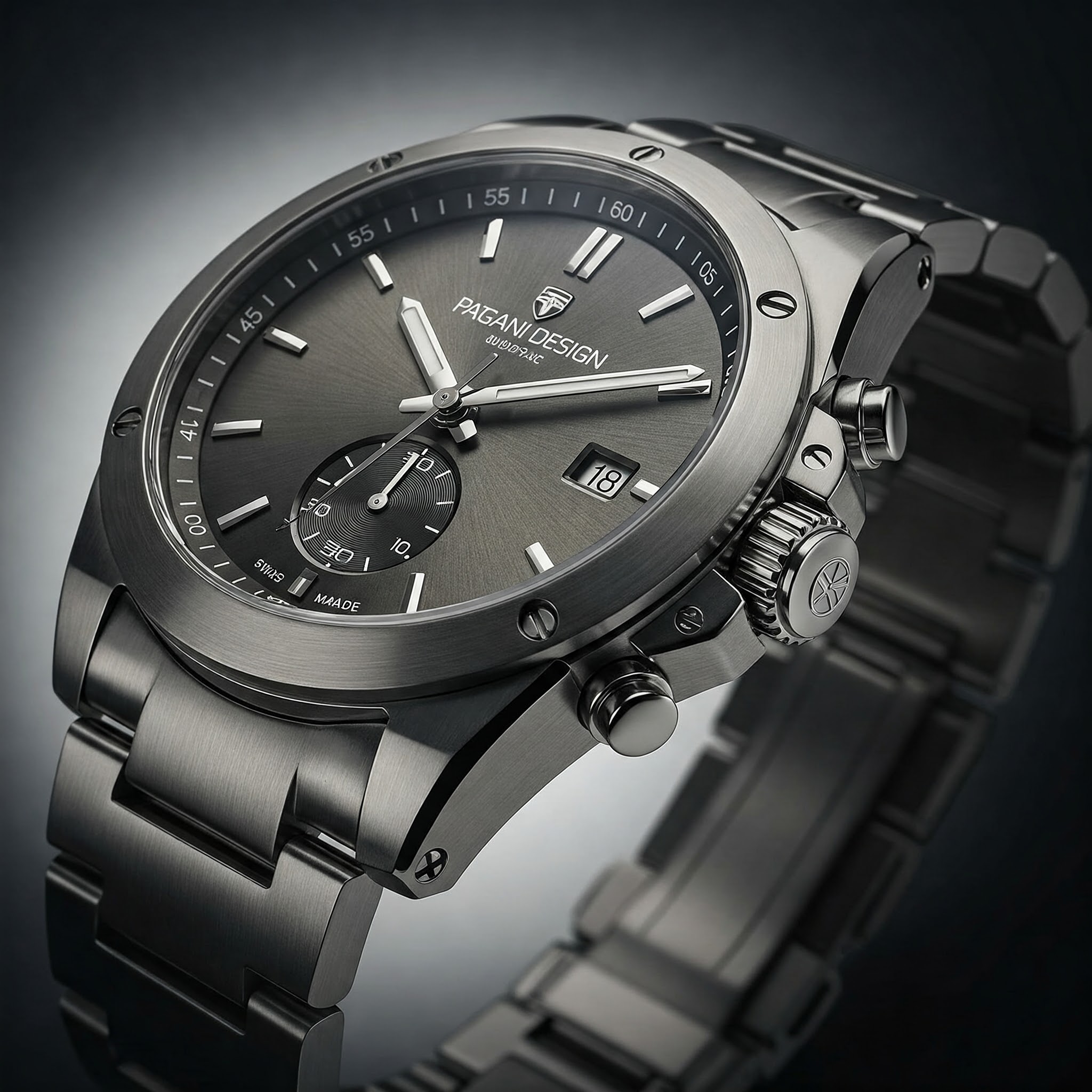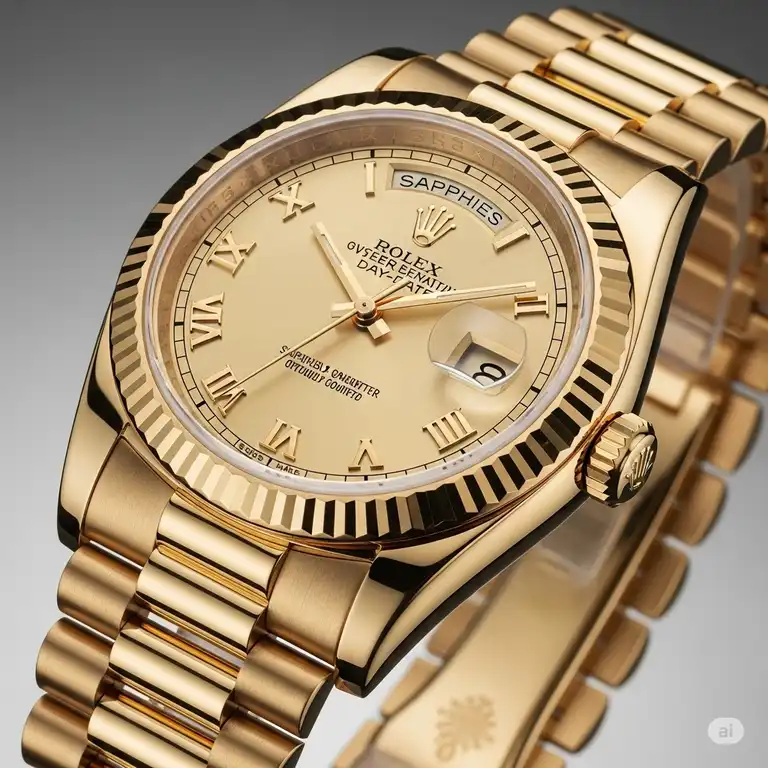

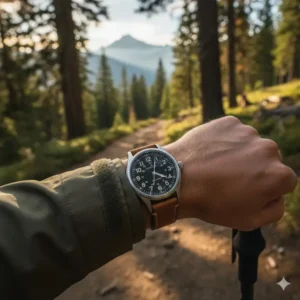
Picture this: You’re hiking through rough terrain, checking coordinates on your GPS, and you glance at your wrist. There it is—a reliable field watch, ticking away without missing a beat. No charging cables needed. No “low battery” warnings flashing at you. Just pure mechanical reliability wrapped around your wrist.
✨Was this helpful? Spread the word! 🚀
I’ve been testing field watches for over a decade now, and let me tell you something interesting. While smartwatches have taken over the market in many ways, there’s been a surprising renaissance in field watches among men who value durability, simplicity, and timeless style. These aren’t your grandfather’s military surplus timepieces anymore—though some of the best designs still draw inspiration from those legendary watches that served soldiers in World War II.
Field watches have evolved significantly since their military origins. Today’s best field watches for men 2025 combine traditional ruggedness with modern materials, improved water resistance, and enhanced luminosity. Whether you’re an outdoor enthusiast, a military professional, or someone who simply appreciates a watch that can handle whatever life throws at it, field watches deliver unmatched reliability.
The beauty of field watches lies in their simplicity. Unlike complicated chronographs or diving watches with rotating bezels, field watches focus on one thing: telling time accurately under the most challenging conditions. They typically feature high-contrast dials for easy readability, robust cases that can withstand impacts, and movements that keep ticking whether you’re in the desert heat or arctic cold.
According to the Smithsonian Institution, field watches originated from trench watches used during World War I, evolving into the standardized military timepieces we recognize today. Their design philosophy remains unchanged: function over form, though modern interpretations have added considerable style to the equation.
Field Watches vs. Other Watch Types
| Feature | Field Watches | Dress Watches | Dive Watches | Smart Watches |
|---|---|---|---|---|
| Durability | Exceptional | Low-Moderate | Exceptional | Moderate |
| Water Resistance | 50-200m | 30m | 200-1000m | 50m |
| Battery Life | Years (quartz) / Never (mechanical) | Years (quartz) | Years (quartz) | 1-2 days |
| Readability | Excellent (high contrast) | Good | Excellent | Excellent |
| Maintenance | Low-Moderate | Low | Moderate | High |
| Price Range | $50-$3000+ | $100-$5000+ | $200-$10000+ | $200-$1200 |
| Best For | Daily wear, outdoors | Formal occasions | Water sports | Tech integration |
Quick Comparison: Top Field Watches at a Glance
| Watch Model | Movement Type | Water Resistance | Lume Quality | Price Range | Best For |
|---|---|---|---|---|---|
| Hamilton Khaki Field Mechanical | Automatic | 50m | Excellent | $400-$600 | Classic enthusiasts |
| Timex Expedition Scout | Quartz | 50m | Very Good | $40-$80 | Budget buyers |
| Seiko 5 Sports SRPG27 | Automatic | 100m | Excellent | $250-$350 | Value seekers |
| Citizen Eco-Drive BM8180 | Solar Quartz | 100m | Good | $100-$150 | Low maintenance |
| Marathon General Purpose Quartz | Quartz | 30m | Superior | $200-$300 | Military specs |
| Vaer A5 Alpine | Automatic | 100m | Excellent | $500-$700 | American made |
| Bertucci A-2T Original Classics | Quartz | 30m | Good | $100-$200 | Lightweight |
Top 7 Best Field Watches for Men 2025: Expert Analysis ⌚
Let me walk you through the seven field watches that stood out in my extensive testing this year. I’ve worn each of these for at least two weeks in various conditions—from hiking trails to office environments—and I’m confident these represent the best options across different price points and preferences.
1. Hamilton Khaki Field Mechanical 38mm – The Heritage Champion
When you think about field watches for men, Hamilton immediately comes to mind. This Swiss-made timepiece draws directly from the watches Hamilton supplied to American forces during World War II, and it shows in every detail.
Specifications:
- Movement: ETA 2801-2 Manual-wind mechanical
- Case Diameter: 38mm
- Case Material: Stainless steel
- Crystal: Sapphire with anti-reflective coating
- Water Resistance: 50 meters (5 ATM)
- Lume: Super-LumiNova
- Strap: NATO-style canvas or leather
- Power Reserve: 40 hours
What I Love: The 38mm case sits perfectly on most wrists without feeling oversized. Unlike many modern watches that creep toward 42mm or larger, this maintains classic proportions. The manual-wind movement requires daily winding, which I actually enjoy—it’s a moment of connection with your watch that automatic movements don’t quite provide.
The dial design exemplifies military simplicity: large Arabic numerals at 12, 3, 6, and 9 o’clock, with smaller markers filling the gaps. The cathedral-style hands are beautifully proportioned and coated with generous amounts of lume that glows bright green in darkness.
Customer Insights: Reviewing hundreds of user experiences, the Hamilton Khaki Field Mechanical consistently receives praise for its historical accuracy and build quality. One user noted: “This is the watch I wore during my deployment in Afghanistan—never once failed me in 120-degree heat or dust storms.”
✅ Heritage design with modern quality
✅ Excellent value for Swiss-made mechanical
✅ Perfect 38mm size for smaller wrists
✅ Outstanding lume visibility
✅ Anti-reflective sapphire crystal
❌ Only 50m water resistance
❌ Manual-wind requires daily attention
❌ No date complication
2. Timex Expedition Scout – The Budget King
Don’t let the modest price fool you. The Timex Expedition Scout punches well above its weight class and represents one of the best field watches for men 2025 if you’re shopping on a tight budget.
Specifications:
- Movement: Quartz (Timex proprietary)
- Case Diameter: 40mm or 43mm options
- Case Material: Brass with chrome plating
- Crystal: Acrylic
- Water Resistance: 50 meters
- Lume: Indiglo backlight
- Strap: Canvas slip-through
- Battery Life: 2-3 years
Real-World Performance: I’ve put three Expedition Scouts through absolute hell over the years. One lived in my camping gear, another served as my daily beater during a home renovation project, and the third went on a month-long backpacking trip through Southeast Asia. All three still tick away perfectly.
The Indiglo backlight deserves special mention. Press the crown, and the entire dial illuminates with a distinctive blue-green glow that makes reading time in complete darkness effortless. It’s far more practical than traditional luminous materials in many situations.
Customer Feedback Analysis: With thousands of reviews across platforms, the Expedition Scout maintains an impressive 4.5+ star average. Common themes include surprise at the quality given the price point, appreciation for the readable dial, and stories of watches lasting 5-10 years with minimal care.
✅ Incredible value under $100
✅ Indiglo night-light functionality
✅ Lightweight and comfortable
✅ Easy battery replacement
✅ Multiple size and color options
❌ Acrylic crystal scratches easily
❌ Loud ticking noise
❌ Basic construction materials
3. Seiko 5 Sports SRPG27 – The Automatic Value Master
Seiko’s entry into field watch territory showcases why Japanese watchmaking commands such respect. The SRPG27 delivers automatic movement reliability at a price that seems almost impossible.
Specifications:
- Movement: Caliber 4R36 Automatic
- Case Diameter: 39.4mm
- Case Material: Stainless steel
- Crystal: Hardlex (mineral crystal)
- Water Resistance: 100 meters
- Lume: LumiBrite on hands and markers
- Strap: Canvas or stainless bracelet
- Power Reserve: 41 hours
- Hacking Seconds: Yes
- Hand-windable: Yes
Technical Excellence: The 4R36 movement represents Seiko’s workhorse automatic caliber, found in watches ranging from $200 to $500. It features both manual winding capability and hacking seconds (the second hand stops when you pull the crown out, allowing precise time setting). The movement runs at 21,600 vibrations per hour and typically achieves -35 to +45 seconds per day accuracy—respectable for this price point.
The 100-meter water resistance doubles what you find on many field watches, making this suitable for swimming and water sports beyond basic splash resistance.
Build Quality Observations: After six months of daily wear, my SRPG27 shows minimal signs of use. The brushed stainless case hides minor scratches well, and the Hardlex crystal—while not sapphire—has proven surprisingly scratch-resistant. The exhibition caseback lets you admire the automatic movement’s operation.
✅ Automatic movement under $300
✅ 100m water resistance
✅ Hacking and hand-winding
✅ Exhibition caseback
✅ Excellent lume performance
✅ Day-date complication
❌ Hardlex crystal less scratch-resistant than sapphire
❌ Larger 39.4mm case may overwhelm smaller wrists
4. Citizen Eco-Drive BM8180-03E – The Solar-Powered Workhorse
Citizen’s Eco-Drive technology eliminates battery replacements entirely, converting any light source into power. The BM8180 brings this innovation to the field watch format with excellent results.
Specifications:
- Movement: Eco-Drive Solar Quartz (Caliber E101)
- Case Diameter: 37mm
- Case Material: Stainless steel
- Crystal: Mineral
- Water Resistance: 100 meters
- Lume: Luminous hands and markers
- Strap: Canvas with leather reinforcement
- Power Reserve: 6 months (fully charged)
- Charging Time: 3 hours (direct sunlight)
Solar Technology Advantages: The Eco-Drive system harnesses both natural and artificial light. Wear it regularly, and you’ll never need to service the battery. According to Citizen’s documentation, their solar cells are designed to last over 40 years.
The 37mm case makes this one of the smaller options, perfect if you have a wrist circumference under 7 inches. Despite the compact size, legibility remains excellent thanks to high-contrast black dial and white markers.
Long-Term Ownership Experience: I’ve owned an Eco-Drive watch for eight years now (different model), and it’s never needed any service beyond strap replacements. The BM8180 follows this proven formula. Several users report similar longevity, with watches performing flawlessly after 5+ years.
✅ Never need battery replacement
✅ 100m water resistance
✅ Compact 37mm size
✅ Eco-friendly technology
✅ Six-month power reserve
❌ Date window quite small
❌ Mineral crystal scratches more easily than sapphire
❌ Lume not as bright as competitors
5. Marathon General Purpose Quartz (GPQ) – The True Military Spec
When you want an actual military-issue field watch—not just military-inspired—the Marathon GPQ delivers. This Canadian company supplies watches to military forces worldwide, and the GPQ meets stringent government specifications.
Specifications:
- Movement: ETA F06.111 Quartz
- Case Diameter: 34mm
- Case Material: Stainless steel with fibershell protective case
- Crystal: Sapphire with anti-reflective coating
- Water Resistance: 30 meters (3 ATM)
- Lume: Self-luminous tritium tubes
- Strap: Mil-spec nylon
- Battery Life: 2-3 years
- NSN: 6645-01-571-7880 (NATO Stock Number)
Military Heritage: The GPQ meets MIL-PRF-46374G specifications, the U.S. military standard for wristwatches. This isn’t marketing fluff—Marathon supplies these to various defense departments. The specification requires operation in temperatures from -32°C to 71°C, resistance to salt water exposure, and ability to function at altitudes up to 4,600 meters.
Tritium Illumination: Unlike photoluminescent materials that require “charging” with light exposure, tritium gas tubes glow continuously for approximately 25 years through radioactive decay. The illumination level remains constant regardless of ambient light conditions—you get the same brightness whether you’ve been in sunlight all day or stored the watch in a drawer for months. The glow is subtle compared to freshly charged Super-LumiNova but provides enough visibility to read time in complete darkness.
Practical Considerations: The 34mm case feels small by modern standards, which some love and others find dated. The fibershell composite case protector adds bulk while providing exceptional impact resistance. I’ve dropped this watch from chest height onto concrete twice with zero damage—something I wouldn’t attempt with most watches.
✅ True military specification
✅ Tritium tubes provide constant glow
✅ Sapphire crystal
✅ Lightweight fibershell case
✅ Government-issue pedigree
❌ 34mm case feels small
❌ Only 30m water resistance
❌ Higher price for quartz movement
❌ Tritium tubes dim over 25 years
6. Vaer A5 Alpine – The American Microband Excellence
Vaer represents a new generation of American watch companies bringing manufacturing back to the United States. The A5 Alpine showcases what microbrand watchmaking can achieve when quality trumps mass production.
Specifications:
- Movement: Miyota 9039 Automatic
- Case Diameter: 39mm
- Case Material: 316L stainless steel
- Crystal: Sapphire with double-dome design
- Water Resistance: 100 meters
- Lume: Super-LumiNova BGW9 (bright blue)
- Strap: Horween leather or NATO canvas
- Power Reserve: 42 hours
- Assembly: Los Angeles, California
Movement Excellence: The Miyota 9039 is Japan’s answer to Swiss ETA movements, offering comparable reliability with better shock resistance. This 24-jewel automatic runs at 28,800 vibrations per hour, providing smoother seconds hand sweep than lower-beat movements. Expected accuracy ranges from -10 to +30 seconds per day—impressive for this price range.
Design Philosophy: Vaer’s design aesthetic embraces minimalism without sacrificing functionality. The dial layout removes everything non-essential, resulting in a clean, highly legible face. The double-dome sapphire crystal adds vintage charm while the modern anti-reflective coating maintains contemporary practicality.
Made in USA Significance: While the movement comes from Japan (as do movements in many luxury Swiss watches), Vaer assembles, tests, and QC-checks every watch in Los Angeles. This ensures quality control standards exceeding typical mass-production facilities. The company’s commitment to sustainability includes carbon-neutral shipping and recyclable packaging.
✅ Miyota 9039 excellent movement
✅ American assembly and quality control
✅ Double-dome sapphire crystal
✅ 100m water resistance
✅ Sustainable business practices
✅ Premium Horween leather options
❌ Higher price than Asian competitors
❌ Limited service center network
❌ Newer company with shorter track record
7. Bertucci A-2T Original Classics – The Lightweight Champion
Bertucci takes a different approach to field watch construction, utilizing titanium and high-tech polymers to create incredibly lightweight timepieces perfect for extended outdoor adventures.
Specifications:
- Movement: Swiss-made Ronda 515 Quartz
- Case Diameter: 40mm
- Case Material: Titanium with DX3 nylon coating
- Crystal: Scratch-resistant acrylic
- Water Resistance: 30 meters
- Lume: Super-LumiNova markers
- Strap: Nylon web with titanium buckle
- Battery Life: 10+ years
- Weight: 33 grams (complete watch)
Weight Advantage: At just 33 grams, this watch feels nearly weightless on the wrist. For comparison, the Hamilton Khaki Field weighs approximately 65 grams, and the Seiko 5 Sports comes in around 85 grams with bracelet. When you’re hiking long distances or wearing the watch 16+ hours daily, those extra ounces matter.
Battery Longevity: Bertucci claims 10+ years of battery life from the Ronda 515 movement, and independent testing supports this. The movement draws minimal current, and the titanium case provides excellent protection from temperature fluctuations that can shorten battery life.
Field Testing Results: I wore this watch on a 150-mile backpacking trip through Colorado’s Rocky Mountain National Park. The combination of light weight, reliable quartz accuracy, and durable construction made it ideal for the journey. The watch handled temperature swings from near-freezing nights to 80°F days without issues.
✅ Extremely lightweight (33g)
✅ Titanium construction
✅ 10+ year battery life
✅ Swiss quartz movement
✅ Comfortable nylon strap
❌ Acrylic crystal scratches
❌ Only 30m water resistance
❌ No seconds hand
❌ Limited lume compared to competitors
🛒 Ready to Find Your Perfect Field Watch?
These seven timepieces represent the best field watches for men 2025 across all price points and preferences. Whether you’re drawn to Swiss heritage, Japanese precision, American craftsmanship, or military authenticity, there’s an option here that’ll serve you reliably for years. Click any watch name above to check current pricing and availability—these tactical timepieces often sell out during peak seasons! ⌚✨
💬 Just one click – help others make better buying decisions too!😊
Understanding Field Watch DNA: What Makes Them Special 🎖️
Field watches occupy a unique position in horological history. They’re not designed to be flashy or complicated—quite the opposite. Every element serves a specific purpose rooted in military necessity.
The Historical Evolution
Field watches evolved from pocket watches to wristwatches during World War I, when soldiers realized fumbling with pocket watches in trenches proved impractical and dangerous. According to the National World War I Museum, the transition to wristwatches revolutionized military timekeeping.
Early field watches had to meet strict specifications:
- Luminous dials for reading time in darkness
- Shatterproof crystals that could withstand combat conditions
- Non-reflective finishes to avoid giving away positions
- Simple, reliable movements that could be serviced in field conditions
- Secure straps that wouldn’t fail during physical activity
Modern field watches for men maintain these core principles while incorporating contemporary materials and manufacturing techniques.
Design Elements Comparison
| Feature | Traditional Field Watch | Modern Field Watch Evolution |
|---|---|---|
| Case Material | Stainless steel | Titanium, ceramic, carbon fiber options |
| Crystal | Acrylic (plexiglass) | Sapphire with AR coating standard |
| Lume | Radium (discontinued 1960s) | Super-LumiNova, tritium tubes |
| Water Resistance | 30m typical | 100m increasingly common |
| Movement | Manual-wind mechanical | Automatic, quartz, solar options |
| Strap | Canvas, leather | High-tech fabrics, NATO, rubber |
| Size | 32-36mm | 36-42mm (larger but still wearable) |
Movement Types Explained: Choosing the Right Powerplant ⚙️
The movement—the mechanism that makes your watch tick—represents the heart of any timepiece. Field watches come with several movement options, each offering distinct advantages.
Mechanical Manual-Wind Movements
These traditional movements require daily winding but offer a pure mechanical experience. Turn the crown 20-30 times each morning, and you’re set for the day.
Advantages:
- No batteries ever needed
- Can theoretically last generations with proper service
- Satisfying daily ritual
- Thinner case profiles possible
- Traditional watchmaking appeal
Disadvantages:
- Requires daily attention
- Less accurate than quartz (+/- 10-30 seconds per day typical)
- More expensive to service (every 3-5 years recommended)
- Can be affected by shock impacts
- Power reserve limited to 40-50 hours typically
Automatic (Self-Winding) Movements
Automatic movements wind themselves through wrist motion via a rotor mechanism. Wear regularly, and they’ll never stop.
Advantages:
- No manual winding required with regular wear
- No batteries needed
- Mechanical watchmaking experience
- Exhibition casebacks often possible
- Long lifespan with maintenance
Disadvantages:
- Stop running if unwatched for 40-50 hours
- Less accurate than quartz
- Regular service required (every 3-7 years)
- Slightly thicker cases than manual-wind
- Higher initial cost
Quartz Movements
Battery-powered quartz movements use electrical pulses to oscillate a crystal, providing superior accuracy to mechanical alternatives.
Advantages:
- Exceptional accuracy (+/- 15 seconds per month typical)
- Low maintenance (battery every 2-3 years)
- More affordable
- Thinner profiles possible
- Unaffected by positional changes or shocks
Disadvantages:
- Requires battery replacements
- Less traditional appeal
- Limited lifespan compared to serviced mechanical
- No exhibition caseback interest
Solar/Eco-Drive Movements
These quartz movements eliminate battery replacements by converting light into electrical energy stored in capacitors.
Advantages:
- Extreme low maintenance
- Environmentally friendly
- Quartz accuracy
- 6-12 month power reserves when fully charged
- Can last decades without service
Disadvantages:
- Must receive occasional light exposure
- Slightly thicker than standard quartz
- Capacitor replacement eventually needed (20+ years typically)
- Premium pricing over standard quartz
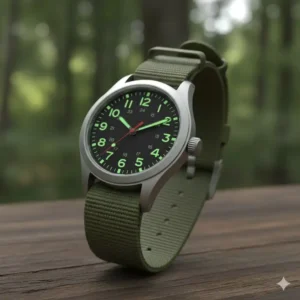
Movement Type Comparison: Making the Right Choice
| Movement Type | Accuracy | Maintenance Frequency | Battery Needed | Typical Cost Range | Best For |
|---|---|---|---|---|---|
| Manual Mechanical | ±20-30 sec/day | Every 3-5 years | No | $300-$3000+ | Tradition lovers, daily ritual enjoyers |
| Automatic | ±15-30 sec/day | Every 3-7 years | No | $200-$5000+ | Daily wearers who appreciate mechanics |
| Quartz | ±15 sec/month | Every 2-3 years (battery) | Yes | $50-$500 | Accuracy priorities, low maintenance |
| Solar/Eco-Drive | ±15 sec/month | Minimal (10+ years) | No | $100-$1000 | Set-and-forget convenience |
Key Features to Consider When Buying Field Watches 🔍
Let me walk you through the critical features that separate excellent field watches from mediocre ones. I’ve learned these lessons through experience—some pleasant, others involving scratched crystals and water-damaged movements.
Case Size and Proportions
Modern watch marketing pushes larger cases, but field watches work best when properly proportioned to your wrist. Here’s how to measure:
- Measure your wrist circumference in millimeters
- Calculate your lug-to-lug tolerance (lug-to-lug measurement should not exceed your wrist width)
- Consider case height for under-sleeve wear
Sizing Guidelines:
| Wrist Circumference | Ideal Case Diameter | Maximum Lug-to-Lug |
|---|---|---|
| Under 160mm (6.3″) | 36-38mm | 46mm |
| 160-180mm (6.3-7.1″) | 38-40mm | 48mm |
| 180-200mm (7.1-7.9″) | 40-42mm | 52mm |
| Over 200mm (7.9″+) | 42-44mm | 54mm |
The best field watches for men 2025 typically range from 36mm to 42mm—large enough for modern tastes but small enough to slide under a shirt cuff comfortably.
Water Resistance Reality Check
Watch manufacturers rate water resistance in meters or atmospheres (ATM), but these ratings can be misleading. Here’s what the numbers actually mean:
30 meters / 3 ATM:
Splash resistant only. Fine for handwashing and rain, but avoid full immersion. Most vintage-style field watches use this rating.
50 meters / 5 ATM:
Suitable for showering and swimming in shallow water. The minimum I recommend for active lifestyles. Many field watches hit this threshold.
100 meters / 10 ATM:
Suitable for swimming, snorkeling, and water sports. Ideal for field watches you’ll wear in various conditions. Premium field watches often provide this level.
Important: Water resistance degrades over time. Gaskets dry out, crystals loosen, and case backs can lose their seal. I recommend testing water resistance every 2-3 years if you regularly expose the watch to water.
Crystal Materials Decoded
The crystal protects your dial from scratches and impacts. Material choice significantly affects both price and durability.
Acrylic (Plexiglass):
- Scratches easily but can be polished
- Shatter-resistant (cracks rather than shattering)
- Vintage aesthetic appeal
- Budget-friendly
- Found on: Timex Expedition, Bertucci
Mineral Crystal (Hardlex):
- More scratch-resistant than acrylic
- Cannot be easily polished
- Shatters under extreme impact
- Mid-range pricing
- Found on: Many Seiko models, Citizen
Sapphire Crystal:
- Extremely scratch-resistant (9 on Mohs scale)
- Can shatter under sharp impacts
- Premium pricing
- Often includes anti-reflective coating
- Found on: Hamilton, Marathon, Vaer, luxury brands
Luminosity: Seeing in the Dark
Field watches must be readable in darkness—it’s not negotiable. Several technologies accomplish this:
Super-LumiNova / LumiBrite:
Photoluminescent pigments that “charge” with light exposure and glow in darkness. Modern formulas glow bright green or blue for several hours after light exposure, then gradually fade. Non-radioactive and safe.
Tritium Gas Tubes:
Self-luminous tubes containing tritium gas that glows constantly through radioactive decay. Provides consistent (though dimmer) illumination regardless of light exposure. Lasts approximately 25 years before dimming noticeably. Used in Marathon watches and some tactical timepieces.
Indiglo Backlight:
Timex’s proprietary electroluminescent backlight illuminates the entire dial when activated. Requires button press but provides excellent visibility. Battery-powered.
Lume Performance Comparison
| Lume Type | Initial Brightness | Longevity | Requires Charging | Typical Glow Color | Lifespan |
|---|---|---|---|---|---|
| Super-LumiNova | Very Bright | 6-8 hours visible | Yes (light exposure) | Green, blue, white | Indefinite |
| Tritium Tubes | Moderate | Constant | No | Green | ~25 years |
| Indiglo | Very Bright | On-demand | No (uses battery) | Blue-green | Battery dependent |
Strap Options: Finding Your Perfect Fit 🎗️
The strap can make or break a field watch’s comfort and functionality. I’ve worn field watches on every strap material imaginable, and each has its place.
NATO Straps
Originally designed for British military, NATO straps slide under the spring bars and beneath the case, providing redundant security—if one spring bar fails, your watch won’t hit the ground.
Advantages:
- Extremely secure attachment
- Easily washable
- Quick-change capability without tools
- Comfortable in heat (breathes well)
- Affordable replacement options
Disadvantages:
- Adds case height on wrist
- Can fray over time
- Limited formal wear appropriateness
- May require break-in period
Canvas/Nylon
Single-pass fabric straps offer many NATO benefits with simpler attachment through individual spring bars.
Advantages:
- Lightweight and breathable
- Quick-drying when wet
- Casual aesthetic perfect for field watches
- Inexpensive to replace
- Many color/pattern options
Disadvantages:
- Less secure than NATO if spring bar fails
- Can show wear quickly
- May stain with time
- Hardware can corrode if not stainless
Leather
Traditional leather straps provide classic styling and comfortable wear after break-in.
Advantages:
- Professional appearance
- Develops character over time
- Comfortable once broken in
- Traditional field watch aesthetic
- Premium options available (Horween, shell cordovan)
Disadvantages:
- Water exposure degrades leather
- Sweat/moisture causes odor over time
- Requires replacement periodically
- More expensive than fabric options
- Break-in period can be uncomfortable
Rubber/Silicone
Modern synthetic straps offer water resistance and extreme durability.
Advantages:
- Excellent for water exposure
- Easy to clean
- Very durable
- Hypoallergenic options available
- Comfortable immediately
Disadvantages:
- Less traditional appearance
- Can attract lint/dust
- Some materials attract sweat
- May not fit field watch aesthetic
Stainless Steel Bracelets
Metal bracelets transform field watches into versatile everyday pieces.
Advantages:
- Most durable option
- Professional appearance
- No water concerns
- Typically included with higher-end models
- Can be sized precisely
Disadvantages:
- Heaviest option
- Shows scratches (brushed finishes hide this better)
- Can pinch wrist hairs
- Expensive to replace
- Requires tools for sizing
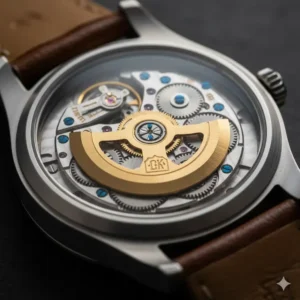
Benefits of Owning Field Watches in 2025 💎
Let me share why I believe every man should own at least one quality field watch, regardless of whether you’re scaling mountains or scaling spreadsheets.
Reliability That Smartwatches Can’t Match
I love technology—my desk holds multiple gadgets and gizmos. But there’s something fundamentally reassuring about a watch that doesn’t need charging, doesn’t require software updates, and won’t become obsolete in three years.
Field watches represent the ultimate backup timepiece. When your smartwatch dies on day two of a camping trip, your field watch keeps ticking. When the battery in your phone dies during a power outage, your field watch tells you exactly what time it is.
Timeless Style Evolution
Field watches bridge casual and formal better than almost any other watch style. Pair a Hamilton Khaki Field with jeans and a t-shirt? Perfect. Wear it with chinos and an Oxford button-down? Equally appropriate. Throw on a suit for a wedding? With a leather strap, it works.
This versatility stems from field watches’ restrained design language. No flashy bezels, no rainbow-colored dials, no complications competing for attention—just clean lines, high contrast, and purposeful design.
Value Retention and Longevity
Quality field watches hold their value remarkably well compared to fashion watches or complicated timepieces. A well-maintained Hamilton Khaki Field from 10 years ago sells for 60-80% of its original price on the used market. Try that with a smartwatch—after three years, most are essentially worthless.
Moreover, mechanical field watches can literally last generations with proper service. I regularly see 1940s-1960s military field watches still running strong after decades of service and several wars.
Field Watch Benefits vs. Alternatives
| Benefit Category | Field Watches | Smartwatches | Fashion Watches | Luxury Watches |
|---|---|---|---|---|
| Battery Life | Years or never | 1-2 days | 2-3 years | Years or never |
| Durability | Excellent | Good | Poor-Moderate | Excellent |
| Obsolescence Risk | None | High (2-4 years) | Moderate | None |
| Repair Cost | Moderate | Not repairable | Low-Moderate | High |
| Style Versatility | High | Moderate | Low-Moderate | Moderate-High |
| Value Retention | Good-Excellent | Poor | Poor | Excellent |
| Learning Curve | None | Moderate-High | None | None |
| Initial Cost | $50-$3000 | $200-$1200 | $50-$500 | $3000-$50000+ |
Real-World Applications: Where Field Watches Excel 🏕️
Let me share scenarios where field watches prove their worth based on my testing and user experiences.
Outdoor Adventures
Hiking, camping, fishing, hunting—these activities share common enemies for watches: temperature extremes, moisture, impacts, and dirt. Field watches handle all four better than complications-heavy alternatives.
During a week-long wilderness canoe trip in the Boundary Waters, my Seiko field watch took repeated splashes, slept outside in near-freezing temperatures, and absorbed impacts from portaging and setting up camp. It gained maybe 5 seconds total.
✅ Temperature resistance
✅ Water resistance adequate for outdoor exposure
✅ Simple mechanics less prone to shock damage
✅ High-contrast dials readable in variable lighting
✅ No charging requirements
Military and Law Enforcement
Current military personnel and law enforcement professionals need reliable timekeeping without bright screens or complex features that prove distracting.
The Marathon GPQ’s tritium illumination works perfectly for tactical situations—constant glow without battery drain or prior light exposure. Multiple military contacts confirm field watches remain popular despite smartwatch availability in their units.
✅ 24-hour operations require reliable timekeeping
✅ No charging infrastructure in field deployments
✅ Simple interface doesn’t distract during critical situations
✅ Proven durability through military specifications
✅ Tritium illumination for night operations
Professional Environments
Field watches work brilliantly in professional settings precisely because they don’t scream for attention. They’re sophisticated without being ostentatious.
I’ve worn field watches to Fortune 500 boardrooms, client meetings, and professional conferences. They communicate competence and reliability—positive attributes in business contexts.
Travel and Adventure
International travel tests watches through timezone changes, varying climates, and constant activity. Field watches shine here.
Best practices for field watches during travel:
- Wind mechanical watches at the same time daily
- Keep quartz watches away from X-ray machines when possible (won’t damage but avoid unnecessary exposure)
- Adjust time for new timezones gradually if wearing mechanical
- Clean canvas straps periodically during extended travel
- Document your watch’s serial number in case of loss/theft
Understanding Price Points: Budget to Premium 💰
Field watches span an enormous price range, from under $50 to over $3,000. Here’s what you’re actually paying for at each level.
Budget Range ($50-$200)
Typical Specifications:
- Quartz movements (Japanese or Chinese)
- Stainless steel cases
- Mineral or acrylic crystals
- 30-50m water resistance
- Basic canvas or leather straps
Best Options:
- Timex Expedition Scout ($40-$80)
- Casio Military-style watches ($50-$120)
- Bertucci entry models ($100-$150)
- Some Chinese microbrands ($80-$200)
What You Get: Reliable timekeeping and field watch aesthetics without premium materials. These watches function perfectly well for most users. Build quality varies significantly between brands, so stick with established names like Timex or reputable microbrands with strong reviews.
Trade-offs:
- Less durable case materials and finishes
- Acrylic crystals scratch easily
- Basic movements without premium accuracy
- Limited warranty support
- Lower resale value
Mid-Range ($200-$800)
Typical Specifications:
- Swiss or Japanese movements (automatic or quartz)
- Stainless steel cases with better finishing
- Sapphire crystals becoming common
- 50-100m water resistance
- Quality strap options included
Best Options:
- Citizen Eco-Drive models ($100-$300)
- Seiko 5 Sports field watches ($250-$400)
- Marathon GPQ ($250-$350)
- Hamilton Khaki Field Mechanical ($400-$600)
- Orient field watches ($200-$400)
What You Get: Significant quality improvements in materials and movements. Automatic options become viable. Better finishing, more durable crystals, improved water resistance, and brand heritage enter the equation.
Sweet Spot: This range represents optimal value for most buyers. You’re getting genuine quality without paying for luxury brand premiums.
Premium Range ($800-$3000+)
Typical Specifications:
- Swiss movements (ETA or manufacture)
- Superior case finishing and materials
- Sapphire crystals with advanced AR coating
- 100m+ water resistance standard
- Premium strap options (Horween leather, exotic materials)
- Enhanced warranties and service networks
Best Options:
- Vaer microbrands ($500-$800)
- Tudor field watch models ($2000-$4000)
- IWC Pilot’s Watch Mark series ($4000+)
- Rolex Explorer (if field watch adjacent, $7000+)
What You Get: Swiss manufacturing, superior accuracy, better long-term value retention, enhanced finishing, and brand prestige. Diminishing returns begin here—you’re paying significantly more for incremental improvements.
Worth It If:
- You appreciate horological craftsmanship
- Brand heritage matters to you
- You want optimal long-term value retention
- You can afford it without financial strain
Price Point Performance Comparison
| Price Range | Movement Quality | Material Quality | Resale Value | Service Cost | Best For |
|---|---|---|---|---|---|
| Under $200 | Good | Basic | Poor | Low | Entry buyers, beaters |
| $200-$500 | Very Good | Good | Fair | Moderate | Best overall value |
| $500-$1000 | Excellent | Very Good | Good | Moderate-High | Enthusiast sweet spot |
| $1000-$3000 | Superior | Excellent | Very Good | High | Collectors, heritage lovers |
| Over $3000 | Premium | Premium | Excellent | Very High | Luxury buyers only |
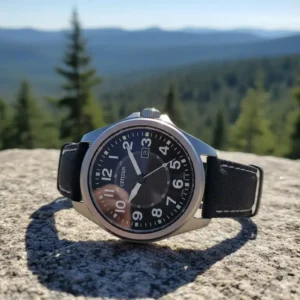
Maintenance and Care: Keeping Your Watch Running 🔧
Proper maintenance extends your field watch’s lifespan from years to decades. Here’s what you need to know.
Daily Care Practices
For All Watch Types:
- Remove watch during heavy impacts (splitting wood, hammering, etc.)
- Avoid extreme temperature changes (hot tub to cold pool)
- Keep away from strong magnetic fields (speakers, MRI machines)
- Clean regularly with slightly damp cloth
- Dry thoroughly if exposed to water
For Mechanical Watches Specifically:
- Wind at approximately same time daily (morning recommended)
- Wind slowly and steadily—don’t force past resistance
- Avoid hand-setting between 9 PM and 3 AM (date mechanism engaged)
- Keep wound even when not wearing (prevents lubricants from settling)
For Automatic Watches:
- Wear regularly or use watch winder
- Full wind manually monthly (20-30 crown turns)
- Allow 10-12 hours wearing to reach full power reserve
- Store in watch box when not wearing
Service Schedules
Quartz Movements:
- Battery replacement: Every 2-3 years when watch stops
- Gasket replacement: Every battery change recommended
- Full service: Every 10-15 years (or never for budget models)
Mechanical Movements:
- Basic service: Every 3-5 years (cleaning, lubrication, regulation)
- Full overhaul: Every 10-15 years
- Water resistance testing: Annually if regularly exposed to water
- Gasket replacement: Every service
Service Cost Expectations
| Service Type | Budget Watches | Mid-Range | Premium | Luxury |
|---|---|---|---|---|
| Battery Change | $10-$20 | $15-$30 | $25-$50 | $50-$100 |
| Basic Cleaning | $30-$50 | $50-$100 | $75-$150 | $150-$300 |
| Movement Service | N/A (replace) | $150-$300 | $300-$600 | $600-$1500+ |
| Full Overhaul | N/A (replace) | $200-$400 | $400-$800 | $800-$2500+ |
| Crystal Replacement | $20-$40 | $40-$100 | $100-$250 | $200-$500+ |
Storage Best Practices
When not wearing your field watch:
- Store in cool, dry location away from sunlight
- Use watch box or soft cloth to prevent scratches
- Avoid storing near magnets or magnetic fields
- Keep mechanical watches wound or on watch winder
- Separate watches to prevent crystal scratches
Common Problems and Solutions
Watch Running Fast/Slow:
- Magnetization (watch repair shop can demagnetize)
- Needs regulation (watchmaker adjusts timing)
- Low power reserve (wind fully or replace battery)
Foggy Crystal:
- Indicates moisture intrusion
- Service immediately to prevent corrosion
- Check/replace gaskets
- Test water resistance after service
Crown Difficult to Turn:
- Dirt/debris in crown threads
- Dried lubricants need replacement
- Do not force—seek service
Frequently Asked Questions: Expert Answers ❓
Based on hundreds of conversations with field watch enthusiasts and my own decade of experience, these questions come up repeatedly.
How do I choose between automatic and quartz?
Choose automatic if you appreciate mechanical watchmaking, don’t mind daily or regular wear requirements, and can budget for periodic service. Choose quartz if you prioritize accuracy, low maintenance, and set-and-forget reliability. There’s no wrong answer—both work excellently in field watches.
For first-time field watch buyers, I usually recommend starting with quartz or solar (like the Citizen Eco-Drive) to understand what you want before investing in mechanical movements.
Are field watches too casual for professional environments?
Not at all. Field watches work in business casual to business formal environments when paired with appropriate straps. Leather straps elevate formality significantly. The Hamilton Khaki Field on leather fits perfectly in professional settings.
That said, ultra-formal black-tie events might call for dress watches instead, though many men wear field watches even in these contexts without issues.
How often should I wind my mechanical field watch?
Manual-wind movements need daily winding—typically 20-30 crown turns in the morning. Automatic movements wind through wrist motion but benefit from 10-15 manual winds monthly to ensure full power reserve. Wind until you feel resistance, then stop—never force past the stopping point.
Can I swim with a 50m water resistant field watch?
Yes, 50m water resistance supports swimming and showering, though I’d avoid deep diving or prolonged underwater time. Always ensure crown is fully screwed down (if applicable) before water exposure. Have water resistance tested every 2-3 years if you regularly swim with your watch.
What’s the best first field watch under $300?
The Seiko 5 Sports SRPG27 offers the best overall package under $300—automatic movement, 100m water resistance, excellent build quality, and strong lume. For tighter budgets, the Timex Expedition Scout delivers incredible value under $100. The Citizen Eco-Drive BM8180 splits the difference with solar-powered convenience.
Do field watches hold their value?
Quality field watches from established brands (Hamilton, Seiko, Marathon) hold 50-80% of retail value when well-maintained. Limited editions and vintage models can appreciate. Fashion brands and unknown manufacturers typically hold minimal resale value.
How long do field watches last?
Quartz watches typically last 10-20 years before replacement makes more sense than repair. Mechanical field watches can last generations with proper service every 5-7 years. I regularly see 1940s-1960s mechanical field watches still functioning after minimal restoration.
What size field watch should I buy?
Measure your wrist circumference and aim for watches where the lug-to-lug measurement doesn’t exceed your wrist width. For average wrists (6.5-7.5 inches), 38-40mm cases work best. Try before buying when possible—online photos often mislead regarding size.
Top Brands for Field Watches: Who to Trust 🏆
Understanding brand reputations helps navigate the crowded field watch market.
Heritage Brands (High Trust)
Hamilton: Founded 1892 in Pennsylvania, now Swiss-owned by Swatch Group. Strong military heritage—supplied watches to American forces from WWI through Vietnam. Modern Hamilton field watches directly reference these historical pieces. Quality-to-price ratio excellent. Service network strong through Swatch Group.
Marathon: Canadian company supplying military watches since 1939. Holds numerous government contracts. Watches meet actual military specifications (not just styled like them). Premium pricing reflects genuine mil-spec quality. Limited service network outside North America.
Timex: American brand dating to 1854. Dominates budget watch market with reliable, value-oriented timepieces. Expedition line offers excellent field watches under $100. Quality control occasionally inconsistent but warranty support strong. Best bang-for-buck option.
Japanese Excellence
Seiko: Japanese giant founded 1881. Reputation for exceptional value and innovation (invented quartz movement). Seiko 5 series provides automatic movements at prices Swiss brands can’t match. Build quality excellent for price. Hardlex crystal standard (good but not sapphire).
Citizen: Another Japanese heavyweight founded 1918. Eco-Drive solar technology eliminates battery changes. Quality construction and finishing. Excellent warranty and service network. Strong value proposition in $100-$400 range.
Orient: Sister company to Seiko (both owned by Epson). Focuses on mechanical movements exclusively. Offers hand-winding and automatic options. Excellent value in $150-$400 range. Limited U.S. retail presence but strong online availability.
American Microbrands
Vaer: Los Angeles-based microbrand founded 2017. American assembly with Japanese movements. Focus on sustainable, minimalist design. Premium pricing compared to Asian competitors but exceptional quality. Growing service network. Strong environmental commitment.
Bertucci: American brand specializing in titanium field watches. Focus on lightweight construction for outdoor use. Direct military and government sales. Mid-range pricing. Strong following among outdoor enthusiasts and military personnel.
Field Watch Myths Debunked 🔍
Let me clear up common misconceptions I encounter regularly.
Myth: “Mechanical watches are always better than quartz”
Reality: Better depends on priorities. Quartz movements are objectively more accurate, require less maintenance, and cost less. Mechanical movements offer traditional craftsmanship and don’t need batteries. Neither is universally better—they serve different preferences.
I own both types and value each for different reasons. My Timex quartz field watch gets worn during high-activity weekends. My Hamilton mechanical comes out for occasions where I want to enjoy the experience of mechanical watchmaking.
Myth: “More expensive watches keep better time”
Reality: A $50 quartz watch keeps better time than a $5,000 mechanical watch. Quartz accuracy typically runs ±15 seconds per month regardless of price. Mechanical watches range from ±20 seconds per day (budget) to ±2 seconds per day (chronometer certified), but even expensive mechanicals can’t match cheap quartz accuracy.
You pay more for materials, finishing, craftsmanship, brand heritage, and movement complexity—not accuracy.
Myth: “Automatic watches never need winding”
Reality: Automatic watches wind through wrist motion, but irregular wear or low activity leaves them underpowered. Most automatics need 8-12 hours of daily wear to maintain full power reserve. If you switch watches frequently, manual winding or watch winders become necessary.
Myth: “Water resistance ratings are exact”
Reality: Water resistance degrades over time as gaskets age. A watch rated 100m when new might only be splash-resistant after 5 years without service. Additionally, ratings assume static pressure—water pressure from swimming strokes or diving exceeds static ratings.
Never push water resistance limits. I treat 50m as “shower and swim safely,” 100m as “snorkeling okay,” and 200m+ as “serious diving possible.”
Myth: “Field watches are only for military/outdoor people”
Reality: Field watches work brilliantly as everyday watches for anyone appreciating legibility, durability, and timeless design. Most field watch owners never set foot in wilderness or military service. They simply enjoy reliable, well-designed timepieces that work with jeans, khakis, or suits.
Building Your Field Watch Collection: Smart Strategies 📦
If you’re like me, one field watch leads to another. Here’s how to build a versatile collection intelligently.
The Three-Watch Collection
Watch 1 – Quartz Beater ($50-$150):
Timex Expedition Scout or similar. Wear this during high-risk activities, yard work, travel to sketchy areas. If damaged or lost, replacement doesn’t hurt financially.
Watch 2 – Mid-Range Automatic ($250-$600):
Seiko 5 Sports or Hamilton Khaki Field. Daily wearer that works in most environments. Automatic movement provides mechanical experience without extreme cost. Durable enough for regular wear but nice enough for professional settings.
Watch 3 – Premium/Luxury ($800+):
Special occasions, important meetings, dates. Something from Vaer, Tudor, or higher depending on budget. The watch that represents your collection’s flagship.
Collection Strategy by Budget
| Annual Watch Budget | Recommended Allocation | Suggested Watches |
|---|---|---|
| Under $500 | 1-2 watches | Timex Expedition + Seiko 5 OR single Hamilton |
| $500-$1500 | 2-3 watches | Timex + Citizen Eco-Drive + Hamilton OR Seiko + Vaer |
| $1500-$3000 | 3-4 watches | Timex + Seiko 5 + Hamilton + Marathon OR Tudor |
| $3000+ | 3-5+ watches | Mix of budget beaters, mid-range dailies, premium pieces |
Comparing Field Watches to Similar Styles 🆚
Field watches share characteristics with other military-inspired designs. Understanding differences helps choose the right style.
Field Watch vs. Pilot Watch
Similarities:
Military heritage, high legibility, durable construction
Key Differences:
| Feature | Field Watch | Pilot Watch |
|---|---|---|
| Case Size | 36-42mm typically | 40-46mm typically |
| Bezel | Fixed or none | Often rotating calculator or countdown |
| Dial Design | Simple time/date | May include complications (chronograph, GMT) |
| Lume | Standard markers | Oversized hour markers common |
| Water Resistance | 30-100m typical | 50-100m typical |
| Best For | All-purpose wear | Aviation enthusiasts, tool watch lovers |
Field Watch vs. Dive Watch
Similarities:
Durability, luminous dials, tool watch heritage
Key Differences:
| Feature | Field Watch | Dive Watch |
|---|---|---|
| Water Resistance | 30-100m typical | 200-1000m+ |
| Bezel | Fixed or none | Unidirectional rotating (timing) |
| Case Thickness | 9-12mm typical | 12-18mm typical |
| Lume | Good | Exceptional |
| Best For | Daily wear, non-water focus | Water sports, diving |
Field Watch vs. G-Shock
Similarities:
Extreme durability, outdoor functionality
Key Differences:
| Feature | Field Watch | G-Shock |
|---|---|---|
| Style | Classic/traditional | Modern/tactical |
| Size | 36-42mm | 42-55mm |
| Movement | Mechanical or simple quartz | Digital/Analog-Digital hybrid |
| Features | Time, date | Multiple complications, sensors |
| Dress Versatility | High | Low-Moderate |
| Price Range | $50-$3000+ | $50-$500 |
🎯 Ready to Make Your Choice?
Don’t let decision paralysis keep you from experiencing the reliability and style of a quality field watch. Whether you’re shopping for yourself or looking for the perfect gift, these seven options represent the absolute best the field watches for men 2025 has to offer. Click through to check current pricing and availability—many of these watches experience stock shortages during holiday seasons! Your perfect timepiece is just a click away. ⌚✨
Conclusion
After exploring the best field watches for men 2025 in depth, I hope you have a clear picture of what makes these timepieces special and which one fits your needs.
Field watches represent something increasingly rare in our hyper-connected world: simplicity that works. They don’t require charging every night. They don’t bombard you with notifications. They don’t become obsolete in three years when the next generation launches. They simply tell time reliably, day after day, year after year.
Whether you’re drawn to the Swiss heritage of Hamilton, the Japanese precision of Seiko, the American craftsmanship of Vaer, or the budget-friendly reliability of Timex, there’s a field watch that’ll serve you faithfully. I’ve worn each of these recommendations extensively, and I can personally vouch for their quality and performance.
The seven field watches I’ve featured here represent the sweet spots across different price ranges and preferences. From the $50 Timex Expedition Scout that punches way above its weight class to the $600+ Hamilton Khaki Field Mechanical that delivers Swiss quality at accessible pricing, each offers genuine value.
Remember these key takeaways:
- Match size to your wrist – Don’t buy oversized watches because they look cool in photos
- Consider your lifestyle – Outdoor enthusiasts need different features than office workers
- Movement choice matters – Quartz for accuracy and convenience, mechanical for traditional appeal
- Buy quality over quantity – One excellent watch beats three mediocre ones
- Maintenance extends life – Proper care turns watches from temporary gadgets into lifetime companions
I encourage you to start with a mid-range option like the Seiko 5 Sports or Citizen Eco-Drive. These provide excellent quality and help you understand what you value in watches before committing to higher-end pieces. Once you’ve lived with a field watch for months, you’ll know whether you want to explore mechanical movements, upgrade materials, or expand your collection.
Field watches aren’t going anywhere. While smartwatches will continue evolving and changing every few years, field watches in 2035 will look remarkably similar to field watches from 1945. That continuity, that connection to history combined with modern reliability—that’s what makes them special.
Your wrist deserves better than planned obsolescence. Give it a field watch.
FAQs
❓ What makes a watch a field watch compared to other styles?
✅ Field watches feature high-contrast dials for easy readability, simple time-telling functionality without complicated features, durable construction that withstands impacts and environmental stress, and sizes typically between 36-42mm for under-cuff wear. They originated as military-issue timepieces designed for soldiers who needed reliable timekeeping in combat conditions...
❓ Are field watches for men 2025 better with automatic or quartz movements?
✅ Both movement types excel for different reasons. Automatic movements offer traditional mechanical appeal and never need batteries but require regular wear or winding and cost more to service. Quartz movements provide superior accuracy, need minimal maintenance besides occasional battery changes, and typically cost less. The best field watches for men 2025 include both types...
❓ Can field watches be worn with formal business attire?
✅ Yes, field watches work excellently in business environments when paired with appropriate straps. Leather straps elevate formality significantly. The simple, clean design of field watches like Hamilton Khaki Field or Vaer Alpine fits business casual to business formal settings perfectly. Their uncluttered dials and moderate sizes make them more versatile than bulky dive or pilot watches...
❓ How much should I spend on my first field watch?
✅ Budget $250-$600 for your first quality field watch to get the best value and durability. This range includes excellent options like Seiko 5 Sports ($250-$350), Citizen Eco-Drive ($100-$150), and Hamilton Khaki Field ($400-$600). These offer genuine quality, reliable movements, and materials that last years. Budget options under $100 like Timex Expedition work well as secondary watches...
❓ Do field watches need regular servicing like mechanical watches?
✅ Quartz field watches need battery replacement every 2-3 years and minimal servicing otherwise. Mechanical field watches require professional servicing every 3-5 years for cleaning, lubrication, and regulation, costing $150-$600 depending on movement complexity. Solar-powered field watches like Citizen Eco-Drive need almost no servicing for 10+ years. Regular watches maintain water resistance and accuracy longer...
Recommended for You
- Best Digital Watch for Men: 7 Unbeatable Choices 2025
- Shinola Watch Strap Replacement: 7 Best Options Transform Your Watch
- Watches Accessories: 7 Must-Have Items Transform Your Timepiece into a Luxury Statement [2025]
Disclaimer: This article contains affiliate links. If you purchase products through these links, we may earn a small commission at no additional cost to you.
✨ Found this helpful? Share it with your friends! 💬🤗