As an Amazon Associate I earn from qualifying purchases. Links in this article may be affiliate links. How we choose gear
Seiko’s own care page tells owners to keep even a water-resistant watch away from a running faucet, while a Wempe executive quoted in WatchTime says a watch rated past 100 meters can be rinsed under one. Both pieces of advice are real, and both make sense once you know the rating, the crown position and the age of the gaskets. That is why a sound answer to how to clean a watch starts with a short check, not a soap bottle, and why the 2027 routine below sticks to still water and a soft brush.
The method rests on maker pages from Seiko and Longines, a WatchTime interview with three industry figures, and owner threads on Omega Forums and Breitling Source; no watch was scrubbed for this guide, so any remark about feel or finish is credited to whoever made it. A bowl, a drop of dish soap and a soft brush cover the core routine. Four products come in only where a step needs more than that.
Before the soap: what the rating, the crown and the gaskets allow
A case-back rating describes static pressure, not a depth you can swim to, as the UK retailer Loupe spells out in its care guide. Seiko adds that the figure fades: aging gaskets or one hard knock can erode it, and the pressure from a faucet alone is enough to push moisture inside. Its instruction pages for the 5R65 and 4J52 calibers go further and say a watch rated non-water resistant, or only water resistant for everyday use, should not be washed at all.
| What the case back or manual says | Cleaning route the sources allow | Who says so |
|---|---|---|
| Non-water resistant, everyday-use rating, or about 30 m or less | Dry soft brush, then a lightly damp cloth; no soaking | Seiko manuals, WatchTime |
| 50 m to 100 m | Soapy brush, then a quick dip in clean water to rinse | WatchTime (Wempe US) |
| 100 m or more, crown screwed down | Soapy brush, then a rinse in still water; Wempe allows a tap, Seiko does not | WatchTime, Seiko |
| Any rating, no pressure test in two years | Surface methods only | Longines |
The middle two rows depend on gaskets nobody can see, which is why Longines caps a watch untested for two years at surface cleaning whatever its number says. Where Wempe’s Ruediger Albers allows a running tap and Seiko forbids one, a bowl of still water satisfies both. One Breitling Source member also singles out baths and showers for their steam and sharp temperature swings, a single report that happens to echo Seiko’s bath-and-sauna warning.
How to clean a watch at home, step by step
Michael Ryan of Watches of Switzerland and Ruediger Albers of Wempe US, both quoted in WatchTime’s home-care guide, agree on the outline. The steps below fold in Seiko’s and Longines’s rules where those are stricter.
- Check and secure. Read the rating, push or screw the crown fully home, and leave chronograph pushers alone while the watch is wet, because WatchTime’s experts note that an opened-up case resists water less. Work over a folded towel; wet steel is slippery.
- Dry-brush first. Sweep dust and dried sweat out of the crown, case back and bracelet gaps with a soft brush. Seiko’s 6R15 manual calls a soft toothbrush convenient for exactly those clearances, and a dry pass keeps grit from being dragged around once water arrives.
- Detach the bracelet if the pins allow. Longines says to remove a bracelet or strap that uses quick-release bars, and on a standard spring bar the first tool in the buying section below does the job without gouging the lugs.
- Wash in a bowl, not under a tap. Lukewarm water and one drop of mild dish soap is the formula both Longines (pH-neutral soap) and WatchTime (hand soap or Dawn) give. Brush away from the case with light pressure. Below about 50 m, use a damp cloth instead of a dip. One Breitling Source owner keeps soap off the bezel and pusher gaps of a chronograph for the same reason.
- Rinse in still, clean water. Longines rinses with the crown facing down, and Seiko’s advice to use still water in a sink or container fits here too. Longines also stresses that no soap residue should stay on the crystal or bezel.
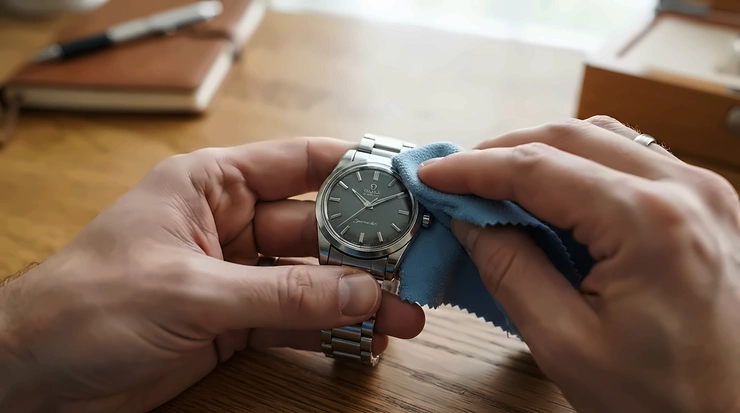
- Dry thoroughly. Pat with microfiber, clear crevices with a manual air-puffer bulb (Longines advises against compressed air near the case), and buff steel along the grain. Keep hair dryers away from rubber and nylon.
- Test the controls. Spin the crown and pushers; Longines says grinding means the watch needs service. If droplets or fog persist under the crystal, WatchTime’s experts say to see a jeweler the same day, though brief fog after a big temperature change can be normal.
The best way to clean a stainless steel watch band
Sources converge on one sequence for steel: take the bracelet off the head if the pins allow, soak it about a minute in lukewarm water with a drop of dish soap, brush between the links, flush it in clean water and dry it fully. Longines gives the one-minute soak, and Timex’s care blog asks for a deep clean once a month on a daily-wear watch, with a daily wipe for the most meticulous owners.
WatchTime’s experts say a water-resistant steel bracelet can stay on and be cleaned along with the watch, while Longines and several dealers favor removing it. With unknown seals, taking it off is the safer choice, since that also exposes the clasp and the undersides of the links, where skin oils and dust pack in.
Soft toothbrush or a softer brush: owners disagree
A thread on Omega Forums about watch brushes shows the split. One member is happy with an extra-soft toothbrush and a light touch, another prefers a shaving brush or a one-inch paint brush for its tapered bristles, and a third thinks dive watches can take a firm toothbrush. A hobbyist blog cited in the thread says even a soft toothbrush leaves fine scratches on a polished case that show only under magnified raking light, though another member suspects the case in the photo was already buffed. ECI Jewelers’ care guide sides with caution for high-polish center links and recommends a dedicated ultra-soft watch brush.
The thread ends without a consensus. A sensible approach is to match the brush to the finish: a toothbrush on brushed links, the softest bristles you own on mirror polish, light pressure either way.
How to clean stainless steel watch band links when grime won’t budge
Soap and a brush do not always finish the job. One poster in an Omega Forums thread on watch cleaners reports that bracelets which looked clean after a toothbrush and dish soap still shed debris in an ultrasonic tank. That is one person’s experience, but it matches the packed-in look of an old clasp. Longines restricts ultrasonic cleaning to bracelets detached from the head, and THMarch’s Rolex guide also keeps a whole watch out of the tank.
For a hand method, THMarch allows a metal or wooden pick with a tissue-covered tip, while Majestix says wood only. Wood is the better choice, because steel on steel is how new scratches start. A longer soak in lukewarm soapy water should come before any picking.
How to clean watch glass without haze or scratches
Whether the crystal is sapphire, mineral or acrylic changes how forgiving it is, but the daily method barely differs. WatchScanning’s guide says to breathe lightly on the glass and wipe with a clean microfiber in small circles, saving a tiny drop of isopropyl alcohol for stubborn spots on sapphire. Majestix lists paper towels, tissues and household glass cleaner among the things to avoid, while a Watchchest guide lists glass cleaner for sapphire; the sources disagree there, and since Seiko and Longines both steer owners away from chemicals, microfiber and water is the safer choice.
Acrylic is the soft one. WatchTime’s experts say hesalite and acrylic scratch easily and should meet only microfiber or bare hands, never abrasive brushes. Mineral and sapphire are the opposite problem: a watch specialist quoted by The RealReal says their scratches cannot be removed and the crystal must be replaced, although Gear Patrol has published a diamond-paste polishing method for the persistent. A poster in an Omega Forums crystal-scratch thread warns that polishing paste can strip an anti-reflective coating, so treating a scratch is a decision for after the cleaning, not during it.
How to clean a watch band when it isn’t steel
Longines’ guide splits the advice by material, and the other sources line up behind it.
- Leather: never soak it. Wipe with a barely damp cloth, work in a pea-sized amount of balm made for watch straps, and let it dry overnight before refitting. WatchTime’s experts add that alcohol, wet cloths, soap and hard rubbing are out, and THMarch gives matte, suede or nubuck a dry cloth or soft brush only.
- Rubber and silicone: rinse after swimming or exercise; for odor, rub in a little dish soap, rinse and pat dry, with no hair dryer. Fitbit’s own advice, relayed by TechRadar, is to avoid hand sanitizer and soap on its silicone bands, so a smartwatch band follows its maker’s page instead.
- Fabric and NATO: Longines says textile is generally fine in soapy water if rinsed thoroughly and dried completely, and WatchScanning adds to take the strap off, scrub with a soft brush and hang it to dry.
How to clean a good watch: gold, vintage and pieces you can’t replace
Precious metals ask for less. WatchTime’s experts say gold and platinum should meet only an ultra-soft brush, microfiber or bare hands, because the brush that is fine on steel can scratch a gold finish. Vintage watches sit at the other extreme: Longines notes that vintage cases are often rated under 30 m or not at all, tells owners to consult a service center before any soaking, and limits vintage or precious-material pieces to light wipes. WatchTime adds that old gaskets dry out and crack.
That makes how to clean a good watch mostly a question of restraint: dry brush, microfiber, and water left to professionals. Service intervals quoted by the sources run from yearly seal tests (Loupe) to every two years (Longines, Serica) to a manufacturer schedule of one to three years or more (WatchTime), so look up the maker’s own figure and count a pressure test as part of the cleaning budget.
Mistakes that scratch, cloud or flood a watch
Most damage in the sources traces back to a short list of habits:
- Scrubbing before sweeping. Esquire India’s beginner guide opens with a dry microfiber wipe so loose grit is not dragged across the surface during the wet clean.
- Reaching for toothpaste or baking soda. Longines names both as abrasives that scratch crystals and wear PVD coatings.
- Using chemicals. Seiko lists benzine, thinner and bleach; Longines adds jewelry cleaners containing ammonia or acids, which can tarnish brushed finishes.
- Working the crown wet or pulled out. Seiko says never to wash a water-resistant watch with the crown extended and never to turn it while the watch is wet.
- Blasting or baking. Longines rules out compressed air near the case and hair dryers on rubber or nylon.
Recovery is mostly a matter of stopping. A wash that left a soap film wants a second rinse and a microfiber buff, and a watch that now shows droplets under the crystal wants a jeweler the same day, per WatchTime.
Four tools worth owning, each tied to one step
Soap, a bowl and a microfiber cloth cover most of how to clean a watch at home, so each product below earns its place by solving one step: detaching the bracelet, brushing the links, wiping the glass and polishing mirror steel. Spotted one you like? Take a closer look at its Amazon.com listing and check the current price there, since figures in this article come from other pages.
1. Bergeon 6767-F Spring Bar Tool — frees the bracelet without gouging lugs
Taking the bracelet off is what makes step three possible, and the tool decides whether the lugs stay clean. A review at Two Broke Watch Snobs explains that the 6767 line comes in three versions: the -F suits metal bracelets because its thin forked tip reaches the small spring bar openings, the -S carries a wider fork for straps, and the -SF carries both. The review rates it better built than the cheap tools it replaces, with the caveat that the reviewer’s watches have no fully drilled lugs, so the pointed tip went untried.
One eBay buyer found the fork too wide for some Rolex steel bracelets and stoned about half a millimeter off each side to make it fit, a single report but a reminder to compare the fork with your lug gap. Keep the towel from step one under the work, since a released spring bar needs somewhere soft to land.
Dealer data disagree on the details. Perrin Watch Parts lists a 0.80 mm pin and a 1.20 mm fork, WatchGecko a 0.80 mm pin, a 1 mm fork and a 145 mm length, and both name a nickel-plated brass handle where the review describes solid stainless steel. Check the exact version before ordering, because the -S and -SF tools differ in tip shape.
2. UltraVue Watch Cleaning Kit — soft horsehair brushes for tight links
A bowl and a toothbrush already cover the basics, so this kit has to win on its brushes and cloths. Retailer listings, including Newegg’s, put in the box a 2 oz and an 8 oz bottle of gel spray, three microfiber cloths and two horsehair brushes with tin handles. D MARGE, in a roundup of watch-cleaning kits, finds the horsehair soft enough for links and bezels without scratching, puts the kit at roughly $25 to $30 on Amazon, and rates it less refined than rival kits. The site does not describe a testing protocol, so treat its verdict as one reviewer’s impression.
The maker’s steps, as quoted on a reseller listing, spray the gel onto the surface and let it sit for a minute. On a watch whose seals you cannot vouch for, it is better to keep the gel to the bracelet and use the brush dry around the case.
Pros:
- ✅ Two horsehair brushes, described as gentle on links and bezels
- ✅ Three microfiber cloths in the box for wiping off gel and drying
Cons:
- ❌ D MARGE says the gel can leave slight residue unless wiped off thoroughly
- ❌ Judged less refined than competing kits by the same reviewer
A gel that needs a full wipe-off adds a step that plain soap and water does not.
3. ZEISS Pre-Moistened Lens Cleaning Wipes — fingerprint removal for the crystal
Fingerprints on flat sapphire are a recurring complaint on Omega Forums, where replies lean on eyeglass wipes to clear them. Becker Time’s care series names ZEISS lens wipes as its pick, on the grounds that individually sealed wipes carry no abrasive material embedded in the cloth, and another Omega Forums member says they wipe their watches with one after cleaning their glasses. B&H lists the wipes as individually wrapped, pre-moistened, ammonia-free and nonabrasive, and ZEISS UK describes a microfine tissue that avoids aggressive substances.
What is in them is less settled. ZEISS told an OpticsPlanet customer it does not share the alcohol content, a grocer’s ingredient list names isopropyl alcohol, and a B&H answer about the company’s sibling cloth product says there is no rubbing alcohol. Read the pack in your hands, and keep the wipe on the crystal, because WatchTime’s experts rule alcohol out for leather.
For anyone working out how to clean watch glass without scrubbing, a dry microfiber pass first and a wipe only for the print that remains is the gentlest order. ZEISS UK adds that the wipes carry no anti-fog or anti-static properties, so they clean the glass but will not stop the next fingerprint.
4. Cape Cod Metal Polishing Cloths — last step for mirror-polished steel
Polished surfaces only. The Cape Cod Metal Polishing Cloths come pre-moistened with a mild abrasive polish, and the instructions reproduced by a UK dealer say they are not intended for brushed stainless steel; Gnomon Watches makes the same point and adds satin and sandblasted finishes to the exclusion list. A reply on Breitling Source puts it plainly: these cloths are a polish, not a cleaner, so the soap-and-brush routine comes first.
Sources disagree about glass. Gnomon Watches says the cloths can lift light scratches from acrylic crystals, while a MisterChrono guide keeps them off glass, PVD and DLC surfaces. They are best kept to polished metal.
Pros:
- ✅ Made for mirror-polished steel, with a pouch of two cloths
- ✅ Buffed off dry, so no rinsing near the seals
Cons:
- ❌ Never for brushed, satin or sandblasted surfaces
- ❌ Mildly abrasive, so D MARGE advises against weekly use
D MARGE also notes that the cloths cannot clean the grime between links and remove a little metal with each pass, which is why they come after the wash and never replace it.
Toothpaste, ultrasonic tanks and hand sanitizer: what a watch can take
Can I clean a watch with toothpaste or baking soda?
Longines lists both among abrasives to avoid, since they scratch crystals and wear PVD coatings, and Seiko warns against bleach and thinner as well. Stay with lukewarm water, one drop of mild dish soap and a soft brush, then dry the watch completely.
Can a watch go in an ultrasonic cleaner?
Not whole. Longines limits ultrasonic cleaning to detached bracelets, never assembled watches, and a UK retailer's Rolex guide gives the same warning about the movement. One Omega Forums poster uses a tank only on bracelets that have been taken off.
How often should I clean my watch?
Longines suggests a monthly deep clean for divers and sports models, a monthly surface clean for everyday water-resistant watches, and a weekly wipe for leather-strap dress watches. Timex also suggests a monthly deep clean for daily wear. Vintage pieces get light wipes only.
Is hand sanitizer or an alcohol wipe safe on a watch?
Sources split. WatchScanning uses a drop of isopropyl alcohol on sapphire, but WatchTime's experts rule alcohol out for leather, Fitbit advises against hand sanitizer on its silicone bands, and Seiko bans solvents. If alcohol touches a watch at all, keep it on the crystal.
How can I tell if water has gotten inside my watch?
Droplets or fog that stay under the crystal point to a leak, and WatchTime's experts say to see a jeweler the same day. Brief fog after a sharp temperature change can be normal. Stop washing the watch until it has been checked.
The short version: dry, brush, rinse in still water, repeat monthly
If you keep one rule about how to clean a watch, let the rating and the age of the seals pick the method, and let the finish pick the tool. A watch with a current pressure test and a screwed-down crown gets a soapy bowl, a soft brush and a still-water rinse. Anything vintage, unrated or untested for two years gets a dry brush and a microfiber cloth, with water left to a service center.
For steel, the best way to clean a stainless steel watch band is off the head, with the softest brush the finish allows. The four tools above matter only once that basic routine is in place. Spotted a tool you like? Take a closer look at its listing on Amazon.com and compare it with your own watch before ordering.
Recommended for You
- How to change watch batteries at home: Mistakes and Easy Fixes
- Gold watch: Fixes, Mistakes, and Tools
- Cheap smartwatches: Buying Mistakes and the Fixes
Got a bracelet that is overdue for a bath? Bookmark this routine for the weekend.