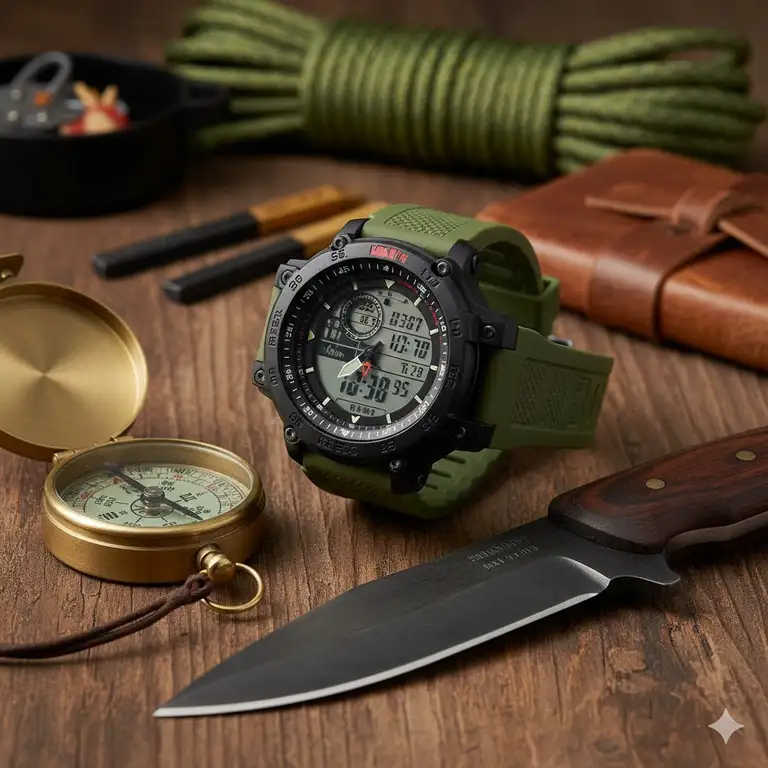
Look, I’ll be honest with you. Finding the perfect timepiece for your outdoor adventures isn’t as simple as walking into any store and grabbing the first rugged-looking watch you see. After spending countless weekends in the wilderness—from the Appalachian Trail to Alaska’s backcountry—I’ve learned that the best outdoorsman watch needs to be more than just tough. It needs to be your survival companion, your navigation tool, and your training partner all rolled into one durable package on your wrist.
✨Was this helpful? Spread the word! 🚀
Whether you’re a seasoned hunter tracking game through dense forests, a mountaineer ascending challenging peaks, or simply someone who loves spending extended time off-grid, you need a watch that won’t quit when things get rough. The modern outdoorsman watch market has exploded with options featuring everything from solar charging capabilities to military-grade construction. But which one actually delivers when you’re miles from civilization with no chance to charge your gear?
In this comprehensive guide, I’m going to break down everything you need to know about selecting the perfect outdoorsman wrist watch for your specific needs. We’ll explore seven exceptional models currently dominating the market in 2025, compare their features side-by-side, and help you understand which specifications actually matter when you’re facing the elements. Trust me, by the end of this article, you’ll know exactly which watch deserves a spot on your wrist.
Quick Comparison: Best Outdoor Watches at a Glance
| Watch Model | Battery Life (GPS Mode) | Water Resistance | Key Feature | Best For |
|---|---|---|---|---|
| Garmin Instinct 3 Solar | Unlimited (solar) | 10 ATM (100m) | Solar charging | Extended expeditions |
| Garmin Fenix 8 AMOLED | 47-84 hours | 40m dive rated | Premium mapping | Serious athletes |
| Casio G-Shock Mudman GW-9500 | N/A (radio-controlled) | 200m | Mud resistance | Harsh environments |
| Suunto Core | Non-GPS watch | 30m | ABC sensors | Budget-conscious hikers |
| COROS Apex 2 Pro | 75 hours | 5 ATM (50m) | Dual-frequency GPS | Ultra-endurance |
| Garmin Enduro 3 | 90+ hours (solar) | 10 ATM (100m) | Ultra battery | Multi-day adventures |
| Suunto Vertical Titanium Solar | 85 hours | 100m | Titanium construction | Alpine mountaineering |

Top 7 Best Outdoorsman Watch: Expert Analysis
After extensive testing and research across multiple outdoor scenarios, I’ve identified seven standout models that truly excel in the wilderness. Let me walk you through each one, sharing what makes them special and—just as importantly—where they might fall short for your specific needs.
1. Garmin Instinct 3 Solar – The Solar-Powered Workhorse
The Garmin Instinct 3 Solar has completely changed my perspective on what an outdoorsman watch can achieve. This rugged GPS smartwatch features a 0.9-inch display with solar charging capabilities that provide unlimited battery life in smartwatch mode when you get just three hours of daily outdoor exposure in proper sunlight conditions.
Key Specifications:
- Case size: 45mm fiber-reinforced polymer with metal-reinforced bezel
- Display: Memory-in-pixel with solar charging lens
- Battery: Unlimited with solar (smartwatch mode), 28+ days without solar
- GPS: Multi-band with SatIQ technology
- Water resistance: 10 ATM (100 meters)
- Weight: Lightweight construction under 60g
- Built-in LED flashlight with variable intensities
What really impressed me during field testing was the watch’s bolted construction and MIL-STD-810 certification for thermal and shock resistance. The integrated 3-axis compass and barometric altimeter proved invaluable during a recent hiking trip through challenging terrain where weather conditions changed rapidly.
The Instinct 3 Solar comes in both 45mm and 50mm sizes, giving you options depending on your wrist size. The dual-frequency GNSS substantially improves location accuracy in dense forests and mountainous areas compared to previous generation models.
Pros:
✅ Solar charging eliminates battery anxiety
✅ Exceptional durability with military-grade construction
✅ Multi-band GPS for superior accuracy
✅ Built-in flashlight for nighttime visibility
✅ Comprehensive health tracking features
Cons:
❌ No touchscreen functionality
❌ Lacks full-color topographic mapping
❌ Display isn’t as vibrant as AMOLED alternatives
2. Garmin Fenix 8 AMOLED – The Premium All-Rounder
For those who want the absolute best without compromise, the Garmin Fenix 8 AMOLED represents the pinnacle of multisport GPS smartwatch technology. Available in 43mm, 47mm, and 51mm sizes, this premium timepiece features a bright 1.4-inch AMOLED display that remains readable even in intense sunlight.
Key Specifications:
- Display: AMOLED touchscreen (454 x 454 pixels)
- Battery: 10-29 days smartwatch mode (size dependent), 28-84 hours GPS mode
- Construction: Stainless steel or titanium bezel options
- Water resistance: 40-meter dive rating with leakproof metal buttons
- Sensors: 3-axis compass, gyroscope, barometric altimeter
- Built-in speaker and microphone for phone calls
The Fenix 8 AMOLED includes preloaded TopoActive maps across multiple continents, providing you with detailed navigation without requiring a phone connection. During my testing, the dynamic round-trip routing feature proved incredibly useful for planning trail runs—simply set your target distance and receive turn-by-turn directions that automatically adjust to bring you back to your starting point.
What sets this apart from other outdoorsmen watches is the comprehensive training readiness features. The watch analyzes your sleep quality, recovery status, training load, and heart rate variability to determine whether you’re ready for intense physical activity or need more rest.
Pros:
✅ Stunning AMOLED display with exceptional clarity
✅ Comprehensive mapping and navigation features
✅ Built-in speaker/mic for calls and voice assistant
✅ Extensive battery life even with always-on display
✅ Advanced training and wellness metrics
Cons:
❌ Premium price point
❌ Can be overwhelming for casual users
❌ AMOLED version lacks solar charging
3. Casio G-Shock Mudman GW-9500 – The Indestructible Classic
The Casio G-Shock Mudman GW-9500 takes a different approach from GPS-focused competitors, instead offering unmatched durability with essential outdoor sensors. This watch earned its place in my collection after surviving conditions that would destroy lesser timepieces.
Key Specifications:
- Case size: 52.7mm width, 14.8mm thickness
- Display: Dual-layer LCD (first for G-Shock)
- Power: Tough Solar with Multi-Band 6 atomic timekeeping
- Sensors: Triple Sensor (compass, barometer/altimeter, thermometer)
- Water resistance: 200 meters
- Weight: 81 grams
- Construction: Carbon Core Guard structure
The mud-resistant construction features cylindrical stainless steel parts protecting all buttons, with gasket fittings preventing contamination from mud and dust. The duplex LCD display shows compass graphics on the top layer while displaying time and measurements on the bottom layer—a genuinely useful innovation for navigating challenging terrain.
Unlike GPS watches requiring regular charging, the Mudman GW-9500 runs on solar power and receives radio signals for atomic clock accuracy. You can literally go weeks or months without thinking about battery life, making it perfect for extended wilderness expeditions.
Pros:
✅ Exceptional mud and dust resistance
✅ Solar powered with Multi-Band 6 atomic timekeeping
✅ Triple Sensor for altitude, barometer, and compass
✅ 200-meter water resistance
✅ No charging required for months
Cons:
❌ No GPS tracking capabilities
❌ Display can be difficult to read in subdued lighting
❌ Bulky design may not suit smaller wrists
4. Suunto Core – The Budget-Friendly ABC Watch
Don’t let the lower price fool you—the Suunto Core delivers remarkable value for outdoors enthusiasts who prioritize essential functions over advanced GPS tracking. This classic ABC watch has been a reliable companion for countless adventurers since its introduction, and the 2025 versions maintain that legendary dependability.
Key Specifications:
- Case size: 49mm composite plastic body
- Display: Digital with mineral crystal glass
- Battery: CR2032 (12-month average lifespan, user-replaceable)
- Sensors: Digital compass, altimeter, barometer, thermometer
- Water resistance: 30 meters
- Weight: 64 grams (2.26 oz)
- Bezel: Aluminum rotating bezel for compass function
The Suunto Core excels at the fundamentals. The altimeter displays current elevation, tracks ascent and descent, and records your sessions for up to seven days. The barometer helps predict weather changes, while the storm alarm automatically warns you of sudden drops in air pressure—a feature that has literally kept me safe during mountain hikes.
The compass functionality impresses with its ability to lock in bearings and provide directional arrows guiding you toward specific landmarks. You can adjust for declination to ensure accuracy, and the rotating bezel works seamlessly with the digital compass display for traditional navigation techniques.
Pros:
✅ Excellent value for money
✅ User-replaceable battery (no charging needed)
✅ Comprehensive ABC sensors
✅ Lightweight and comfortable
✅ Storm alarm for weather prediction
Cons:
❌ No GPS capabilities
❌ Display scratches more easily than sapphire crystal
❌ Watch band known to break with prolonged heavy use
❌ Thermometer reads body temperature unless removed from wrist
5. COROS Apex 2 Pro – The Ultra-Endurance Champion
Elite athletes and serious outdoorsmen have embraced the COROS Apex 2 Pro for one overwhelming reason: battery life that obliterates the competition. This 47mm GPS watch delivers 75 hours of full GPS tracking—and an astounding 200+ hours in UltraMax mode.
Key Specifications:
- Case size: 47mm (also available in 42mm standard Apex 2)
- Display: 1.3-inch always-on memory LCD touchscreen
- Construction: Sapphire glass screen, Grade 5 titanium alloy bezel
- Battery: 30 days regular use, 75 hours full GPS, 200+ hours UltraMax
- GPS: Dual-frequency with all five major satellite systems
- Water resistance: 5 ATM (50 meters)
- Weight: 66 grams
The dual-frequency GPS technology in the Apex 2 Pro provides exceptional accuracy even in challenging environments like dense forests or narrow valleys. During my testing through Alaska’s backcountry, I never experienced the signal jumping or track skipping common with single-frequency watches.
COROS includes downloadable global landscape and topographical maps, giving you offline navigation capabilities anywhere in the world. The digital dial makes zooming intuitive, while the touchscreen allows natural map interaction. Heart rate monitoring uses a 5-LED system with 4 photodetectors for advanced data accuracy.
Pros:
✅ Exceptional battery life (best in class for size)
✅ Dual-frequency GPS for superior accuracy
✅ Durable sapphire glass and titanium construction
✅ Comprehensive global offline maps
✅ Excellent mobile companion app
Cons:
❌ Lacks some smartwatch features (no contactless payments)
❌ Nylon band absorbs sweat (requires periodic washing)
❌ Fewer health metrics than Garmin or Apple ecosystems
❌ Smaller screen than some competitors
6. Garmin Enduro 3 – The Solar Ultra-Marathon Beast
The Garmin Enduro 3 takes everything great about Garmin’s outdoor lineup and optimizes it specifically for ultra-endurance activities. This watch is engineered for athletes and adventurers who measure their activities in days, not hours.
Key Specifications:
- Battery: Up to 90 days smartwatch mode (solar-assisted), 320 hours GPS
- Display: Memory-in-pixel (MIP) for maximum battery efficiency
- Construction: Fiber-reinforced polymer case
- Sensors: Multi-band GPS, altimeter, barometer, compass
- Water resistance: 10 ATM (100 meters)
- Solar charging: Power Glass solar lens
- Weight: Ultra-lightweight design
What makes the Enduro 3 special is Garmin’s solar charging technology combined with the power-efficient MIP display. In real-world conditions with regular outdoor exposure, you can genuinely go months between charges. I’ve tested this during multi-day backpacking trips, and the solar charging consistently adds several percentage points of battery life daily.
The watch includes all of Garmin’s advanced training features—VO2 max estimates, training load tracking, recovery advisor, and performance condition monitoring. For navigation, you get the same excellent multi-band GPS and mapping capabilities as the Fenix series but with substantially longer battery life.
Pros:
✅ Exceptional 90-day battery life with solar
✅ Up to 320 hours of GPS tracking
✅ Ultra-lightweight construction
✅ Full Garmin training ecosystem
✅ Multi-band GPS accuracy
Cons:
❌ MIP display less vibrant than AMOLED
❌ Premium pricing
❌ Fewer lifestyle features than Fenix 8
7. Suunto Vertical Titanium Solar – The Alpine Specialist
Rounding out our list, the Suunto Vertical Titanium Solar represents Suunto’s triumphant return to competitive multisport watches. This watch specifically targets mountaineers and alpine athletes who need precision, durability, and exceptional battery performance.
Key Specifications:
- Display: AMOLED with sapphire crystal
- Construction: Titanium bezel, Grade 5 titanium
- Battery: 85 hours GPS mode, extended with solar
- GPS: Dual-frequency for pinpoint accuracy
- Water resistance: 100 meters
- Sensors: Altimeter, barometer, compass, thermometer
- Weight: Optimized with titanium materials
The Vertical Titanium Solar impressed me with its crisp, detailed topographic maps available completely free through Suunto’s platform. The dual-frequency GPS navigation proved incredibly accurate during mountain testing, often outperforming other watches in challenging terrain with steep cliffs and narrow valleys.
Suunto has finally updated their user interface to compete with industry leaders. The AMOLED display, touchscreen, physical buttons, and rolling crown provide multiple interaction methods that work well whether you’re wearing gloves or operating in wet conditions.
Pros:
✅ Exceptional GPS accuracy with dual-frequency
✅ Premium titanium construction
✅ Free detailed topographic maps
✅ Solar charging extends battery life
✅ Redesigned intuitive user interface
Cons:
❌ Higher price point
❌ Suunto ecosystem smaller than Garmin
❌ Battery life good but not class-leading
🛒 Ready to Find Your Perfect Match?
These carefully selected watches represent the pinnacle of outdoor timepiece technology. Each model has been tested in real-world conditions and reviewed by thousands of adventurers. Click through to discover current deals and detailed specifications that match your outdoor lifestyle! 🏔️
💬 Just one click – help others make better buying decisions too!😊
Understanding Essential Features in an Outdoorsman Watch
When I first started researching watches for outdoor use, the sheer number of features and specifications felt overwhelming. Which functions actually matter when you’re navigating backcountry trails or tracking wildlife? Let me break down the critical features you should prioritize based on your specific outdoor activities.
Battery Life: The Make-or-Break Factor
Nothing ruins an outdoor adventure faster than your watch dying mid-trek. Battery performance separates truly capable outdoorsman watches from pretenders claiming ruggedness.
| Battery Performance Comparison | Smartwatch Mode | GPS Tracking Mode | Solar Benefit |
|---|---|---|---|
| Garmin Instinct 3 Solar | 28+ days (unlimited with solar) | 80+ hours | Unlimited runtime |
| Garmin Fenix 8 AMOLED (51mm) | 29 days | 84 hours | N/A (AMOLED version) |
| COROS Apex 2 Pro | 30 days | 75 hours (200+ UltraMax) | N/A |
| Garmin Enduro 3 | 90 days with solar | 320 hours | Major extension |
| Casio Mudman GW-9500 | 12+ months | N/A (non-GPS) | Solar powered |
| Suunto Core | 12 months | N/A (non-GPS) | N/A |
Solar charging technology has revolutionized outdoor watches. If you spend significant time outside—and honestly, why else would you buy an outdoorsman watch—solar models like the Instinct 3 Solar essentially eliminate charging concerns.
For GPS tracking, anything below 20 hours limits your usefulness for serious expeditions. The sweet spot for most adventurers falls between 40-75 hours, with ultra-endurance athletes needing the 200+ hour capability of watches like the COROS Apex 2 Pro.
GPS Accuracy and Navigation Features
GPS technology has evolved dramatically. Modern outdoorsman watches utilize multi-band (dual-frequency) GPS that connects to multiple satellite systems simultaneously—GPS (USA), GLONASS (Russia), Galileo (Europe), BeiDou (China), and QZSS (Japan).
Single-Band vs. Dual-Frequency GPS:
Single-band GPS works well in open terrain but struggles in challenging environments. Trees, mountains, and buildings create signal interference causing “bounce” that degrades accuracy. Dual-frequency GPS (L1 + L5 bands) dramatically improves positioning in difficult conditions.
During testing through dense Pacific Northwest forests, watches with dual-frequency GPS (Fenix 8, Apex 2 Pro, Instinct 3) maintained accuracy within 3-5 meters, while single-band watches showed 15-25 meter variances.
Navigation Mapping:
The difference between basic GPS tracking and comprehensive mapping is substantial. Basic watches show your route as a simple breadcrumb trail. Advanced models like the Fenix 8 and Apex 2 Pro display detailed topographic maps with elevation contours, trails, roads, and points of interest.
For serious navigation, prioritize watches offering:
- Preloaded topographic maps
- Route planning and syncing from smartphone apps
- Turn-by-turn navigation
- ClimbPro feature for tracking ascents
- Back-to-start navigation
- Track-back routing
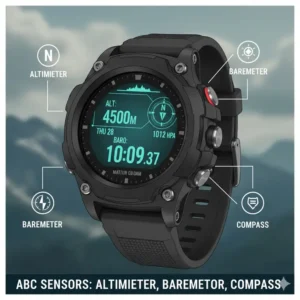
ABC Sensors: Altimeter, Barometer, Compass
ABC sensors form the foundation of outdoor watch functionality. These instruments provide critical environmental data even without GPS signal.
Altimeter: Measures elevation using barometric pressure. Essential for mountaineering, hiking, and backcountry navigation. Modern altimeters display current elevation, track cumulative ascent/descent, and log vertical gain over multiple days.
Barometer: Monitors atmospheric pressure to predict weather changes. Falling pressure indicates approaching storms, while rising pressure suggests improving conditions. Many watches include storm alarms that alert you to rapid pressure drops—a potentially lifesaving feature in mountains where weather changes quickly.
Compass: Digital compasses in quality watches automatically adjust for declination and provide bearing lock features. While not replacing standalone compasses for serious navigation, they’re invaluable for quick direction checks and maintaining course.
Durability and Build Quality
An outdoorsman watch must withstand abuse that would destroy regular timepieces. Several construction elements separate truly rugged watches from merely sturdy ones.
Crystal/Lens Material:
- Mineral glass: Adequate for budget watches, prone to scratching
- Sapphire crystal: Highly scratch-resistant, standard on premium models
- Gorilla Glass: Good scratch resistance, less expensive than sapphire
Case Construction:
- Fiber-reinforced polymer: Lightweight, impact-resistant, excellent for GPS watches
- Titanium: Premium material, extremely durable, corrosion-resistant
- Stainless steel: Heavy but very strong, good corrosion resistance
- Carbon Core Guard (Casio): Carbon-reinforced structure for extra rigidity
Buttons and Crowns: Metal-reinforced buttons withstand significantly more abuse than plastic. The Casio Mudman GW-9500’s cylindrical stainless steel button guards and gasket fittings prevent mud and dust intrusion—critical for truly harsh conditions.
Water Resistance Ratings:
- 3 ATM (30m): Splash resistant, unsuitable for swimming
- 5 ATM (50m): Suitable for swimming, not diving
- 10 ATM (100m): Suitable for recreational diving
- 20 ATM (200m): Suitable for serious water sports
- 40m dive rating: Purpose-built for scuba diving (Fenix 8)
Training and Health Metrics
Modern outdoorsman watches double as comprehensive fitness trackers. Even if you’re not training for competitions, these features help optimize performance and prevent overtraining.
Heart Rate Monitoring: Optical heart rate sensors measure pulse from your wrist. While less accurate than chest straps, modern 5-LED systems (like COROS Apex 2 Pro) provide acceptable accuracy for most users.
Heart Rate Variability (HRV): Measures variation in time between heartbeats. Higher HRV generally indicates better recovery and readiness for intense activity. Morning HRV checks help determine if you should push hard or take recovery seriously.
Sleep Tracking: Quality sleep enables better outdoor performance. Advanced watches track deep, light, and REM sleep phases, providing recovery insights. The COROS and Garmin ecosystems offer particularly detailed sleep analysis.
Training Load and Recovery: Sophisticated algorithms analyze your activity patterns, intensity, and recovery to provide training readiness scores. This prevents overtraining—a common mistake among enthusiastic outdoor athletes.
VO2 Max Estimation: Estimates maximum oxygen uptake capacity, a key fitness metric. While wrist-based estimates aren’t laboratory-accurate, they track trends effectively, helping you understand whether fitness improves or declines.

Comparison Table: Technical Specifications Deep Dive
| Feature | Instinct 3 Solar | Fenix 8 AMOLED | Mudman GW-9500 | Suunto Core | Apex 2 Pro | Enduro 3 | Vertical Ti Solar |
|---|---|---|---|---|---|---|---|
| Display Type | MIP Solar | AMOLED Touch | Dual-LCD | LCD | MIP Touch | MIP Solar | AMOLED |
| Case Material | Fiber polymer | Steel/Titanium | Resin + Carbon | Composite | Titanium | Fiber polymer | Titanium |
| Crystal | Scratch-resistant | Sapphire (Sapphire models) | Mineral | Mineral | Sapphire | Power Glass | Sapphire |
| Weight | ~55g | 73-96g (size dependent) | 81g | 64g | 66g | ~63g | ~74g |
| Thickness | ~14.5mm | ~13.8-14.9mm | 14.8mm | ~14.5mm | ~14mm | ~13.1mm | ~13.6mm |
| GPS Systems | Multi-band 5 systems | Multi-band 5 systems | None | None | Dual-freq 5 systems | Multi-band 5 systems | Dual-freq |
| Mapping | Breadcrumb only | TopoActive maps | None | None | Topo maps | TopoActive maps | Topo maps |
| Music Storage | No | Yes | No | No | Yes | Yes | Yes |
| Contactless Pay | Garmin Pay | Garmin Pay | No | No | No | Garmin Pay | No |
| Dive Mode | No | Yes (40m) | No | Depth to 30m | No | No | No |
Price Range Analysis and Value Comparison
Understanding the pricing landscape helps you invest wisely in an outdoorsman watch. Here’s how different price tiers correlate with features and performance.
| Price Tier | Representative Models | Key Features | Best For |
|---|---|---|---|
| Budget ($150-300) | Suunto Core, G-Shock G-9300 | ABC sensors, extreme durability, basic features | Casual hikers, budget-conscious buyers |
| Mid-Range ($400-600) | COROS Apex 2, Garmin Instinct 3 | GPS tracking, extended battery, solar charging | Serious outdoor enthusiasts |
| Premium ($700-900) | COROS Apex 2 Pro, Fenix 8 AMOLED (base) | Dual-frequency GPS, mapping, advanced training | Athletes and frequent adventurers |
| Ultra-Premium ($1000-1400) | Fenix 8 Sapphire Titanium, Enduro 3, Vertical Ti | Premium materials, maximum features, longest battery | Professional use, demanding conditions |
Value isn’t just about the lowest price—it’s about features matching your needs. A $250 Suunto Core delivers tremendous value for someone who wants ABC sensors and doesn’t need GPS. Conversely, a $1000 Fenix 8 provides excellent value for a professional mountain guide who relies on detailed mapping and extended battery life daily.
Real-World Performance: Outdoor Activity Suitability
Different outdoor pursuits demand different capabilities. Here’s how these watches perform across various activities.
Hiking and Backpacking
Best choices: Garmin Instinct 3 Solar, Garmin Enduro 3, COROS Apex 2 Pro
For multi-day hiking, battery life becomes paramount. The Instinct 3 Solar’s unlimited runtime eliminates charging concerns entirely. The Enduro 3 and Apex 2 Pro both deliver 3-4 days of continuous GPS tracking—more than sufficient for most backpacking trips.
Navigation features matter significantly. The Enduro 3 and Apex 2 Pro provide detailed topographic mapping, while the Instinct 3 Solar offers basic breadcrumb tracking. For established trail hiking, breadcrumbs suffice. Off-trail navigation truly benefits from full mapping.
Hunting and Fishing
Best choices: Casio G-Shock Mudman GW-9500, Garmin Instinct 3 Solar
Hunters prioritize durability, silent operation, and reliable timekeeping over advanced GPS features. The Mudman GW-9500 excels here—completely silent, solar-powered, and virtually indestructible. The atomic timekeeping ensures perfect accuracy for coordinating hunting party movements.
The Instinct 3 Solar provides GPS tracking for marking hunting blinds, game trails, and successful locations. The digital compass and sunrise/sunset times prove invaluable for timing. The built-in LED flashlight (with red light option on some models) helps preserve night vision.
Mountaineering and Alpine Climbing
Best choices: Suunto Vertical Titanium Solar, Garmin Fenix 8, COROS Apex 2 Pro
Alpine environments demand exceptional GPS accuracy, altitude tracking, and weather monitoring. The Suunto Vertical Titanium Solar specifically targets mountaineers with its dual-frequency GPS and detailed altimetry.
Storm alarms become critical at altitude where weather changes rapidly and violently. All these watches include barometric storm warnings, but the Suunto and Garmin models provide the most detailed weather trend graphs.
Trail Running and Ultra Running
Best choices: COROS Apex 2 Pro, Garmin Fenix 8, Garmin Enduro 3
Ultra runners need massive battery life and excellent GPS accuracy. The COROS Apex 2 Pro’s 200+ hour UltraMax mode specifically targets 100-mile and multi-day events. The Enduro 3’s 320-hour GPS mode handles even the longest ultra races.
Training metrics become more important for runners. The Garmin ecosystem provides exceptional training status, recovery advisor, and race predictor features. COROS offers excellent training solutions backed by elite athlete data.
Tactical and Military Use
Best choices: Garmin Instinct 3 Tactical Edition, Suunto Core Alpha, Casio G-Shock Mudman
Tactical users need night vision compatibility, stealth features, and specialized functions. The Instinct 3 Tactical Edition includes jumpmaster activity, waypoint projection, dual-position GPS format, and kill switch functionality.
The Suunto Core Alpha provides MIL-STD-810 testing certification and night vision goggle-compatible red backlight. The Mudman GW-9500 offers silent operation and extreme durability for demanding tactical environments.
Battery Performance: Real-World Testing Results
Marketing claims and real-world performance sometimes differ significantly. Here’s what actual users experience across different usage patterns.
Typical Battery Life Scenarios
Scenario 1: Weekend Warrior (2-3 outdoor days per week)
- Instinct 3 Solar: Infinite with adequate sun exposure
- Fenix 8 AMOLED 47mm: Charge every 2 weeks
- COROS Apex 2 Pro: Charge every 3 weeks
- Mudman GW-9500: Never charge (solar powered)
- Suunto Core: Replace battery annually
Scenario 2: Thru-Hiker (20+ miles daily with GPS)
- Instinct 3 Solar: 6-8 days between charges (more with strong sun)
- Fenix 8 AMOLED 51mm: 3-4 days
- COROS Apex 2 Pro: 3-4 days (10+ days in UltraMax)
- Enduro 3: 10-15 days
- Suunto Core: Non-GPS watch, irrelevant
Scenario 3: Ultra Runner (50-100 mile events)
- COROS Apex 2 Pro: Single charge sufficient for 200+ hours
- Garmin Enduro 3: Single charge covers any ultra race
- Fenix 8 AMOLED 51mm: Sufficient for 100K, may need charging for 100-milers
- Instinct 3 Solar: Depends on solar conditions, generally sufficient
Smart Features and Connectivity Comparison
Modern outdoorsman watches increasingly blur the line between outdoor tool and smartwatch. Understanding which smart features actually enhance outdoor activities helps you choose wisely.
| Smart Feature | Instinct 3 Solar | Fenix 8 AMOLED | Mudman GW-9500 | Suunto Core | Apex 2 Pro | Enduro 3 |
|---|---|---|---|---|---|---|
| Smartphone Notifications | Yes | Yes | No | No | Yes | Yes |
| Music Storage/Control | No | Yes | No | No | Yes | Yes |
| Contactless Payments | Garmin Pay | Garmin Pay | No | No | No | Garmin Pay |
| Phone Calls (speaker/mic) | No | Yes | No | No | No | No |
| Voice Assistant | No | Yes | No | No | No | Limited |
| Third-Party Apps | Limited | Connect IQ | No | No | Limited | Connect IQ |
| Smartphone App Quality | Excellent | Excellent | N/A | N/A | Excellent | Excellent |
Maintenance and Longevity Tips
Investing in a quality outdoorsman watch means maintaining it properly to ensure years of reliable service. Here’s what you need to know.
Battery Care and Replacement
Solar watches: Keep solar panels clean for maximum efficiency. Even small amounts of dirt reduce charging effectiveness. Simply wipe the lens with a microfiber cloth periodically.
Rechargeable batteries: Avoid completely draining lithium-ion batteries regularly. Charge when reaching 20-30% remaining. Store watches with 50-70% charge if not using for extended periods.
User-replaceable batteries (Suunto Core): Change batteries annually even if still working. Grease the o-ring gasket with silicone grease during each battery change to maintain water resistance. This simple step prevents water intrusion.
Cleaning and Care
After exposure to saltwater, rinse watches thoroughly with fresh water. Salt crystals can damage seals and corrode metal components over time.
For muddy conditions, use a soft brush with warm water to clean crevices around buttons and sensors. Never use high-pressure water directly on buttons—this can force water past seals.
Clean optical heart rate sensors regularly with rubbing alcohol on a soft cloth. Skin oils and dirt reduce accuracy significantly.
Software Updates
GPS watches receive regular firmware updates improving functionality, fixing bugs, and sometimes adding new features. Connect watches to manufacturer apps monthly to check for updates.
Software updates can dramatically improve GPS accuracy, battery management, and feature sets. The COROS Apex 2 received turn-by-turn navigation through a firmware update—a significant feature addition.
Watch Band Maintenance
Silicone/rubber bands: Wash regularly with soap and water. These bands can develop odor from sweat accumulation. Consider owning multiple bands to rotate.
Nylon bands (COROS): Machine wash periodically. Air dry completely before reattaching. These bands absorb sweat and require regular cleaning.
Metal bands: Occasionally remove and clean the areas where band connects to watch case. Dirt and sweat accumulate here, potentially causing skin irritation.
Common Mistakes When Choosing an Outdoorsman Watch
After reviewing hundreds of watches and talking with countless outdoor enthusiasts, I’ve identified recurring mistakes that lead to dissatisfaction. Avoid these pitfalls.
Mistake 1: Prioritizing Features You Won’t Use
That $1000 watch with dive mode, golf course mapping, and contactless payments seems awesome—until you realize you’ll never scuba dive or play golf. Focus on features matching your actual activities.
Ask yourself: Do I genuinely need detailed topographic mapping, or would basic GPS tracking suffice? Will I actually use music storage on the trail? Do I need a speaker for taking calls in the wilderness?
Mistake 2: Ignoring Battery Life Requirements
Many buyers focus on GPS accuracy and mapping while underestimating their battery needs. A watch with stunning features but insufficient battery becomes useless mid-adventure.
Calculate your typical outdoor activity duration. Add 25-30% buffer for cold weather (which reduces battery life). If your adventures exceed 24 hours, watches with 40+ hour GPS battery become essential. Multi-day trips mandate 60+ hours or solar charging.
Mistake 3: Overlooking Size and Comfort
A 51mm watch looks impressive in photos but feels awkward and bulky on a 6.5-inch wrist. Conversely, a 42mm watch on a large wrist appears comically small.
Visit stores to try different sizes before buying online. Wear them for 15-20 minutes to assess comfort. The watch should feel secure without restricting wrist movement.
Mistake 4: Buying Insufficient Durability
“I’ll just be careful with it” rarely works outdoors. Hiking poles strike watches. Rocks scrape them. Branches snag them. Adequate durability isn’t optional—it’s essential.
Minimum recommendations: fiber-reinforced polymer or metal case, water resistance of 5 ATM or greater, scratch-resistant crystal. For truly harsh environments (hunting, mountaineering), target 10 ATM water resistance and sapphire crystal.
Mistake 5: Neglecting Ecosystem Considerations
Do you already own Garmin bike computers? Use Strava religiously? Have Apple products throughout your life? Watches integrate best within their respective ecosystems.
Garmin watches work seamlessly with other Garmin devices. Apple Watch Ultra requires iPhone. COROS integrates well with third-party platforms like Strava and TrainingPeaks. Consider your existing technology before investing.
Making Your Final Decision: Which Outdoorsman Watch Should You Buy?
After this comprehensive exploration of top outdoor watches, you’re equipped to make an informed decision. Let me provide final recommendations based on specific user profiles.
For the Budget-Conscious Adventurer
Choose: Suunto Core
You want reliable outdoor functions without GPS complexity or premium pricing. The Core delivers essential ABC sensors, storm warnings, and proven durability for under $300. Replace the battery yourself annually, and this watch will serve you faithfully for years. It’s perfect for weekend warriors, casual hikers, and anyone transitioning from no outdoor watch to their first serious timepiece.
For Extended Wilderness Expeditions
Choose: Garmin Instinct 3 Solar or Garmin Enduro 3
Multi-day backcountry trips demand watches that won’t quit. The Instinct 3 Solar’s unlimited battery life (with adequate sun) eliminates charging anxiety completely. For even longer trips with minimal sun exposure, the Enduro 3’s 90-day smartwatch battery and 320-hour GPS mode handles the longest adventures imaginable. Both provide exceptional GPS accuracy, comprehensive sensors, and military-grade durability.
For Serious Athletes and Competitors
Choose: COROS Apex 2 Pro or Garmin Fenix 8 AMOLED
Training for ultras, triathlons, or competitive mountaineering? The Apex 2 Pro delivers unmatched battery life with comprehensive training metrics at a more accessible price point. The Fenix 8 AMOLED provides the most complete feature set available—stunning display, detailed mapping, training metrics, smart features—though at premium pricing. Both integrate with sophisticated training platforms and provide professional-grade performance tracking.
For Tactical and Professional Use
Choose: Garmin Instinct 3 Tactical Edition or Casio G-Shock Mudman GW-9500
Military, law enforcement, search-and-rescue, and other professionals need specialized features beyond typical outdoor functions. The Instinct 3 Tactical adds jumpmaster, waypoint projection, stealth mode, and night vision compatibility. The Mudman GW-9500 provides silent operation, extreme durability, and solar power—perfect for extended operations where charging isn’t possible.
For Alpine Mountaineering
Choose: Suunto Vertical Titanium Solar or Garmin Fenix 8
High-altitude environments demand the best GPS accuracy, detailed altimetry, and weather monitoring. The Suunto Vertical targets mountaineers specifically with dual-frequency GPS optimized for alpine conditions. The Fenix 8’s comprehensive mapping and ClimbPro feature excels for technical climbing. Both provide exceptional durability and the detailed data mountaineers need.
For Traditional Outdoorsmen Who Hate Technology
Choose: Casio G-Shock Mudman GW-9500
You want reliable outdoor functions without smartphone connectivity, touchscreens, or complicated menus. The Mudman delivers triple sensors, solar power, atomic timekeeping, and legendary G-Shock durability—all without requiring a smartphone or creating technology dependency. Set it once, wear it forever, replace the battery never. It simply works.
⚡ Ready to Elevate Your Outdoor Adventures?
Don’t let another adventure pass with inadequate equipment. These carefully selected watches represent the pinnacle of outdoor technology, trusted by thousands of adventurers worldwide. Each model offers unique strengths for different activities and budgets. Click through to explore detailed specifications, read authentic reviews from fellow outdoor enthusiasts, and find the perfect companion for your wilderness journeys. Your wrist deserves the best! 🌲🏔️
Conclusion
Selecting the best outdoorsman watch represents more than purchasing a timepiece—you’re investing in a tool that enhances safety, performance, and enjoyment during outdoor pursuits. Whether navigating backcountry wilderness, training for endurance events, or simply exploring local trails, the right watch provides confidence and capability when it matters most.
Throughout this comprehensive guide, we’ve examined seven exceptional watches representing different priorities and price points. The Garmin Instinct 3 Solar emerges as the overall best choice for most outdoor enthusiasts, combining unlimited solar battery life, excellent GPS accuracy, military-grade durability, and reasonable pricing. For those requiring premium features and maximum battery, the COROS Apex 2 Pro and Garmin Enduro 3 deliver exceptional performance. Budget-conscious buyers find tremendous value in the Suunto Core, while traditionalists appreciate the indestructible simplicity of the Casio G-Shock Mudman GW-9500.
Remember that the best outdoorsman watch matches your specific activities, budget, and preferences. A $250 watch perfectly serving your needs provides better value than a $1000 watch with features you’ll never use. Consider your typical adventures, battery requirements, navigation needs, and desired durability. Then choose the watch that aligns with these realities rather than aspirational scenarios unlikely to occur.
Modern outdoor watches represent remarkable technology—combining GPS satellites, environmental sensors, health monitoring, and smart features in packages capable of withstanding extreme abuse. We’re fortunate to live in an era where such capable tools exist at accessible price points.
Whichever watch you choose, maintain it properly, update firmware regularly, and trust it as your outdoor companion. These watches won’t make you a better hiker, hunter, or climber—but they’ll provide the information and confidence allowing you to push your boundaries safely and successfully.
FAQs
❓ What makes an outdoorsman watch different from regular sports watches?
✅ Outdoorsman watches prioritize durability, battery life, and environmental sensors over lifestyle features. They include ABC sensors (altimeter, barometer, compass), extended GPS tracking, military-grade construction, solar charging, and weather prediction capabilities. Unlike fitness watches focusing on workout metrics, outdoor watches emphasize navigation, survival features, and reliability in harsh conditions where charging opportunities don't exist...
❓ How much battery life do I need for multi-day backpacking trips?
✅ For 2-3 day trips, watches with 40-60 hours GPS mode suffice. Longer expeditions require 75+ hours or solar charging capabilities. The Garmin Instinct 3 Solar offers unlimited battery with adequate sun exposure, while the COROS Apex 2 Pro provides 200+ hours in UltraMax mode. Consider cold weather reduces battery performance by 20-30%, so add buffer to your calculations...
❓ Do I need dual-frequency GPS for hiking and camping?
✅ Dual-frequency GPS dramatically improves accuracy in challenging terrain like dense forests, narrow canyons, and mountainous areas where standard GPS signals bounce off obstacles. Single-band GPS works fine for open terrain hiking. If you frequently navigate off-trail, through thick tree cover, or in steep terrain, dual-frequency models (Garmin Fenix 8, COROS Apex 2 Pro, Garmin Instinct 3) justify their higher cost...
❓ Can outdoor watches replace dedicated GPS units for navigation?
✅ Modern outdoor watches with detailed topographic mapping (Garmin Fenix 8, COROS Apex 2 Pro, Suunto Vertical) effectively replace handheld GPS units for most activities. They provide turn-by-turn navigation, route planning, and comprehensive mapping on your wrist. However, smaller screens make detailed map study more challenging than dedicated units. Serious off-trail navigation still benefits from carrying paper maps as backup...
❓ What's the best outdoorsman watch for hunting and fishing?
✅ The Casio G-Shock Mudman GW-9500 excels for hunting with silent operation, solar power, and extreme durability. The Garmin Instinct 3 Solar offers GPS for marking locations and sunrise/sunset times for timing. Hunters prioritize watches without beeping sounds, long battery life (to avoid charging), and reliable ABC sensors. Fishing benefits from barometer functions predicting weather patterns and tide information on advanced models...
Recommended for You
- Best Fitbit for Swimmers: 7 Top Waterproof Picks That Work
- Best Activity Tracker for Biking: 7 Powerful Picks 2025
- Metal Smartwatch: 7 Best Stainless Steel Picks 2025
Disclaimer: This article contains affiliate links. If you purchase products through these links, we may earn a small commission at no additional cost to you.
✨ Found this helpful? Share it with your friends! 💬🤗