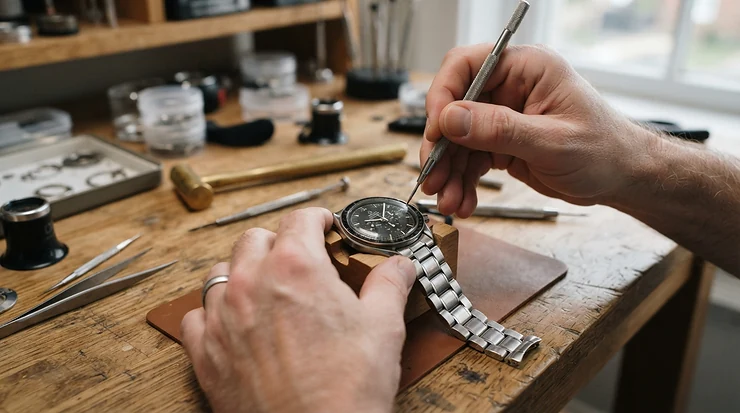
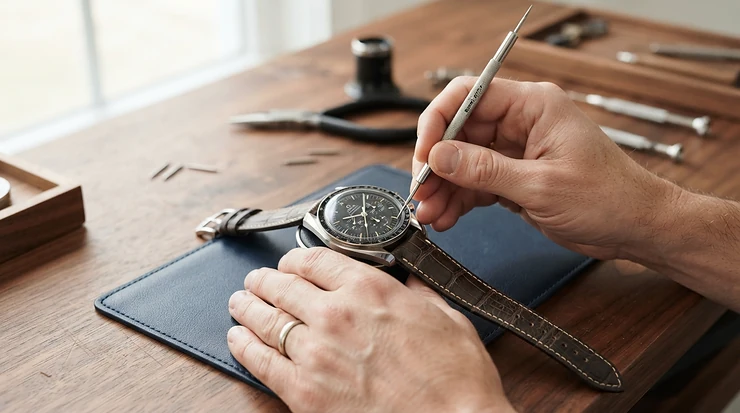
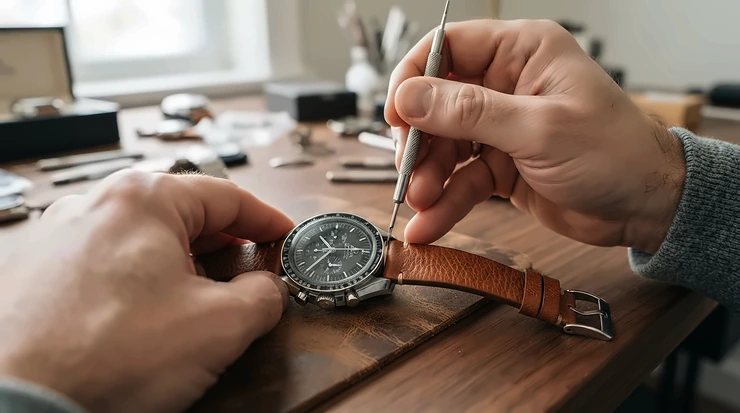
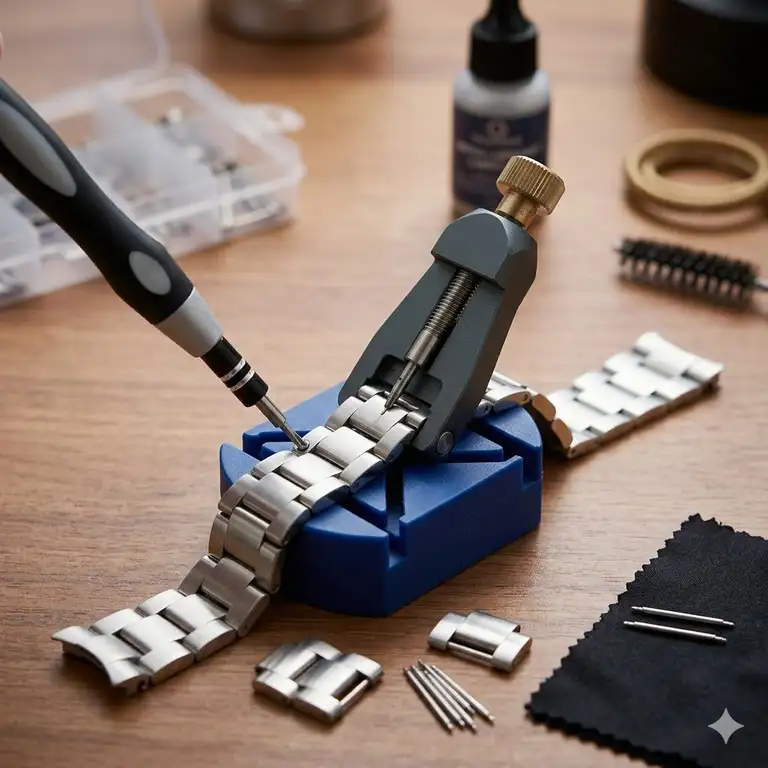
A leather strap on a watch with drilled lugs and a steel bracelet on one with solid end links call for different tool tips, yet plenty of the watch spring bar tools sold in 2027 pack both jobs into one thin, cheap handle. When a fork bends mid-push, Time and Tide warns in its tool roundup, the slip that follows is how a favorite watch picks up “honest wear” on the lugs.
The short version: match the tip to the lug, tape the case, and push inward instead of prying. For bracelets with solid end links, the Bergeon 6767-F Spring Bar Tool is the name that tool roundups and owner threads cite most often in the sources below; a budget kit covers occasional swaps; and quick-release bars take the tool out of the routine altogether. No tool here was handled for this guide, so the findings rest on instructions from Gear Patrol and WatchGecko, tool advice from Time and Tide, a Two Broke Watch Snobs review of the Bergeon, an Omega Forums thread and storefront pages that mirror Amazon listings, each credited where it appears.
Forks, pins and slots: what a spring bar asks of the tool
A spring bar is a steel bar with spring-loaded ends, and WatchGecko’s strap-changing guide points out that those ends must be compressed before a strap will come free. Spring bar tools for watch straps and bracelets all do that one job. They differ in how they reach the bar, and three layouts cover most swaps:
Undrilled lugs. The bar sits in blind holes, so a V-shaped fork slides between the strap end and the lug and catches the groove on the bar.
Drilled lugs. Small holes run through the outside of the lugs, and a pointed pin pushes the bar in from the side.
Bracelets with solid end links. The bar hides behind the link, so the fork has to be thin enough to enter a narrow slot.
Tip size matters more than handle material. Two Broke Watch Snobs lists the Bergeon 6767-F with a 1.2 mm fork and a 0.8 mm pin, the Bergeon 6767-S with a 3.0 mm fork, and the Bergeon 6767-SF carrying both forks. Craft & Tailored’s product page puts the fine fork closer to 1 mm, so measure your own slot instead of trusting either figure. Per the same review, the thinner fork is the one for metal bracelets, while the two-fork SF version also handles leather and rubber.
Single-fork bar tools free one end at a time. Tweezer and plier styles pinch both ends together, which one Omega Forums poster who owns the Bergeon 6767-F, the Bergeon 6825-PF and the Bergeon 7825 says is what tight end links need; the same poster found the plier style cumbersome and sold it. That is one owner’s view in a thread where only two members named a pick, so treat it as a lead and not a rule.
Swapping a strap with a spring bar tool, in seven moves
Set up a soft, bright workspace. Lay a cloth on a firm surface, put the watch face down and unbuckle the strap, as Elestraps advises.
Tape the lugs. WatchGecko suggests it for extra protection, and an Omega Forums poster who uses the Bergeon 6767-F says the same.
Find the bar. On undrilled lugs, slot the fork between the strap end and the lug until it catches the groove; on drilled lugs, seat the pin in the hole.
Push in, don’t pry. Gear Patrol says to hold the tool at 90 degrees and press inward, since prying scratches lugs; WatchGecko describes easing the bar toward the center of the case. The common thread is slow, steady pressure, and a few attempts are normal.
Control the release. The bar can fly out, so let tension off slowly and keep a finger near the lug.
Seat the new strap. Put one end of the bar in a lug hole, line up the other end from the underside of the lugs so any mark stays hidden, compress and slide until it clicks.
Tug both sides. Pull the strap firmly at each end to confirm the bars have seated.
Gear Patrol also notes that owners of very expensive watches who worry about even inside-the-lug marks should hand the job to a professional.
How to attach a watch strap without a spring bar tool: what works and what scratches
Some straps never needed a tool. Elestraps sorts the options by risk, and the ranking is worth knowing before you reach for a kitchen drawer.
Method
Works on
Risk per Elestraps
Quick-release lever
Straps with a built-in lever or button
Essentially none
Slide-through
NATO, Zulu and Perlon straps
Low
Dental floss
Standard spring bars
Lowest of the improvised methods
Credit card
Tight lugs where floss will not fit
Can slip and scratch the case
Small screwdriver
Drilled lugs, stubborn bars
Highest scratch risk
Toothpick
Last resort
Can snap in the gap
The floss route has a documented walk-through. Writing at The Slender Wrist, one author swapped a Timex Marlin’s leather strap for a mesh band by threading floss between the dial and the strap, pulling it tight against the lug until the bar clicked, then yanking down and out. The job took 10 to 15 minutes, and the bar nearly landed in the fireplace ashes, so his advice is to keep a finger on the lug in the bar’s path.
Fitting is the easier half. After a bar is out, the same author seated one end in a lug hole and pressed the other end in with a fingernail, and Gear Patrol agrees a dedicated tool is often unnecessary for that part. Elestraps’ stop rule is worth borrowing: after three to five gentle attempts that fail, or the moment new scratches appear, quit and see a watchmaker. That ranking is the practical answer to how to attach a watch strap without a spring bar tool: lever or pass-through straps first, floss second, and nothing metal near the case. And if you change straps often, quick-release bars (entry 4 below) make the whole question disappear.
Watch spring bar tools reviews: where swaps go wrong and how to recover
Bent forks come first. Time and Tide says the tools that arrive free with straps or in generic sets range from fair to appalling and that their forks bend or snap, and the Two Broke reviewer reports cheap tips that deform, even in the hand, after a few uses. Two independent reviewers pointing the same way is as close to a consensus as this niche offers.
Prying is the second. Gear Patrol warns it scratches the lugs, and WatchGecko adds that even careful work can leave small marks around the lugs after many changes, which is why it pushes the bar out toward the back of the watch, where marks hide.
Third, tight end links punish a thick fork. The Omega Forums poster mentioned earlier says tight links need a two-ended squeeze, while looser, cheaper end links with machining wiggle are fine for the Bergeon 6767-F. Modern Omega pieces tend to have less wiggle, and Rolex the least, according to that poster.
Fourth, bar thickness. A buyer on a storefront mirror of Barton’s tool kit listing says the tool does not work at all on Seiko-style fat bars like those on 22mm divers, and a separate buyer of a budget kit found its 1.5mm pins too large for a Seiko diver bracelet extension that takes about 1.32mm. Two buyers, two tools, one watch family: measure the bar before ordering.
Last, stubborn bars. Elestraps and Gear Patrol agree that a bar refusing to budge after several gentle tries belongs on a watchmaker’s bench, not under a bigger screwdriver.
Best watch spring bar tools, matched to the job
The four spring bar tools for watch straps and bracelets below answer different jobs from the steps above and are not ranked against each other. The table shows how little they overlap.
Tool
Tip setup
Job it solves
Worth knowing
Bergeon 6767-F Spring Bar Tool
Fine fork (about 1 to 1.2 mm, sources differ) plus 0.8 mm pin
Solid end links, drilled lugs
Replaceable tips, one-piece steel handle
Barton Watch Bands Spring Bar Tool Kit
Dual-ended, two extra tips; the mirrored listing adds a ruler and tweezer head
Everyday straps, lug-width checks
One buyer says it fails on Seiko fat bars
EFIXTK Spring Bar Tool Set
Two tools, six extra tips, tweezers, 72 pins
Occasional swaps and spare pins
Pins may be too thick for some Seiko parts
Barton Quick Release Spring Bars
No tool: slide-lever bars, 16 to 24 mm
Frequent swaps, NATO straps
Lug width must match exactly
Choose by the lug type first and the budget second, because a cheap fork that cannot enter the slot is no saving. That is also the thread running through the watch spring bar tools reviews above: tip fit decides the outcome. Spotted a tool whose tip matches your lugs? Take a closer look at its fork size on the Amazon.com listing.
Solid end links are where generic forks give up first, and this is the tool built for them. Two Broke Watch Snobs describes a one-piece stainless steel handle with knurled grips at both ends, hardened tempered-steel tips that can be replaced when worn, and a weight of 27 grams, with the pointed end sized for drilled lugs. After many strap changes the reviewer saw no damage or deformation on the fork, a contrast with the cheaper tools described above.
Owners lean the same way. An Omega Forums poster who has used the Bergeon 6767-F for years values its simplicity and advises taping the lugs and working in good light. Time and Tide, whose own top pick is the cheaper Bergeon 3153 with a 3 mm fork, still calls the all-steel Bergeon 6767 a fine choice.
Two limits show up. Comments under the Two Broke review include one reader whose tips loosen and need regular tightening and another who finds the pointed tip snaps easily, and leather or rubber straps are better served by the two-fork SF version. A specialist retailer lists the F model at around $25 to $30, and sellers vary, so check the current price on Amazon.com.
Bergeon 6767-F Spring Bar ToolSee current price, sizes and reviews on Amazon.
One buyer warning belongs at the front: a reviewer on a storefront page mirroring the listing says the tool does not work at all on Seiko-style fat bars, such as those on 22mm diver watches. It is a single report, but it names a watch family, so owners of thick-barred divers should measure before ordering.
For everyone else the mirrored page describes a stainless steel dual-ended tool with an integrated metric ruler, a tweezer head and two extra tips, rated 4.4 out of 5 across about 1,300 reviews. Buyers call it a clear step up from the cheap tools sold online, and one drove pins out of three watches by tapping the tool with a hammer and reports it held. The ruler suits the lug-width check Barton’s own fit guidance leans on, since its quick-release bands only seat when lug width equals band width.
Barton’s own tool page tells a slightly different story: a stainless steel tool with two extra tips and a one-year satisfaction promise, with no mention of a ruler or tweezer head. Compare the two descriptions on the listing you are about to buy, since the extras are what separate this kit from a plain fork.
Barton Watch Bands Spring Bar Tool KitSee current price, sizes and reviews on Amazon.
Price tier is the draw. The kit bundles two spring bar tools, six extra tips, 72 pins in 18 sizes from 18mm to 25mm, four of each, and tweezers, and a storefront page mirroring the Amazon listing shows 4.5 out of 5. Buyers on that page call the tools easy to use and sturdy for the money, and one used the kit to free a stuck band.
Two complaints are concrete. One buyer found the 1.5mm pins too thick for a Seiko diver bracelet extension, and another disliked the two-piece storage box that slides apart and scatters the bars. Nothing on the page addresses tip breakage, the weakness Time and Tide and Two Broke pin on generic tools, so that stays an open question.
A sensible way to use a kit like this: tape the lugs, treat the first bent fork as the signal to fit a spare tip, and keep a sturdier tool for any watch you would hate to mark.
EFIXTK Spring Bar Tool SetSee current price, sizes and reviews on Amazon.
Do the swap with a tool once, and later changes can happen with a fingernail. Barton sells packs of four stainless steel quick-release bars that slide in and out with a finger lever, and it describes them as suited to NATO-style straps and to bands designed for quick-release pins. A storefront mirror lists widths from 16 to 24 mm, with 17 mm appearing in only part of the description, so confirm that size before ordering. It shows 4.5 out of 5, and buyers quoted there call the bars easy to use and fine on NATO and quick-release leather straps.
WatchGecko adds the safety argument: quick-release bars stay attached to the strap, so nothing launches across the room. Fit is the boundary. Barton says quick-release bands only seat when the watch’s lug width matches the band width, and the thick-barred Seiko divers mentioned earlier are the case to measure first. Getting the standard bars out in the first place still takes a fork or floss, once.
Barton Quick Release Spring BarsSee current price, sizes and reviews on Amazon.
Can you change a watch strap without a spring bar tool?
Yes, if the strap is quick-release or a NATO-style pass-through, both of which come off by hand. For standard spring bars, dental floss carries the lowest scratch risk among tool-free tricks, while a small screwdriver carries the highest. Stop after a few gentle tries.
Which fork size should I buy first?
Match the fork to the gap. A 3 mm fork suits leather and rubber straps with room beside the lug, while a fine fork of roughly 1 to 1.2 mm reaches the slots behind solid end links. A 0.8 mm pin handles drilled lugs.
Do I really need to tape the lugs?
WatchGecko suggests taping the lugs and working on a soft mat, and it still warns that frequent swaps can leave small scratches. Gear Patrol adds working from the underside of the lugs so any mark stays out of sight.
Are cheap spring bar tool kits worth buying?
They are fine for a handful of swaps if you protect the lugs and replace any fork that bends. Time and Tide says generic tips bend or break, so a kit with spare tips, or a single better tool, saves trouble later.
Why does the spring bar sometimes fly off, and how do I stop it?
Compressed spring tension releases suddenly when the bar clears the lug hole. Release pressure slowly, rest a finger over the lug and work above a cloth. Quick-release bars stay attached to the strap, so they cannot be flung across the room.
Which spring bar tool to buy first
Start with the lug, not the brand. If your watch has a steel bracelet with solid end links, the Bergeon 6767-F Spring Bar Tool is the safer first purchase among the best watch spring bar tools for bracelets, because the thin fork enters slots that wider forks cannot. For leather or rubber straps on ordinary lugs and a tight budget, the EFIXTK Spring Bar Tool Set or the Barton Watch Bands Spring Bar Tool Kit will do the job if you tape the case and replace the first bent tip. And if you swap straps weekly, fit Barton Quick Release Spring Bars once and retire the fork.
WatchWiseHub is an independent buying-guide site for watches, smartwatches, straps and accessories. Our editorial team compares gear using manufacturer specifications, independent tests from specialist watch media, owner reports and retailer listings. We do not claim to have tested the watches ourselves; see How We Choose Gear for our method.