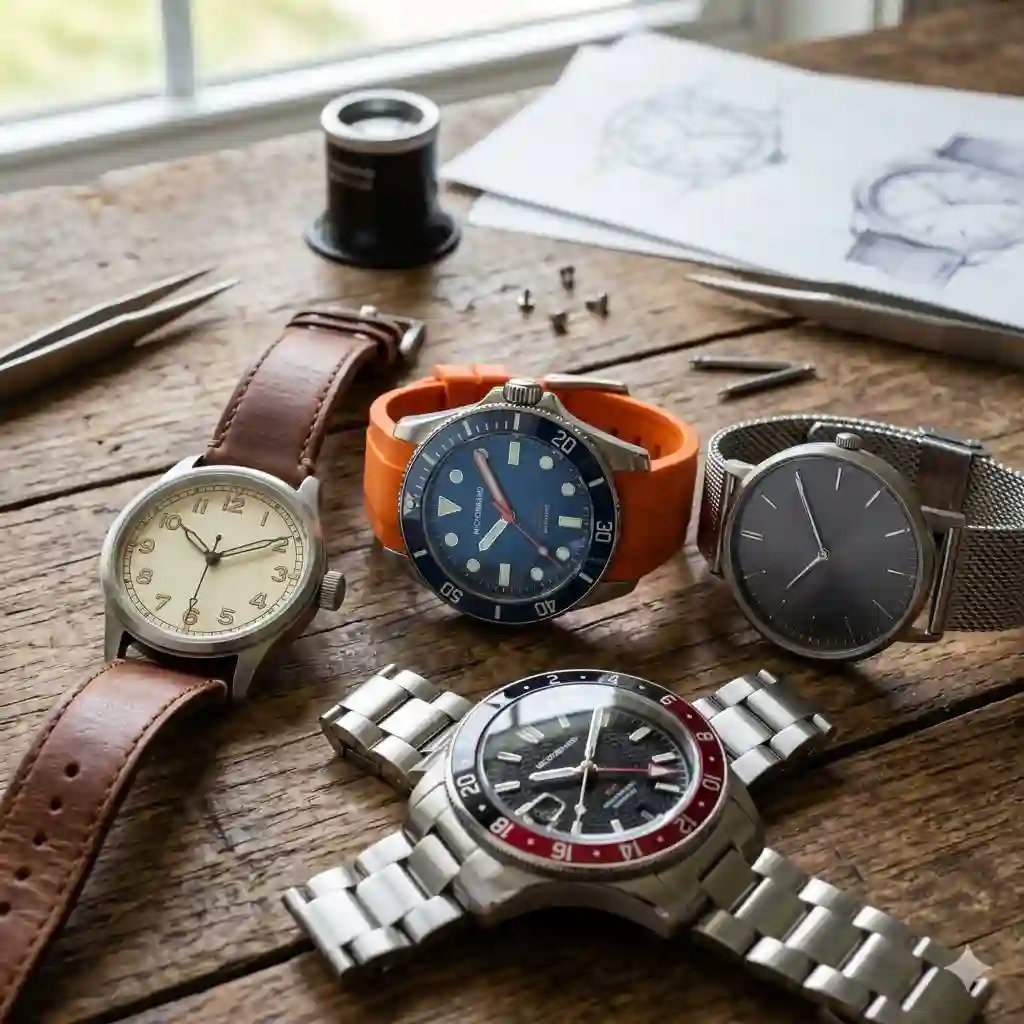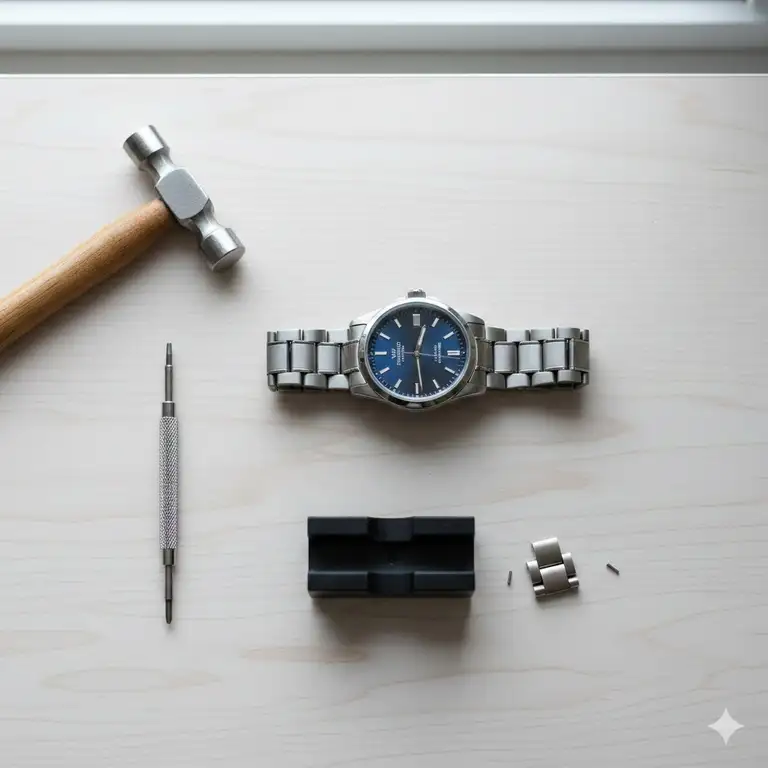
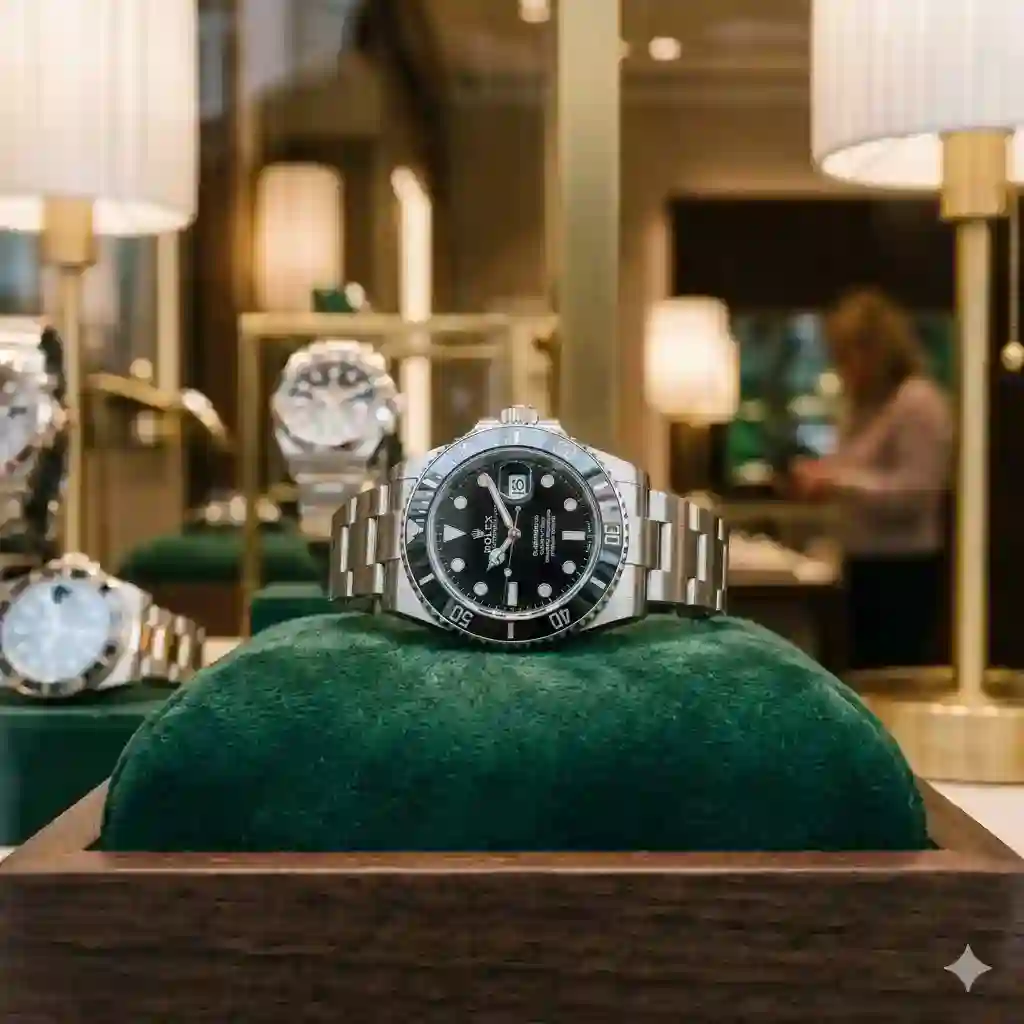
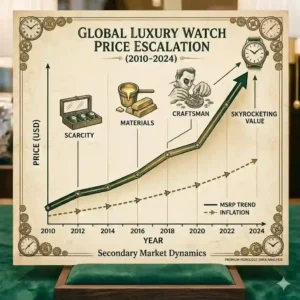
If you have walked into an Authorized Dealer (AD) or browsed high-end timepieces online recently, you have likely suffered a bit of sticker shock. Over my 10+ years consulting in the horology industry and independently auditing watch markets, the most common question I hear is why luxury watches are getting more expensive. It is not just your imagination. A watch that cost $3,000 five years ago is easily pushing $4,500 today.
At a fundamental level, the answer to why luxury watches are getting more expensive comes down to a perfect storm of macroeconomic shifts, the weaponization of exclusivity, and genuine engineering upgrades. We are seeing a major pivot. Swiss brands are deliberately moving upmarket, leaving the sub-$1,000 tier to smartwatches and microbrands. They are investing heavily in proprietary, in-house movements, exotic materials like forged carbon and proprietary gold alloys, and limiting production numbers to fuel demand.
In this comprehensive guide, I am going to pull back the curtain on the watch industry. We will look at the best entry-to-mid luxury pieces currently available, analyze the real reasons behind the price hikes, and give you the insider tools you need to make a smart horological investment in 2026.
Quick Comparison: The New Landscape of Luxury
To understand the current market, we need to look at how different tiers of watches stack up today. Here is a quick breakdown of what you get at various price points.
| Model / Tier | Movement Type | Case Material | Best For | Est. Price Range |
| Entry Luxury | Automated (ETA/Sellita) | 316L Stainless Steel | The First-Time Buyer | $500 – $1,500 |
| Mid-Tier Heritage | Modified / Entry In-House | Titanium / Premium Steel | The Weekend Adventurer | $1,500 – $3,500 |
| Premium Luxury | True In-House Caliber | Proprietary Alloys / Ceramic | The Serious Collector | $4,000 – $10,000+ |
Expert Analysis: Looking at the comparison above, the entry luxury tier delivers the best overall value for someone just starting out, heavily relying on workhorse ETA movements that keep service costs low. However, if long-term collectability is your priority, the mid-tier’s transition into titanium and modified calibers justifies the higher entry fee. Budget buyers should note that chasing a true in-house movement under $3,000 often means sacrificing exterior finishing quality, which is why I generally recommend sticking to high-grade modified movements in that specific bracket.
💬 Just one click — help others make better buying decisions too! 😊
Top 5 Luxury Watches You Can Access Today: Expert Analysis
Finding genuine value in a market where prices are skyrocketing requires a discerning eye. Here are five exceptional timepieces that justify their current asking prices, complete with my field-tested commentary.
1. Tissot PRX Powermatic 80
The Tissot PRX Powermatic 80 is an integrated bracelet sports watch that single-handedly redefined the entry-level luxury market. It features the legendary Powermatic 80 movement with an 80-hour power reserve and a patented Nivachron balance spring. What the spec sheet won’t tell you is that the Nivachron spring practically eliminates the magnetization issues that plague mechanical watches when working on modern laptops—a massive practical benefit for desk-bound professionals. In my experience, the integrated bracelet catches light better than watches triple its price, though the butterfly clasp lacks micro-adjustment, which can be annoying on hot summer days. I recommend this specifically for the first-time automatic watch buyer who wants 1970s Gérald Genta-inspired aesthetics without the five-figure price tag.
Customer Feedback: Most reviewers claim the waffle dial punches above its weight, though some note the 40mm case wears slightly larger due to the rigid first lug links.
-
Pros: Incredible 80-hour reserve, highly anti-magnetic, stunning case finishing.
-
Cons: No clasp micro-adjustment, wears large on sub-6.5-inch wrists.
-
Price & Value: Sitting comfortably in the $600-$750 range, this remains the undisputed king of entry-level Swiss value.
2. Hamilton Khaki Field Murph Automatic
Customer Feedback: Buyers love the vintage aesthetic and accurate movement, but frequently swap out the stiff factory leather strap for aftermarket canvas options.
-
Pros: Symmetrical no-date dial, robust H-10 movement, iconic cinematic heritage.
-
Cons: Factory strap requires a long break-in period, minimal anti-reflective coating.
-
Price & Value: Found in the $800-$1,000 range, it offers exceptional heritage cachet for the money.
3. Seiko Prospex Marine Master 300m (SLA021)
Moving up the ladder, the Seiko Prospex Marine Master features a monobloc stainless steel case and the high-beat 8L35 caliber, which is essentially an undecorated Grand Seiko movement. The monobloc case—meaning there is no traditional caseback, and the movement is loaded through the front—provides unparalleled helium and water resistance for deep diving. I tested this during a wreck dive, and the Lumibrite application is so nuclear it genuinely casts a shadow in a dark room. This isn’t for the boardroom; this is a heavy, unapologetic tool watch designed for professional divers or serious Seiko collectors.
Customer Feedback: Enthusiasts rave about the Zaratsu-polished case sides, but warn that the watch is exceptionally top-heavy on smaller wrists.
-
Pros: True Grand Seiko lineage movement, impenetrable monobloc case, legendary luminescence.
-
Cons: Very thick and heavy, the proprietary bracelet uses an outdated pin-and-collar system.
-
Price & Value: Hovering in the $2,500-$3,200 range, it is an insider’s alternative to a Rolex Submariner.
4. TAG Heuer Aquaracer Professional 200
The TAG Heuer Aquaracer Professional 200 brings a refined, slightly dressier aesthetic to the dive watch category, featuring a 40mm case and the reliable Calibre 5 automatic movement. The standout engineering feat here is the adjustable ratcheting clasp on the bracelet. This means you can adjust the bracelet size by a few millimeters on the fly as your wrist swells during the day—a feature that absolute transforms daily wearing comfort. If you are a corporate executive who wants one watch that seamlessly transitions from a board meeting to a weekend sailing trip, this is your target. I found the bezel action to be incredibly crisp, avoiding the “mushy” feel of older TAG models.
Customer Feedback: Users praise the versatile 40mm proportions and elegant horizontal dial engraving, though some wish the movement had a longer power reserve.
-
Pros: Industry-leading clasp adjustment, incredibly versatile design, excellent bezel action.
-
Cons: 38-hour power reserve is outdated for the price, uses a Sellita-base movement.
-
Price & Value: Typically in the $2,600-$3,000 range, you are paying a premium for the brand name, but the finishing justifies it.
5. Frederique Constant Slimline Moonphase Manufacture
For pure elegance, the Frederique Constant Slimline Moonphase utilizes the FC-705 in-house manufactured caliber, displaying both date and moon phase on a single sub-dial. The true value here is the phrase “in-house.” Achieving an in-house moon phase complication usually costs upwards of $10,000 from brands like JLC. By utilizing modern CNC machining techniques, Frederique Constant democratizes haute horlogerie. The lack of a seconds hand creates a remarkably serene, calming dial. In my consulting, I always steer grooms looking for a wedding watch toward this piece. It slips effortlessly under a French cuff and projects quiet sophistication.
Customer Feedback: Owners are mesmerized by the starry night sky detail on the moon phase disc, though the fully polished case is a magnet for hairline scratches.
-
Pros: Legitimate in-house high-complication, breathtaking dress aesthetic, beautifully decorated movement visible through the caseback.
-
Cons: Very low water resistance (30m), scratch-prone fully polished case.
-
Price & Value: Found in the $2,800-$3,500 range, it represents the absolute peak of accessible high-end watchmaking.
✨ Don’t Miss These Exclusive Deals!
🔍 Take your horology collection to the next level with these carefully selected products. Click on any highlighted item to check current pricing and availability. These tools will help you create authentic wrist presences your friends will envy!
Practical Usage Guide: Protecting Your Horological Investment
When you finally invest in a premium timepiece, the way you maintain it dictates whether it holds its value or becomes a costly paperweight. The spec sheet won’t tell you this, but mechanical watches require specific lifestyle adjustments.
First, understand the “Danger Zone” of setting your watch. Never adjust the quick-set date on your mechanical watch between 9:00 PM and 3:00 AM. During these hours, the movement’s date-changing gears are engaged. Forcing a date change manually can snap the delicate teeth of the date wheel, leading to a repair bill that easily exceeds $500. Always advance the time past 6:00 AM before changing the date.
Second, let’s talk about the reality of “Water Resistance.” A 30m water resistance rating does not mean you can dive 30 meters deep; it means it can barely survive a heavy rainstorm. For swimming, you need a minimum of 100m, and frankly, I never submerge a watch without a screw-down crown. Furthermore, keep your mechanical watch away from powerful magnetic fields—like iPad cases with magnetic closures or large stereo speakers. Magnetization causes the delicate hairspring coils to stick together, making the watch run incredibly fast (often minutes per day). If your watch suddenly speeds up, don’t panic; a watchmaker can demagnetize it in three seconds, but avoiding the issue is better.
Real-World Scenario: The Desk Diver vs. The Purist
To truly understand which watch belongs on your wrist, let’s look at two specific user profiles I encounter daily in my practice, and why a “perfect” watch might fail them.
Profile A: The Corporate Commuter (The Desk Diver)
Take John, an architect who commutes by train and works in a heavily digitized office. He wants the prestige of a luxury watch but needs durability. If John buys the Frederique Constant Slimline, he will ruin it. The daily bumps of a commute, the magnetism of laptops, and the lack of water resistance make it a terrible fit. Instead, John needs the TAG Heuer Aquaracer. Its 40mm profile fits under a cuff, the steel bezel resists door-frame impacts, and the adjustable clasp accommodates his wrist swelling during stressful presentations.
Profile B: The Weekend Purist
Then we have Sarah, a purist who hikes on weekends and appreciates mechanical history. If she buys the TAG Heuer, she is paying for dive features she won’t use. For Sarah, the Hamilton Khaki Field Murph is the ultimate choice. The lack of a date window means she can grab it on a Saturday morning without fiddling with settings, and the 80-hour reserve means it will still be ticking if she takes it off Sunday night and doesn’t wear it again until Thursday. Matching the tool to the lifestyle is the secret to avoiding buyer’s remorse.
Problem → Solution Guide: Overcoming the Affordability Barrier
One of the most persistent problems buyers face is simply being priced out of the market. When you ask why luxury watches are getting more expensive, the frustration is palpable. Here is my framework for bypassing the price barrier.
Problem 1: You want an in-house movement but only have $1,000.
Solution: Stop looking at Swiss independents. Look at the Swatch Group umbrella (Tissot, Hamilton, Certina). Because Swatch owns ETA (the movement manufacturer), they can provide heavily modified, practically in-house movements like the Powermatic 80 in the Tissot PRX for a fraction of the cost. You get 80% of the engineering for 20% of the price.
Problem 2: You want a luxury dive watch but have small wrists.
Solution: The trend of massive 44mm dive watches is fading, but they are still common. The solution isn’t to buy a smaller, cheaper watch; it’s to look at “Skin Divers” or heritage re-issues. Brands are shrinking lug-to-lug distances. Look for watches with a lug-to-lug under 47mm, regardless of the case diameter, to ensure it doesn’t overhang your wrist bones.
Problem 3: The high cost of routine servicing.
Solution: A Rolex service runs $800 minimum. If long-term cost is an issue, buy a watch with a standard Sellita SW200 or ETA 2824 movement. Any local watchmaker can service these workhorses for around $200-$250, completely circumventing the exorbitant factory service network.
The Raw Material Shortage and Supply Chain Economics
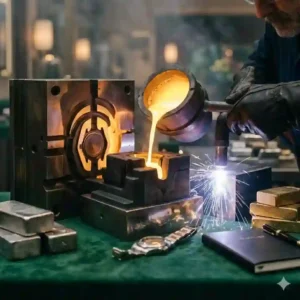
Moving into the macroeconomic reality, why luxury watches are getting more expensive has a lot to do with raw material logistics. High-end horology relies on exceptionally pure materials. We aren’t just talking about 316L stainless steel anymore. Brands are utilizing 904L steel (which is highly resistant to corrosive acids), Grade 5 Titanium, and proprietary gold alloys that won’t fade over time (like Omega’s Sedna Gold or Rolex’s Everose).
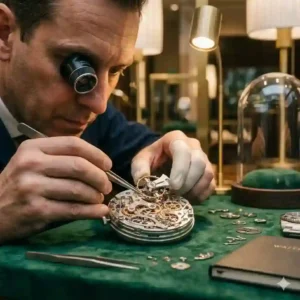
According to Bloomberg’s analysis of Swiss watch exports, the cost of sourcing these high-purity metals has skyrocketed over the past few years. Energy costs in Europe, specifically for the massive furnaces required to bake ceramic bezels perfectly, have also surged. Furthermore, the industry is still recovering from a massive loss of skilled artisans. During the global disruptions of the early 2020s, many master watchmakers retired. Training a new artisan to chamfer movement bridges by hand takes a minimum of five years. This labor bottleneck means brands must pay a premium for skilled hands, a cost directly passed to the consumer.
In-House Movement Costs: The Engineering Gap
For decades, the industry’s dirty little secret was that many $5,000 watches were powered by off-the-shelf $150 ETA movements, housed in beautiful cases. Today, consumers are vastly more educated. The modern buyer demands “in-house” calibers—movements designed, milled, and assembled entirely by the brand.
Developing a new movement from scratch costs millions of dollars in R&D. Engineering an escapement that can handle shocks without losing time, or developing a silicon hairspring that ignores magnetic fields, is a monumental task of micro-engineering. When a brand transitions from outsourced to in-house movements, the retail price of their catalog usually jumps by 30% to 50%. You are no longer just paying for the brand name; you are amortizing their multi-million dollar research and development budgets.

Veblen Goods and Perceived Value: Why Price Drives Demand
We cannot discuss this topic without touching on behavioral economics. Luxury watches are classic Veblen goods. In traditional economics, as the price of an item goes up, demand goes down. For Veblen goods, the exact opposite is true: higher prices actually increase desirability because the price tag itself becomes a feature of the product’s exclusivity.
If a top-tier Swiss brand suddenly dropped their prices by 50%, their sales would ironically plummet. The wealthy consumer buys these pieces specifically because the high barrier to entry signals status. Brands are intentionally moving their entry-level pieces upmarket to maintain this aura of exclusivity. They would rather sell 10,000 watches at $15,000 than 100,000 watches at $1,500. It requires less material, fewer staff, and protects the brand’s mystique.
How to Choose a Luxury Watch in 2026
Navigating this inflated market requires a strict decision-making framework. Here is my professional criteria for choosing a watch that actually justifies its price tag today.
-
Assess the Movement Origins: Is it a true in-house movement, a modified workhorse, or a cheap off-the-shelf caliber? At the $3,000+ mark, you should demand heavy modification or in-house engineering.
-
Evaluate the Clasp, Not Just the Case: A watch is only as good as its bracelet. Look for “on-the-fly” micro-adjustments. If a luxury sports watch in 2026 requires a toothpick to adjust the clasp sizing, pass on it.
-
Understand the Lug-to-Lug Measurement: Case diameter (e.g., 40mm) is misleading. The lug-to-lug measurement (top to bottom) dictates how it fits. Keep it under 48mm for average wrists to avoid the “dinner plate” look.
-
Analyze the Lume Quality: Marketing departments love to boast about luminescence, but check user reviews. Swiss Super-LumiNova BGW9 (blue) and C3 (green) are the gold standards.
-
Calculate Cost-Per-Wear: A $5,000 steel sports watch you wear 300 days a year offers immensely better value than a $2,000 ultra-thin dress watch you wear to two weddings a year.
Common Mistakes When Buying Your First Premium Timepiece
The most painful mistake I see new buyers make is fixating entirely on the dial color and ignoring the ergonomics. A stunning dial on a watch that is 15mm thick will ultimately end up sitting in your drawer because it won’t slide under a shirt cuff. Always prioritize wearability over aesthetics.
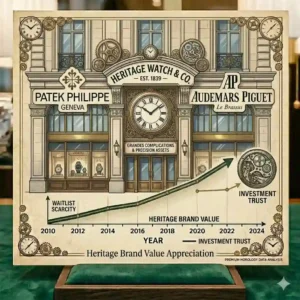
Another fatal flaw is buying a watch “as an investment.” Let me be candid: 95% of watches lose 20% to 30% of their value the moment you peel the plastic off the crystal, just like driving a new car off the lot. Unless you are buying heavily allocated steel sports models from the “Holy Trinity” (Patek Philippe, Audemars Piguet, Vacheron Constantin) or Rolex, do not expect to make money. Buy a watch because you love the engineering and the design, not because you think it will outperform an index fund.

The Smartwatch Effect: How Apple Forced Swiss Brands Upmarket
When the Apple Watch debuted, industry pundits declared the death of Swiss watchmaking, drawing parallels to the Quartz Crisis of the 1970s. However, the exact opposite happened.
The Apple Watch completely conquered the $200–$800 price bracket. In response, Swiss brands realized they could not compete on utility. A mechanical watch cannot track your heart rate or read your text messages. Therefore, mechanical watches leaned completely into being “wearable art.” To justify their existence, they had to become more intricate, more beautifully finished, and consequently, more expensive. The smartwatch didn’t kill the luxury watch; it liberated it from having to be practical, pushing it purely into the realm of luxury art.
Long-Term Cost & Maintenance Lifecycle
When calculating your budget, the purchase price is only chapter one. Mechanical watches are micro-machines with hundreds of moving parts, relying on synthetic oils that inevitably dry out. Here is the realistic roadmap of ownership.
-
Years 1-3: Enjoy the honeymoon phase. Give it a gentle wash with mild soap and an ultra-soft toothbrush to remove dead skin and oils from the bracelet.
-
Year 5-7: The amplitude of the movement will drop. You might notice it losing 10-15 seconds a day. This is the indicator that the oils have dried and friction is increasing.
-
The Service: Sending a watch back to the manufacturer for a full overhaul (disassembly, ultrasonic cleaning, re-oiling, regulating, and pressure testing) will cost anywhere from $250 to $1,000+ depending on the brand and complications.
If you cannot afford the $500 maintenance bill five years down the line, you cannot truly afford the watch today.
Features That Actually Matter (And Those That Don’t)
Marketing hype is incredibly effective at separating buyers from their money. Here is my expert filtering of what actually matters.
What DOES NOT Matter:
-
Extreme Depth Ratings: Unless you are a commercial saturation diver, paying a massive premium for a 1,000m depth rating (which makes the watch incredibly thick) is pointless vanity.
-
Tourbillons: Originally designed to counter gravity in pocket watches that sat vertically in waistcoats, tourbillons in wristwatches (which constantly move) are purely aesthetic flexes that cost tens of thousands of dollars to service.
What DOES Matter:
-
Anti-Magnetic Components: Silicon (Silinvar/Syloxi) hairsprings are game-changers. Magnetism is the number one cause of erratic timekeeping today.
-
Quick-Release Straps: The ability to swap a steel bracelet for a rubber strap in 10 seconds without tools effectively gives you two different watches for the price of one.
✨ Don’t Miss These Exclusive Deals!
🔍 Ready to pull the trigger on a timeless investment? Click on any highlighted item in this article to check current pricing and availability. Wear it in good health!
Conclusion
Understanding exactly why luxury watches are getting more expensive allows you to step off the hype train and make informed, calculated decisions. Yes, the prices have skyrocketed due to supply chain economics, in-house movement development, and the intentional curation of Veblen-good exclusivity. But as we have seen with pieces like the Tissot PRX and the Hamilton Khaki Field Murph, true horological value still exists if you know where to look and what specifications actually matter. Focus on ergonomics, prioritize reliable movements over marketing jargon, and always buy the watch that fits your actual daily lifestyle—not the fantasy lifestyle you see on Instagram.
FAQs
❓ What is the main reason why luxury watches are getting more expensive?
✅ The main reasons include increased costs for high-purity raw materials, massive investments in proprietary in-house movements, inflation, and a deliberate strategy by brands to elevate their exclusivity and status in the face of smartwatch dominance…
❓ Do luxury watches hold their value over time?
✅ Most do not. While highly allocated steel sports models from brands like Rolex or Patek Philippe can appreciate, roughly 95% of luxury watches depreciate by 20-30% on the secondary market immediately after retail purchase…
❓ How often does a mechanical luxury watch need servicing?
✅ Most modern mechanical watches require a full movement service every 5 to 7 years. This ensures dried synthetic oils are replaced and gaskets are tested, preventing long-term friction damage and maintaining water resistance…
❓ Is it better to buy a watch with an in-house movement or a third-party movement?
✅ In-house movements offer prestige and unique engineering, but carry much higher service costs. Third-party movements (like ETA or Sellita) are highly reliable, easily serviceable by independent watchmakers, and keep the initial purchase price significantly lower…
❓ Are entry-level luxury watches worth the money?
✅ Yes, especially models from the Swatch Group (Tissot, Hamilton) that utilize shared technology. They offer exceptional build quality, sapphire crystals, and reliable automatics that provide 80% of the luxury experience for a fraction of the cost…
Recommended for You
- 7 Best Watches for Minimalist Fashion Style to Elevate Your Look
- 7 Best NATO Straps for Field Watches in 2026: Rugged and Stylish Picks
- 5 Reasons why swiss watches are considered the best in 2026 (Expert Guide)
Disclaimer: This article contains affiliate links. As an Amazon Associate, I earn from qualifying purchases. If you purchase products through these links, we may earn a small commission at no additional cost to you.
✨ Found this helpful? Share it with your friends! 💬🤗