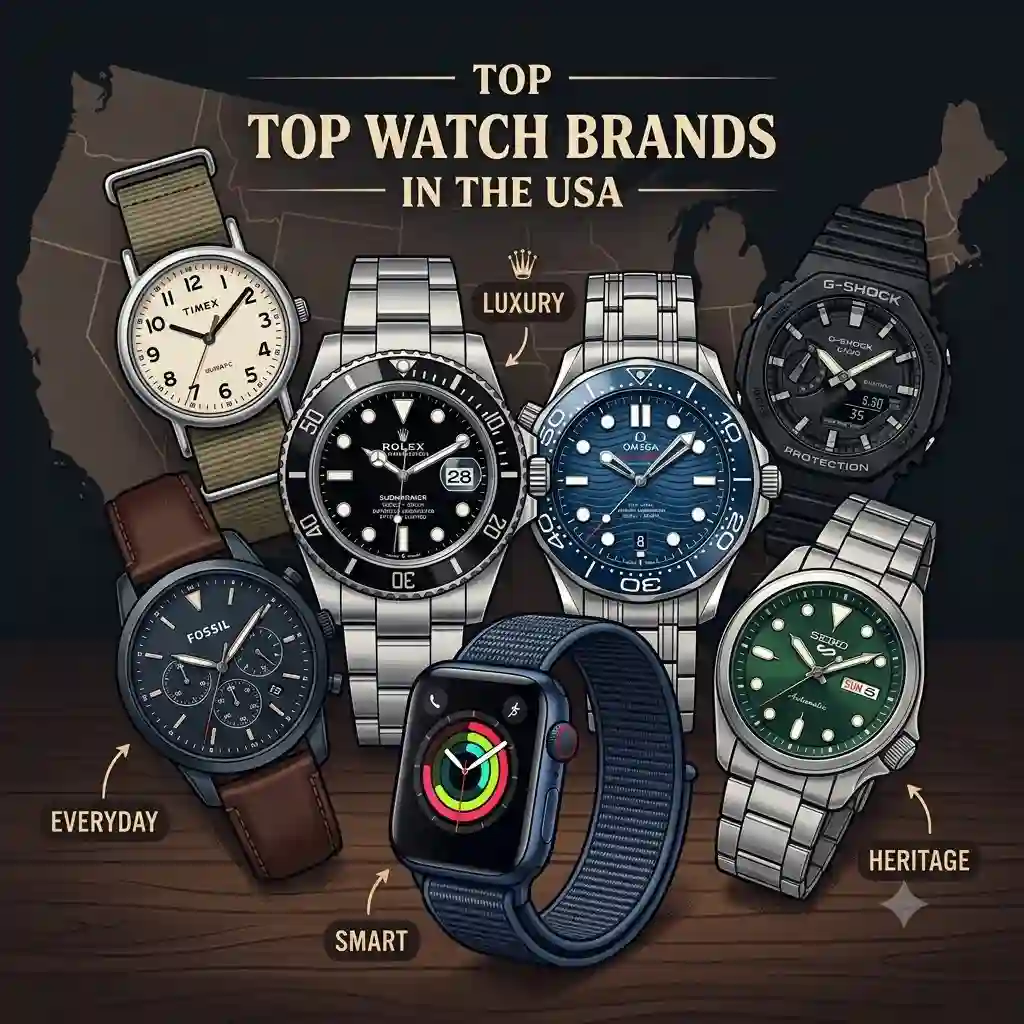
What are the most popular watch brands in the USA? Simply put, they are a diverse mix of historic American heritage labels, meticulously engineered Japanese giants, and cutting-edge tech companies that have successfully captured the wrists of millions across the country. In my ten years as an industry consultant and horology specialist, I’ve seen watch trends come and go, but the core players dominating the American market remain surprisingly consistent, blending utility with undeniable style.
The watch market in the United States has undergone a massive shift recently. We’ve moved past the phase where a watch was just a tool to tell time. Today, your timepiece is a statement of intent, a piece of wearable tech, or a nod to traditional craftsmanship. Whether I am consulting for boutique jewelers or testing rugged field watches in the damp forests of the Pacific Northwest, one thing remains clear: Americans demand versatility.
When looking at the most popular watch brands in the USA right now, you will notice a distinct divide between smartwatches that integrate seamlessly with our digital lives and traditional analog watches that offer a much-needed escape from screens. The spec sheets will try to sell you on millimeter thicknesses and battery capacities, but in this guide, I will break down what those numbers actually mean when the watch is strapped to your wrist during a chaotic Monday commute or a weekend hike.
Quick Comparison: Top Timepieces at a Glance
To help you navigate the landscape of the most popular watch brands in the USA, I have distilled the current top performers into a quick reference matrix.
| Brand & Model | Movement Type | Case Size | Water Resistance | Best For |
| Seiko 5 Sports | Automatic (Self-winding) | 42.5mm | 100m (10 ATM) | Entry-level mechanical enthusiasts |
| Casio G-Shock DW5600 | Digital Quartz | 42.8mm | 200m (20 ATM) | Extreme durability and tactical use |
| Citizen Promaster Diver | Eco-Drive (Solar) | 44mm | 200m (ISO Certified) | Water sports and zero-maintenance |
| Timex Weekender | Analog Quartz | 38mm | 30m (3 ATM) | Casual everyday weekend wear |
| Apple Watch Series 9 | Smartwatch (S9 SiP) | 41mm / 45mm | 50m (Swimproof) | Seamless digital integration |
Expert Analysis:
Looking at the comparison above, the Seiko 5 Sports delivers the absolute best value for anyone looking to enter the world of mechanical watches, but if zero-maintenance reliability is your priority, the Citizen’s solar-powered Eco-Drive justifies its slightly larger case size. Budget buyers should note that while the Timex Weekender sacrifices high water resistance for its lower price point, its slim profile makes it infinitely more comfortable under a shirt cuff than the bulky G-Shock.
💬 Just one click — help others make better buying decisions too! 😊
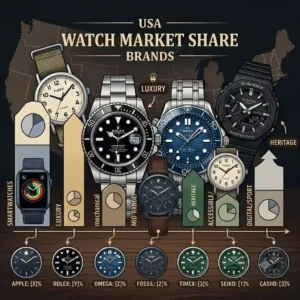
Top 5 most popular watch brands in the USA — Expert Analysis
When evaluating the most popular watch brands in the USA, I never rely on press releases. I wear these watches, scratch them, swim with them, and test their limits. Here is my insider analysis of the five foundational pieces dominating the 2026 market.
1. Seiko: The Mechanical Benchmark
The Seiko 5 Sports SRPD Collection completely dominates the entry-level automatic space.
The key specification here is the 4R36 automatic movement featuring hacking and hand-winding capabilities. In real-world terms, “hacking” means the second hand stops when you pull the crown out, allowing you to set the time exactly to the second—a feature older, cheaper Seiko models lacked. The 42.5mm stainless steel case sits surprisingly well on smaller wrists due to its compact 46mm lug-to-lug distance.
In my experience, this is the perfect “first real watch.” The spec sheet won’t tell you this, but the proprietary Hardlex crystal on the dial is highly shatter-resistant, making it excellent for daily office-to-gym transitions. However, it will pick up micro-scratches over time if you regularly brush it against brick or metal.
Customer Feedback: Most users rave about the rich dial colors and robust build, though a few note the standard bracelet feels a bit lightweight compared to the watch head.
-
Pros: Reliable in-house automatic movement, excellent nighttime luminosity, versatile styling.
-
Cons: Hardlex crystal can scratch, bracelet clasp feels slightly stamped.
-
Price & Value: Sitting in the $250-$350 range, it offers unmatched mechanical value.
2. Casio G-Shock: The Indestructible Legend
When we talk about the most popular watch brands in the USA, Casio’s Casio G-Shock DW5600E-1V is an unavoidable titan.
Its standout feature is the hollow-core case structure that houses the quartz module. What this means practically is that the internal timekeeping engine essentially “floats” inside the resin case, protecting it from sudden impacts that would instantly shatter a mechanical watch escapement.
I have personally dropped this watch from a two-story window onto concrete during a field test, and it didn’t even drop a second. It is built for construction workers, military personnel, and anyone who is aggressively tough on their gear. What most buyers overlook, however, is that the recessed adjust button (top left) is intentionally difficult to press to prevent accidental time changes—it’s a feature, not a flaw, though it can be annoying with gloves on.
Customer Feedback: Reviewers universally praise its immortality, with many claiming they’ve worn the same unit for a decade without issue.
-
Pros: Practically indestructible, 200m water resistance, incredibly lightweight.
-
Cons: Recessed buttons are hard to press, resin strap gets stiff in cold weather.
-
Price & Value: At under $60, this is the best horological insurance policy money can buy.
3. Citizen: The Solar Powerhouse
The Citizen Eco-Drive Promaster Diver represents the peak of worry-free watch ownership.
Powered by Citizen’s proprietary Eco-Drive technology, this watch features a hidden solar panel beneath the dial that converts any light source—even dim office fluorescents—into energy. The real-world translation? You will never need to pay a jeweler to crack open the case to change a battery, preserving the crucial factory waterproof seals for decades.
If you are a weekend boater or desk diver who wants a rugged aesthetic without the fuss of resetting a mechanical watch every Monday, this is your piece. The ISO-certified 200m water resistance means it’s legally tested to withstand actual scuba diving, not just a splash in the sink. The bezel action is loud and deliberate, ensuring it won’t get bumped out of place under a wetsuit.
Customer Feedback: Buyers love the “set it and forget it” nature of the Eco-Drive, though some find the 44mm case size a bit imposing on wrists under 6.5 inches.
-
Pros: Never needs a battery change, highly legible hands, professional-grade dive certification.
-
Cons: Large footprint on the wrist, the polyurethane strap is quite long (designed for wetsuits).
-
Price & Value: Typically found in the mid-$200s to low-$300s range, the total cost of ownership is incredibly low.
4. Timex: The Heritage Everyday Companion
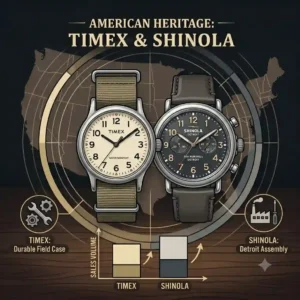
You can’t discuss the most popular watch brands in the USA without mentioning the Timex Weekender Chronograph.
Its defining feature is the Indiglo night-light system. Unlike traditional glow-in-the-dark paint (lume) that fades after an hour in the dark, pressing the crown activates an electroluminescent panel that illuminates the entire dial uniformly. If you frequently check the time in dark theaters or while camping, this beats any mechanical watch on the market.
In practice, I recommend this for students, creatives, and anyone wanting a casual, non-pretentious accessory. The slip-through NATO strap design means you can swap out the band for a different color in five seconds without any tools. A word of warning: Timex standard three-handers are notoriously loud tickers, but the chronograph version uses a different movement that is blissfully silent.
Customer Feedback: Customers adore the classic, versatile look and the Indiglo feature, but warn that the brass case will eventually show wear if exposed to heavy sweat over years.
-
Pros: Perfect dial illumination, infinitely customizable straps, silent chronograph movement.
-
Cons: Brass case underneath the plating, minimal 30m water resistance.
-
Price & Value: Hovering around $50-$80, it’s the ultimate low-stakes style upgrade.
5. Apple: The Digital King
While traditionalists might scoff, the Apple Watch Series 9 is statistically the king of American wrists.
The integration of the S9 SiP (System in Package) chip with an always-on Retina display fundamentally changes how you interact with your phone. The practical application here is seamless “glanceability”—you can check a text message, monitor your heart rate, or pay for your coffee without breaking stride or digging into your pocket.
I view this not just as a watch, but as a biometric health tool. If you are an urban professional attempting to optimize your fitness or streamline your digital notifications, there is no substitute. However, the requirement to charge it every 18-36 hours introduces a psychological burden that traditional watch wearers often struggle to adapt to.
Customer Feedback: Users are obsessed with the fitness tracking rings and screen brightness, but consistently lament the battery life compared to dedicated fitness trackers.
-
Pros: Unrivaled smart ecosystem integration, life-saving health sensors, brilliant display.
-
Cons: Requires daily charging, becomes obsolete in a few years unlike traditional watches.
-
Price & Value: In the $350-$450 range, it represents a high upfront cost with immense daily utility.
✨ Don’t Miss These Exclusive Deals!
🔍 Take your wristwear to the next level with these carefully selected products. Click on any highlighted item to check current pricing and availability. These tools will help you create authentic daily styles your family and friends will love!
Practical Usage Guide: Maximizing Your Watch’s Lifespan
Amazon listings will sell you the watch, but they won’t tell you how to keep it alive. One of the reasons the most popular watch brands in the USA maintain their status is because, if treated right, these tools last lifetimes. Here is your Year-One roadmap for maintenance.
The “Danger Zone” for Mechanicals:
If you purchase an automatic watch like a Seiko, never adjust the date complication between the hours of 9:00 PM and 3:00 AM. During this window, the microscopic gears that flip the date wheel are actively engaged. Forcing a quick-set during this time can snap the plastic or brass teeth inside, resulting in a costly repair. Always roll the time to 6:30 before setting the date.
The Biofilm Build-Up:
For watches worn on metal bracelets or resin straps (like G-Shocks), dead skin and sweat build up between the links, acting like a grinding paste that prematurely stretches the metal. My field-tested advice? Once a month, take a soft-bristled toothbrush and a drop of mild dish soap, and scrub the bracelet under lukewarm water. Do not do this in a hot shower, as steam can bypass rubber gaskets that are rated only for liquid water pressure.
Solar Optimization:
If you buy an Eco-Drive or Tough Solar watch, leaving it in a dark drawer for six months will deeply deplete the secondary battery, drastically reducing its overall lifespan. Keep solar watches on a dresser that receives ambient (not direct, baking hot) sunlight.
Case Studies: Matching the Watch to the American Lifestyle
Choosing from the most popular watch brands in the USA isn’t about specs; it’s about context. Let’s look at how perfect products can fail if mismatched with the wearer.
Profile 1: The Corporate Commuter
Scenario: Takes the subway, types on a laptop for 8 hours, attends after-work networking events.
The Match: Apple Watch Series 9 or Seiko 5 Sports.
The Reality: While the Apple Watch dominates here for productivity, I often counsel clients to adopt the Seiko if they suffer from screen fatigue. The ‘Anti-Recommendation’ logic applies here: if your job requires heavy, abrasive physical labor, the Apple Watch’s glass screen is a terrible fit despite its high-tech appeal.
Profile 2: The Weekend Hobbyist
Scenario: Chops wood, works on cars, hikes on Saturdays.
The Match: Casio G-Shock DW5600.
The Reality: This user needs a watch that survives oil spills and intense vibrations. A mechanical watch worn while using a pneumatic drill or chopping wood will eventually suffer from a damaged hairspring due to the shockwaves traveling up the arm. The G-Shock absorbs these impacts effortlessly.
Profile 3: The Minimalist Traveler
Scenario: Flies frequently, wants one watch for the pool, the dinner table, and the trail.
The Match: Citizen Promaster Diver.
The Reality: You don’t want to pack a watch charger, and you don’t want to worry about water damage in a hotel pool. The Eco-Drive movement means zero battery anxiety across time zones, and the dive bezel is incredibly handy for tracking flight times.
Buyer’s Decision Framework: Which Brand Belongs on Your Wrist?
Before you click “add to cart” on any of the most popular watch brands in the USA, walk through this priority checklist. Helping readers self-identify their needs prevents buyer’s remorse.
-
If your priority is zero maintenance… Choose Quartz or Solar (Citizen, Casio). You sacrifice the romantic, sweeping second hand of a mechanical watch, but you gain absolute grab-and-go reliability.
-
If your priority is digital connectivity and health metrics… Choose a Smartwatch (Apple). Just be prepared to add another device to your nightly charging routine.
-
If your priority is horological heritage and craftsmanship… Choose Mechanical (Seiko). You will have to accept that it might lose 10-15 seconds a day, but you are wearing a micro-machine powered by your own kinetics.
-
If your budget is strictly under $100… Choose Timex or Casio. Do not buy ultra-cheap, no-name automatic watches. They use inferior, unlubricated movements that will seize up within six months. Stick to established entry-level quartz.
How to Choose the Perfect Everyday Watch
Selecting a watch from the most popular watch brands in the USA requires understanding your own anatomy as much as horological engineering.
1. Ignore Case Diameter; Focus on Lug-to-Lug:
Most buyers look at a 42mm case diameter and think, “That’s too big.” But case diameter is misleading. The crucial metric is lug-to-lug distance (the measurement from the top strap attachment to the bottom). A 42mm watch with short, curved lugs (like the Seiko 5) will wrap around a small wrist beautifully, whereas a 40mm watch with long, flat lugs will overhang awkwardly, making you look like a child wearing a parent’s watch.
2. Crystal Material Matters:
The “glass” covering the dial dictates how your watch ages. Acrylic (plastic) scratches if you look at it wrong but can be polished with toothpaste in five minutes. Mineral crystal (or Hardlex) is harder to scratch but impossible to polish out. Sapphire crystal is virtually unscratchable (second only to diamond), but it is brittle and can shatter upon extreme blunt impact. For a daily desk-diver, prioritize sapphire.
3. The Bracelet Taper:
A high-quality steel bracelet tapers—meaning it is wider at the watch head (e.g., 22mm) and narrows down at the clasp (e.g., 18mm). This engineering choice drastically increases wrist comfort and reduces weight. Cheap bracelets stay the same width all the way around, feeling clunky and restrictive.
Common Mistakes When Buying Popular Watches
In my years evaluating the most popular watch brands in the USA, I see consumers fall into the same traps repeatedly.
The “Investment” Fallacy:
Do not buy entry-level or mid-tier watches expecting them to appreciate. Watches are like cars; they lose 20% of their value the moment you take the tags off. Buy a watch because you love the design and the utility, not because you think a $300 piece will fund your retirement.
Misunderstanding Luminous Paint:
Marketing departments love to boast about “glowing hands.” What they don’t tell you is that standard luminescent paint needs to be “charged” by UV light. If your watch sits under a long sleeve all day in a windowless office, it will be pitch black when you turn the lights out. If nighttime legibility is crucial, you need active illumination like Timex’s Indiglo or a smartwatch.
Ignoring the Crown Placement:
A large metal crown located at the traditional 3 o’clock position can dig painfully into the back of your hand if you do push-ups or ride a motorcycle. Look for watches with crowns at 4 o’clock (like many Seikos and Citizens) if wrist mobility is a major factor in your daily life.
Traditional Mechanical vs Smartwatches
Let’s do a deep comparison between traditional analog watches and smartwatches to understand the total value proposition.
| Feature | Traditional Mechanical | Smartwatch | Best For |
| Lifespan | Decades (with servicing) | 3-5 Years (battery degradation) | Heritage vs Tech |
| Power Source | Kinetic energy (wrist movement) | Lithium-ion battery | Autonomy vs Features |
| Daily Distraction | Zero (tells time only) | High (notifications, alerts) | Mindfulness vs Connectivity |
| Depreciation | Moderate to Slow | Rapid (obsolete quickly) | Long-term Value vs Immediate Utility |
Expert Analysis:
Looking at the comparison above, traditional mechanical watches from the most popular watch brands in the USA deliver far superior long-term ROI, often becoming heirlooms. However, if daily productivity and biometric tracking are your priorities, the rapid depreciation of a smartwatch is a fair trade-off for its immense processing power. Budget buyers must factor in that a $400 smartwatch needs replacing every four years, whereas a $300 mechanical watch just needs a $50 service.
Long-Term Cost & The Maintenance Cycle
Let’s calculate the “Total Cost of Ownership” (TCO), a concept rarely discussed on Amazon listings.
If you buy a high-quality quartz watch for $150, the immediate cost is low. However, you will need a battery change roughly every 2-3 years. If you take it to a proper horologist who replaces the water-resistance gaskets and pressure tests the case, that service costs about $35. Over ten years, your $150 watch has cost you roughly $300.
Conversely, a $300 automatic watch uses no batteries. However, the microscopic oils lubricating the gears will dry out over 7-10 years. A full teardown and re-lubrication service can cost anywhere from $100 to $250 depending on the movement. The “efficiency gap” here means that while mechanicals are more romantic, solar-quartz watches (like Eco-Drive) offer the lowest possible Total Cost of Ownership over a 20-year span.

Features That Actually Matter (And Those That Don’t)
When browsing the most popular watch brands in the USA, you will be bombarded with terminology. Here is my expert filtering of horological marketing hype.
✅ Features That Matter:
-
Drilled Lugs: Small holes on the outside of the watch lugs that allow you to push a pin in and remove the strap effortlessly. This saves your watch from getting heavily scratched by spring-bar tools.
-
Solid End-Links: Where the metal bracelet meets the watch case, it should be a solid block of milled steel, not folded sheet metal. Solid end-links prevent the bracelet from rattling noisily.
-
Micro-Adjust Clasps: Your wrist swells and shrinks throughout the day depending on temperature and sodium intake. A clasp with 3-5 micro-adjustment holes is mandatory for all-day comfort.
❌ Features That Don’t Matter:
-
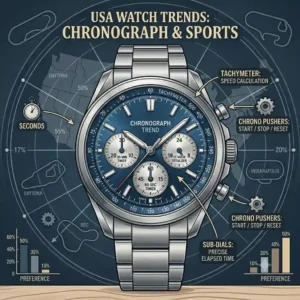
Tachymeter Bezels: These are scales around the outside of chronographs used to calculate speed based on travel time. Unless you are manually timing race cars at a track in 1965, you will literally never use this feature.
-
Helium Escape Valves: Found on extreme dive watches. Unless you are a commercial saturation diver living in a pressurized underwater habitat, this feature is completely useless and just adds another potential point of water ingress.
Decoding Safety and Water Resistance Ratings
Water resistance is the most widely misunderstood metric in watchmaking. When an Amazon listing says “Water Resistant 30m,” people logically assume they can dive 100 feet underwater. This is dead wrong and a recipe for a flooded, ruined watch.
| Stated Rating | Real-World Translation | Safe Activities | Best For |
| 30m / 3 ATM | Splash resistant only | Washing hands, light rain | Dress watches |
| 50m / 5 ATM | Submersible but vulnerable | Quick surface swimming | Casual sports watches |
| 100m / 10 ATM | Highly water resistant | Swimming, snorkeling, surfing | Daily beaters |
| 200m / 20 ATM+ | Professional grade | Scuba diving, high-impact watersports | True Dive watches |
Expert Analysis:
The chart above clarifies why treating a 30m rated watch like a dive tool leads to disaster. The static pressure of 30 meters in a laboratory is vastly different from the dynamic pressure created when you forcefully swing your arm into a swimming pool. If your lifestyle includes water sports, the 200m ISO certification of watches like the Citizen Promaster justifies its bulk, ensuring absolute peace of mind against water intrusion.
To understand exactly how these pressure standards are established, I highly recommend reading up on the NIST time and frequency standards or exploring the deep technical history of Horology on Wikipedia to see how far case engineering has come. Furthermore, industry-leading blogs like Hodinkee frequently feature deep dives into how modern brands test their seals against these exact parameters.
✨ Don’t Miss These Exclusive Deals!
🔍 Take your horological journey to the next level with these carefully selected timepieces. Click on any highlighted item to check current pricing and availability. These tools will help you create a rugged, reliable daily carry that won’t let you down!
Conclusion
Navigating the landscape of the most popular watch brands in the USA doesn’t have to be overwhelming. The market in 2026 offers incredibly refined choices, whether you are seeking the unbreakable resilience of a Casio G-Shock, the traditional mechanical heartbeat of a Seiko 5, or the biometric brilliance of the latest Apple Watch.
Remember, the “best” watch is rarely the one with the most impressive spec sheet; it’s the one that seamlessly integrates into your daily life. If a timepiece constantly requires you to charge it when you forget, or if it’s too delicate for your weekend hobbies, it will end up sitting in a drawer. Prioritize your lifestyle context over the marketing hype. By focusing on factors like lug-to-lug distance, real-world water resistance, and the true cost of long-term ownership, you can invest in a companion that will proudly serve on your wrist for years to come.
FAQs
❓ What are the most popular watch brands in the USA right now?
✅ The most popular watch brands in the USA currently include Apple, Seiko, Casio (specifically G-Shock), Citizen, and Timex. These brands dominate because they offer a perfect mix of heritage, extreme durability, and modern smart technology across various accessible price points…
❓ Is a mechanical watch better than a quartz watch?
✅ “Better” depends entirely on your needs. Quartz watches are significantly more accurate, cheaper to maintain, and more durable against shocks. Mechanical watches offer traditional craftsmanship, never require batteries, and possess a sweeping second hand that watch enthusiasts highly value…
❓ Can I swim with a 50m water resistant watch?
✅ Yes, but with caution. A 50m (5 ATM) rating is suitable for surface swimming and showering, but it is not built for high-velocity water sports, diving, or jumping from diving boards, which can force water past the internal rubber gaskets…
❓ How long do automatic watches last?
✅ With proper maintenance, an automatic watch can last indefinitely, often being passed down through generations. However, to maintain accuracy and prevent gear wear, the internal movement requires a professional cleaning and re-lubrication service approximately every 5 to 10 years…
❓ Are smart watches making traditional watches obsolete?
✅ No. While smartwatches dominate the tech and fitness sectors, traditional watches have seen a massive resurgence as luxury items and “screen-free” accessories. Many American buyers now own both, wearing a smartwatch for workouts and a traditional watch for evenings and office wear…
Recommended for You
- 5 Best Rubber Straps for Dive Watches: 2026 Expert Review & Guide
- 5 Iconic Famous Watches Worn by Movie Characters Revealed (2026 Guide)
- Fashion Watches vs Mechanical Watches: 7 Powerful Differences You Need to Know in 2026
Disclaimer: This article contains affiliate links. As an Amazon Associate, I earn from qualifying purchases. If you purchase products through these links, we may earn a small commission at no additional cost to you.
✨ Found this helpful? Share it with your friends! 💬🤗