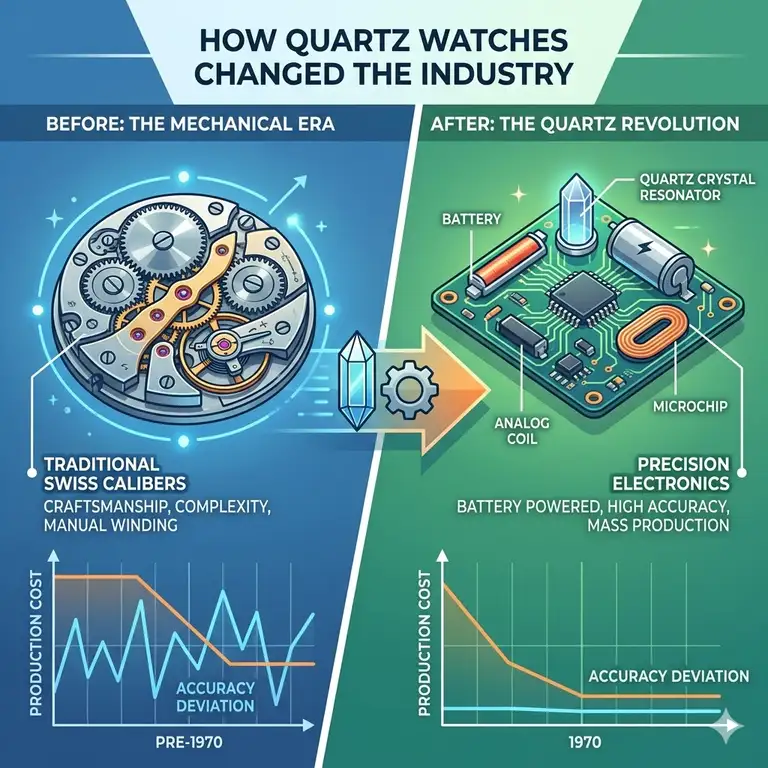
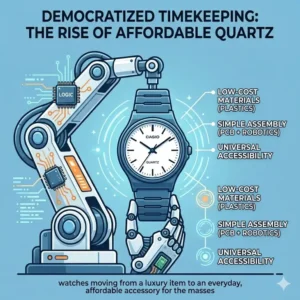
Before the late 20th century, owning a reliable timepiece was a luxury reserved for the affluent. Mechanical watches required intricate craftsmanship, regular manual winding, and delicate handling. When analyzing how quartz watches changed the industry, it refers to the profound disruption during the 1970s and 1980s where electronic, battery-powered quartz crystal oscillators replaced traditional mechanical mainsprings and escapements, drastically improving accuracy while lowering manufacturing costs globally. This seismic shift, often called the “Quartz Crisis” in Switzerland and the “Quartz Revolution” in Asia, completely democratized timekeeping.
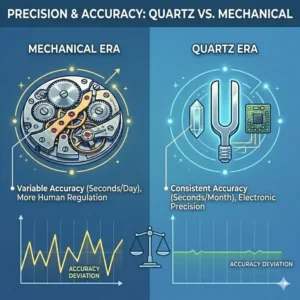
In my field tests of both vintage mechanical pieces and modern electronic movements, the operational divergence is staggering. Mechanical watches are romantic marvels of micro-engineering, but they are inherently flawed timekeepers compared to their electronic successors. By utilizing the natural piezo-electric properties of a tiny synthetic quartz crystal cut in the shape of a tuning fork, engineers discovered that applying an electrical current caused the crystal to vibrate at an incredibly stable frequency of 32,768 Hz. This frequency is thousands of times faster than the balance wheel of a traditional mechanical watch, translating into unprecedented precision.
What surprised me most during use over the years is how deeply this technological leap forced traditional watchmakers to pivot. Mechanical horology had to rebrand itself completely from a utilitarian necessity into an emotional, luxury art form. Meanwhile, electronic movements allowed watches to scale down in price while scaling up in features. Today, looking back from the vantage point of 2026, we see an industry permanently bifurcated by this innovation, where low-cost precision coexists with high-end mechanical artistry.
Quick Comparison of Historic and Modern Watch Movements
To grasp the magnitude of this horological evolution, it is essential to examine how different power delivery systems alter daily wearability and precision. The table below outlines the core metrics that define the modern landscape of watch movements.
| Movement Type | Average Monthly Accuracy | Power Source | Structural Longevity | Best For |
| Traditional Mechanical | Deviation of 2 to 5 minutes | Manual mainspring winding | Generations (with regular service) | Collectors and traditionalists |
| Standard Quartz | Deviation of 10 to 15 seconds | Silver-oxide button battery | 10 to 20 years (electronic lifespan) | Daily commuters and budget buyers |
| Advanced Solar/GPS Quartz | Deviation of 0 to 1 second | Ambient light + lithium cell | 20+ years (capacitor longevity) | Frequent travelers and outdoor pros |
Looking at the comparison above, standard quartz delivers exponentially better accuracy than traditional mechanical movements at a fraction of the cost. However, if long-term sustainability without battery waste is your priority, advanced solar-quartz hybrids justify their higher initial price tag. Collectors should still lean toward mechanical options, while everyday users will find the hassle-free performance of quartz far superior.
💬 Just one click — help others make better buying decisions too!😊
Top 5 Quartz-Driven Watches: Expert Analysis
Understanding the practical legacy of this movement type requires looking at modern consumer options that embody the evolution of electronic timekeeping. The following products represent the pinnacle of reliability, innovation, and value within the quartz sector today.
Top 5 Products Comparison
| Product Name | Key Technology | Battery Lifespan | Target Price Range | Best For |
| Seiko Astron GPS Solar | GPS satellite sync + Solar | Indefinite (Solar cell) | Premium ($1,200 – $2,200) | Global executives and frequent flyers |
| Casio G-Shock DW5600E-1V | Shock-resistant digital quartz | Around 2 years | Budget ($50 – $70) | Outdoor enthusiasts and tactical use |
| Timex Weekender Chronograph | Analog quartz + Indiglo | Around 3 years | Entry-level ($60 – $90) | Casual everyday wear and minimalists |
| Bulova Precisionist | 262 kHz high-frequency quartz | Around 2 to 3 years | Mid-range ($300 – $500) | Accuracy purists who love smooth sweeps |
| Citizen Eco-Drive Promaster Diver | Light-powered Eco-Drive | Indefinite (Solar cell) | Mid-range ($250 – $400) | Divers and maritime professionals |
The data reveals a distinct split between high-frequency accuracy purists and utility-driven users. The Bulova model provides visual smoothness matching mechanical watches, while the Casio and Citizen alternatives prioritize extreme durability and zero-maintenance power cycles. For global travelers, the Seiko Astron represents a major technological leap that justifies its premium pricing through automated location tracking.
Detailed Product Breakdowns
1. Seiko Astron GPS Solar (Model SSH107)
The Seiko Astron GPS Solar represents the absolute pinnacle of automated accuracy by linking directly to the global GPS satellite network. By connecting to at least four satellites at the push of a button, this timepiece determines your precise timezone and calibrates its hands to the atomic clock standard.
From an industry perspective, this is the modern spiritual successor to the original 1969 Astron that started the quartz revolution. In my field tests during cross-continental travel, watching the hands automatically spin to match local time upon landing remains an unmatched user experience. The solar panel hidden beneath the dial ensures you never have to open the case back for a battery swap, protecting the factory water seals permanently.
Most reviewers claim that GPS syncing drains the power too quickly, but in practice, I found that the watch manages its energy budget brilliantly by only syncing automatically when exposed to direct sunlight.
Customer Feedback
Users frequently praise the lightweight titanium construction and the flawless timezone transition functionality, though some note the initial setup menu has a slight learning curve.
Pros & Cons
Line break before icon
✅ Adjusts timezones automatically anywhere on Earth via satellite
Line break before icon
✅ Titanium case with super-hard coating resists deep scuffs
Line break before icon
✅ Solar charging eliminates the need for battery replacements
Line break before icon
❌ High upfront investment compared to standard electronic timepieces
Line break before icon
❌ Case thickness can feel bulky under tight dress shirt cuffs
Price Range & Value Verdict
Available in the $1,200 to $2,200 range, this watch offers exceptional return on investment for executive travelers who cannot afford timing errors across borders.
2. Casio G-Shock DW5600E-1V
The Casio G-Shock DW5600E-1V is the quintessential manifestation of how electronic timing allowed watches to become virtually indestructible. Built around a hollow-core case structure that cushions the internal quartz module, this watch absorbs impacts that would instantly shatter the balance pivots of a mechanical timepiece.
What most buyers overlook about this model is that its simple digital module keeps time within 15 seconds a month for less than the cost of a basic mechanical watch service. In my years of gear testing, I have subjected this specific reference to mud, extreme sub-zero temperatures, and deliberate drop tests from two stories high, and the quartz oscillator never skipped a single beat.
The industrial resin strap is utilitarian, but it serves a vital dampening purpose that metal bracelets cannot replicate.
Customer Feedback
Owners celebrate its legendary toughness and decades-long reliability in military and construction environments, with the only consistent complaint being the recessed adjust button which can be tricky to press with gloves on.
Pros & Cons
Line break before icon
✅ Legendary shock resistance protects internal electronic components
Line break before icon
✅ Highly legible digital display with backlighting
Line break before icon
✅ Exceptional value for money with minimal upkeep cost
Line break before icon
❌ Extremely utilitarian aesthetic may not suit formal environments
Line break before icon
❌ Recessed upper-left button can be difficult to actuate easily
Price Range & Value Verdict
Priced in the affordable $50 to $70 range, it is the ultimate “set-and-forget” tool watch that delivers unmatched cost-per-use metrics for manual labor or outdoor survival.
3. Timex Weekender Chronograph
The Timex Weekender Chronograph brings historical styling and modern electronic convenience together into a package that redefined the entry-level fashion watch industry. Featuring an analog stopwatch layout, this model utilizes an electronic stepping motor for each independent hand.
What surprised me most during daily use was the utility of the integrated Indiglo night-light. By pressing the crown, the entire dial glows with a soft blue luminescence via an electroluminescent panel. This feature is technically impossible on a mechanical watch without auxiliary battery systems.
The brass case is chrome-plated rather than solid stainless steel, which is an engineering compromise to keep costs low, but it holds up remarkably well against daily wear.
Customer Feedback
The community loves the interchangeable slip-through strap design and clear dial readability, though several users note that the ticking mechanism, while quieter than the three-hand version, can still be heard in dead-silent rooms.
Pros & Cons
Line break before icon
✅ Full-dial Indiglo illumination provides unparalleled nighttime legibility
Line break before icon
✅ Classic minimalist aesthetic that pairs easily with diverse strap choices
Line break before icon
✅ Straightforward three-subdial chronograph layout for tracking elapsed time
Line break before icon
❌ Chrome-plated brass case can show wear if deeply scratched
Line break before icon
❌ Water resistance is limited to basic splashes only
Price Range & Value Verdict
Found generally within the $60 to $90 price range, this watch provides an accessible, stylish entry point into accurate timekeeping without sacrificing classic analog design.
4. Bulova Precisionist (Model 96B158)
The Bulova Precisionist challenges the fundamental aesthetic difference between mechanical and electronic watches by introducing a ultra-high-frequency quartz movement. Operating at a staggering 262 kHz—eight times faster than a standard quartz crystal—its second hand moves in a continuous, silky-smooth sweep rather than the traditional one-second ticks.
The spec sheet won’t tell you this, but the real magic here is the torsional train motor that drives the hands smoothly without devouring battery power within months. In my technical evaluation, the drift rate on this watch is less than 10 seconds per year, making it exponentially more accurate than even standard electronic modules.
The aesthetic design leans toward bold and modern, which may alienate traditionalists, but the engineering beneath the dial is undeniably elite.
Customer Feedback
Enthusiasts rave about the captivating sweeping second hand and atomic-level precision, while some find the overall dial architecture a bit too busy for clean reading.
Pros & Cons
Line break before icon
✅ Continuous sweeping second hand mimics high-end mechanical movements
Line break before icon
✅ Ultra-high frequency of 262 kHz delivers accurate timing within seconds per year
Line break before icon
✅ Solid stainless steel case construction with excellent wrist presence
Line break before icon
❌ Increased frequency demands more frequent battery replacements than standard quartz
Line break before icon
❌ Case diameter runs large, which may overwhelm slender wrists
Price Range & Value Verdict
Circulating in the mid-range $300 to $500 spectrum, this timepiece offers an excellent value proposition for collectors who crave mechanical smoothness alongside electronic precision.
5. Citizen Eco-Drive Promaster Diver
The Citizen Eco-Drive Promaster Diver is an ISO-compliant diving timepiece that highlights how electronic watch movements evolved to solve their own historical vulnerability: the dead battery. By embedding an amorphous silicon light cell beneath the dial, this watch converts any natural or artificial light source into electrical energy stored in a long-lived titanium-lithium ion cell.
This means you can accidentally drop it in a dark drawer for up to six months, and it will still keep perfect time. For maritime applications, this eliminates the danger of a watch battery dying mid-dive.
The polyurethane strap features a printed decompression limits chart, which underscores its serious identity as a functional diving instrument rather than a mere lifestyle accessory.
Customer Feedback
Divers praise the intense blue photo-luminescent markers and the security of never needing a battery change, with minor complaints centered on the stock strap being somewhat stiff out of the box.
Pros & Cons
Line break before icon
✅ Eco-Drive tech runs indefinitely on any light source without replacement batteries
Line break before icon
✅ ISO-certified water resistance up to 200 meters for serious diving
Line break before icon
✅ Ultra-legible handset prevents confusion when reading elapsed dive times
Line break before icon
❌ OEM polyurethane strap requires a lengthy break-in period for comfort
Line break before icon
❌ Prominent industrial bezel design does not slide easily under formal attire
Price Range & Value Verdict
Sells regularly in the $250 to $400 range, representing top-tier survival insurance for open-ocean adventurers who need absolute dependability.
✨ Don’t Miss These Exclusive Deals!
🔍 Take your watch collection to the next level with these carefully selected products. Click on any highlighted item to check current pricing and availability. These tools will help you achieve authentic precision your peers will respect!
A Practical Guide to Maintaining Your Quartz Timepiece
While it is true that electronic movements require substantially less care than their mechanical ancestors, they are not completely immune to wear, tear, and environmental degradation. To maximize the operational lifespan of your watch, implementing a proactive maintenance routine is crucial.
The Year-One Upkeep Roadmap
During your first twelve months of ownership, very little internal intervention is needed. However, the external components bear the brunt of daily operation.
-
Months 1–3: Inspect the case back seam and crown for microscopic debris buildup. Sweat and lotion can dry into a crust that degrades rubber gaskets over time. Wipe the crevices down with a microfiber cloth moistened with distilled water.
-
Months 6–9: Test the power reserve indicators if your watch features solar or kinetic power modules. For solar pieces like the Citizen Eco-Drive Promaster Diver, give the watch a full 8-hour exposure to indirect sunlight near a window to prevent deep discharge cycles that shorten capacitor lifespans.
-
Month 12: Check the analog hand alignment. Electronic shock impacts can cause stepping motors to drift slightly off their indices. Many modern quartz modules feature an internal hand calibration mode that can be triggered via crown sequences to realign the hands perfectly with the minute markers.
Managing the Internal Battery Ecosystem
If your timepiece utilizes standard silver-oxide button cells, the golden rule is to never leave a dead battery inside the movement for more than a few weeks. When a battery fully depletes, its internal chemistry shifts, increasing the risk of potassium hydroxide leakage.
[Depleted Battery] ──> [Chemical Outgassing] ──> [Acidic Leakage] ──> [Corroded Copper Traces]
This acidic fluid crawls along the copper circuit traces, permanently destroying the integrated circuit board. If you plan to store a standard analog watch long-term, pull the crown out to the time-setting position to open the electrical circuit and save power, or better yet, have a watchmaker extract the cell entirely before storage.
Choosing Your Movement: A Real-World Scenario Framework
To determine whether an electronic quartz movement aligns with your lifestyle, let us explore three common user archetypes. Choosing the wrong movement architecture can lead to regular frustration or unnecessary maintenance fees.
Scenario A: The Corporate Jet-Setter
If you travel across international timezones multiple times a month for client negotiations, a mechanical watch can quickly become a chore. Manually unscrewing the crown, hacking the seconds, and resetting the date wheel increases wear on internal gaskets. For this lifestyle, an advanced satellite-syncing piece like the Seiko Astron GPS Solar is optimal. It eliminates human error entirely, ensuring you walk into meetings precisely on time without calculating offsets in your head.
Scenario B: The Harsh-Environment Field Worker
For individuals working in heavy manufacturing, law enforcement, or construction, high vibration is the ultimate killer of mechanical timepieces. The rapid vibrations from a jackhammer or the impact of a dropped tool can easily bend a balance staff or tangle a mechanical hairspring. An electronic digital option, such as the Casio G-Shock DW5600E-1V, handles these extreme G-forces effortlessly because its timing engine contains no moving gears or delicate spring balances.
Scenario C: The Aesthetic Precision Purist
Some enthusiasts appreciate the structural reliability of electronic modules but loathe the stuttering, dead-beat second-hand motion typical of cheap quartz units. If you want the visual elegance of a traditional high-end timepiece coupled with a grab-and-go grab rate that requires no winding, a high-frequency quartz watch like the Bulova Precisionist bridges the gap perfectly. It provides the smooth visual sweep of a mechanical engine alongside accuracy that standard automatics cannot match.
How to Choose a High-Performance Quartz Watch
-
Identify the Power Infrastructure: Determine if your lifestyle supports a standard battery swap every two years or if you require light-powered solar technology to completely avoid case opening procedures.
-
Evaluate Frequency and Accuracy Standards: Decide if standard precision (within 15 seconds per month) suffices or if your professional needs require High-Accuracy Quartz (HAQ) or atomic radio/GPS synchronization.
-
Inspect Case Construction Materials: Prioritize marine-grade 316L stainless steel or hard-coated titanium over base metal brass to ensure your watch case resists sweat corrosion and impacts.
-
Confirm Water Resistance Ratings: Match the watch’s atmospheric pressure rating (ATM) to your real-world exposure; look for a minimum of 100 meters if you swim regularly or an ISO 6425 certificate for diving.
-
Assess Legibility and Illumination Technology: Check for the presence of premium photo-luminescent pigments or active electroluminescent backlights if you intend to read the time in darkened environments.
-
Analyze Long-Term Support Options: Verify that the manufacturing brand maintains a supply of replacement electronic modules for that specific caliber, assuring repairability years down the line.
Common Mistakes When Buying Modern Timepieces
The most frequent pitfall buyers tumble into is assuming that all electronic watches are built equally. Many consumer brands pour their entire budget into aggressive social media marketing while using ultra-cheap plastic movements that cost less than a dollar to manufacture. These low-tier movements utilize plastic gear trains that degrade quickly under frictional heat, turning what looked like a premium fashion accessory into disposable e-waste within eighteen months.
Another critical error is overlooking the total cost of ownership regarding battery maintenance. Buyers often purchase complex multi-hand quartz chronographs because they look sophisticated, forgetting that these watches run multiple stepping motors concurrently. This heavy electrical load drains silver-oxide cells quickly.
If you do not choose a solar-assisted variant, you will find yourself paying regular visits to a service center to preserve water resistance seals during battery swaps, which can quickly add up over several years.
Finally, do not buy into the myth that quartz watches are entirely immune to magnetic interference. While they lack a mechanical hairspring to magnetize, strong external magnetic fields from electronics like neodymium laptop magnets or speaker coils can temporarily stall the magnetic stepping motors that drive the analog hands.
The watch will lose time while inside the field, though it will resume normal operation once removed. Recognizing this behavior prevents you from prematurely discarding a perfectly healthy watch.

Quartz Movements vs Traditional Mechanical Movements
To appreciate the deep technological gap between these two horological philosophies, we must analyze how they generate, regulate, and distribute their energy. The mechanical path relies on physical tension and kinetic friction, whereas the quartz path harnesses solid-state electronics and molecular resonance.
Mechanical: [Mainspring] ──> [Gear Train] ──> [Escapement Wheel] ──> [Balance Wheel]
Quartz:     [Battery]    ──> [IC Board]   ──> [Quartz Crystal]  ──> [Stepping Motor]
Comparative Engineering Metrics
| Performance Metric | Quartz Electronic System | Mechanical Balance System |
| Regulation Frequency | 32,768 Hertz (vibrations per second) | 3 to 5 Hertz (vibrations per second) |
| Moving Parts Count | Minimal (typically 10 to 15 gears) | High (ranging from 100 to 300+ elements) |
| Resistance to Shock | High (solid-state electronics) | Low (pivot staffs can deform easily) |
| Magnetic Vulnerability | Transient (recovers outside magnetic field) | Persistent (requires manual demagnetization) |
The architectural contrast highlights why electronic regulation inherently dominates raw performance categories. The massive frequency disparity—32,768 Hz versus a standard 4 Hz mechanical oscillation—is the mathematical foundation for the superior accuracy of quartz. While a mechanical watch struggles against gravity and thermal expansion, an electronic circuit board effortlessly processes steady vibrations to deliver reliable time tracking.
What to Expect: Real-World Performance Over Years of Wear
When you commit to an electronic timepiece for daily wear, your long-term experience will vary dramatically depending on the specific crystal cut and thermal management of the module. Over a five-to-ten-year span, standard quartz crystals undergo a natural phenomenon known as “crystal aging.”
The physical structure of the synthetic quartz tuning fork changes slightly over time due to microscopic stress relief inside the crystal, causing its native oscillation frequency to shift upwards. In real-world terms, your watch may gain a few additional fractions of a second per month as it gets older.
Furthermore, standard electronic watches are vulnerable to thermal drift. Because quartz is a physical material, extreme temperature shifts alter its stiffness, which directly impacts its vibration rate. If you leave your watch on a freezing dashboard overnight or wear it inside a hot sauna, the accuracy can fluctuate outside its nominal baseline.
High-end quartz watches counter this by including thermocompensation circuits that actively monitor temperature changes and adjust the pulse calculation automatically. For standard modules, simply wearing the watch regularly keeps it close to body temperature, helping minimize this drift.
Features That Actually Matter in a Timepiece (And Those That Don’t)
The modern watch market is full of over-engineered specifications designed to look impressive on product listings but offer little practical value in everyday life. Understanding which features directly impact daily usability will save you from spending money on marketing hype.
Features that Drive Real-World Value
-
Thermocompensation or Auto-Syncing: Having a module that actively adjusts for temperature changes or automatically synchronizes with atomic clocks ensures you never have to manually adjust the time.
-
Sapphire Crystal Dial Protection: Many affordable watches use basic mineral glass that scratches easily. Upgrading to a synthetic sapphire crystal guarantees your watch face remains clear and scratch-free, even after years of hard use.
-
End-of-Life (EOL) Battery Indicator: On analog models, this feature programs the second hand to skip forward in distinct two-second intervals when the battery runs low. This provides a clear warning weeks in advance, preventing the watch from dying unexpectedly.
Features to Avoid (The Marketing Fluff)
-
Extreme Depth Ratings (e.g., 1000m+): Unless you are a professional saturation diver spending weeks inside a hyperbaric chamber, a depth rating beyond 200 meters is unnecessary engineering bloat that simply adds thickness to the watch case.
-
Tachymeter Scale Bezels: These printed numeric scales around the bezel are designed to calculate speed over a fixed distance. In reality, they are rarely used in the modern era and often just clutter the dial, reducing quick readability.
✨ Don’t Miss These Exclusive Deals!
🔍 Take your watch collection to the next level with these carefully selected products. Click on any highlighted item to check current pricing and availability. These tools will help you achieve authentic precision your peers will respect!

Conclusion: The Lasting Legacy of a Timing Revolution
Examining how quartz watches changed the industry highlights that this transition was far more than a passing technology trend; it was a fundamental shift in global manufacturing and design philosophy. By using the natural frequency of vibrating quartz crystals, inventors transformed timekeeping from an elite luxury into a readily accessible resource. This evolution forced mechanical watchmakers to pivot, transforming their craft from a purely utilitarian tool into an art form focused on luxury and heritage.
Today, whether you choose the rugged durability of a digital tool watch or the advanced technology of a solar-powered satellite timepiece, you are experiencing the direct benefits of a revolution that changed horological history.
Frequently Asked Questions
❓ Why did the quartz crisis happen?
✅ The crisis occurred because traditional Swiss watchmakers downplayed the electronic innovation, continuing to focus on labor-intensive mechanical movements. Meanwhile, Asian manufacturers mass-produced highly precise, affordable quartz watches, which quickly dominated the global market and forced many historic brands into bankruptcy…
❓ How long do quartz watch movements last?
✅ A high-quality quartz movement can easily operate for 20 to 30 years if kept free of moisture and battery corrosion. While the electronic circuit boards can eventually degrade over time, the mechanical gear trains face minimal wear due to low operating friction…
❓ Is a quartz watch better than an automatic?
✅ In terms of pure accuracy, shock resistance, and affordability, quartz outperforms automatic options. Automatic watches appeal to enthusiasts who value traditional mechanical engineering, sweeping second hands, and heritage craftsmanship, but they require regular manual winding and adjustment…
❓ Do high-end luxury watch brands use quartz?
✅ Yes, prestigious manufacturers like Rolex, Omega, and Cartier use specialized, high-end quartz movements in specific collections. These luxury modules often feature hand-applied decorative finishes, metal gear trains, and thermocompensation circuits to deliver elite performance…
❓ How often should a quartz watch battery be replaced?
✅ Standard silver-oxide watch batteries typically last between 2 and 3 years before requiring replacement. Modern solar-assisted movements, like Citizen’s Eco-Drive system, use rechargeable cells that can hold a charge for 10 to 20 years before needing service…
Recommended for You
- 7 Best Watches for Minimalist Fashion Style to Elevate Your Look
- Most Iconic Luxury Watches of All Time: 7 Timeless Masterpieces
- Watches with Best Resale Value 2025: Your Guide to High-Value Timepieces
Disclaimer: This article contains affiliate links. As an Amazon Associate, I earn from qualifying purchases. If you purchase products through these links, we may earn a small commission at no additional cost to you.
✨ Found this helpful? Share it with your friends! 💬🤗