We have all been there. You are walking through a doorway, your arm swings naturally, and—thwack—your brand-new wearable meets the doorframe. In that split second, time slows down. You look at your wrist, praying to the tech gods that the shimmering display isn’t a spiderweb of cracks. Smartwatch screen protectors worth buying are no longer just “nice-to-have” accessories; they are essential insurance policies for your most intimate piece of hardware.
What are smartwatch screen protectors worth buying? These are specialized transparent layers made of tempered glass, thermoplastic polyurethane (TPU), or hybrid materials designed to absorb impact and resist scratches without compromising touch sensitivity or optical clarity. In 2026, as displays become even more edge-to-edge and sophisticated, the margin for error is slimmer than ever.
While manufacturers like Apple and Samsung claim their sapphire crystal or Ion-X glass is tougher than ever, the reality is that “scratch-resistant” is not “scratch-proof.” Micro-abrasions from sand, keys, or even rough fabric can dull a screen over time. A high-quality protector acts as a sacrificial layer. It is far easier and cheaper to peel off a cracked $15 piece of glass than it is to pay $200+ for a manufacturer screen replacement. This guide dives into the nuances of modern screen protection, ensuring your investment remains as pristine as the day you unboxed it.
Quick Comparison: Top Smartwatch Protectors at a Glance
| Product Model | Primary Material | Best For | Price Range | Durability Rating |
| Spigen Glas.tR EZ Fit | Tempered Glass | Apple Watch Users | Around $15-$20 | 9H Hardness |
| LK TPU Film | Flexible TPU | Curved Displays | Under $15 | Self-Healing |
| ZAGG InvisibleShield | Hybrid Glass | Premium Protection | Around $30-$40 | High Impact |
| Supershieldz Glass | Tempered Glass | Budget Conscious | Under $10 | Scratch Resistant |
| Mous Hybrid Glass | Glass/Plastic Blend | Extreme Athletes | Around $25-$35 | Shatterproof |
Expert Analysis: If you are using a flat-screened watch, the Spigen Glas.tR EZ Fit offers the most seamless installation experience. However, for those with curved glass like the Google Pixel Watch series, the LK TPU Film is superior because glass often struggles to adhere to extreme edges without lifting. The ZAGG remains the choice for those who want a lifetime warranty and are willing to pay the “premium tax” for peace of mind.
💬 Just one click — help others make better buying decisions too!😊
Top 5 Smartwatch Screen Protectors: Expert Analysis for 2026
1. Spigen Glas.tR EZ Fit: The Gold Standard for Precision
The Spigen Glas.tR EZ Fit is widely considered the benchmark for tempered glass protection because of its revolutionary installation tray.
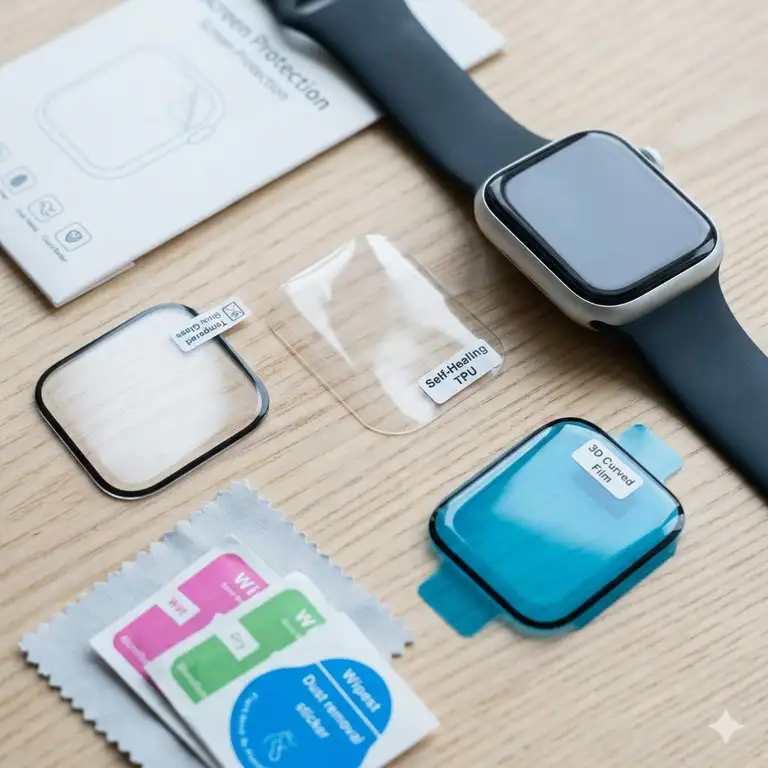
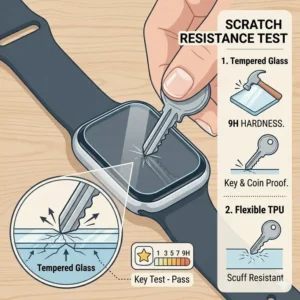
This protector features 9H hardness tempered glass, which essentially means it is as hard as a sapphire—only a diamond could easily scratch it. The kit includes an auto-alignment tray that fits over the watch body, ensuring the glass drops perfectly centered every time. In my experience, the biggest failure point for screen protectors isn’t the material, but the human error during installation. Spigen removes that variable entirely.
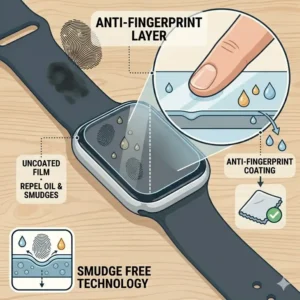
What most buyers overlook is the oleophobic coating. This is a thin layer that repels finger oils. Cheap glass feels “sticky” after a day of use; the Spigen stays slick, mimicking the feel of the original screen. It is best for Apple Watch and Galaxy Watch users who want a “install and forget” solution.
-
Pros:
-
Foolproof installation with the alignment tray
-
Excellent optical clarity (99.9% transparency)
-
Maintains original touch sensitivity
-
-
Cons:
-
Slightly thicker than film protectors
-
Limited to flat or slightly curved models
-
-
Price Range & Verdict: In the $15-$20 range, this is the best overall value for anyone who values their time and sanity during installation.
2. LK Flexible TPU Film: The Curve-Hugging Specialist
The LK Flexible TPU Film is a “wet-install” or high-adhesion film designed specifically for watches with aggressive edge curvatures.
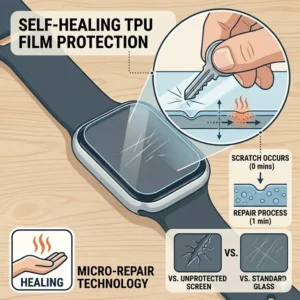
TPU (thermoplastic polyurethane) is a flexible, plastic-like material that has “self-healing” properties. Small scratches from a set of keys will literally disappear over 24-48 hours as the material settles back into place. While it doesn’t offer the same “shatter” protection as glass, it provides much better coverage for watches like the Google Pixel Watch or the older Apple Watch Series.
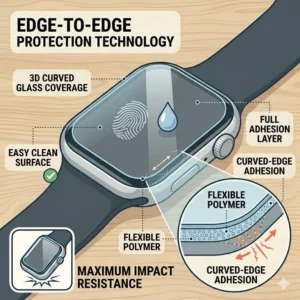
The spec sheet says “99% HD Clear,” and while that is true, film will always have a slightly different texture than glass. It feels a bit softer. However, if you hate the “lip” that glass protectors create on the edge of your watch, this is your only real solution. It stays flush and is virtually invisible once the bubbles settle out.
-
Pros:
-
Edge-to-edge coverage on curved screens
-
Self-healing technology for minor scratches
-
Ultra-thin profile that doesn’t interfere with cases
-
-
Cons:
-
More difficult to install than glass
-
Doesn’t protect against heavy direct impacts
-
-
Price Range & Verdict: Usually under $15 for a multi-pack, this is the top pick for those who prioritize aesthetics and have a curved-screen wearable.
3. ZAGG InvisibleShield Ultra Eco: The Premium Investment
The ZAGG InvisibleShield Ultra Eco represents the high end of the market, focusing on sustainability and extreme impact protection.
ZAGG uses a “hybrid” material that combines the scratch resistance of glass with the impact-absorbing qualities of a polymer. The “Ultra Eco” version is particularly notable in 2026 because it is made from plant-based materials, appealing to the environmentally conscious tech enthusiast.
The standout feature here isn’t just the protection; it’s the warranty. ZAGG has a legendary replacement program. If the protector cracks, they send you a new one for the life of the device (you usually just pay shipping). This justifies the higher price range for people who plan on keeping their watch for 3-4 years. It also features antimicrobial treatment, which, given how much sweat a watch collects, is a feature I wish more brands would adopt.
-
Pros:
-
Hybrid material won’t shatter or chip at the edges
-
Excellent “Lifetime” replacement warranty
-
Made from eco-friendly, sustainable materials
-
-
Cons:
-
Significantly more expensive than competitors
-
Thicker than standard film protectors
-
-
Price Range & Verdict: Around $30-$40, this is for the user who wants a one-time purchase backed by a company that will replace it if anything goes wrong.
4. Supershieldz Tempered Glass: The Budget-Friendly Workhorse
Supershieldz Tempered Glass is the king of the “multi-pack,” offering solid protection at a fraction of the cost of big-name brands.
These are no-frills tempered glass sheets. They offer the same 9H hardness as more expensive brands, but they skip the fancy alignment trays and eco-friendly branding. The spec sheet is basic: anti-scratch, anti-bubble, and high transparency.
In real-world use, these are fantastic for people who work in manual labor or high-impact environments. If you are a construction worker or a rock climber, you will break your screen protector. Using a Supershieldz protector means you can just pop off the broken one and put on a fresh one from your 3-pack without feeling the sting in your wallet. It’s a sacrificial layer in the truest sense.
-
Pros:
-
Extremely affordable (usually comes in 2 or 3 packs)
-
Strong 9H tempered glass protection
-
Very high transparency levels
-
-
Cons:
-
No alignment tray; requires a steady hand
-
Edges can chip more easily than hybrid models
-
-
Price Range & Verdict: Under $10, this is the best choice for those who view screen protectors as consumables that need frequent replacing.
5. Mous Hybrid Glass: The Ultimate Impact Absorber
Mous Hybrid Glass is built for those who treat their smartwatches like rugged action cameras.
Mous became famous for their phone cases, and they have brought that same engineering to their screen protectors. The “Hybrid” refers to a blend of glass and plastic layers. Pure tempered glass is great for scratches but can be brittle. Mous’s blend allows the protector to flex slightly under impact rather than shattering.
If you are an athlete—think mountain biking or CrossFit—the Mous protector is designed for you. It handles direct hits better than almost anything else on the market. The clarity is excellent, though it can be slightly more prone to fingerprints than the Spigen. It bridges the gap between the cheap glass and the ultra-premium ZAGG.
-
Pros:
-
Shatterproof design is safer for high-intensity sports
-
Excellent impact absorption compared to pure glass
-
Very thin while remaining highly durable
-
-
Cons:
-
Attracts fingerprints more than some competitors
-
Price is on the higher side
-
-
Price Range & Verdict: In the $25-$35 range, this is the “middle ground” premium choice for active users who need more than just scratch resistance.
✨ Don’t Miss These Exclusive Deals!
🔍 Take your wearable tech to the next level with these carefully selected products. Click on any highlighted item to check current pricing and availability. These tools will help you create authentic protection your family will love!
Practical Usage Guide: Mastering the Dust-Free Installation
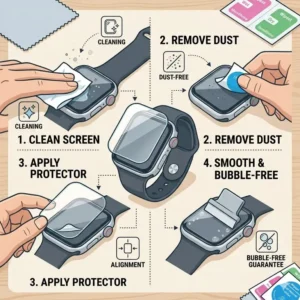
Installing smartwatch screen protectors worth buying is often a stressful experience. The smallest speck of dust can create a permanent bubble that mocks you every time you check the time. Here is the expert-approved method for a perfect, factory-finish install:
-
The “Steam Room” Trick: Go into your bathroom and run a hot shower for 3-5 minutes. The steam will bond to floating dust particles in the air and pull them down to the floor. This creates a near-sterile environment for your installation.
-
Clean Twice, Apply Once: Use the provided alcohol wipe to remove oils. Then, use a microfiber cloth to dry it. Finally, use the “dust absorber” sticker to tap the screen repeatedly. Even if it looks clean, keep tapping. One microscopic flake of skin is all it takes to ruin the job.
-
Check Your Alignment: Before peeling the backing off, do a “dry run.” See exactly how the protector needs to sit. If you are using a Spigen with a tray, this is easy. If not, use two pieces of Scotch tape as “hinges” on one side of the protector to align it before removing the adhesive film.
-
The Center-Press Method: Once you drop the protector, press firmly in the very center. Let the adhesive spread outward naturally. If you press the edges first, you will trap air in the middle.
-
Heat for Edges: If you are using a TPU film (like the LK), use a hair dryer on a low, cool setting for 5 seconds after installation to help the edges “wrap” and bond to the curved glass.
Buyer’s Decision Framework: Which Protector Suits Your Lifestyle?
Choosing between the various smartwatch screen protectors worth buying depends entirely on how you live your life. Use this checklist to self-identify your needs:
-
The Office Professional: If your watch mostly encounters desk edges and occasional bumps in the hallway, go for Tempered Glass. It offers the best clarity and feels just like the original screen.
-
The “Curved Screen” Techie: If you own a Pixel Watch or a curved-edge Galaxy Watch, do not buy glass. It will likely lift or have a “halo” effect at the edges. Stick to TPU Film.
-
The Outdoor Adventurer: If you hike, climb, or work in the trades, you need Hybrid Glass. You want something that won’t shatter into sharp shards if it takes a direct hit from a rock or a tool.
-
The Budget-Minded Minimalist: If you just want basic “scratch insurance” and don’t care about fancy trays or brands, a 3-pack of Budget Glass is the logical choice.
-
The Long-Term Owner: If you plan on keeping your watch for 4+ years, spend the extra money on a Premium Protector with a Lifetime Warranty. It will pay for itself the second time the protector cracks.
How to Choose Smartwatch Screen Protectors Worth Buying
Selecting the right protection requires looking past the marketing jargon. Here is a numbered criteria list to guide your purchase:
-
Material Compatibility: Ensure the material matches your screen type. Sapphire screens (found on “Ultra” or “Pro” watches) are very scratch-resistant but brittle. They benefit most from impact-absorbing hybrid protectors.
-
Hardness Rating: Look for “9H” on the box. This is the industry standard for tempered glass. Anything lower will scratch too easily from common household items.
-
Touch Sensitivity: Some thick, cheap protectors can make the touch screen feel “mushy” or unresponsive. Read reviews specifically mentioning “haptic feedback” and “touch lag.”
-
Case Compatibility: If you use a rugged case (like a Supcase or Spigen Rugged Armor), ensure the screen protector is “case friendly.” Some edge-to-edge protectors will be pushed up by the lips of a protective case.
-
Installation Kit Quality: A protector is only as good as its install. If the kit doesn’t include a microfiber cloth, a dust sticker, and ideally an alignment tool, keep looking.
Common Mistakes When Buying Screen Protectors
In my years of testing tech accessories, I see the same three mistakes over and over. Avoiding these will save you money and frustration.
The first mistake is buying for the wrong model generation. Manufacturers often change the screen curvature by a fraction of a millimeter between years (e.g., Apple Watch Series 10 vs. Series 11). A protector for last year’s model might “fit,” but it won’t adhere properly at the edges, leading to “ghost bubbles” within a week.
The second mistake is overestimating sapphire glass. Many people buy an expensive “Ultra” watch and assume they don’t need a protector because it has a sapphire screen. While sapphire is incredibly hard to scratch, it is actually more prone to shattering than Ion-X or Gorilla Glass because it is more rigid. A screen protector adds a layer of elasticity that can prevent the sapphire from spidering under a sharp impact.
Finally, people often ignore the “Black Border” design. Many modern protectors have a thin black rim to hide the adhesive edge. If this border isn’t perfectly aligned, it can cut off a few pixels of your watch face. If you are a stickler for detail, look for “totally clear” options or brands known for high-precision manufacturing.
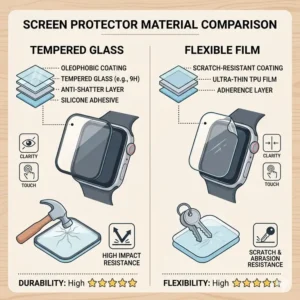
Tempered Glass vs. TPU Film: The Final Showdown
The debate between glass and film is the “Coke vs. Pepsi” of the tech world. But in 2026, the technical differences are more pronounced than ever.
Tempered Glass is superior for impact protection and “hand-feel.” Because it is a rigid sheet, it dissipates energy across its surface when hit. When it fails, it cracks so your watch screen doesn’t. It also stays clearer over time and is much easier to clean. However, its rigidity is its downfall on curved screens, where the edges often fail to bond perfectly.
TPU Film is the king of versatility. It is so thin that you truly cannot tell it is on the watch. It is perfect for curved displays and won’t chip or crack. The downside? It provides almost zero protection against a heavy drop. It is essentially a “skin” for your screen to prevent scratches from sand and keys.
Verdict: If your watch is flat, go Glass. If your watch is curved, go Film. If you are an athlete with a flat watch, go Hybrid.
What to Expect: Real-World Performance Over Time
When you install smartwatch screen protectors worth buying, you shouldn’t expect them to last forever. A good protector has a “service life” of about 6 to 12 months.
Over time, the oleophobic coating will wear off. You will notice that fingerprints become harder to wipe away and the screen feels less “silky.” This is normal. Additionally, tempered glass protectors often develop “micro-chips” along the edges. These aren’t necessarily from a major drop; they can come from your watch rubbing against your sleeve or bumping into a table.
In 2026, modern adhesives have improved significantly. You no longer have to worry about the “yellowing” effect that used to plague cheap plastic protectors. Most high-quality TPU films now contain UV-resistant polymers that stay crystal clear for years. However, if you see the edges starting to lift and collect pocket lint, it’s time to swap it out. A lifting protector is a magnet for the very dust that can scratch your screen.
Features That Actually Matter (And Those That Don’t)
Marketing departments love to invent “features” to justify a higher price tag. Let’s filter the noise.
Matte/Anti-Glare: This actually matters if you spend a lot of time outdoors. A matte protector reduces reflections significantly, making the watch easier to read in direct sunlight. However, it will slightly “blur” the sharpness of the screen.
Privacy Layers: Some protectors claim to hide your screen from people looking at your wrist from an angle. On a phone, this makes sense. On a watch? It’s usually more trouble than it’s worth, as it makes it harder for you to see the screen if your arm isn’t at a perfect 90-degree angle.
Blue Light Filtering: Most modern smartwatches have “Night Shift” or “Blue Light” modes built into the software. A physical blue-light-filtering screen protector is largely redundant and can often give your beautiful OLED screen a weird yellowish tint. Save your money and stick to the clear stuff.
Safety and Durability: Does it Affect Water Resistance?
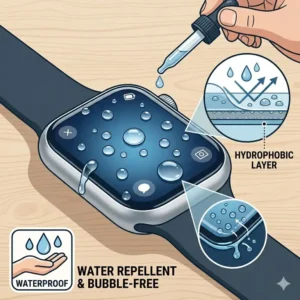
A common concern is whether applying a screen protector will affect the water resistance or the “swim-proof” nature of your watch. The short answer is: No.
The water-resistance of your watch is determined by internal gaskets and seals, not the surface of the glass. However, water can get under the protector. If you are a frequent swimmer, you might find that a “dry-install” tempered glass protector can eventually trap moisture at the edges, leading to a “rainbow effect.”
If you swim daily, a “wet-install” TPU film (like the LK) is often better because the adhesive bond is more uniform across the entire surface, leaving no gaps for water to seep into. For most users, though, a standard tempered glass protector will survive showers and rain without any issues. Just be sure to dry the watch thoroughly after it gets wet to prevent mineral buildup around the edges of the protector.
✨ Don’t Miss These Exclusive Deals!
🔍 Take your smartwatch protection to the next level with these carefully selected products. Click on any highlighted item to check current pricing and availability. These tools will help you keep your tech looking brand new for years to come!
Conclusion: Securing Your Digital Companion
Investing in smartwatch screen protectors worth buying is the smartest move you can make to ensure the longevity of your wearable. Whether you choose the foolproof installation of the Spigen Glas.tR EZ Fit, the curve-hugging reliability of the LK TPU Film, or the premium peace of mind offered by ZAGG, the goal is the same: keeping that beautiful display functional and scratch-free.
In 2026, our watches are more than just timepieces; they are our health monitors, our communication hubs, and our digital wallets. A small investment today prevents a major headache tomorrow. Don’t wait for that first “thwack” against the doorframe—shield up now.
FAQs
❓ Do screen protectors reduce touch sensitivity?
✅ High-quality tempered glass and TPU films have a negligible impact on touch sensitivity. Most modern wearables use capacitive touch technology that works perfectly through layers up to 0.33mm thick. If you experience lag, check if your watch has a “Touch Sensitivity” setting to boost responsiveness…
❓ Can a screen protector hide existing scratches?
✅ Yes, to an extent. The adhesive used in “wet-install” TPU films can fill in very fine micro-abrasions, making them virtually invisible once the film is applied. However, deep gouges that you can feel with a fingernail will still be somewhat visible under the protector…
❓ Is it worth putting a protector on a sapphire screen?
✅ While sapphire is incredibly hard to scratch, it is more brittle than standard glass. A screen protector adds an extra layer of impact absorption that can prevent the sapphire from shattering during a heavy drop. It also protects the anti-reflective coating that manufacturers often apply to the outside of the sapphire…
❓ How do I remove a cracked glass protector safely?
✅ Use a piece of thin plastic (like a guitar pick or a credit card) to gently lift one corner. Slow and steady is the key. Avoid using metal tweezers or knives, as these can scratch the actual watch screen. Once lifted, the protector should peel off in one piece…
❓ How often should I replace my screen protector?
✅ Most users should replace their protector every 6-12 months, or immediately if it cracks. Over time, the protective coatings wear off and the adhesive can weaken, especially if exposed to high heat or frequent salt water…
Recommended for You
- Best Smartwatches for Android Users: 7 Top Picks 2025
- Metal Smartwatch: 7 Best Stainless Steel Picks 2025
- Watches Accessories: 7 Must-Have Items Transform Your Timepiece into a Luxury Statement [2025]
Disclaimer: This article contains affiliate links. As an Amazon Associate, I earn from qualifying purchases. If you purchase products through these links, we may earn a small commission at no additional cost to you.
✨ Found this helpful? Share it with your friends! 💬🤗