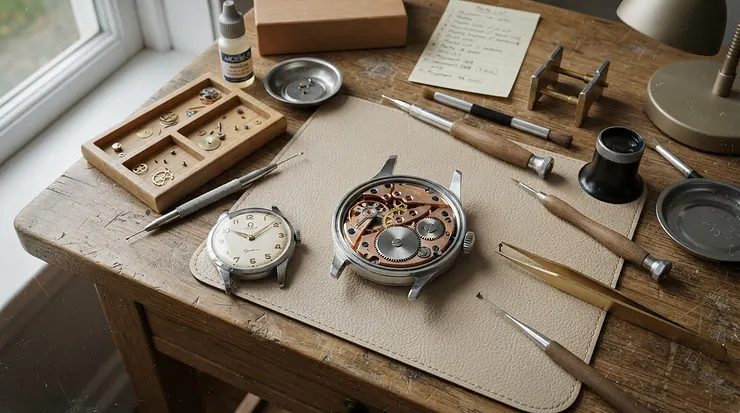
Changing a watch battery looks like a two-minute job. The two minutes are rarely where it goes wrong. Trouble starts earlier, when the case back is misjudged and the wrong cell arrives in the mail, and it shows up later, when the back is pressed shut over a gasket that isn’t sitting flat. Knowing how to change watch batteries at home is mostly a matter of handling those two ends well, with the swap itself in the middle.
We have not opened any of these watches ourselves. What follows rests on Gear Patrol’s how-to, service pages from Casio and TAG Heuer, Consumer Reports, the National Capital Poison Center and retailer listings for the tools, and the text says where the evidence thins out. This 2027 edition covers the method, the usual mistakes and the handful of tools that earn their place.
The short version: identify the back, open it with the tool that matches, swap the cell with plastic tweezers while keeping track of which side faces up, and close the back evenly. A watch that has to stay water resistant is the exception, and it belongs at a service counter.
How to change a watch battery at home, step by step
Eight steps cover how to change a watch battery on any of the three back types. Gear Patrol’s walkthrough supplies the backbone; the extra cautions come from reasoning about what can go wrong at each stage.
Identify the case back.Gear Patrol sorts backs into three kinds: screw-backs, with several notches or a raised edge around the rim; snap-backs, with a small notch or lip; and battery hatches, found on some CWC and MWC watches and certain Timex models. Turn the watch over under a lamp and look before you buy anything. Read any water-resistance marking on the back while you’re there, because it matters again in step 8.
Find the battery code. There are two routes. Gear Patrol suggests checking the watch’s documentation or searching online for the model before ordering. The other route is to open the watch, read the code printed on the old cell and order from that. Either way, match the whole code, letters included. A distributor’s comparison on Utmel lists alkaline LR626 at a nominal 1.5 volts and silver-oxide SR626 at 1.55, both 6.8 by 2.6 mm. Same size, different chemistry, so the code settles which cell goes in.
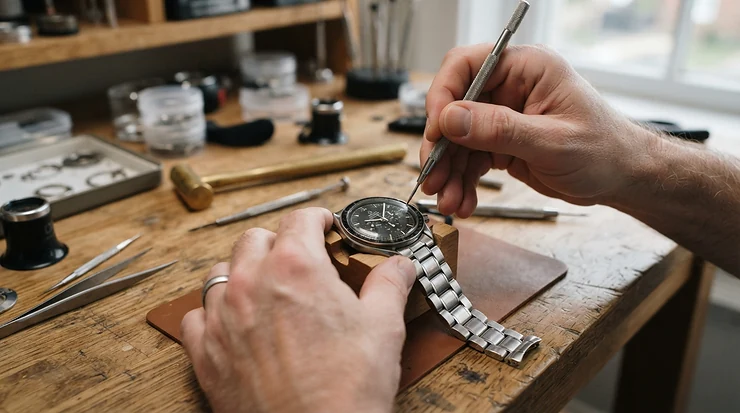
Clear a bench. A flat table, a light-colored cloth that makes a dropped screw or spring bar easy to spot, and a lamp. If you have a case holder, use it. Gear Patrol’s shopping list includes one, plus a vise to steady it. A watch that spins under the opener is how rims get scratched.
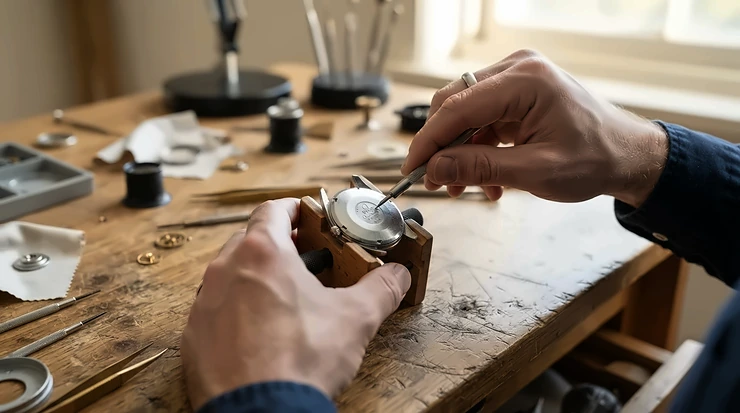
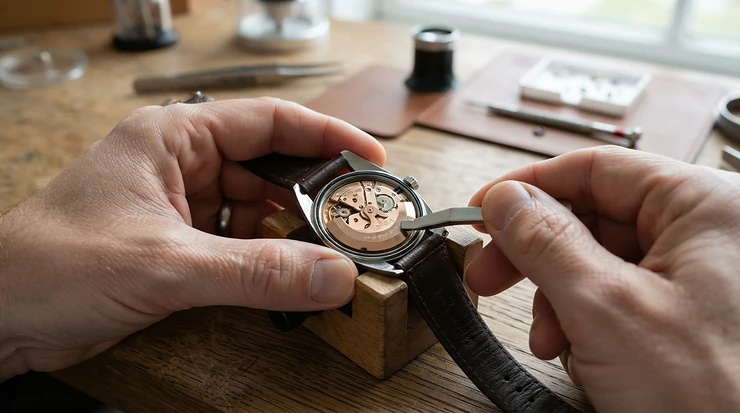
Open the back. Match the tool to the type. For a snap-back, Gear Patrol seats the case in the holder, slides a case knife into the notch and lifts until the back pops. A screw-back takes a wrench or ball opener that grips the rim, turned counterclockwise. A battery hatch needs only a coin. If a tool slips, stop and re-seat it rather than forcing the turn.
Photograph what you see. Before touching the cell, take a phone photo: which side faces up, where any retaining clamp or strap sits, any small parts. Gear Patrol’s short list of mistakes comes down to a wrong-way cell and a wrong cell, and a photo settles the first one.
Lift out the old cell. Use plastic tweezers or a toothpick, which Gear Patrol mentions. Metal tips can touch both the cell and the contact beneath it, so plastic is the safer default. Slide the cell out from under its retainer instead of prying down into the movement.
Seat the new one. Place it the same way up as the old one, nudge it under the clamp with the plastic tool, and put any strap or clamp back where the photo shows. A quartz watch should start moving at once. If it doesn’t tick, Gear Patrol says the cell is probably backward or the wrong type.
Close the back and test. Check that the gasket, the ring in the groove of the case back, is intact and lying flat. Screw-backs go back on with the same opener, snug but not forced, and hatches thread on. Gear Patrol presses snap-backs on by hand, though a press gives even pressure with less guesswork (more on that in the tools below). Then set the time and confirm the hands or display are running.
Where replacing watch batteries at home goes wrong, and the fix for each
Most failures fall into five groups, and each has a cheap remedy.
The opener slips. A prong that skids across a rotating case leaves a bright arc on the back. The holder prevents the rotation, and a strip of masking tape around the rim takes the first scratch instead of the metal.
The watch stays dead. Gear Patrol points to two causes: a cell inserted backward or the wrong type. Reopen the back, compare the orientation with your photo, then compare the letters on the new cell with the code on the old one.
The back won’t close. Thumb pressure on a snap-back can leave it half-seated or pinch the gasket against the rim. Check the ring is in its groove, then use a die that matches the back’s diameter so the force spreads around the edge.
The seal gets assumed. Casio’s service page says its battery replacement fee covers a current consumption test, a water pressure test and a gasket replacement. TAG Heuer says its service replaces the case back gasket so water resistance holds. A home swap does none of that, so the rating printed on the dial is a claim nobody has re-tested. Keep the watch out of pools and showers.
The old cell wanders. It ends up on the desk, in a pocket or on the floor. The next section deals with why that matters.
Three kinds of watch to leave for a service counter
Knowing how to replace a watch battery at home also means knowing when not to. Casio’s page recommends its service centers or authorized partners for the job, and its European FAQ adds that the replacement should be the type named in the user’s guide.
A watch that goes in water. Dive, swim and rugged sport models depend on the seal that a pressure test checks, and TAG Heuer notes that its partial maintenance service, which renews water resistance, is recommended every two to three years.
A watch you would hate to damage. Gear Patrol points out that a watchmaker may be able to fit a new movement after a mishap, but buying a new watch may cost less. On a cheap quartz piece that’s a small risk. On a keepsake it isn’t.
A watch whose back or battery you can’t identify. If the documentation doesn’t name the cell and the old one is unreadable, guessing is how the wrong cell gets in.
Keep the old cell off the table
A loose button cell is a hazard the moment the back comes off. Consumer Reports, citing Consumer Product Safety Commission figures, counts an estimated 54,300 emergency room visits and at least 25 deaths from 2011 to 2021, with about 78% of incidents involving children aged six or younger. Its advice is to store unused batteries where kids can’t reach them. Treat the cell you just removed the same way until it’s disposed of; that page offers no disposal guidance, so check your local battery-recycling rules.
If a battery may have been swallowed, or put in a nose or ear, the National Capital Poison Center says to call the 24-hour Battery Ingestion Hotline at 1-800-498-8666 right away, or a poison center at 1-800-222-1222. It also says not to induce vomiting, and that severe damage can occur within about two hours, so the call shouldn’t wait for symptoms.
How to replace watch battery cells with the right tool at each step
The essentials are fewer than the 150-piece boxes suggest. Esslinger, a specialist watch-tool retailer, sells a set for around $20 to $25 that holds a screw-back opener, a pry knife, Phillips and flat-head screwdrivers, a spring bar tool, two brushes, plastic tweezers and a cloth. Everything beyond that is convenience or bracelet work. The tool listings below were read through retailer pages instead of Amazon itself, so the specs are the sellers’ claims. Prices are left out on purpose; check the current price on Amazon.com.
Step 4 carries most of the risk, and this kit puts a holder beside the opener. The listings describe an adjustable opener for notched backs, a five-in-one screwdriver with five bits, a case holder, spring bars, tweezers and a picture manual, at a listed weight of 6.7 ounces.
The holder does more of the protecting than the opener does. Clamping the case stops it rotating while the prongs grip the notches. Listings give the opener’s range as 15 to 55 mm in some places and 15 to 60 mm in others, so read the version you’re buying against the diameter of your own back. One buyer review on a retailer listing says the booklet never explains closing the back after the swap, so lean on step 8 above for that part. The holder is listed for cases up to 50 mm, which leaves a larger watch outside it.
JOREST Watch Battery Replacement KitSee current price, sizes and reviews on Amazon.
Quartz watches tend to close in one of two ways, tiny screws or a lip that pries off, and this 12-piece kit carries tools for both. The listing names five precision screwdriver bits, an adjustable opener rated 15 to 57 mm, two pry knives, tweezers, a holder and a cleaning cloth.
Two pry knives mean a spare blade to try before reaching for a screwdriver tip, which is how smooth backs get gouged. The seller names Casio and Citizen among supported brands. Treat that as a seller claim, since Casio’s own page sends battery work to its service centers. EasyTime sells several kits with similar names, including a 14-piece set, an eight-in-one opener set and a 149-piece box, so confirm the piece count on the listing you open. The 149-piece set is mostly bracelet tools, with 108 spring bars and pin pushers that a battery swap never touches.
EasyTime Watch Repair Tool KitSee current price, sizes and reviews on Amazon.
Opening a snap-back takes a knife and some patience. Closing one takes even pressure, and that is this press’s whole job. Twelve dies cover 18 to 50 mm, and the set adds a spring bar tool, a pry opener and a cleaning cloth. The listing describes an aluminum non-slip handle and a base with four threaded holes, and the maker says the nylon dies were tested for more than 10,000 press cycles. That figure is the manufacturer’s; I haven’t seen independent testing.
Thumb pressure can leave a back half-seated or pinch the gasket. A die matched to the back’s diameter spreads the force around the rim, and the nylon is there to protect the finish. One buyer review on a retailer listing describes replacing a battery, failing to refit the back by hand, and solving it with the press in about a minute. The press has no role on screw-backs. It seats a back; it cannot test the seal.
Eventronic 16PCS Watch Press ToolSee current price, sizes and reviews on Amazon.
No single battery suits every watch, so treat this entry as an illustration of what a correct match looks like. The 377, also labeled SR626SW or SR66, is a 1.55-volt silver oxide cell about 6.8 mm across and 2.6 mm tall, according to retailer listings, and Renata’s own data sheet lists the 377 as Swiss made. Listings name Casio, Seiko, Timex and Citizen among the watches that take it, which is a seller claim and not a guarantee for any particular model.
Packs come in twos and in tens, and a ten-pack only makes sense if you own several watches that share this code. Energizer sells the same size as the 377/376, and a distributor listing for it names SR626SW among its equivalents.
Spotted a tool that fits your case back? Take a closer look on Amazon.com before the cell dies for good.
Renata 377 SR626SW BatteriesSee current price, sizes and reviews on Amazon.
Can I replace a watch battery at home and keep it water resistant?
You can't confirm it at home. Opening the case disturbs the gasket, and none of the tools above tests a seal. Casio's battery service includes a water pressure test and gasket replacement, and TAG Heuer's replaces the case back gasket. For a watch that goes in water, the service route is the safer one.
How do I know which battery my watch takes?
Read the code printed on the old cell once the back is open, letters included, or search the model number engraved on the case back, as Gear Patrol suggests with documentation. Retailers list codes such as 377 and SR626SW together for the same size of cell, so either label works when you shop.
How long should a new watch battery last?
TAG Heuer's service page puts a new battery at two to three years on average, depending on the watch type, and the jeweler Mappin & Webb advises replacing within 24 months. Both are service-side estimates. A cell that dies much sooner is worth showing to a watchmaker.
What should I do if my watch does not tick after a battery change?
Gear Patrol says a quartz watch should start moving at once; if it doesn't tick, the cell is probably backward or the wrong type. Reopen the back, compare the orientation with your photo, then compare the letters on the new cell with the code on the old one.
What should I do if someone swallows a watch battery?
The National Capital Poison Center says to call the 24-hour Battery Ingestion Hotline at 1-800-498-8666 right away, or a poison center at 1-800-222-1222, if a battery may have been swallowed. It says not to induce vomiting, and severe damage can occur within about two hours, so the call shouldn't wait.
Start with the back, finish with the gasket
The swap is the easy third of the job. Look at the back first, find the full cell code second, and close the case evenly at the end. That sequence is how to change watch batteries at home without a scratched rim or a dead watch. For a notched screw-back and a first attempt, the JOREST kit gives you an opener and a holder together. For tiny screws or a pry-off back, the EasyTime kit carries both kinds of tool. A snap-back that refuses to close is the Eventronic press’s job, and the Renata cell shows what a matched code looks like. Anything that must stay water resistant, or that you would hate to damage, belongs with the brand’s service center. Which of the four tools matches your watch? Open the listing and compare its size range with your case back.
WatchWiseHub is an independent buying-guide site for watches, smartwatches, straps and accessories. Our editorial team compares gear using manufacturer specifications, independent tests from specialist watch media, owner reports and retailer listings. We do not claim to have tested the watches ourselves; see How We Choose Gear for our method.