Consider a hypothetical shopper: an adult daughter whose mother quit wearing her old watch because the hands blur at arm’s length and the clasp pinches. That one situation covers most of what goes wrong when people buy watches for seniors in 2027, because the right watch depends on what the wearer can no longer do easily. A large-numeral analog suits someone who only wants the time. A talking watch suits someone who can no longer read the dial. A smartwatch that alerts family after a hard fall suits a third household, provided somebody keeps it charged.
None of these watches was worn for this guide, so every opinion about feel or comfort belongs to a named reviewer, and the findings rest on maker pages, Apple and Samsung support documents, a caregiver-run fall-detection test and buyer reviews on retailer listings. The stakes are real: the CDC reports that more than one in four older adults falls each year, and fewer than half tell a doctor. No watch below replaces supervision or medical care. Price ranges come from the pages opened, and the current price on Amazon.com may differ.
What separates watches made for seniors from ordinary ones
Searching for the best watches for seniors returns analog classics, talking watches, medical alert bracelets and full smartwatches in one list, and those products don’t compete with each other. Four things sort them.
Legibility: numerals, contrast and a light
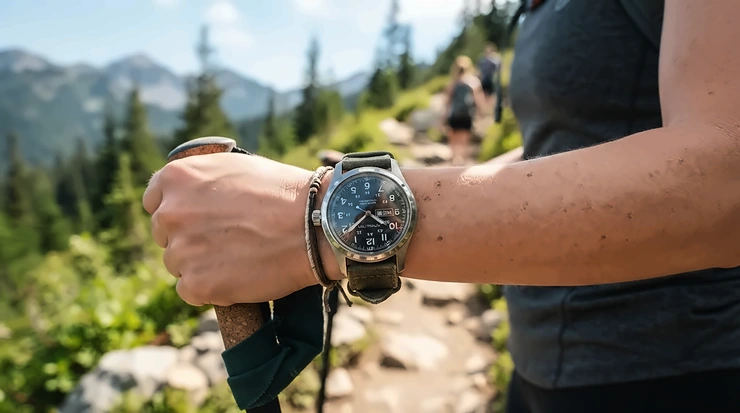
Timex says its Easy Reader, on sale since 1977, pairs large Arabic numerals and bold hands with a dial colored for high contrast, so the time can be read from across a room. That is the maker’s claim, but it describes the design logic of the whole category. Digital faces follow a different logic. Cleveland Heart’s roundup of talking watches notes that a positive LCD, with dark digits on a light background, gives better contrast than a negative one, and that a digital readout removes the need to interpret hands. For wearers who cannot see the display at all, the same roundup says voice quality, button feel and band comfort matter more than the screen type.
Charging habits decide whether it stays on the wrist
A coin-cell watch asks for nothing for months. One reviewer reports more than a year from a single CR2032 in a Hearkent LCD model, and a retailer buyer says each of their Timex Easy Readers lasted about three to four years. Smartwatches run the other way: The Senior List measured 18 hours for the Apple Watch SE 3, and a Tech-Enhanced Life reviewer saw about 20 hours from a dementia-oriented smartwatch. A watch parked on its charger cannot detect anything.
Phone dependence and monthly fees
Apple’s support page says fall detection needs a satellite, cellular or Wi-Fi Calling connection from the watch or a nearby iPhone. Samsung says SOS calls and messages need a network connection and a paired smartphone. Analog and talking watches have no such dependence and no subscription.
Band and clasp
Expansion bands slide on with no clasp. Buckles need fine finger control; one reviewer of a leather-band talking watch flags that people with arthritis may need help. Band length is also where several buyers report trouble, covered below.
How the five line up
Model
How you read the time
Phone needed
Fall alert
Power
Price tier
Timex Women’s Easy Reader 30mm Watch
Analog, large numerals
No
No
Replaceable battery
Roughly $75 to $90 on Timex’s site
Timex Easy Reader Day Date 35mm Watch
Analog plus day and date window
No
No
Replaceable battery
Roughly $80 to $90 on Timex’s site
Hearkent Atomic Talking Watch
LCD digits plus spoken time
No
No
CR2032 coin cell
Check the current price on Amazon.com
Apple Watch SE 3
Color touchscreen
iPhone, or a cellular plan, for alerts to reach anyone
Yes, built in
About 18 hours (The Senior List)
Around $250 to start (The Senior List)
Samsung Galaxy Watch8
Touchscreen
Paired smartphone for SOS
Yes, switched on by hand
Not verified
Check the current price on Amazon.com
Two of the five cost under $100 and never need a charger, while the two smartwatches carry the fall alerts and the charging chore together. That trade-off is the main fork in the road, and everything else in this guide follows from it.
Which watch for which wrist, eye and household
Each pick starts from a situation and works back to the watch.
Timex builds its women’s Easy Reader in cases from 25mm to 30mm, and the 30mm version gives senior ladies watches the largest dial in the range short of the 32mm Modern Easy Reader. Timex’s own site lists four 30mm versions (TW2P68700, TW2R62800, TW2R62900 and TW2P78700), mostly on leather straps, between roughly $75 and $90. A retailer listing carries a black-leather 30mm in a brass case with a 14mm band under TW2R63300. These are different versions, so a review of one does not transfer to another.
Buyer reviews on retailer listings split between praise for the dial and complaints about the band. One reviewer of the women’s watch says the numerals are big enough to read without glasses, and several mention the INDIGLO light that shows the dial in the dark. On the other side, one buyer returned the watch because the band was too small for an average wrist, and another says the band needed a jeweler to adjust. Two reports are not a consensus, yet they match the sizing note on the 25mm expansion-band listing, which states a fit for wrists up to 7.5 inches.
Timex Women’s Easy Reader 30mm WatchSee current price, sizes and reviews on Amazon.
This watch tracks nothing, locates no one and calls nobody. What it adds to the Easy Reader dial is a window showing the day of the week beside the date, and Timex lists the expansion-band version (T20031) at around $80 to $90. A Tech-Enhanced Life reviewer, writing about a different, dementia-oriented watch, observed that a large face showing day, date and time may help a person who forgets which day it is. Treat that as one reviewer’s reasoning rather than a tested outcome.
Setting it is the sticking point. A Two Broke Watch Snobs review says the date can be set in either direction but the day has no quick-set, a retailer buyer says the box held no directions for the day and date so he had to go online, and a commenter who inherited a father’s Easy Reader describes hunting for a manual for the same reason. Three separate accounts agree the day wheel is the fiddly part, so whoever buys it should plan on doing the setup. Timex also sells extra-long expansion versions (T2N091 and T2N092) for larger wrists.
Spotted a size that suits the wrist? Take a closer look at the listing.
Timex Easy Reader Day Date 35mm WatchSee current price, sizes and reviews on Amazon.
Reading is the single job this watch hands to a speaker. Cleveland Heart’s roundup says the Hearkent models set themselves from the U.S. atomic time signal broadcast from Colorado, adjust for daylight saving, and announce the time, date and alarm in an American English male voice. The four buttons sit at the 2, 4, 8 and 10 o’clock positions and can be told apart by touch.
Scott Grant, a Certified Senior Advisor writing for Graying With Grace, found the voice natural and not robotic, and describes setup as a short, one-time job where a caregiver can handle the time zone. He also lists limits: the atomic signal covers only the four continental U.S. time zones, the model he reviewed is not water resistant, and the watch has no health tracking. The complaints elsewhere are about sound and paperwork. Cleveland Heart reports a voice that can turn crackly or tinny in noise, poorly written directions and an hourly chime that is hard to disable. One owner on a retailer listing wished the volume could be raised, and another says a relative switched off the automatic voice because it spoke at 3 a.m. A Walmart page for one variant shows 4.3 stars across 28 ratings.
Hearkent sells several variants. Cleveland Heart says the Large Digital version has no backlight and is not waterproof, while the LCD version is waterproof and ran over a year on a CR2032 for one reviewer, so compare the exact model number before ordering. Check the current price on Amazon.com.
Hearkent Atomic Talking WatchSee current price, sizes and reviews on Amazon.
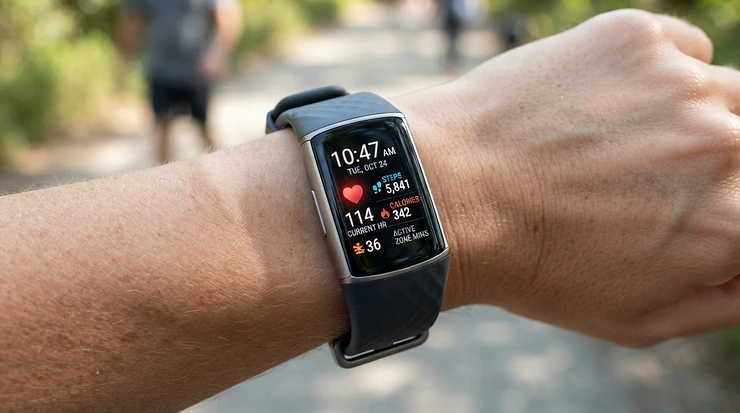
Around $250 is the starting figure The Senior List gives for the Apple Watch SE 3, before any cellular plan for a wearer who leaves the phone at home. Apple’s support page says fall detection switches on automatically for a wearer whose entered age is 55 or older. After a hard fall the watch taps the wrist and sounds an alarm; if it senses no movement for about a minute it starts a 30-second countdown, then calls emergency services and sends the emergency contacts a message with the location.
That chain works only when the watch is on the wrist and charged. The Senior List puts battery life at 18 hours, notes that the roughly 1.5-inch screen and interface may be hard for older adults with vision loss, and points out that the watch calls 911 rather than a monitoring center. Caregivers get location sharing and automatic alerts after fast falls, and it is the only device in that test that places calls and sends texts from the wrist. Apple adds that the watch cannot detect all falls and that high-impact activity can be mistaken for one.
Apple Watch SE 3See current price, sizes and reviews on Amazon.
An Android phone in the household is the deciding fact here. Samsung’s support page says the watch uses an enhanced accelerometer to detect hard falls, and the Hard Fall detection setting sits under Safety and emergency in the Wearable app. Carrier help pages from Vodafone and O2 walk through the same setting on the Watch8. If the wearer does not respond within 60 seconds, an SOS message with the location goes to the emergency contacts.
Someone has to turn it on and enter at least one emergency contact first, which is a real difference from Apple’s age-based default, and sending SOS calls or messages needs a network connection and a paired smartphone. No independent fall test of the Watch8 turned up among the pages opened, so The Senior List’s result for Apple’s watch has no equivalent here. Samsung’s own page says the watch cannot detect all falls, that intense activity can trigger the feature, and that it is not a medical or therapeutic device.
Samsung Galaxy Watch8See current price, sizes and reviews on Amazon.
Watches for seniors with fall detection: what the tests show
The Senior List’s fall-detection test covered 12 devices from 10 companies. Each got 10 simulated falls, five fast and five slow, and testers wore each device for a week to count false alarms. The Apple Watch SE 3 caught four fast falls and no slow ones, with no false alarms. A bracelet-style device from Medical Guardian caught 8 of 10 (all five fast, three slow), also with no false alarms, at around $150 for the device and roughly $55 to $60 a month, with a 36-hour battery.
Ten falls per device is a small sample from one tester, so it is one data point, not a verdict. Still, the pattern fits how the watches work: a smartwatch costs less per month and does more besides, while a dedicated alert device trades looks and versatility for slow-fall detection and a response center. A household that already wears a smartwatch every day may prefer the notifications to family. Someone who lives alone and may slide down rather than drop might lean the other way.
Watches for seniors with dementia: what a watch can and cannot do
No watch above can keep a person with dementia from leaving home. The Alzheimer’s Association says six in 10 people living with dementia will wander at least once, that its suggested steps cannot guarantee a person won’t wander, and that caregivers can consider enrolling the person in a wandering response service. Its page mentions GPS only for people who can still drive safely, so a watch’s location feature is a supplement to supervision and door alerts, not a replacement.
What the ordinary picks offer is modest. The Timex Easy Reader Day Date 35mm Watch gives a date cue, the Apple Watch SE 3 and Samsung Galaxy Watch8 share location and send fall alerts but depend on nightly charging and menus a person with memory loss may find confusing, and Graying With Grace advises that a caregiver handle any settings changes on the talking watch for someone with moderate to advanced dementia.
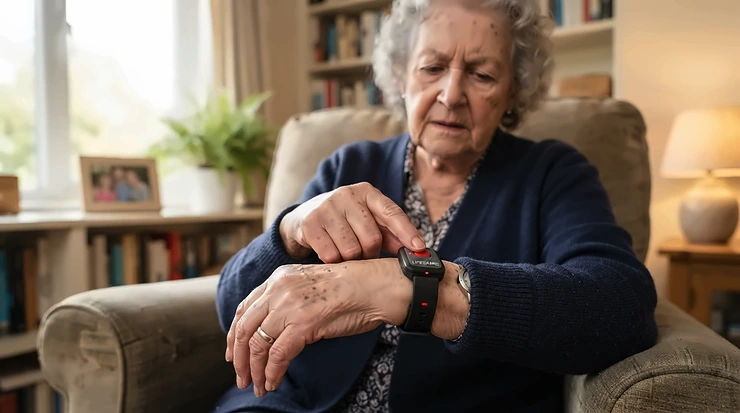
Products built for this job work differently. Tech-Enhanced Life reviewed the Theora Connect, a 4G watch that shows a caregiver the wearer’s GPS location and can alert on geofence exits. It has an optional locking clasp that needs a tool to open, a password-protected settings menu and a large digital face with day, date and time. In about 10 tests the reviewer usually found the wearer, though the pin was sometimes off by a few houses. Fall detection and the emergency button message the caregiver, who then decides whether to call 911, and battery life averaged about 20 hours. The review dates from December 2023, priced the watch at around $250 up front plus around $30 a month, and does not confirm current availability, so confirm that with the vendor. A locking clasp and location sharing also raise questions of consent and dignity, which belong in the conversation with the person and their care team.
What owners report in watches for seniors reviews
Four complaints recur in the pages opened for this guide.
Band fit comes first. Two Timex buyers describe a band too small or in need of a jeweler, and Cleveland Heart says one Hearkent model’s stainless stretch band may pull wrist hair. Setup instructions come second: Cleveland Heart and retailer reviewers call the Hearkent directions poor, and Timex buyers report no day-and-date instructions in the box.
Charging is third. The Tech-Enhanced Life reviewer judged a roughly 20-hour battery suitable for daytime wear with nightly charging and unsuitable for around-the-clock wear. A watch that spends nights on a dock misses overnight events, which for fall alerts is a real gap.
Unwanted alerts are fourth. Apple’s page says that after an accidental emergency call the wearer should stay on the line and tell the responder no help is needed, and hanging up is the wrong move. Anyone setting up a fall alert for a parent should rehearse that once.
Fall alerts, dementia and ladies’ sizes: short answers
Can a fall detection watch work without a phone nearby?
Only with a cellular model or a nearby phone. Apple says fall detection needs a satellite, cellular or Wi-Fi Calling connection from the watch or a nearby iPhone, and Samsung says SOS calls and messages need a network connection plus a paired smartphone.
What is the easiest watch for someone with poor eyesight?
A large-numeral analog with a light-up dial suits someone who can still read a dial; a talking watch suits someone who cannot. Cleveland Heart's roundup adds that for completely blind users, voice quality, button feel and band comfort matter more than the display.
Can a watch stop a person with dementia from wandering?
No. The Alzheimer's Association says its suggested steps cannot guarantee that a person won't wander, and it recommends considering a wandering response service. A GPS watch can help caregivers find someone, but it works as one layer alongside door alerts, supervision and a recent photo.
What case size suits a smaller wrist?
Timex's women's Easy Reader range runs from 25mm to 30mm cases, with a 32mm Modern Easy Reader above them. One retailer listing says the 25mm expansion band fits wrists up to 7.5 inches, so measure the wrist before ordering.
Do these watches have monthly fees?
Analog and talking watches carry none. Cellular smartwatches need a carrier plan, and dedicated alert devices bill for monitoring: The Senior List's test lists a bracelet-style alert device at around $150 up front plus roughly $55 to $60 a month. Compare running costs before comparing watches.
Start with the daily obstacle, then pick
Start with the thing the wearer finds hardest each day. Trouble reading the dial points to the Timex Women’s Easy Reader 30mm Watch or, for a day-and-date window, the Timex Easy Reader Day Date 35mm Watch; not being able to read it at all points to the Hearkent Atomic Talking Watch. A household that wants a hard-fall alert to reach family should choose the Apple Watch SE 3 with an iPhone or the Samsung Galaxy Watch8 with an Android phone, and accept the nightly charging that comes with it. Among watches for seniors, none of these locates or protects someone living with dementia on its own; for that need, a tracker built for caregivers and a conversation with the person’s care team come first. Whichever you choose, put it on the wrist, set it up together once, and check that the time, the day and any emergency contacts are right before it goes into daily use.
Spotted one you like? Take a closer look at its listing on Amazon.com.
WatchWiseHub is an independent buying-guide site for watches, smartwatches, straps and accessories. Our editorial team compares gear using manufacturer specifications, independent tests from specialist watch media, owner reports and retailer listings. We do not claim to have tested the watches ourselves; see How We Choose Gear for our method.