Pick quick release watch bands by the connector on your watch, not by the number printed on the box. A 20mm strap can mean a spring-bar lever on a Garmin Forerunner 165, a sliding latch on a QuickFit Garmin, or Apple’s slide-in slot, and none of the three seats in another’s mount. This 2027 guide sorts five bands by situation: a Garmin owner who wants the factory match, a small wrist on a budget, a classic 20mm lug, and two Apple Watch bands, one for everyday wear and one dressier. No strap was worn for this article; the findings rest on Apple’s support pages, Garmin-focused reviews and buying guides, Barton’s own design notes and owner reports from forums and retailer listings, each credited where it appears.
The short version: Garmin’s own 20mm band for a Forerunner 165, a nylon loop for a narrow Garmin wrist, Barton for a traditional 20mm lug, and Apple’s own loops for an Apple Watch. The reasoning starts with why “quick release” names three different mechanisms.
Spring bar, QuickFit latch or Apple slot: three systems behind one label
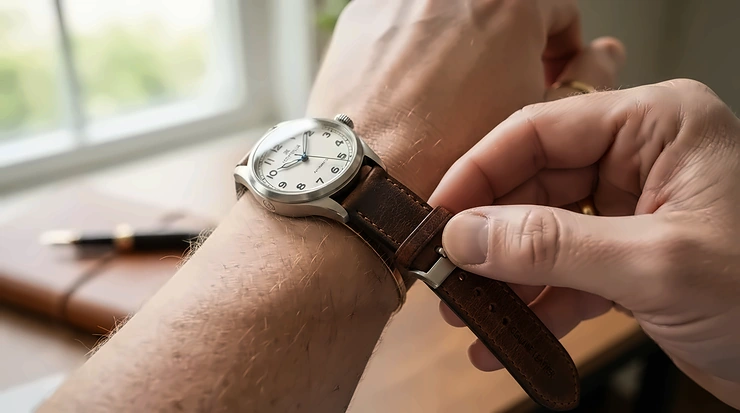
Standard quick release is the familiar one. The strap ends in a thin spring bar with a small lever on the underside, and sliding the lever with a fingernail frees the strap from the lugs, as StrapsCo’s Garmin guide describes it. Barton builds the same bars into its straps and states that the lug width must equal the band width exactly, or the bars will not seat.
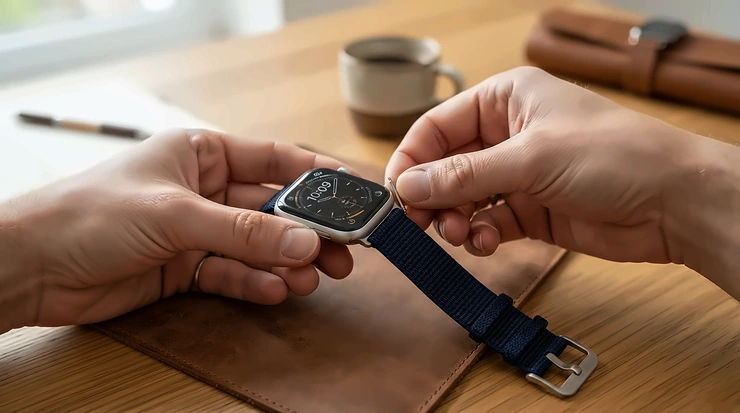
Garmin QuickFit works differently. A latch built into the band connector closes over a pin on the watch, and the strap lifts off while the pin stays put, according to Bandletic’s connector guide. QuickFit comes in 20mm, 22mm and 26mm, so a QuickFit 20 and a 20mm quick release strap share a number and nothing else. Apple’s system is a third design again: hold the band release button on the underside of the case, slide the band across, and slide the new one in until it clicks, per Apple Support.
The width printed on a strap therefore says less than the mount behind it. The Garmin Forerunner 165 and vivoactive 5 take 20mm spring-bar quick release, according to Android Central and StrapsCo. The Fenix 8 in its 43mm size takes QuickFit 20, according to guides from StrapsCo and watchband.direct. Two Garmins, the same 20mm, no cross-fit. Sources even disagree about the Forerunner 965: watchband.direct says it ships with a 22mm quick release band but also accepts QuickFit 22, while StrapsCo lists it among the QuickFit models, which is one more reason to read the label on your own strap.
One reassurance comes from StrapsCo, itself a third-party seller: nothing in a Garmin checks which strap is attached, so a third-party band does not affect the sensors or battery.
Lug width, connector and wrist range: the filters that decide the order
Connector comes first. Turn the watch over and look where the strap meets the case. A lever on a bar means standard quick release, a latch in the connector means QuickFit, and a slot with a release button means Apple. Confirm against the manual for your exact model and case size, because families split: Bandletic lists the Forerunner 570 at 20mm in its 42mm case and 22mm in its 47mm case.
Width comes second, and for spring-bar straps it has no tolerance. Garmin examples from StrapsCo and Bandletic include the Forerunner 165 and vivoactive 6 at 20mm, the Forerunner 265 at 22mm and the 265S at 18mm. A buyer on a retailer listing for Barton straps reports a 20mm strap running about 1mm too wide for their watch, and the fix was reusing the watch’s original pins.
Wrist range comes third, and listings disagree. One European retailer gives Garmin’s silicone band a 125 to 218 mm range, while a two-size kit listing gives 107 to 177 mm for small/medium and 127 to 204 mm for large. Those are different products on different pages, so read the range on the exact band you are ordering.
Band
Attaches to
Width
Closure
Fits best
Garmin Quick Release Band 20mm Silicone
Spring-bar quick release
20mm
Adjustable silicone
Forerunner 165-type Garmins
ANNEFIT Nylon Sport Loop Quick Release Bands
Spring-bar quick release
20mm (other widths listed)
Hook-and-loop nylon
Small Garmin wrists, budget swaps
Barton Elite Silicone Quick Release Watch Band
Integrated quick release bars
18mm to 24mm
Buckle with locking keeper
Standard-lug watches, not Garmin
Apple Sport Loop
Apple band slot
Set by case size
Hook-and-eye
Everyday Apple Watch wear
Apple Milanese Loop
Apple band slot
Set by case size
Magnetic wrap
Dressier looks, narrow wrists
Only two of these five share a mount, and that is the point: the best quick release watch bands for one watch are wrong for another. The table reads left to right, so settle the second column before you look at the last. Check current availability on Amazon.com.
A Forerunner 165 owner who wants no compatibility homework can stop here. Android Central’s review of the watch says Garmin uses 20mm Quick Release bands on it, “easily swapped out by pulling a tab,” and sells replacements in silicone, nylon and leather. When that review ran in April 2024, silicone sat around $40 and nylon and leather around $70, all bought from Garmin directly; the current price on Amazon.com may differ.
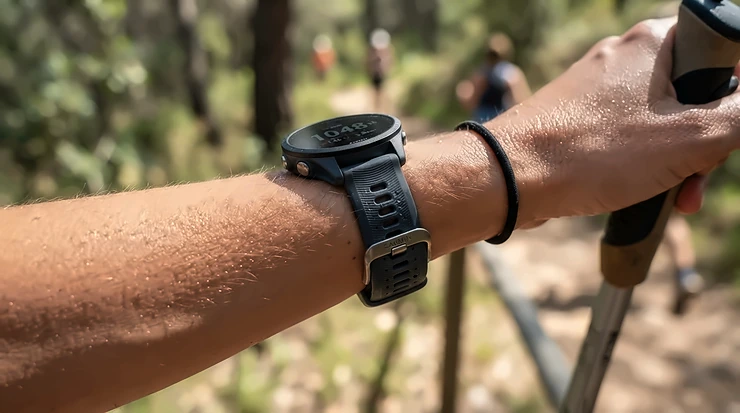
Retailer listings for Garmin’s 20mm band name a long roster: Forerunner 55, 165, 245 and 645, Venu Sq 2, vivoactive 3, 5 and 6, several vivomove models, and the 42mm Forerunner 570. That roster is the main argument for it, since this is the 20mm quick release watch band for Garmin that the maker itself matches to those models. Silicone also suits training, and StrapsCo’s guide steers fitness use toward silicone or FKM rubber.
The trade-off is cost, since official Garmin watch bands carry the highest prices in this group. StrapsCo says third-party straps fit the same connectors as Garmin’s own bands for far less, which is a seller’s claim but one the Reddit post below partly backs.
Garmin Quick Release Band 20mm SiliconeSee current price, sizes and reviews on Amazon.
Budget pricing is why this one comes up. A r/XXRunning poster with a 5.5-inch wrist, unwilling to risk about $50 on Garmin’s own nylon band in case it did not fit, bought a two-pack of 20mm ANNEFIT loops for a Forerunner 165 instead. The band closes with hook-and-loop fabric like Apple’s sport loop, and the poster rates the quality as comparable to an Apple nylon band while noting that some reviewers complain about quality.
Two flaws came with it. The pin-based quick release is a bit fiddly, so the poster tugs the band after fitting to confirm it has seated, and the plastic end piece sits slightly closer to the watch than they wanted. Two commenters with small wrists report the same fit issue and prefer these loops to the stock band but want smaller sizes, and another says a similar quick release band is easier than silicone for frequent swaps.
This is one thread, so treat it as a lead rather than a verdict. An automated bot in the same thread gave the listing’s reviews a failing authenticity grade, a judgment about the reviews and not about the band itself.
ANNEFIT Nylon Sport Loop Quick Release BandsSee current price, sizes and reviews on Amazon.
Barton’s product pages carry a blunt warning: the bands are not compatible with the Suunto 9, the Suunto Traverse or any Garmin smartwatches. That confines this pick to watches with ordinary spring-bar lugs, such as dive watches, field watches and fashion-brand hybrids. Within that group the Elite line is documented in detail. Barton’s design page lists a 316L stainless steel solid-tang buckle, a locking feature that keeps the free end tucked in, a standard length for wrists of 5 to 8 inches and a long length for 7 to 9 inches, and a 2mm taper on the 22mm and 24mm sizes. A retailer listing repeating Barton’s copy gives the 20mm size as tapering to 18mm at the buckle, and the maker backs every purchase with a 365-day satisfaction guarantee.
The weak spot is the spring bars. Buyers on a retailer’s listing for the Elite line say the supplied bars have small ends that rattled in a Seiko dive watch, that fatter aftermarket bars fixed it, and that pulling the bars out marked the small slot in the rubber; a different buyer called the bars too short for the strap on a 20mm-lug watch. One Forerunner 165 owner on another retailer page took Barton’s bars out, refitted the watch’s stock bars and worried about the small hole in the strap. That is a single report, and it runs against Barton’s own Garmin warning.
Pros:
✅ 316L steel buckle with a locking keeper
✅ Tool-free bars and two lengths in the Elite line
✅ 365-day guarantee on the maker’s site
Cons:
❌ Barton says no Garmin smartwatch support
❌ Retailer reviewers report rattling or short bars on some watches
❌ Pulling the bars can mark the strap’s release slot
Barton Elite Silicone Quick Release Watch BandSee current price, sizes and reviews on Amazon.
Digital Trends names the Apple Sport Loop the best simple Apple Watch band in its roundup, and the reasons are comfort and adjustability: soft nylon that the reviewer says does not get hot and sweaty, a hook-and-eye closure with no fixed holes, and an affordable price tier. The one reservation is that it is not dressy.
Fit is a matter of case size, because Apple Watch bands share one slot design. Apple Support says most bands work with any Series 3 or later watch of the same size, with 38/40/41/42mm bands fitting those cases and 44/45/46/49mm bands fitting the larger group. The change itself is the Apple routine of holding the release button, sliding the old band out and clicking the new one in. Digital Trends does not address small wrists for the loop, so check the sizing section below before ordering on a narrow wrist.
Apple Sport LoopSee current price, sizes and reviews on Amazon.
Magnetic closures solve the problem of a narrow wrist falling between hole positions, and Astra Straps, a strap seller, recommends thin Milanese-style mesh with continuous adjustment for small wrists. Digital Trends calls the Apple Milanese Loop the best Milanese Apple Watch band, praising the stainless steel build, the gold, silver and graphite finishes and the magnetic wrap closure, and flags it as expensive. Astra Straps also warns that magnetic bands can fold over on themselves.
A compatibility detail matters for old stock. Apple Support says Milanese Loops redesigned in 2018 open fully by sliding the magnetic closure through the lug, while earlier ones do not, so an older band is harder to swap on and off.
Pros:
✅ Continuous magnetic adjustment instead of fixed holes
✅ Stainless steel in gold, silver or graphite
✅ Slides open fully on the post-2018 design
Cons:
❌ Digital Trends calls it expensive
❌ Magnetic bands can fold over on themselves, per Astra Straps
❌ Pre-2018 closures will not pass through the lug, per Apple
Apple Milanese LoopSee current price, sizes and reviews on Amazon.
20mm quick release watch band for Garmin: which watches take it
Garmin’s catalog mixes mounts and widths, so a short lookup helps before you choose between the first two picks. The rows below combine StrapsCo, Bandletic and watchband.direct, plus Android Central for the Forerunner 165.
Garmin watch
Width
Mount
Forerunner 165
20mm
Spring-bar quick release
vivoactive 5 and 6
20mm
Spring-bar quick release
Forerunner 570, 42mm case
20mm
Spring-bar quick release
Forerunner 570, 47mm case
22mm
Spring-bar quick release
Forerunner 265
22mm
Spring-bar quick release
Forerunner 265S and Venu 3S
18mm
Spring-bar quick release
Fenix 8, 43mm case
20mm
QuickFit
Only the 20mm spring-bar rows suit the first two picks, and the Fenix 8 row shows why a 20mm label is not enough. A 22mm Forerunner 265 owner needs a different strap entirely, even though the connector style matches the Forerunner 165. These garmin watch bands also vary by wrist range, so a small-wristed owner should read the closure and sizing details on the listing rather than the width alone.
Quick release watch bands reviews: what owners and testers report
Apple’s slot is where people report getting stuck. Several Apple Support Community threads describe a band that will not slide out even with the release button held, and the replies give consistent advice: hold the button fully, move the band gently side to side, never force it. One reply says sweat and grime can build up in the slide area of a well-used watch and suggests soaking it in water, and another warns against pressing the button with a metal object, offering a plastic guitar pick instead. Those are community replies, not Apple’s guidance, which stops at not forcing the band.
On the spring-bar side, complaints center on the bars rather than the strap. Beyond the Barton reports above, StrapsCo says that when a band’s width is right but it will not hold, the strap’s hole for the spring bar may have stretched with wear and the band needs replacing. That is a seller’s explanation, not a measured failure rate.
One-piece loops draw a different warning. Digital Trends says the Braided Solo Loop stretches out over time, and Astra Straps calls Solo Loops among the most-returned smartwatch accessories because the sizing is unforgiving. Neither source gives a return figure, so this is a consistent caution rather than a count.
For a rating, a reviews.io page for Barton’s standard Black Quick Release Silicone 20mm shows 4.7 out of 5 from 36 reviews. That is the non-Elite line, so it speaks to the brand more than to the Elite strap.
Apple Watch bands for women: size by wrist, not by label
Apple’s support page sorts bands by case size, 38/40/41/42mm and 44/45/46/49mm, not by gender, so apple watch bands for women are really bands for smaller wrists. BestReviews points buyers with smaller wrists to the smaller case group, with bands there generally fitting wrists of 5.1 to 7.4 inches. Digital Trends does not address women’s sizing or small wrists for its Sport Loop, Braided Solo Loop, Milanese Loop, Spigen Lite Fit or Nomad Sport Band entries.
Astra Straps adds the sharpest filter: many standard straps start at 5.5 inches, and it advises looking for bands that start at 4.5 inches or lower, favoring adjustable closures such as magnetic bands and braided nylon loops over chunky bands. Apple lists Solo Loop sizes 0 to 9 on the 40/41/42mm cases and 0 to 12 on the larger group, and with no clasp, the size has to be right on the first try. For narrow wrists, then, the Apple Milanese Loop and the Apple Sport Loop beat a fixed-size loop on forgiveness, and the same logic applies to the nylon loop for Garmin.
Four ways a quick release strap ends up back in the box
Right width, wrong mount. StrapsCo notes that the Forerunner 245 and 165 are quick release like the 265 but 20mm instead of 22mm, and Bandletic warns that two bands marked 22mm can attach differently.
Width off by a millimeter. Spring-bar straps need an exact match to the gap between the lugs, as Barton states.
Skipping the tug test. StrapsCo advises tugging a new band after installing it, and Apple says not to wear the watch if the band slides.
Guessing a one-piece loop size. Apple’s Solo Loop sizing runs 0 to 9 on small cases, and Astra Straps flags the returns that follow a wrong guess.
Each of these is cheaper to prevent than to fix, and three of the four are settled by one look at the underside of the watch.
Connector, width and Apple sizing: quick answers
❓ Are quick release watch bands interchangeable between brands?
✅ Only when the connector and width both match. A standard spring-bar strap fits any watch with the same lug width, but Garmin QuickFit and Apple's slide-in slot use different mounts, so a 20mm label alone does not guarantee a fit.
❓ Is a 20mm quick release watch band for Garmin the same as QuickFit 20?
✅ No. QuickFit 20 snaps onto a pin through a latch in the connector, as on the Fenix 8 43mm, while 20mm quick release uses a spring bar with a lever, as on the Forerunner 165. Same width, different mounts.
❓ Can a Barton band go on a Garmin watch?
✅ Barton states its bands do not work with any Garmin smartwatches. One buyer on a retailer page used a Barton strap on a Forerunner 165 after swapping in the watch's stock spring bars, but that is a single report, not an endorsement.
❓ Do Apple Watch bands for women come in different sizes?
✅ Apple sorts bands by case size, 38/40/41/42mm or 44/45/46/49mm, not by gender. Solo Loops come in sizes 0 to 9 on the smaller cases, so measure your wrist first; adjustable loops and magnetic bands forgive more.
❓ How do I remove a stuck Apple Watch band?
✅ Hold the band release button down while sliding the band across, and press it again if it will not move. Apple warns against forcing a band. Community replies suggest a plastic tool, not metal, and a visit to Apple if it stays jammed.
Which quick release band to order, by watch
Start with the mount, then the width, then the wrist. A 20mm Garmin such as the Forerunner 165 points to Garmin Quick Release Band 20mm Silicone for a factory match or ANNEFIT Nylon Sport Loop Quick Release Bands for a small-wrist budget build. A standard 20mm lug on a non-Garmin watch points to Barton Elite Silicone Quick Release Watch Band. An Apple Watch points to Apple Sport Loop for daily wear or Apple Milanese Loop for a dressier, fully adjustable fit. The best quick release watch bands are the ones that match your connector, so read the underside of your watch and compare the exact model and width on the listing before you order. Check current availability on Amazon.com.
Disclaimer: This post contains affiliate links. As an Amazon Associate, we earn from qualifying purchases made through these links, at no additional cost to you.
A two-second tug after a new band clicks in is the cheapest insurance on any wrist.
WatchWiseHub is an independent buying-guide site for watches, smartwatches, straps and accessories. Our editorial team compares gear using manufacturer specifications, independent tests from specialist watch media, owner reports and retailer listings. We do not claim to have tested the watches ourselves; see How We Choose Gear for our method.