As an Amazon Associate we earn from qualifying purchases. Links in this article may be affiliate links. How we choose gear
Why do so many of the best metal watch bands still end up back in the box? Usually the steel is fine and the geometry is wrong: a lug gap a millimeter off, an end link that ignores the shape of the case, or a length that cannot be trimmed without a tool nobody owns. Metal watch bands live or die on that fit, so this 2027 guide sorts four bracelets by the situation each one solves, then answers the questions that keep surfacing around them, from resizing a Belushi to finding steel for a Citizen BJ2115-07E.
The findings rest on maker spec pages, resizing guides from Orient Watch USA and WatchGecko, buyer reviews on retailer, storefront and Trustpilot pages, and one hands-on blog review of a Strapcode bracelet; no band was worn or tested for this guide. Prices appear as ranges, and the current price on Amazon.com may differ.
Lug gap, adjustment method, end links and steel grade: what really separates steel bands
Start with the gap between the lugs. Barton’s FAQ states that for quick-release bands the lug width must match the band width exactly, and the same logic holds for every band below. Measure in millimeters, then look at the case ends. One generic 18 to 24 mm listing in the research set warns that it suits straight lug ends and not curved or specially shaped cases, a warning that matters for any watch that shipped with a molded rubber strap, as the Citizen sections below show.
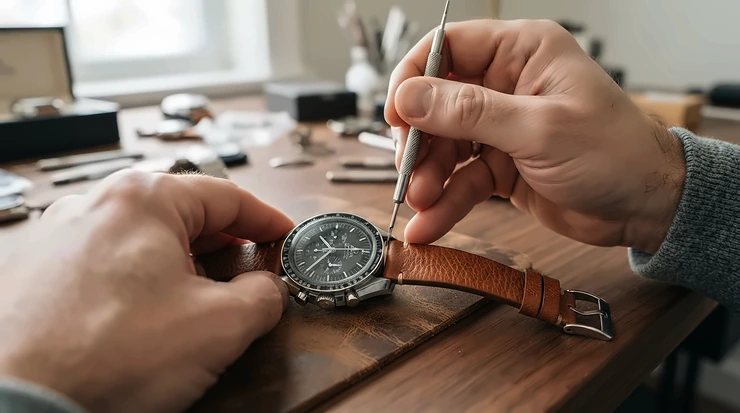
Next comes the way the length adjusts. WatchGecko’s guide to adjusting a metal bracelet sorts bracelets into screw links, push pins, pin-and-collar, sliding mesh and micro-adjust clasps, and each calls for a different tool. Pins are pushed out along the arrows on the inside of the links, screw links need only a small screwdriver, and mesh needs no link removal at all. Choose by the tool you are willing to own.
End links and hardware come third. A hands-on reviewer on an Orient blog regards solid end links as a more substantial upgrade than hollow ones, which he sees as a weak point where steel meets steel. One Citizen buyer warns that a bracelet and a strap on the same watch can use different spring bars.
Last is the grade of steel. The roundups on thewearify treat 316L as the corrosion-resistant choice and 304 as acceptable for occasional wear, and the makers of the bands below list either 316L or plain stainless steel.
| Band | Built for | Length adjustment | Widths listed | Ends | Rough price |
|---|---|---|---|---|---|
| Strapcode Super-J Louis 22mm | Straight-lug divers and tool watches | Screw links plus 2 micro-hole clasp positions | 22 mm | Straight, solid | $60 to $90 |
| Juntan Stainless Steel Curved End Watch Band | Curved-lug watches with rubber straps | Up to 4 links, tools in the box | 18, 20, 21, 22 mm | Curved | Check the current price on Amazon.com |
| Barton Mesh Milanese Quick Release Band | Dress watches, warm wrists | Not spelled out on the maker page | 20, 22 mm | Straight, quick-release | Around $50 |
| Speidel Twist-O-Flex Adjustable End Band | A stretch fit with no clasp | Expansion links | Ends fit 16 to 22 mm (18 to 24 mm in a straight-end version) | Adjustable curved end | $30 to $40 |
The spread is wider in how each band adjusts than in price: screws, links with a tool kit, a sliding mesh clasp, and a stretch band that skips all of that. For a straight-lug watch, the Strapcode Super-J Louis 22mm is the one with a hands-on review behind it, while the Juntan Stainless Steel Curved End Watch Band is the only curved-end option here. Check current availability on Amazon.com once you have your lug width.
The best metal watch bands for four different wrists
Each entry starts from a situation and works back to the band, and the first and last sit at opposite ends of the effort scale.
1. Strapcode Super-J Louis 22mm — solid screw-link bracelet for divers
A hypothetical owner of a 22 mm straight-lug diver, fed up with a rattling stock bracelet, is the buyer this one targets. Strapcode’s page lists solid 316L links throughout, end links included, held with screws instead of pressure pins, so resizing takes a small screwdriver and no hammer. The double flip-lock diver clasp has two micro-hole positions, the bracelet tapers from 22 mm at the lugs to an 18 mm buckle, runs 114 to 175 mm and weighs 78 g, and a pair of thicker 2.5 mm spring bars is included. The maker’s page shows 4.85 out of 5 from 13 reviews without displaying their text. Expect to pay between roughly $60 and $90 depending on seller and variant.
The best independent read is a 2022 hands-on review on an Orient blog of a Kamasu-specific Super-J, not this universal straight-end model. Its author found the solid end links fit the case, preferred the milled clasp to the stock pressed one, felt no hair-pulling, and noted that a diver’s extension costs extra. The watch’s owner, who wears it tight, said the clasp sometimes digs in. That is one review, so treat it as a pointer.
Trustpilot reviewers of Strapcode bracelets are split, and their reports span several of its lines rather than this model alone. One lost a pin within a week, one found end links slightly wider than 22 mm that would not seat, and one said extra links for a large wrist cost about $15 each; others praise the finish and fit. Buyer reviews mirrored from Amazon add that a jeweler’s screwdriver is needed and that the included bar tips are smaller than the lug holes on some vintage Seiko divers.
Pros:
- ✅ Solid links and end links, held by screws instead of pins
- ✅ Two micro-hole positions in the diver clasp
- ✅ Thicker spring bars included
Cons:
- ❌ Straight ends only, so a curved-lug case will show gaps
- ❌ Needs a screwdriver, and some buyers want a better one than they own
- ❌ After-sales complaints appear on Trustpilot
2. Juntan Stainless Steel Curved End Watch Band — curved ends for rubber-strap Citizens
Curved lugs are what stop most steel bands from fitting a watch that came on a molded rubber strap, and this band is built around that problem. Its listing describes a curved, tapered end in 18, 20, 21 or 22 mm, 185 mm long, 80 g, with up to four removable links, a double flip-lock buckle and a fit for wrists of 5.51 to 8.28 inches. A spring bar tool and a link remover come in the box.
On the storefront mirror of the listing, the rating sits at 4.1 across 11 displayed reviews, and the split is informative. A Citizen Promaster Dive owner says it fit well after bending the hollow curved end link into shape, and a Citizen B612 owner swapped a rubber strap whose keeper kept slipping out of place, needing a small adjustment to the curve. On the other side, one reviewer reports the band came off while worn and the watch fell and broke, another found the flip-lock pin is two friction-fit pieces that separated, and a seven-inch wrist lost three of the four removable links with a micro-adjustment on top. Several reviewers call the end links hollow even though the listing says solid, a mismatch worth checking when the box arrives.
Even so, it is the only curved-end steel band in this lineup, which is why two Citizen owners in those reviews reached for it. Its sizes stop at 22 mm, so a 23 mm gap falls outside its range.
3. Barton Mesh Milanese Quick Release Band — breathable mirror-polished mesh for dress wear
At around $50 on Barton’s own site, this is the dressy, lightweight pick. The page lists 316L stainless wire mesh with a mirror polish, integrated quick-release spring bars and widths of 20 and 22 mm, with the 20 mm marked sold out when the page was read. Barton’s FAQ covers watches with standard spring bars between 16 and 24 mm lugs, backs the band with a one-year satisfaction guarantee, and says it is not compatible with the Suunto 9, Suunto Traverse or any Garmin smartwatch. The brand’s site-wide banner claims more than 100,000 five-star reviews, but no rating appears for this specific band.
The maker’s page does not describe the clasp or how the length adjusts, so confirm that on the listing before ordering. The usual method for Milanese mesh, per WatchGecko, is to lift the clasp latch with a spring bar tool, slide it along the mesh and press it back down, with no links removed; Barton’s separate Apple version states an adjustable range for 5 to 9 inch wrists. WatchGecko also notes that early mesh designs could pinch or pull hair, and a Best Buy reviewer of a different brand’s mesh band praised the breathability while saying it may pull some arm hair.
Pros:
- ✅ Quick-release bars for a no-tool swap
- ✅ 316L mesh with a mirror polish
- ✅ Widths of 20 and 22 mm, with a one-year guarantee
Cons:
- ❌ Clasp mechanics are not described on the maker page
- ❌ The 20 mm size was sold out on the page read
- ❌ Mesh can snag arm hair, according to WatchGecko
4. Speidel Twist-O-Flex Adjustable End Band — a stretch fit with no clasp to adjust
Nothing to resize at the clasp, because there is no clasp. Speidel’s expansion band expands to fit the wrist, and it sells between $30 and $40, with silver at the low end and gold or dual tone at the high end. The 16 to 22 mm curved-end version on Speidel’s site has a 22 mm end piece, a 20 mm band, a 165 mm length and a 4.5 mm thickness, and a separate 18 to 24 mm adjustable straight-end version exists. That straight-end version is the one whose range reaches 23 mm.
Speidel’s page shows 13 reviews, with five carrying text and all of them positive; one reviewer says a family member shortened the band by removing links with a tool bought separately. The thewearify roundup agrees that installation takes patience and that removing links is awkward without Speidel’s fork-style tool. The trade-off is the loss of a clasp with micro-adjust holes and, on the adjustable-end versions, of fixed end links. Speidel backs the band with a one-year limited warranty and a 30-day return window.
Citizen watch metal band replacement: lug width before looks
Citizen does not standardize lug width across its lines, and that is where most swaps are decided. Citizen’s US page for the Promaster Tough CA0720-54H lists a 22 mm lug. A UK dealer’s strap-finder entry for the Promaster Sea BN0191-80L also shows 22 mm, with push-pin mounting and a straight strap mount. An Australian strap finder lists 20 mm for the Citizen Dive and 22 mm for the Aqualand, and a Delugs page puts the Calendrier World Time at 23 mm. One brand, four widths.
Genuine metal exists if you search parts retailers. Total Watch Repair lists a genuine Citizen Aqualand diver’s stainless bracelet and a 23 mm titanium link bracelet, part 59-S01762, for roughly $200, with push pins and a push-button deployment clasp. A third-party band suits any straight-lug Citizen whose width matches; integrated and curved lugs are the exception, and the same retailer says integrated cases need the original strap. One buyer on Citizen’s Promaster Tough page adds that the steel bracelet there takes a different spring bar than the fabric strap, and that Citizen sells the matching bars separately.
An alternative metal bracelet for the rubber band on a Citizen BJ2115-07E
The BJ2115-07E is a Promaster Aqualand, which RightTime lists as Citizen’s Eco-Drive 200 m professional diver chronograph. The strap is where the confusion starts. Parts listings pair the model with 23 mm rubber bands, a UK dealer’s entry for Citizen’s original silicone strap 59-S53296 gives 23 mm with no straight mount, and StrapsCo’s replacement measures 23 mm at the lug end tapering to 20 mm. Another seller describes the same family as a 22 mm lug opening with curved ends. The sources disagree by a millimeter, so measure the gap with calipers before ordering anything.
That matters because the steel bands in this guide stop short of 23 mm. The Juntan Stainless Steel Curved End Watch Band tops out at 22 mm, the Strapcode Super-J Louis 22mm and the Barton Mesh Milanese Quick Release Band list 22 mm at most, and the Speidel Twist-O-Flex Adjustable End Band reaches 23 mm only in its straight-end 18 to 24 mm version. No page reviewed here confirms any of them on this exact reference.
That leaves three realistic routes:
- Citizen’s own 23 mm titanium bracelet, if the seller confirms it fits the BJ2115 (the fit list was blank in the text read).
- A straight-end expansion band such as Speidel’s 18 to 24 mm model, accepting visible gaps at the curved lugs.
- A 22 mm curved-end steel band such as Juntan’s, if your measurement lands on 22 and you accept some play.
The B612 owner who replaced a rubber strap for a keeper that kept slipping is a reminder of why people make this swap at all, though a bracelet cannot match the molded fit of the original.
Metal watch band vs leather: where steel earns its weight
Steel’s case rests on moisture and abuse. Treehut says metal handles water, sweat and temperature swings and does not tear when it snags on something sharp, and WatchPlaza adds that sweat and humidity shorten a leather strap’s life while a steel band needs only soapy water and a soft brush. Weight is the price: Watch Pilot says metal can be twice as heavy as leather, which matters for anyone prone to wrist fatigue.
Krishna Watch argues the other side, noting that solid metal is not breathable and can trap sweat. That is the opening for mesh, which WatchGecko’s own Milanese listing calls breathable. Fit is the other difference, since Joseph Abboud’s guide points out that a link bracelet needs links added or removed to fit.
A reasonable split is steel for heat, water and a long day, leather for light weight and dress codes, and mesh when you want metal without the heft.
How to resize a metal watch band on a Belushi watch
Belushi is a low-cost quartz label rather than a heritage maker. Listings on eBay and Walmart’s marketplace show Mainland China origin and a mix of leather, steel-belt and mesh versions. One eBay listing describes a 40 mm steel case on a two-piece metal band with a fold-over push-button clasp, a retail page lists a 22 mm stainless band on another model, and a third listing shows 20 mm. No maker manual or sizing guide for the brand turned up in the research, so the steps below follow the general method from Orient Watch USA and WatchGecko, and the first job is to identify what your band is.
- Identify the band type. Flip the bracelet over. Arrows on the inside of the links and small holes on the sides mean push pins, visible screw heads mean screw links, and woven mesh with a sliding clasp means no links to remove at all.
- Count the links to remove. Wear the watch, let the bracelet hang and pinch it inward as if closing it around your wrist; Orient Watch USA says the links below the pinch are the surplus.
- Split the removal evenly. Take the same number of links from each side of the clasp so the watch stays centered.
- Free the band. For pins, take the spring bar out of the clasp so the band lies flat, push each pin out in the arrow direction, and tap it back in the opposite direction once the link is gone. For screws, back them out with a small screwdriver; WatchGecko notes that gentle heat from a hair dryer may help if a screw is thread-locked.
- For mesh, hook the clasp latch with a spring bar tool, slide the clasp to the right spot and press it down.
- Mind the small parts. Orient Watch USA warns that pins and collars are tiny and easy to lose, so work over a dish or a strip of tape.
Budget bands are where the bundled tool tends to fail. A buyer of a BINLUN band reports that the pin tool in the box bent and eventually broke while removing the second batch of links, so a separate pin pusher is cheap insurance. If a pin will not move, a jeweler costs less than a ruined bracelet.
Metal watch bands reviews: where owners and testers say steel bands fail
Across these sources the steel itself draws few complaints; the weak points are the parts around it. The tool comes first, as the BINLUN buyer shows, and thewearify’s roundup of budget bands notes straight end links that may need slight filing. Tolerance comes second: the Strapcode and Juntan reports above both involve end links that were off by a hair or hollow where the listing promised solid. Clasps come third, since one Juntan reviewer saw the flip-lock pin separate and thewearify lists occasional reports of a loosening latch on a Juntan 18 mm band.
The pattern points to a simple buying rule: judge a bracelet by its end links, clasp and spring bars, and treat the bundled tool as disposable.
Steel band basics: sizing, steel grade, hair and tools
❓ Are metal watch bands better than leather?
✅ Neither wins everywhere. Treehut says steel handles sweat and water and does not tear, while Watch Pilot notes it can weigh about twice as much as leather. Leather is lighter and dressier but dislikes moisture, and mesh sits between the two.
❓ How many links should I remove from a metal watch band?
✅ Wear the watch, let the bracelet hang and pinch it inward as if closing it around your wrist; Orient Watch USA says the links below the pinch are the surplus. Remove an equal number from each side of the clasp so the watch stays centered.
❓ Can I put a metal band on a watch that came with a rubber strap?
✅ Yes, if the lug width matches and the lug shape allows it. Molded rubber straps on cases like the Citizen Aqualand have curved ends, so a straight-end bracelet can leave gaps. Measure the lug gap in millimeters and look for curved-end bands first.
❓ What is the difference between 316L and 304 stainless steel bands?
✅ The thewearify roundups describe 304 as fine for occasional wear and 316L as more corrosion resistant, which suits daily wear and sweat. Two of the makers above list 316L, so a listing that skips the grade deserves a closer look.
❓ Do metal watch bands pull arm hair?
✅ Some do. WatchGecko says early mesh designs could pinch or pull hair, with modern versions improved, and a Best Buy reviewer says one mesh band may pull some arm hair. A hands-on review of one steel bracelet reported no hair-pulling at all.
A decision rule for your next steel band
Start with the lug gap, not the look: measure it in millimeters, note whether the case ends are straight or curved, and only then choose among metal watch bands. A straight-lug diver or tool watch is the natural home for the Strapcode Super-J Louis 22mm. A curved-lug Citizen on a rubber strap points to the Juntan Stainless Steel Curved End Watch Band, with the width caveat above, and the BJ2115-07E’s 23 mm gap calls for a measurement before any order. A warm, dressy wrist suits the Barton Mesh Milanese Quick Release Band, and anyone who dreads resizing can look at the Speidel Twist-O-Flex Adjustable End Band. Whichever you choose, buy a proper pin pusher or screwdriver instead of relying on the tool in the box. Check current availability below.
Recommended for You
- Metal Smartwatch: 7 Best Stainless Steel Picks 2026
- Tissot watches reviews: Fit for Your Wrist and Budget
- Rolex blue face watch: What Suits Your Budget and Wrist
Disclaimer: This post contains affiliate links. As an Amazon Associate, we earn from qualifying purchases made through these links, at no additional cost to you.
A pin pusher costs less than a jeweler’s visit, so budget for one next to the band. ⌚