
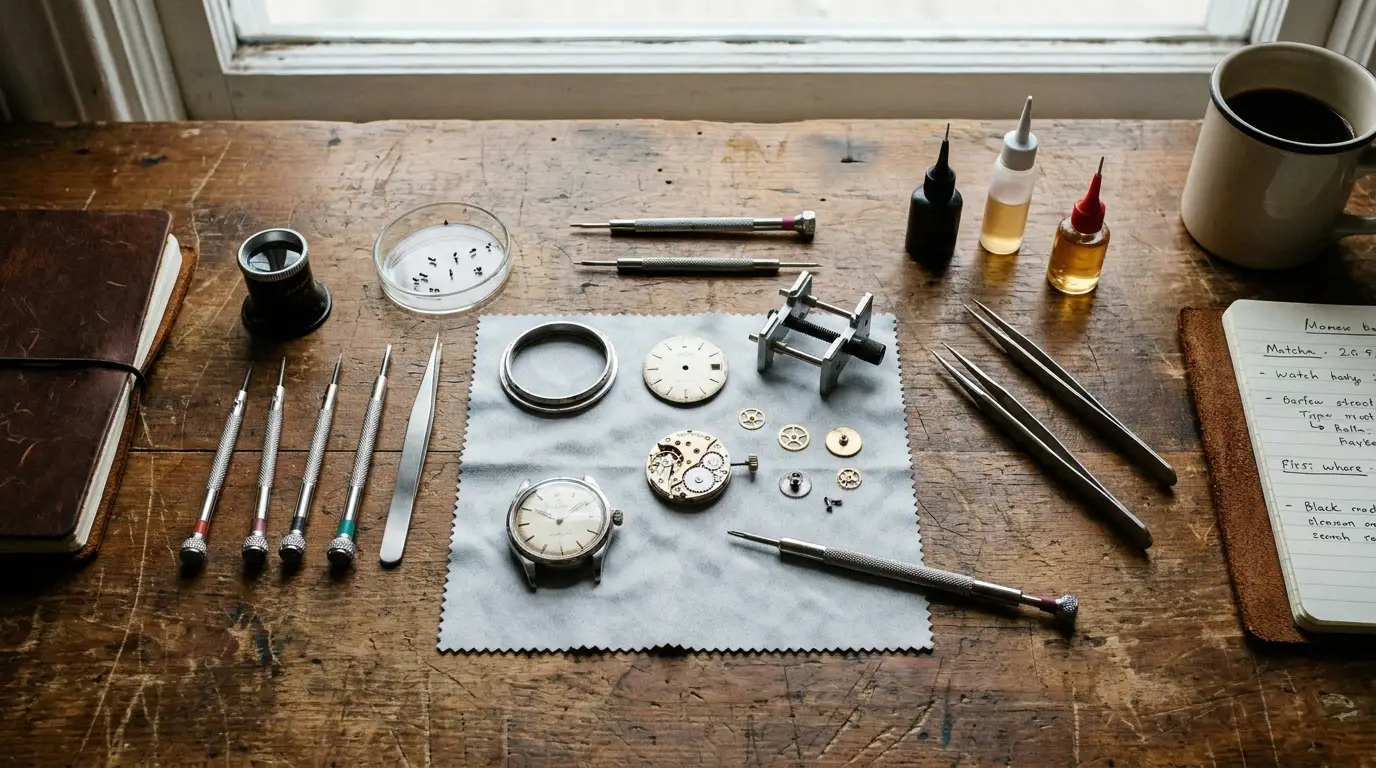
What Is a DIY Watch Battery Change?
A DIY watch battery change means opening your quartz watch’s case back, removing the spent button cell, installing a fresh battery of the exact same size code (such as SR626SW or 371), and resealing the case. With the right small tools, most snap-on and screw-down backs can be handled at a kitchen table in 10-20 minutes.
That’s the short version. The longer version — the one that saves you from a scratched case, a cracked crystal, or a watch that stops again three weeks later — is what this guide is for. Learning how to change watch batteries at home is one of those skills that pays for itself almost immediately. Shoppers regularly report in product reviews that local shops charge anywhere from about $10 to $40+ per watch, while a basic tool kit and a multi-pack of name-brand cells often cost less than a single in-store swap.
But here’s the catch nobody puts on the packaging: the battery is the easy part. The hard parts are identifying your case back, opening it without slipping, and closing it again so it actually seals. That’s why this 2027 guide doesn’t just list products. It explains which battery chemistry your watch needs, which tools match which case styles, and where DIY stops making sense (hello, dive watches and heirloom pieces).
If you’re new to button cells, the Wikipedia overview of button cell batteries is a solid primer on chemistries and size codes. Below, you’ll find a quick comparison table, seven expert-analyzed picks (batteries, kits, and a case press), a full step-by-step walkthrough, real-world scenarios, and the safety rules every household with kids or pets should know. Whether you’ve got one dead Timex in a drawer or a whole rotation of quartz watches, you’ll know exactly what to buy — and what to skip — by the end.
Quick Comparison: The 7 Picks at a Glance
| Product | Type | Key Spec | Price Range (approx.) | Best for |
|---|---|---|---|---|
| Energizer 377/376 Silver Oxide | Battery | 1.55V, 6.8 × 2.6 mm (SR626SW size) | A few dollars per cell | Energizer 377/376 Silver Oxide: easy-to-find everyday replacement |
| Maxell SR626SW (377) | Battery | 1.55V, ~27 mAh, made in Japan | Around $5-$10 for a multi-pack | Maxell SR626SW (377): stocking up on the most common size |
| Renata 371 (SR920SW) | Battery | 1.55V, ~35 mAh, Swiss made | Roughly $10-$20 for a 10-pack | Renata 371 (SR920SW): Swiss and fashion watches using 371 |
| JOREST Watch Battery Replacement Kit | Tool kit | Case wrench, adjustable holder, 5-in-1 screwdriver | Under $20 | JOREST Watch Battery Replacement Kit: first-timers with screw-down backs |
| BYNIIUR Watch Battery Replacement Tool Kit | Tool kit | Twist opener, holder, case knife, back removers | Around $10-$20 | BYNIIUR Watch Battery Replacement Tool Kit: budget all-rounder |
| GLDCAPA Watch Repair Tools (145 pcs) | Kit + batteries | 145 pieces, 60 assorted cells, press tools | Around $15-$30 | GLDCAPA Watch Repair Tools (145 pcs): mixed collections, one box |
| LYECUN Watch Press Tool (YGQ) | Case press | Metal press, 12 dies (10 double-sided + 2 special) | Around $10-$20 | LYECUN Watch Press Tool (YGQ): stubborn snap-on backs |
Looking at the table, the three batteries are not interchangeable — Energizer 377/376 Silver Oxide and Maxell SR626SW (377) share the same 6.8 mm size, while Renata 371 (SR920SW) is a larger 9.5 mm cell, so your watch decides which one you need. On the tool side, JOREST Watch Battery Replacement Kit and BYNIIUR Watch Battery Replacement Tool Kit cover opening, but neither replaces a dedicated press like the LYECUN Watch Press Tool (YGQ) when a snap-on back refuses to close. The GLDCAPA Watch Repair Tools (145 pcs) is the “everything in one box” option — convenient, but read our note on bundled batteries before relying on them for a good watch.
💬 One click helps other shoppers make an informed choice too! 😊
Top 7 Tools and Batteries for how to change watch batteries at home: Expert Analysis
1. Energizer 377/376 Silver Oxide — the grab-anywhere SR626SW standard
If your watch takes the most common small cell on the market, this is the battery you’ll find at nearly every pharmacy and on amazon.com. The Energizer 377/376 Silver Oxide is a 1.55V silver oxide cell measuring 6.8 × 2.6 mm, sold under the IEC SR66 / SR626 designation. Retail spec sheets list its capacity at roughly 24-27 mAh depending on the pack and listing, and it’s marketed as mercury-free with a multi-year shelf life.
What that means in practice: silver oxide holds a flat voltage curve until near the end, which is exactly what a quartz movement wants. Cheaper alkaline “LR626/AG4” cells fit the same hole but sag in voltage over time, which can make some movements run erratically or trigger an end-of-life indicator early. The “377/376” dual label simply tells you it works in both low-drain and higher-drain watches (backlight, alarm).
Who it’s for: anyone with a Timex, Fossil, Casio analog, or fashion-brand watch that calls for 377 or SR626SW, and who wants a recognizable brand without hunting. Feedback on Energizer silver oxide cells tends to center on consistency and leak resistance; we could not verify a large, US-specific review sample for this exact pack, so treat that as a broad trend rather than a guarantee.
Pros:
- ✅ Widely available in single and multi-packs
- ✅ True silver oxide chemistry for stable voltage
- ✅ Dual 377/376 rating covers low and high drain
Cons:
- ❌ Per-cell cost is higher in single blister packs
- ❌ Listed capacity varies between retailers and packs
Price range: typically a few dollars per cell, cheaper per unit in multi-packs — check the current price; solid value if you only need one or two.
2. Maxell SR626SW (377) — Japan-made cells for stocking up
The Maxell SR626SW (377) is the same physical size as the Energizer above, but it’s the one watch hobbyists tend to buy by the five- or ten-pack. Retail listings describe it as made in Japan, rated around 27 mAh at 1.55V, and Maxell has moved its silver oxide line to a mercury-free version marked with an “Hg 0%” logo.
Here’s what the “SW” suffix actually tells you: it’s the low-drain variant, designed for watches without backlights or alarms. That’s the vast majority of three-hand analog watches. If your watch has a light or chime, the manual may specify a “W” (high-drain) cell instead — a detail most buyers overlook, and one reason a “fresh” battery sometimes dies early in a digital-analog combo.
Who it’s for: anyone with several watches using the 377 size, or a household that also uses 377 cells in kitchen timers and small gadgets. Buying in multi-packs drops the per-cell cost sharply. Aggregated buyer comments on US marketplaces frequently mention the Japanese origin and long use-by dates printed on the packaging as reasons for choosing Maxell; that’s the clearest consistent theme we found.
Pros:
- ✅ Japan-made with strong quality reputation
- ✅ Multi-packs bring per-cell cost way down
- ✅ Clear low-drain SW designation for analog watches
Cons:
- ❌ SW variant isn’t ideal for backlight-heavy watches
- ❌ Counterfeit packs exist, so buy from reputable sellers
Price range: around $5-$10 for a multi-pack at the time of writing — prices may vary; excellent per-cell value for multi-watch owners.
3. Renata 371 (SR920SW) — the Swiss pick for larger-cell movements
Many Swiss quartz movements (including popular Ronda calibers) and plenty of fashion watches call for a 371 cell, and the Renata 371 (SR920SW) is the reference choice. It’s a 1.55V silver oxide cell measuring 9.5 × 2.0 mm with a nominal capacity of about 35 mAh, made in Switzerland, and Renata says its zero-mercury line was developed in cooperation with the Swiss watch industry.
In practice, that 35 mAh is meaningfully more energy than a 377’s ~27 mAh, which is one reason watches built around a 371 often run longer between changes. Renata also advertises leak-proof sealing — a bigger deal than it sounds, because a leaking cell can corrode a movement’s contacts and turn a $3 fix into a repair bill.
Who it’s for: owners of Swiss quartz or mid-range fashion watches whose old battery is stamped 371 or SR920SW. Don’t “upsize” or “downsize” — a 370 (SR920W) shares dimensions but is the high-drain variant, and a 395 or 399 has a different thickness. Aggregated customer feedback on US listings commonly says these cells last noticeably longer than generic store-brand replacements, though that’s anecdotal sentiment rather than lab data.
Pros:
- ✅ Swiss made with watch-industry pedigree
- ✅ Higher capacity than smaller 377-size cells
- ✅ Leak-resistant sealing protects movement contacts
Cons:
- ❌ Only fits watches specified for 371/SR920SW
- ❌ Single-cell packs cost more than multi-packs
Price range: roughly $10-$20 for a 10-pack (check the current price); great long-term value if you own more than one 371 watch.
4. JOREST Watch Battery Replacement Kit — best case wrench for beginners
Batteries are useless if you can’t get inside the watch, and the JOREST Watch Battery Replacement Kit is one of the best-known beginner sets on amazon.com. Product listings describe an adjustable case holder for watches up to about 50 mm, a three-jaw case-back wrench, a 5-in-1 screwdriver with interchangeable bits, a case knife, tweezers, and spring bars.
The standout is the wrench. A screw-down case back has small notches around its edge, and the wrench’s adjustable jaws lock into them so you can twist evenly instead of gouging metal with a screwdriver. Paired with the holder (which clamps the watch so it can’t spin), this turns the most intimidating case style into a two-minute job.
Who it’s for: first-timers, especially those with Fossil, Citizen, or Timex models with screw-down or snap backs. Aggregated reviews are strongly positive about the wrench gripping well across different brands, while recurring complaints mention that the storage “case” is a paper box with foam, and at least one reviewer reported the wrench seizing on a tight screw-back. One reviewer also noted it feels geared toward larger watches rather than small women’s models.
Pros:
- ✅ Adjustable wrench handles most screw-down backs
- ✅ Case holder prevents slips and scratches
- ✅ Includes strap-resizing tools as a bonus
Cons:
- ❌ Flimsy paper-and-foam storage box
- ❌ Less suited to very small ladies’ watches
Price range: typically under $20 at the time of writing — prices may vary; very strong value if it saves even one shop visit.
5. BYNIIUR Watch Battery Replacement Tool Kit — the budget all-rounder
The BYNIIUR Watch Battery Replacement Tool Kit takes a slightly different approach. Instead of a heavy-duty three-jaw wrench, many versions include a “twist” ball-type opener, a watch holder, two back removers, and a case-opener knife — a lean lineup built around the two most common case styles.
That rubber ball opener is underrated. For screw-down backs that aren’t torqued tight, pressing a grippy ball onto the back and twisting counterclockwise often works without touching the notches at all — zero scratch risk. The case knife handles snap-on backs with a small lip near the lugs.
Who it’s for: casual owners who change a battery once or twice a year and want something cheap that covers both case types. Aggregated reviews frequently describe the battery change as quick — some mention roughly three minutes — once the back is off. The two most consistent criticisms: some versions don’t include tweezers, and several reviewers recommend buying a separate case press because closing snap-on backs by hand was frustrating.
Pros:
- ✅ Rubber ball opener is gentle on finishes
- ✅ Covers both snap-on and screw-down backs
- ✅ Very affordable entry point
Cons:
- ❌ Tweezers missing from some versions
- ❌ No press included for closing snap backs
Price range: around $10-$20 (check the current price); great value as an opener-only kit paired with a separate press.
6. GLDCAPA Watch Repair Tools (145 pcs) — one box for mixed collections
The GLDCAPA Watch Repair Tools (145 pcs) is the “I don’t want to think about it” option. Listings describe a 145-piece set that includes 60 assorted batteries, press tools, a case opener, tweezers, and a broad spread of strap and pin tools.
On paper, having 60 cells across common sizes means you can revive a drawer of mismatched watches in one evening. Based on comparing kit contents across the category, though, here’s what to weigh: bundled “universal” batteries in all-in-one kits are often unbranded, and their exact chemistry (silver oxide vs. alkaline) isn’t always clearly stated. For a cheap fashion watch, that’s fine. For a watch you care about, put in a name-brand silver oxide cell like the Maxell SR626SW (377) or Renata 371 (SR920SW) instead.
Who it’s for: households with lots of inexpensive watches, or anyone who wants tools for battery swaps and band sizing in one case. We could not verify a substantial body of US customer reviews for this specific kit, so we’re not summarizing sentiment here — judge it mainly on its listed contents and treat the batteries as “convenience spares.”
Pros:
- ✅ Huge tool variety in a single purchase
- ✅ Includes press tools, unlike opener-only kits
- ✅ Assorted cells help with mixed collections
Cons:
- ❌ Bundled batteries may be unbranded or unclear chemistry
- ❌ Limited verifiable review data for this exact kit
Price range: around $15-$30 at the time of writing — check the current price; good value if you’ll actually use the extra pieces.
7. LYECUN Watch Press Tool (YGQ) — the fix for backs that won’t snap shut
Here’s the part of the process nobody warns you about: getting the back off takes seconds; getting it back on can take an hour of frustration. The LYECUN Watch Press Tool (YGQ) solves that. It’s an all-metal screw-down press (about 305 g per the listing) with 12 plastic dies — 10 double-sided plus 2 special dies — designed for round, press-fit case backs.
How it works: you pick a die that supports the crystal side, another that matches the case back’s diameter, and turn the handle so pressure is applied evenly across the whole back. Even pressure is the key. Pressing with your thumbs concentrates force on one edge, which is how people crack crystals or pinch the gasket.
Who it’s for: anyone with snap-on backs — very common on Timex, Movado, and many fashion watches. Aggregated reviews repeatedly describe backs that wouldn’t close by hand snapping on immediately with the press. Listings state it’s only for round dials, so square or tonneau cases won’t seat properly.
Pros:
- ✅ Even pressure protects crystal and gasket
- ✅ Wide die selection fits most round watches
- ✅ Solid metal body for repeated use
Cons:
- ❌ Round cases only — no square or tonneau
- ❌ Plastic dies can wear with heavy use
Price range: around $10-$20 (prices may vary); arguably the best-value tool in this guide because it prevents the most expensive mistake.
Step-by-Step: how to change watch batteries at home
This is the core walkthrough. Read it once fully before you start — it’ll save you from improvising halfway through.
Before you start (5 minutes of prep)
- 🔍 Check the manual or the old battery. The size code (377, 371, CR2016, etc.) is printed on the cell itself.
- 🧼 Clear a light-colored, lint-free surface. A microfiber cloth catches tiny screws.
- 🧤 Wash and dry your hands, or wear finger cots. Skin oils on a cell’s surfaces can affect contact.
The process
- Identify the case back type. Smooth with a small lip = snap-on. Notches around the edge = screw-down. Tiny screws in the corners = screwed back. (More on this in the case-back section below.)
- Clamp the watch in a holder — like the one in the JOREST Watch Battery Replacement Kit — face down on a soft cloth.
- Open the back. Snap-on: slide the case knife into the lip and twist gently, never lever toward your hand. Screw-down: set the wrench jaws in the notches and turn counterclockwise. Screws: use the correct micro screwdriver.
- Note the orientation. Snap a phone photo. Most cells sit “+” side up, but retaining clips vary.
- Release the clip and lift the old cell with plastic or non-magnetic tweezers. Metal tweezers can short the cell across both faces.
- Install the new cell, same size code, same orientation. Press it gently until the clip seats.
- Check the movement. Within a few seconds, the second hand should tick. Some digital modules (Casio is the classic example) have an “AC” reset contact described in the manual.
- Inspect and seat the gasket. If it’s dry, flattened, or cracked, it won’t seal.
- Close the back — by hand for screw-downs, with a press like the LYECUN Watch Press Tool (YGQ) for snap-ons.
- Set the time and date, and write the change date on the battery packaging so you can track lifespan.
✨ Ready to stop paying for five-minute fixes?
🔍 Take your watch maintenance to the next level with the curated lineup above. Click a highlighted item to check current pricing and availability — the right kit plus a pack of name-brand cells will keep every watch in the house ticking!
Real-World Scenarios: Matching the Right Kit to Your Watch
Specs only go so far. Here’s how the picks map onto real situations, with budget and frequency in mind.
Profile 1: “One watch, once every two years”
You own a single Timex Weekender with a snap-on back. Budget: under $25. Frequency: very low.
Best match: the BYNIIUR Watch Battery Replacement Tool Kit for opening plus the LYECUN Watch Press Tool (YGQ) for closing, and a single Energizer 377/376 Silver Oxide cell (check your manual for the size). Why not a giant kit? You’ll never use 140 pieces, and a press matters more than tweezers variety for snap-on backs.
Profile 2: “The fashion-watch drawer”
Six or seven inexpensive watches from different brands, half of them dead. Budget: around $30-$40. Frequency: a weekend project, then occasional.
Best match: the GLDCAPA Watch Repair Tools (145 pcs) for tools and convenience spares, plus a multi-pack of Maxell SR626SW (377) for any watch that turns out to use the most common size. Here’s the reasoning: mixed collections almost always include a few snap-on and a few screw-down backs, and you don’t want to order a second tool mid-project.
Profile 3: “My grandfather’s Swiss quartz”
A sentimental mid-range Swiss quartz with a screw-down back and a 371 cell. Budget: flexible. Frequency: every few years.
Best match: the JOREST Watch Battery Replacement Kit for its adjustable wrench and holder, plus a Renata 371 (SR920SW). The holder keeps the case from spinning — the number-one cause of wrench slips and scratched case backs. If the back is extremely tight or the watch is water-resistant to 100m or more, skip DIY and see the “When You Should NOT” section.
The pattern across all three: match the opener to the case back, match the battery to the code, and never skip a proper closing method.
Problem → Solution: Fixing the 5 Most Common DIY Snags
Problem 1: The case back won’t budge. ✅ Solution: For screw-downs, clamp the watch firmly first — most failures come from the case rotating, not the back being stuck. Try the rubber ball from the BYNIIUR Watch Battery Replacement Tool Kit before forcing a wrench. If it’s still stuck, stop; overtightened backs are a jeweler job.
Problem 2: The new battery is in, but the watch won’t run. ✅ Solution: Confirm the size code and orientation. Check that the retaining clip is pressing the cell, not floating above it. A slightly low-profile cell in the wrong size can lose contact. Some movements also need a few seconds — or an “AC” reset on digital modules.
Problem 3: The snap-on back won’t close. ✅ Solution: Align the back’s notch (if any) with the crown or stem, then use a press. The LYECUN Watch Press Tool (YGQ) applies even force; thumbs don’t.
Problem 4: The watch is ticking but the second hand jumps every two seconds. ✅ Solution: On many Seiko and Citizen models, that’s an end-of-life indicator — which usually means a weak or wrong-chemistry cell. Swap in a fresh silver oxide battery such as the Maxell SR626SW (377) rather than an alkaline “AG” equivalent.
Problem 5: Fog appears under the crystal days later. ✅ Solution: Moisture got in because the gasket didn’t seal. Open it, dry it out in a warm (not hot) spot, replace or lightly lubricate the gasket with silicone grease, and reseal. Avoid water exposure until it’s properly pressure tested.
How to Choose a Watch Battery Replacement Kit
A good watch battery replacement kit is defined by what it lets you open safely — and close properly. Use these seven steps:
- Identify your case backs first. Screw-downs need a wrench or ball; snap-ons need a knife and a press. Buy for what you own.
- Prioritize a case holder. A watch that can’t move can’t slip, and slips cause nearly all scratches.
- Look for an adjustable three-jaw wrench, like the one in the JOREST Watch Battery Replacement Kit, if you own any screw-down backs.
- Get a press for snap-on backs. Kits without one, like many BYNIIUR Watch Battery Replacement Tool Kit versions, pair well with the LYECUN Watch Press Tool (YGQ).
- Check for plastic or anti-static tweezers. Metal tweezers bridging both faces of a cell can short it.
- Don’t buy a kit for its bundled batteries. Treat them as spares; buy name-brand silver oxide cells separately.
- Match kit size to collection size. One watch doesn’t need 145 pieces; a drawer of ten might.
Most first-time frustration comes from mismatches — a great opener with no press, or a giant kit with no proper wrench. Get the pairing right and the rest is easy.
Identifying Your Watch Case Back: Snap-On, Screw-Down, or Screws
Watch case back removal is where most DIY mistakes happen, so it deserves its own section.
Snap-on (press-fit) backs
These look smooth with a tiny pry notch near one lug. They’re held by friction and a gasket. Opening requires a thin case knife slid into that notch, twisted — not levered — so the back pops evenly. Closing requires even pressure, ideally from a press. They’re common on Timex, many Movado models, and fashion brands.
Screw-down backs
You’ll see 6 to 12 notches (or flat facets) around the perimeter. These unscrew counterclockwise. A tight one demands a proper wrench and a holder; a loose one often yields to a rubber ball. Hand-tighten when closing — modern gaskets seal without gorilla force.
Screwed backs (four or more small screws)
Common on some Casio digital and sport models. Use a correctly sized precision screwdriver, keep screws on a magnetic tray or in a dish, and tighten in a crisscross pattern — like lug nuts on a car — so the back seats evenly.
Hatch or coin-slot backs
Some older or budget quartz watches have a small coin-slot hatch just for the battery. A coin or flat screwdriver works; no full back removal needed.
What most buyers overlook: the “tool kit” decision should follow this identification step, not precede it. Five seconds looking at the back of your watch tells you whether you need the JOREST Watch Battery Replacement Kit, the LYECUN Watch Press Tool (YGQ), or just a screwdriver.
SR626SW Battery and Other Common Sizes Explained
The SR626SW battery is the single most common watch cell you’ll encounter, but it’s far from the only one. Button cell codes follow an internationally standardized pattern, and once you can read them, you’ll never buy the wrong one again.
- First letter = chemistry. “S” = silver oxide (1.55V). “L” = alkaline (1.5V). “C” = lithium manganese dioxide (3V).
- “R” = round.
- Digits = size. In SR626, “6” ≈ 6.8 mm diameter and “26” = 2.6 mm thick. In CR2032, “20” = 20 mm diameter and “32” = 3.2 mm thick.
- Suffix “SW” = low drain; “W” = high drain (for silver oxide watch cells).
| Code | Chemistry / Voltage | Size (diameter × height) | Common Equivalent | Best for |
|---|---|---|---|---|
| SR626SW | Silver oxide, 1.55V | 6.8 × 2.6 mm | 377 (e.g., Maxell SR626SW (377)) | Most small analog watches |
| SR626W | Silver oxide, 1.55V | 6.8 × 2.6 mm | 376/377 (e.g., Energizer 377/376 Silver Oxide) | Watches with backlight or alarm |
| SR920SW | Silver oxide, 1.55V | 9.5 × 2.0 mm | 371 (e.g., Renata 371 (SR920SW)) | Many Swiss/fashion quartz watches |
| CR2016 / CR2025 | Lithium, 3V | 20 × 1.6 / 2.5 mm | — | Some digital and sport watches |
Reading the table, the key takeaway is that same diameter does not mean same battery: an SR626SW and an alkaline LR626 fit the same space but behave differently over time, and a 3V lithium cell must never go into a 1.55V watch. When in doubt, copy the exact code from the old cell, and cross-check against your watch’s manual or the manufacturer’s support page.
DIY vs. Jeweler: Cost and Value Analysis
Is learning how to change watch batteries at home actually worth it? For most quartz owners, yes — but not always.
| Option | Typical Cost (approx.) | Speed | Risk Level | Best for |
|---|---|---|---|---|
| DIY with kit + name-brand cells | Roughly $20-$40 upfront, then a few dollars per change | 10-20 minutes | Low-moderate (learning curve) | Owners of several everyday quartz watches |
| Mall kiosk / big-box counter | Roughly $10-$40+ per watch, based on shopper reports | Same day | Variable | One-off swaps when you lack tools |
| Independent jeweler / watchmaker | Often higher; may include gasket and pressure test | Same day to a week | Low | Water-resistant, valuable, or vintage pieces |
| Manufacturer service | Highest; varies by brand | Weeks | Lowest | Luxury watches and warranty coverage |
The table shows why DIY wins on volume: the tools are a one-time cost, and every additional watch is just the price of a cell. Shoppers in reviews regularly describe spending less on a kit plus batteries than a jeweler quoted for three watches. Where DIY loses is water resistance — a professional with a pressure tester can verify the seal, which a kitchen-table setup can’t.
Long-term cost of ownership
A silver oxide watch cell typically lasts somewhere between one and several years depending on the movement and features. Over a decade, a three-watch household might face 10-15 changes. At shop prices, that adds up; with your own tools and a multi-pack like the Maxell SR626SW (377), the marginal cost per change is tiny. Add the value of not leaving a dead cell in the watch, which can leak and damage the movement — a real cost that DIY owners avoid by acting quickly.
Common Mistakes to Avoid When You Replace Watch Battery Yourself
Most “I broke my watch” stories come from the same handful of errors. If you replace watch battery yourself, sidestep these:
- ❌ Prying toward your hand or the crystal. A slipping case knife can puncture a finger or scratch a dial. Always pry away from yourself, with the watch clamped.
- ❌ Using a screwdriver as a case wrench. It gouges the notches and slips. A proper wrench from the JOREST Watch Battery Replacement Kit costs less than a scratched case.
- ❌ Grabbing the cell with metal tweezers or bare fingers. Metal can short a cell; oils interfere with contact.
- ❌ Substituting “close enough” sizes. A 364 is not a 377. Similar-looking cells with the wrong height lose contact or crush the clip.
- ❌ Choosing alkaline over silver oxide to save pennies. Voltage sag can cause erratic timekeeping in some movements.
- ❌ Forgetting the gasket. A pinched or dry gasket ruins water resistance.
- ❌ Squeezing a snap-on back closed with your thumbs. Uneven pressure is how crystals crack. Use a press like the LYECUN Watch Press Tool (YGQ).
- ❌ Leaving old cells on the counter. Dead button cells are still dangerous to kids and pets (see the safety section).
The common thread: every mistake on this list is cheaper to prevent than to fix. A ten-dollar tool beats a hundred-dollar repair.
When You Should NOT Replace a Watch Battery Yourself
Knowing how to change watch batteries at home includes knowing when to stop. Honest analysis says DIY isn’t the right call in these cases:
Water-resistant dive and sport watches
If your watch is rated 100m or more, or you actually swim with it, the seal matters as much as the battery. Ratings like “30m” or “100m” are a test-pressure measure, not literal dive depths — the Wikipedia explainer on water resistance ratings breaks down what each level really means. A watchmaker can replace the gasket and pressure test the case. At home, you can’t verify the seal.
Luxury and warranty-covered watches
Opening some watches yourself can void a manufacturer warranty, and high-end cases often use specialized backs. Check the warranty terms before you twist anything.
Vintage and sentimental pieces
Older gaskets can crumble, and old movements may have corrosion from a past leak. If you open the back and see green or white residue around the battery area, close it and take it to a professional.
Watches that don’t use replaceable batteries
Solar (e.g., light-powered) and kinetic/automatic-quartz watches use rechargeable capacitors or cells that aren’t swapped like a button battery. Mechanical watches have no battery at all. Smartwatches are a different repair category entirely.
When these apply, the most valuable tool in this guide is the phone number of a good local watchmaker.
Safety, Regulations, and Standards: Button Batteries and Reese’s Law
Button cells are small, cheap, and genuinely dangerous if swallowed — especially for young children. A swallowed coin or button cell can cause severe internal burns within hours, which is why US regulators have tightened rules in recent years.
What Reese’s Law requires
Reese’s Law was signed on August 16, 2022, and directed the Consumer Product Safety Commission to set federal safety requirements for button and coin batteries and products containing them. In September 2023, the CPSC adopted ANSI/UL 4200A-2023 as the mandatory standard for many consumer products using these cells, alongside warning-label requirements for battery packaging. The CPSC has reported 27 deaths and an estimated 54,300 emergency-room-treated injuries tied to ingested or inserted button and coin batteries from 2011 through 2021. The agency’s Button Cell and Coin Battery FAQs explain that the law also requires child-resistant special packaging for button batteries sold on their own or included with products.
What’s changing heading into 2027
A 2026 Federal Register filing notes that a revised voluntary standard, UL 4200A-2026, has been published and that the CPSC is assessing it under Reese’s Law. Until the agency acts, the 2023 standard remains the reference — so watch for packaging and labeling tweaks rather than assuming anything has already changed.
Practical safety rules for your workbench
- 🔋 Tape over or bag dead cells immediately, then recycle them at a battery drop-off point.
- 👶 Work where kids and pets can’t reach, and count cells before and after.
- 📦 Keep spare cells in their child-resistant packaging until the moment you install one.
- 🚨 If a battery may have been swallowed, seek emergency care right away — don’t wait for symptoms.
Features That Actually Matter (and Ones That Don’t)
Kit listings love big numbers. Here’s how to cut through the marketing.
Features that matter ✅
- An adjustable case holder. Stability prevents slips — the root cause of scratches.
- A real three-jaw wrench for screw-down backs, like in the JOREST Watch Battery Replacement Kit.
- A press with multiple dies if you own snap-on backs; the LYECUN Watch Press Tool (YGQ) is the benchmark at its price.
- Non-metal tweezers to avoid shorting cells.
- Name-brand silver oxide batteries in the correct code — the Maxell SR626SW (377), Energizer 377/376 Silver Oxide, or Renata 371 (SR920SW) depending on your watch.
Features that don’t matter much ❌
- Piece count. “145 pieces” often includes dozens of spring bars and pins you’ll never use for battery work.
- Assorted bundled batteries of unclear brand — convenient, but not a reason to choose one kit over another.
- Fancy storage cases. Nice to have; irrelevant to whether the back comes off cleanly.
- Strap-resizing tools, unless you also plan to adjust metal bracelets.
The bottom line: buy for the case backs you own and the battery codes your watches use. Everything else is a bonus.
FAQ
❓ Can I use a 377 battery instead of an SR626SW?
✅ Yes — 377 and SR626SW are the same 6.8 × 2.6 mm silver oxide size. The 'SW' marks low drain; a '376/377' dual-rated cell works in both. Always confirm the code printed on your old battery…
❓ How long should a new watch battery last?
✅ Most quartz watch cells last roughly one to several years. Backlights, alarms, chronographs, and small cells shorten life; larger silver oxide cells usually run longer. If it dies within weeks, check the size, chemistry, and contact clip…
❓ What's the best tool to open a watch back at home?
✅ It depends on the case: a three-jaw wrench for screw-down backs, a case knife for snap-on backs, and a precision screwdriver for screwed backs. A case holder is essential for all three to prevent slips…
❓ Will changing the battery myself ruin water resistance?
✅ It can if the gasket is damaged, pinched, or dry. For everyday splash resistance, careful resealing is usually fine. For swimming or diving watches, have a watchmaker replace the gasket and pressure test the case…
❓ Where should I buy watch batteries to avoid fakes?
✅ Buy name-brand cells like Maxell, Energizer, or Renata from reputable sellers, and check for intact packaging and printed use-by dates. Unusually cheap bulk lots from unknown sellers carry a higher counterfeit risk…
Conclusion
Learning how to change watch batteries at home comes down to three decisions: the right battery code, the right opener for your case back, and the right way to close it. Get those right and a dead watch becomes a 15-minute fix instead of a shop visit.
For batteries, the Maxell SR626SW (377) and Energizer 377/376 Silver Oxide cover the most common small size, while the Renata 371 (SR920SW) is the go-to for watches built around a 371. For tools, the JOREST Watch Battery Replacement Kit shines on screw-down backs, the BYNIIUR Watch Battery Replacement Tool Kit is a lean budget opener, and the GLDCAPA Watch Repair Tools (145 pcs) suits mixed collections — just treat its bundled cells as spares. And if you own any snap-on backs, the LYECUN Watch Press Tool (YGQ) is the quiet hero that prevents cracked crystals and pinched gaskets.
Just as important is knowing your limits. Dive watches, luxury pieces under warranty, and vintage heirlooms deserve a watchmaker’s pressure test. And no matter what you’re working on, treat button cells with respect — keep them away from kids and pets, and recycle the dead ones promptly.
Heading into 2027, the tools are cheaper and more accessible than ever. With a little patience and the right kit, your quartz watches can keep ticking for years — on your schedule, at your kitchen table.
🛠️ Bring your watches back to life today!
⌚ Pick the battery that matches your watch and the tool that matches your case back from the lineup above. Click a highlighted product to check current pricing and availability — and enjoy the satisfaction of fixing it yourself!
Recommended for You
- how to change watch batteries at home: 7 Smart Tools & Tips (2027)
- 5 Incredible Ways How AI is Changing Smartwatch Technology in 2026
- 5 Most Anticipated new seiko releases 2026: An Expert’s Power Guide to the Hottest Upcoming Timepieces
Disclaimer: This post contains affiliate links. As an Amazon Associate, I earn from qualifying purchases made through these links, at no additional cost to you.
✨ Found this article helpful? Share it with someone who needs it! 💬🤗
[wpf_share]