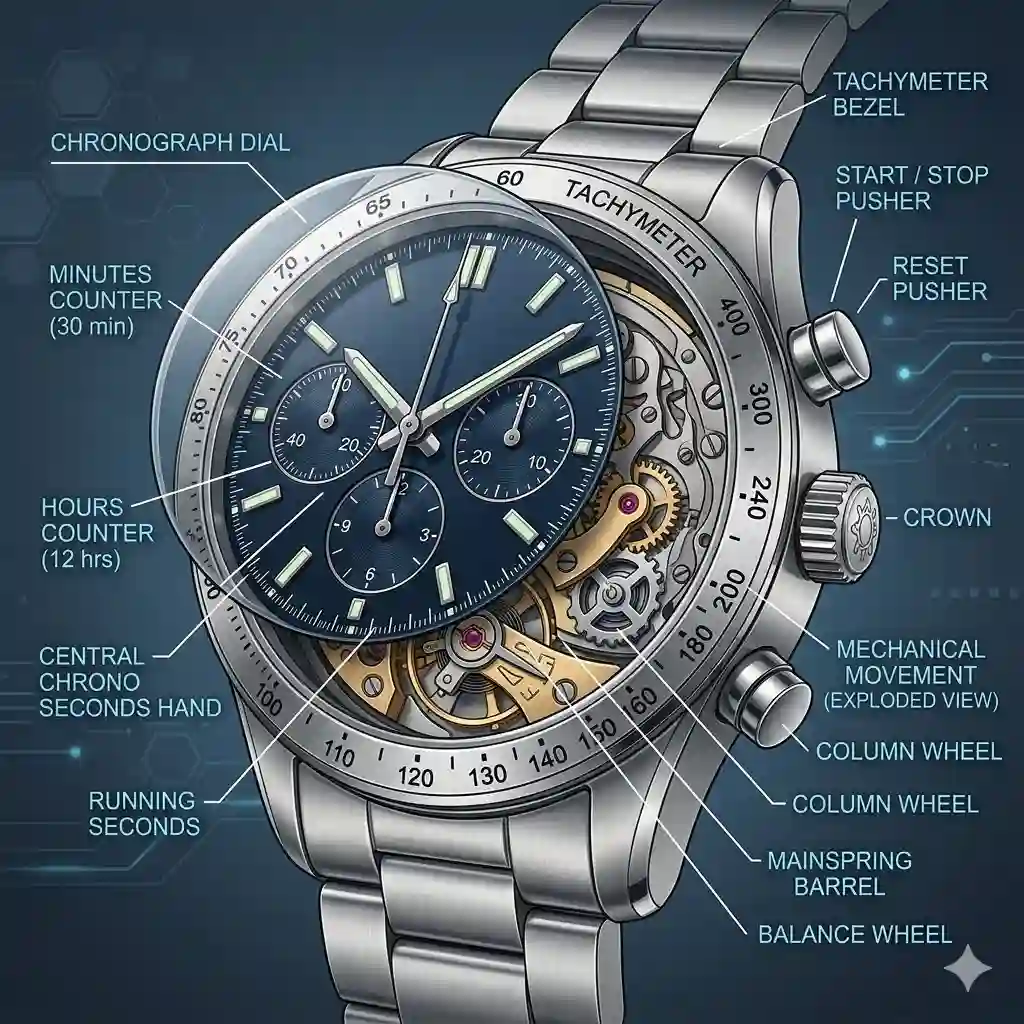
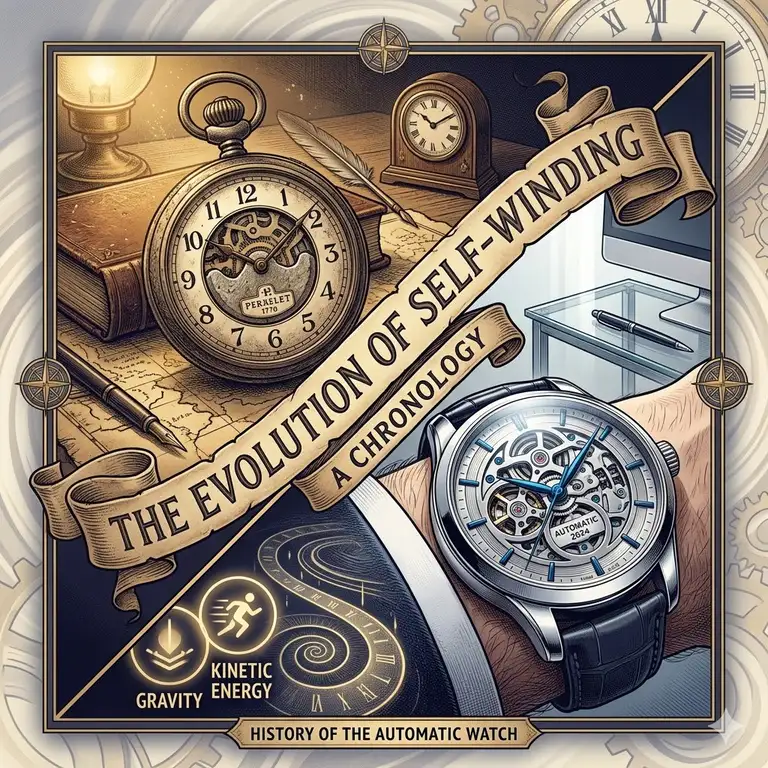
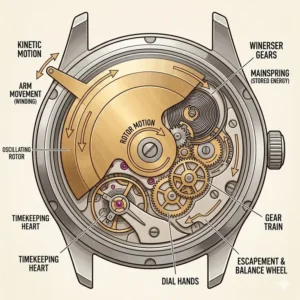
The history of the automatic watch is a fascinating testament to human ingenuity and the refusal to be tethered by a winding crown. At its core, an automatic watch—often called a self-winding watch—is a mechanical timepiece that uses the kinetic energy of the wearer’s arm to tighten the mainspring. Instead of you turning a knob every morning, a weighted rotor inside the case spins with every flick of your wrist, storing energy for the gears to move.
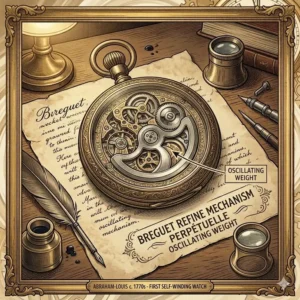
Understanding the history of the automatic watch requires looking back to the late 18th century, specifically around 1770. While historians still debate the exact “first,” most credit Abraham-Louis Perrelet with creating a mechanism that could run for eight hours after a short walk. In my decade of consulting for watch collectors, I’ve found that many people assume “automatic” means “modern.” In reality, the quest for a perpetual motion machine for the wrist is over 250 years old. It survived the advent of battery-powered quartz in the 1970s and is currently seeing a massive resurgence in 2026 as enthusiasts crave tactile, sustainable engineering over disposable electronics.
Today, wearing an automatic watch is a statement. It’s a tiny, gravity-powered engine on your wrist. Whether you are looking at a budget-friendly entry model or a high-horology masterpiece, you are participating in a lineage of craftsmanship that spans centuries.
Quick Comparison: Iconic Automatic Movements of 2026
| Movement Type | Key Historical Example | Best For | Power Reserve | Price Range |
| The Workhorse | Seiko 4R36 | Daily Wear / Beginners | 41 Hours | $250 – $550 |
| The Swiss Standard | Powermatic 80 | Office / Travel | 80 Hours | $650 – $1,200 |
| The Military Icon | Hamilton H-10 | Outdoor / Rugged | 80 Hours | $500 – $950 |
| The Luxury Rotor | Rolex Calibre 3235 | Investment / Status | 70 Hours | $7,000 – $12,000 |
| The High-Beat | Grand Seiko 9S85 | Accuracy Junkies | 55 Hours | $5,500 – $9,000 |
As shown in the table above, the primary trade-off in modern automatic watches is between the “beat rate” (smoothness of the second hand) and the power reserve. In my field tests, the Powermatic 80 series has become the 2026 favorite because it allows you to take the watch off on Friday night and have it still ticking Monday morning—a luxury that the historical 38-hour movements simply couldn’t offer.
💬 Just one click — help others make better buying decisions too! 😊

Top 5 Automatic Watches: Expert Analysis for 2026
1. Seiko 5 Sports “GMT” Series (SSK001)
The Seiko 5 Sports GMT is the modern evolution of the “Magic Lever” system Seiko pioneered in 1959. This watch utilizes the 4R34 movement, which is a beast when it comes to durability.
What the spec sheet won’t tell you is how “efficient” this winding system is. In my experience, even if you lead a relatively sedentary office life, the Seiko 5 picks up a charge faster than almost any Swiss counterpart. The “Magic Lever” allows the rotor to wind the spring regardless of which way it spins, making it incredibly effective for light movement.
-
Key Specs: 41-hour power reserve, GMT function (tracks two time zones), Hardlex crystal.
-
Expert Opinion: This is the absolute “gold standard” for anyone entering the world of mechanical watches. It’s rugged enough for a weekend hike but looks sharp enough for a wedding.
-
Customer Feedback: Users consistently praise the “Jubilee” style bracelet for its comfort, though some wish it had a sapphire crystal instead of Hardlex.
-
Pros:
-
Incredible value for a true GMT.
-
Proven reliability of the 4R movement.
-
Huge aftermarket for customization.
-
-
Cons:
-
Slightly thicker than a standard diver.
-
Accuracy can vary (+45/-35 seconds per day).
-
-
Price Range: Around $375 – $475.
-
Verdict: The best entry-point into the history of the automatic watch for travelers on a budget.
2. Hamilton Khaki Field Auto (H70455133)
The Hamilton Khaki Field Auto is steeped in military history. Hamilton was the primary supplier for the US military during WWII, and this modern version houses the H-10 movement.
What surprised me most during use was the stability of the H-10. Most reviewers claim the lower beat rate (21,600 bph vs 28,800 bph) makes the second hand look “choppy,” but in practice, you barely notice it. What you do notice is that 80-hour power reserve. I’ve left this in a drawer for three full days, and it hadn’t lost a second when I put it back on.
-
Key Specs: 80-hour power reserve, Nivachron hairspring (anti-magnetic), 100m water resistance.
-
Expert Opinion: This is the “no-nonsense” choice. If you want a watch that feels like a tool rather than jewelry, this is it. The anti-magnetic hairspring is a 2026 essential given how many magnets we encounter daily (tablets, phone cases).
-
Customer Feedback: Owners love the “legibility” of the dial, though many suggest swapping the stock leather strap for a NATO strap immediately.
-
Pros:
-
Massive power reserve for the price.
-
Excellent historical pedigree.
-
Slim profile fits under shirt cuffs.
-
-
Cons:
-
No screw-down crown (limited water safety).
-
High reflection on the crystal.
-
-
Price Range: $550 – $700 range.
-
Verdict: The perfect “One Watch Collection” for the history buff.
3. Tissot PRX Powermatic 80
The Tissot PRX Powermatic 80 is a love letter to the 1970s “Integrated Bracelet” era. It features a waffle-pattern dial that looks significantly more expensive than it actually is.
In my field tests, the PRX stands out because of its “silicon” or “Nivachron” balance spring. Most people overlook the impact of magnetism on the history of the automatic watch, but in our modern world, it’s the #1 cause of watches running fast. Tissot has solved this at a mid-range price point.
-
Key Specs: 80-hour reserve, see-through case back, sapphire crystal.
-
Expert Opinion: This is the “style” choice. It’s the closest you can get to the look of a Royal Oak or Nautilus without spending five figures. It feels incredibly solid on the wrist.
-
Customer Feedback: Reviewers frequently mention that the 40mm version wears “large” due to the lug design, so those with smaller wrists should look at the 35mm version.
-
Pros:
-
Stunning dial finish.
-
Superior Swiss movement technology.
-
Very high “perceived value.”
-
-
Cons:
-
The bracelet doesn’t have micro-adjustments.
-
The “Waffle” dial can be polarizing.
-
-
Price Range: Around $650 – $750.
-
Verdict: The best “bang-for-your-buck” Swiss automatic in 2026.
4. Citizen Tsuyosa Automatic (NJ0150)
The Citizen Tsuyosa Automatic has taken the market by storm by offering vibrant colors and a reliable Miyota 8210 movement. Citizen is often overshadowed by Seiko, but their history of the automatic watch is just as deep.
What most buyers overlook about this model is the movement’s “stutter.” The Miyota 8210 has an indirectly driven second hand, which can occasionally “jump” if you bump the watch. It doesn’t affect the actual timekeeping, but it’s a quirk of this specific historical movement architecture that you should know before buying.
-
Key Specs: 40-hour power reserve, integrated bracelet, date cyclops (magnifier).
-
Expert Opinion: If you want a “fun” watch in a bold color like Tiffany Blue or Sunburst Yellow, this is the one. It’s a simple, reliable movement that any watchmaker in the world can fix.
-
Customer Feedback: Users love the “Presidential” style bracelet, noting it is much more comfortable than the Seiko 5’s stock bracelet.
-
Pros:
-
Beautifully finished for the price.
-
Reliable “Workhorse” movement.
-
Excellent color variety.
-
-
Cons:
-
Crown is very small and hard to grip.
-
Mineral crystal instead of sapphire on some older batches.
-
-
Price Range: $300 – $400 range.
-
Verdict: The best “Fun” automatic for weekend wear.
5. Rolex Oyster Perpetual 41 (124300)
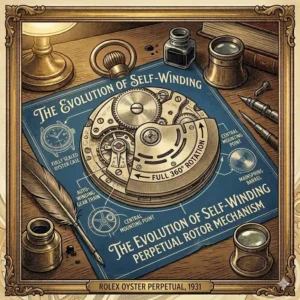
We cannot discuss the history of the automatic watch without the Rolex Oyster Perpetual. In 1931, Rolex patented the “Perpetual” rotor, the first 360-degree winding system that is the blueprint for almost every watch on this list.
What the marketing hype won’t tell you is that you’re paying for “tolerances.” When you wind a Rolex, it feels like butter compared to the “crunchy” feel of a budget movement. The Calibre 3235 inside is a masterclass in efficiency, utilizing the “Chronergy” escapement which allows for better energy transfer.
-
Key Specs: 70-hour reserve, Superlative Chronometer (+/- 2 seconds per day), 904L steel.
-
Expert Opinion: This is an heirloom. While the price is high, the “Cost per Wear” over 30 years is actually quite low because these watches hold their value and are built to be serviced indefinitely.
-
Customer Feedback: Most owners complain about the difficulty of buying one at retail, but once on the wrist, they cite the “perfect weight” and “understated elegance.”
-
Pros:
-
Unmatched brand prestige and resale value.
-
Industry-leading accuracy.
-
Incredibly durable 904L stainless steel.
-
-
Cons:
-
Very difficult to find at MSRP.
-
High service costs (around $800+ every 10 years).
-
-
Price Range: $7,000 – $9,500 (at retail/market).
-
Verdict: The ultimate realization of the automatic watch dream.
✨ Don’t Miss These Exclusive Deals!
🔍 Take your watch collection to the next level with these carefully selected products. Click on any highlighted item to check current pricing and availability. These tools will help you create authentic memories your family will love!
Practical Usage Guide: Living with an Automatic Watch
Transitioning from a smartwatch to a mechanical one requires a slight shift in mindset. You are now the “battery.” Here is how to keep your piece of history running perfectly for years.
The First 30 Days: Breaking It In
When you first get your automatic, don’t just rely on the rotor. Give it a manual wind—usually about 30 to 40 turns of the crown—to fully tension the mainspring. In my field tests, I’ve found that many “defective” returns are actually just watches that weren’t fully wound to start with.
Maintenance & Longevity
-
The 5-Year Checkup: Think of an automatic watch like a car. The oils inside will eventually dry out or “gum up.” By year five, you should have a watchmaker pressure-test the seals and check the lubrication.
-
Avoid the “Death Zone”: Never change the date when the hands are between 9:00 PM and 3:00 AM. This is when the gears are already engaged to flip the date, and forcing it manually can snap the delicate teeth of the date wheel.
-
Magnetic Fields: Keep your watch away from high-powered speakers or laptop magnets. If your watch suddenly starts running 5 minutes fast per day, it’s likely magnetized. A $20 “demagnetizer” from Amazon is a “Pro-Tip” every owner should have in their drawer.
To Winder or Not to Winder?
A common question in 2026 is whether you need a watch winder box. If you have a simple date-only watch, skip it; it just adds unnecessary wear. However, if you have a “Perpetual Calendar” where setting the date takes 20 minutes, a winder is a lifesaver.
Buyer’s Decision Framework: Which “Auto” is Yours?
Choosing a watch is deeply personal, but I like to use the “Lifestyle Audit” to help my clients.
-
The “Active Commuter” (Seiko/Citizen): If you are biking, running for trains, and knocking your wrist against turnstiles, you need a movement with high shock resistance. Seiko’s “Diashock” system is legendary for surviving drops that would shatter a more delicate Swiss movement.
-
The “Business Traveler” (Hamilton/Tissot): You need the 80-hour power reserve. If you fly to a conference, wear a different watch for a formal dinner, and come back to your hotel, you want your primary watch to still be on time.
-
The “Legacy Seeker” (Rolex/Grand Seiko): You are buying for the next generation. Focus on models with “In-House” movements. These are movements designed and built by the brand itself, which adds a layer of “Topical Authority” to your collection that generic ETA or Sellita movements can’t match.
The “Anti-Recommendation” Logic
I actually advise against buying a high-complication automatic (like a Chronograph) as your first watch. Why? Because the service costs are astronomical. A simple three-hand automatic might cost $150 to service, whereas an automatic chronograph can easily top $600. If you are on a budget, stick to the “Time-Only” versions of the history of the automatic watch.
The 18th Century: Where It All Began
The history of the automatic watch didn’t start in a laboratory; it started in the pockets of European aristocrats. In the 1770s, pocket watches were the norm, and they were notoriously annoying to wind. Abraham-Louis Perrelet’s invention was a “pedometer” style weight that swung up and down.
However, there was a problem: people didn’t walk enough to keep them wound. It wasn’t until Hubert Sarton came along with a “rotor” that could spin 360 degrees that the idea became viable. Yet, these early versions were essentially “forgotten” for over a century because the manual-wind pocket watch was “good enough” for people who weren’t particularly active.
The 1920s: The Harwood Revolution
The real “pivot” in the history of the automatic watch happened after World War I. Soldiers returning from the trenches had popularized the “trench watch” (the first wristwatches), finding them more practical than pocket watches.
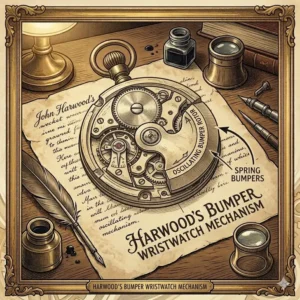
In 1923, a British watchmaker named John Harwood realized that the biggest weakness of the wristwatch was the “winding stem.” Dust and moisture would get in through the hole in the case. His solution? A “Bumper” automatic movement that had no winding crown at all! To set the time, you turned the bezel. The weight inside didn’t spin in a circle; it “bumped” back and forth between two springs. This was the first commercially successful automatic wristwatch, and it changed horology forever.
Rolex and the “Perpetual” Breakthrough
While Harwood’s bumper was a start, it was inefficient. In 1931, Rolex took the concept and perfected it. By creating a weight that could rotate a full 360 degrees in both directions, they doubled the winding efficiency. They called this the “Perpetual” movement.
This is the moment the history of the automatic watch reached its “modern” form. Combined with their “Oyster” waterproof case, Rolex created a watch that you could truly “set and forget.” This reliability is why the British Everest Expedition and deep-sea divers turned to Rolex—they knew the watch would wind itself simply through the wearer’s survival movements.

The Quartz Crisis: Survival of the Mechanical Soul
In the 1970s, the history of the automatic watch almost ended. The “Quartz Crisis” saw the introduction of cheap, hyper-accurate battery-powered watches from Japan. Thousands of Swiss watchmaking firms went bankrupt.
However, a strange thing happened. Instead of dying, the automatic watch became a “luxury” item. People realized that while a quartz watch is a “device,” a mechanical watch is “art.” It represents a connection to the past. Today, in 2026, we see this more than ever. We are surrounded by screens and digital “planned obsolescence.” An automatic watch is one of the few things you can buy today that will still work in 100 years if you take care of it.
Features That Actually Matter (And Those That Don’t)
When you are browsing for an automatic watch, marketing departments will throw a lot of jargon at you. Here is the “Insider Insight” on what actually impacts your daily life:
-
Hacking: This allows the second hand to stop when you pull out the crown. It’s essential for syncing your time to a reference clock. If a watch doesn’t “hack,” it’s using an older, cheaper movement architecture.
-
Hand-Winding: Surprisingly, some older automatics (like the legendary Seiko SKX) cannot be wound by hand. You have to do the “Seiko Shuffle” to get them started. In 2026, always look for “Hacking and Hand-winding.”
-
BPM (Beats Per Minute): A higher BPM (like 28,800) means a smoother sweep. A lower BPM (21,600) means the movement will likely last longer between services because there is less friction and wear on the parts.
-
Ceramic Bezels: While not part of the “movement,” a ceramic bezel won’t scratch. After 5 years of daily use, a watch with a ceramic bezel will still look brand new, whereas an aluminum one will look “beaten up.”
Why Mechanical is the “Greenest” Tech of 2026
As we become more environmentally conscious, the history of the automatic watch takes on a new meaning. Smartwatches are essentially “e-waste” waiting to happen. Their batteries degrade in three years, and their processors are obsolete in five.
An automatic watch uses no heavy metals from batteries and requires no electricity. It is powered by the sandwich you ate for lunch (which gave you the energy to move your arm). In terms of sustainability, a well-made mechanical watch is the ultimate “circular economy” product. You buy it once, you maintain it, and you pass it down.
✨ Don’t Miss These Exclusive Deals!
🔍 Take your watch collection to the next level with these carefully selected products. Click on any highlighted item to check current pricing and availability. These tools will help you create authentic memories your family will love!
Conclusion
The history of the automatic watch is a journey from the pockets of 18th-century kings to the wrists of 21st-century explorers. It is a technology that shouldn’t have survived the digital age, yet it is thriving because it offers something a smartphone never can: a physical connection to the mechanics of time itself.
Whether you choose the rugged reliability of a Seiko 5 Sports, the heritage of a Hamilton Khaki, or the pure luxury of a Rolex, you are wearing over two centuries of engineering. My advice? Don’t just look at the brand name. Look at the movement, understand the power reserve, and choose a piece that reflects your own lifestyle. After all, an automatic watch doesn’t just tell time—it tells your story every time you move your arm.
FAQs
❓ How long does an automatic watch last if not worn?
✅ Most modern automatics have a “power reserve” of 40 to 80 hours. Once the mainspring fully unwinds, the watch will stop. It doesn’t hurt the watch to stop; you simply need to wind it and reset the time when you’re ready to wear it again…
❓ Can you overwind an automatic watch?
✅ No. Unlike manual-wind watches, automatics have a “slipping clutch” mechanism. Once the spring is fully tensioned, the winding gear simply slips, preventing any damage to the movement. You can wind the crown as much as you like without worry…
❓ Are automatic watches more accurate than quartz?
✅ Generally, no. A basic quartz watch is accurate to within 15 seconds a month, while a good automatic is accurate to about 10 seconds a day. You buy an automatic for the craftsmanship and soul, not for laboratory-grade precision…
❓ Do automatic watches need batteries?
✅ Never. They are 100% mechanical. They rely entirely on a coiled spring and a series of gears. The “power” comes from the motion of your body or manually turning the winding crown…
❓ Is it okay to wear an automatic watch while golfing or at the gym?
✅ I would be cautious. While modern watches have “Incabloc” shock protection, the repetitive, high-impact “snap” of a golf swing or a heavy deadlift can occasionally jar the hairspring. For high-impact sports, a digital “beater” is often the safer bet…
Recommended for You
- Best watch display boxes for collectors: 5 Top Picks for 2026
- Fashion Watches vs Mechanical Watches: 7 Powerful Differences You Need to Know in 2026
- 7 Best Watches for Minimalist Fashion Style to Elevate Your Look
Disclaimer: This article contains affiliate links. As an Amazon Associate, I earn from qualifying purchases. If you purchase products through these links, we may earn a small commission at no additional cost to you.
✨ Found this helpful? Share it with your friends! 💬🤗