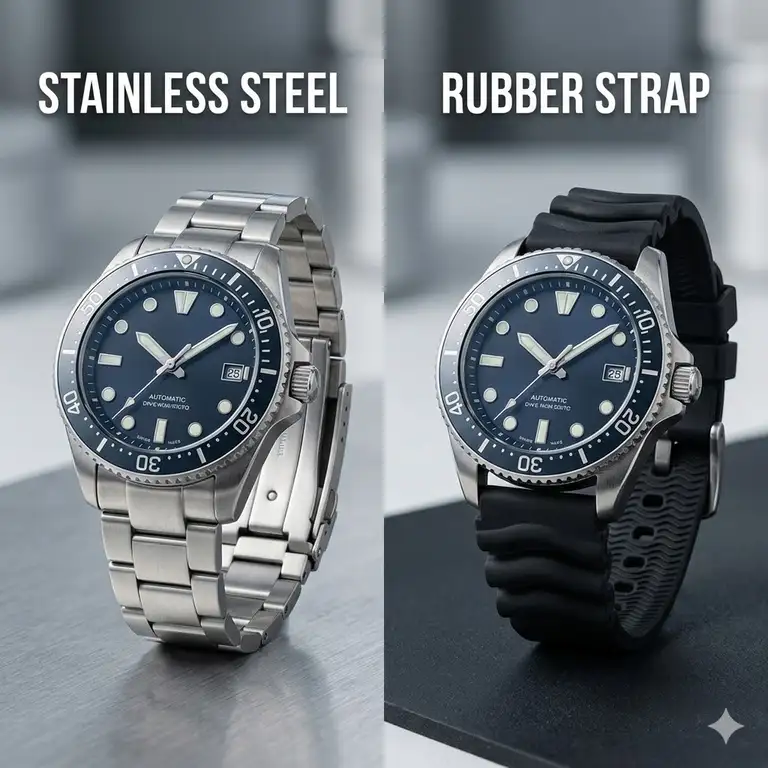
When you invest in a quality timepiece, the watch head is only half the story. The bridge between your wrist and that movement—the strap—dictates how often you’ll actually wear it. In this stainless steel vs rubber straps comparison, we dive into the age-old debate that pits industrial elegance against modern utility. Whether you are a “desk diver” in a Manhattan office or a weekend warrior hitting the trails, your choice of material impacts everything from your skin health to the longevity of your watch lugs.
What is stainless steel vs rubber straps comparison? At its core, this is an evaluation of two distinct horological philosophies: the permanence and prestige of metal versus the versatility and resilience of synthetic polymers. While stainless steel has long been the gold standard for luxury and professional durability, rubber has evolved from a “cheap” alternative into a high-tech material—specifically FKM rubber—that often rivals steel in price and performance. ⌚
Choosing between them isn’t just about looks; it’s about understanding how your body interacts with these materials. Steel offers a weight that many find reassuring, providing a sense of “heirloom quality,” but it can be unforgiving during a summer heatwave. Conversely, rubber provides an ergonomic, “sticky” fit that stays put during activity, though it may lack the gravitas required for a black-tie gala. In 2026, the lines are blurring as luxury brands like Patek Philippe and Audemars Piguet continue to embrace high-end rubber, making this comparison more relevant than ever for the modern enthusiast.
Quick Comparison: Stainless Steel vs. Rubber at a Glance
Before we deep-dive into the technical nuances, let’s look at how these materials stack up in the categories that actually matter for daily wear.
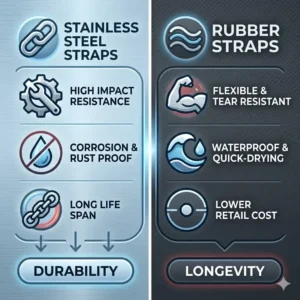
| Feature | Stainless Steel (316L/904L) | Rubber (FKM / Silicone) | Best For… |
| Durability | Extremely High (Scratch-prone) | High (Tear-resistant) | Steel for Longevity |
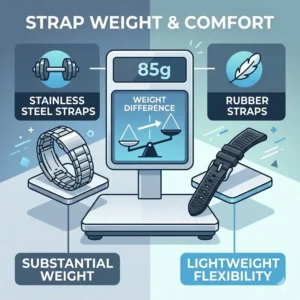
| Weight | Heavy / Substantial | Lightweight / Nimble | Rubber for Comfort |
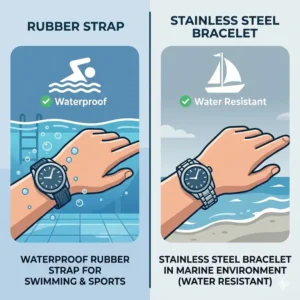
| Water Resistance | Excellent (needs rinsing) | Perfect (Saltwater ready) | Rubber for Diving |
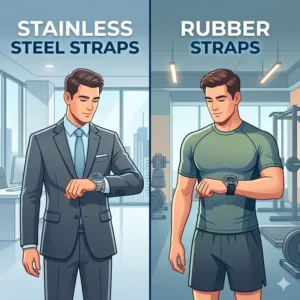
| Style Profile | Formal / Professional | Sporty / Casual | Steel for Office |
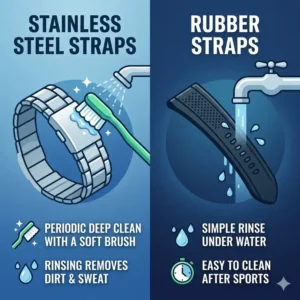
| Maintenance | Periodic cleaning/polishing | Quick soap and water | Rubber for Ease |
Looking at the data above, it’s clear that stainless steel remains the king of professional environments where “heft” is equated with value. However, the rubber column highlights why athletes and outdoor enthusiasts have almost entirely moved away from metal; the weight savings alone can reduce wrist fatigue by over 40% during high-impact activities. If you’re a one-watch person, steel offers the best “all-rounder” versatility, but for dedicated utility, rubber is the undisputed champion of the 2026 market.
💬 Just one click — help others make better buying decisions too! 😊
Top 5 Watch Bands: Expert Analysis for 2026
To provide a real-world stainless steel vs rubber straps comparison, I have selected five industry-leading products that represent the pinnacle of current material science. These aren’t just random picks; they are the benchmarks by which other straps are measured in 2026.
1. Nomad Sport Band (FKM Rubber)
The Nomad Sport Band is widely considered the gold standard for high-performance rubber. It is constructed from FKM (fluoroelastomer), a high-density polymer that resists oils, chemicals, and extreme temperatures. Unlike cheap silicone, this material won’t attract lint or turn “gooey” after a year of sun exposure.
Key Specifications & Interpretation:
-
Material: FKM Fluoroelastomer (this means it won’t degrade when exposed to sweat or sunscreen).
-
Closure: Pin-and-tuck mechanism (provides a flush fit that won’t snag on shirt sleeves).
-
Ventilation Channels: Interior ribbing (essential for airflow, preventing that “swamp wrist” feeling).
Expert Commentary: In my experience, the Nomad Sport Band is the best “active” strap on the market. What most buyers overlook is the interior ventilation. Most rubber straps create a vacuum against the skin, leading to irritation, but Nomad’s design allows the skin to breathe. This is specifically for the person who transitions from the gym to a casual lunch without wanting to change their watch.
Customer Feedback: Users consistently praise its “premium matte finish” and the fact that it doesn’t pick up dust. Some have noted it takes a few days to “break in” the stiffness of the FKM.
-
Pros: Highly durable, lint-resistant, excellent ventilation.
-
Cons: Higher price point for rubber, limited color options.
-
Price Range: Around $50–$70.
-
Value Verdict: The ultimate choice for longevity-focused athletes.
2. Strapcode Super-O Boyer (Stainless Steel)
The Strapcode Super-O Boyer is a legendary aftermarket replacement for Seiko and other dive watches. It utilizes 316L stainless steel with solid end links, providing a massive upgrade over “hollow” factory bracelets that often rattle.
Key Specifications & Interpretation:
-
Material: 316L Stainless Steel (the industry standard for corrosion resistance).
-
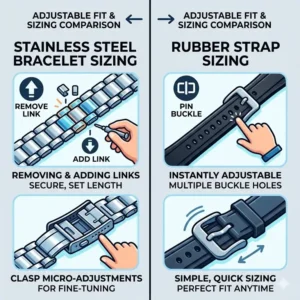
Adjustment: Screw-in links (far more secure and easier to adjust than “pin and collar” systems).
-
Clasp: V-Clasp double lock (ensures the watch stays on even if the primary latch is bumped).
Expert Commentary: The Super-O Boyer transforms a $300 watch into something that feels like $3,000. The weight is significant, which provides that “luxury feel” many enthusiasts crave. If you find your current watch feels “top-heavy” or flops around, the counter-balance of this solid steel bracelet will fix that instantly. It’s the pro’s choice for a “tool watch” aesthetic.
Customer Feedback: Buyers love the “solid thud” of the clasp and the lack of hair-pulling. A few mention the weight can be tiring if you aren’t used to steel bracelets.
-
Pros: Incredible build quality, screw-in links, professional look.
-
Cons: Adds significant weight, can be tricky to size without a screwdriver.
-
Price Range: $80–$110 range.
-
Value Verdict: The best ROI for upgrading a mid-range timepiece.
3. Barton Elite Silicone (Rubber/Silicone)
The Barton Elite Silicone offers a mid-range solution that bridges the gap between basic rubber and high-end FKM. It’s famous for its “quick release” spring bars, allowing you to swap styles in seconds.
Key Specifications & Interpretation:
-
Material: Premium Silicone (softer and more flexible than FKM, offering immediate comfort).
-
Design: Two-toned with a textured top (adds visual depth that usually requires a higher price tag).
-
Hardware: 316L Stainless Steel buckle (ensures the point of failure isn’t a cheap plastic pin).
Expert Commentary: This is the “gateway drug” of watch straps. The spec sheet won’t tell you this, but the proprietary “locking feature” on the keeper is a game changer—it prevents the excess strap from flapping around. I recommend this for people who want to own 5 different colors and swap them daily to match their outfits.
Customer Feedback: Fans call it the “most comfortable strap straight out of the box.” Critics mention that silicone can attract a bit more dust than FKM.
-
Pros: Extremely soft, huge color variety, very affordable.
-
Cons: Not as heat-resistant as FKM, attracts some lint.
-
Price Range: Under $30.
-
Value Verdict: Unbeatable price-to-comfort ratio.
4. Spigen Modern Fit (Stainless Steel)
The Spigen Modern Fit is designed specifically for smartwatches, bringing the classic “Oyster” style to the tech world. It’s a thinner, more modern take on the traditional steel bracelet.
Key Specifications & Interpretation:
-
Finish: Brushed/Matte (hides scratches much better than polished steel).
-
Clasp: Butterfly fold-over (creates a seamless look around the wrist).
-
Compatibility: Precision connectors (eliminates the “gap” between the watch and the band).
Expert Commentary: Many steel bracelets for smartwatches look bulky and out of place. Spigen gets the proportions right. What I like here is the taper; the band narrows toward the clasp, which makes typing on a laptop much more comfortable. It’s the perfect choice for an office worker who wants their Apple Watch or Galaxy Watch to look like a “real” timepiece.
Customer Feedback: Reviewers appreciate the included sizing tool. Some note that the butterfly clasp can be a bit stiff for the first few weeks.
-
Pros: Sleek profile, hides scratches well, easy installation.
-
Cons: Butterfly clasp lacks micro-adjustments, limited to specific smartwatch models.
-
Price Range: $35–$50 range.
-
Value Verdict: The best aesthetic upgrade for smartwatches.
5. Ritche Silicone Watch Bands (Budget Rubber)
The Ritche Silicone Watch Bands are the workhorses of the budget market. They provide a rugged, no-nonsense approach to the stainless steel vs rubber straps comparison for those who prioritize utility over brand names.
Key Specifications & Interpretation:
-
Texture: Diamond-patterned (provides extra grip so the watch doesn’t slide during sweat-heavy activities).
-
Thickness: 3mm (sturdier than generic “free” bands included with cheap watches).
-
Pins: Quick-release (no tools required for installation).
Expert Commentary: If you’re taking your watch into the mud or doing heavy construction, don’t buy an expensive strap. This Ritche band is the one you “beat up.” The diamond texture is surprisingly effective at channeling water away from the skin. It’s not “luxury,” but it’s incredibly honest in its performance.
Customer Feedback: Users are shocked by the durability for the price. A few have noted the buckle is a bit basic compared to premium brands.
-
Pros: Very low cost, rugged texture, reliable quick-release.
-
Cons: Feels “plastic-y” compared to FKM, limited branding appeal.
-
Price Range: Around $15–$25.
-
Value Verdict: The best “disposable” high-performance strap.
✨ Don’t Miss These Exclusive Deals!
🔍 Take your watch game to the next level with these carefully selected products. Click on any highlighted item to check current pricing and availability. These tools will help you create a versatile look that fits your lifestyle perfectly!
Transformation Content: The 2026 Maintenance & Longevity Guide
Buying a strap is only the beginning. To truly get the most out of your stainless steel vs rubber straps comparison, you need to know how to maintain these materials. Most people treat their watch bands as “set it and forget it,” but a little care can triple the lifespan of your investment.
How to Clean and Optimize Your Straps
Stainless steel and rubber have very different enemies. Steel hates salt and grit; rubber hates UV rays and certain chemicals.
-
For Stainless Steel: * The Toothbrush Trick: Every month, use a soft-bristled toothbrush and a drop of mild dish soap to clean between the links. Grit acts as an abrasive, grinding down the metal pins (a phenomenon known as “bracelet stretch”).
-
The Ultrasonic Soak: If your bracelet is detachable, a $30 ultrasonic cleaner will shake loose hidden dirt that you can’t reach. Note: Never put the watch head in the cleaner, only the bracelet.
-
-
For Rubber/Silicone:
-
The UV Shield: If you aren’t wearing your rubber-strapped watch, store it in a dark box. Constant UV exposure can cause “blooming” (a white powdery residue) or make the material brittle.
-
Avoiding Alcohol: Never clean a rubber strap with rubbing alcohol or harsh sanitisers. It strips the plasticizers from the material, leading to cracks. Plain water and soap are all you need.
-
Common Mistakes to Avoid During the First 30 Days
-
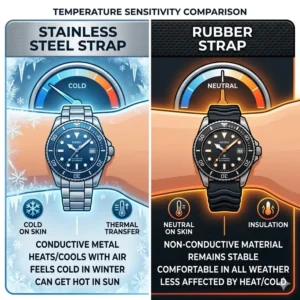
Sizing Too Tight: Steel expands and contracts with the temperature. If you size it perfectly in an air-conditioned room, it will be painful by noon in the sun. Aim for a “one-finger gap” fit.
-
Ignoring the Pins: Always check your spring bars after the first week. New straps often put different “pull” tensions on the lugs, and a loose pin is the #1 cause of a lost watch.
-
The “Lotion” Trap: Sunscreen and lotion are the “rubber killers.” If you apply lotion, wait 10 minutes before putting on a rubber strap, or you’ll find the band becoming “tacky” over time.
Buyer’s Decision Framework: Which Side are You On?
If you are still struggling with the stainless steel vs rubber straps comparison, use this priority checklist to identify your core needs. Horology is personal, and there is no “wrong” answer, only the “wrong for your wrist” answer.
Scenario A: The Professional Office / Formal Event
-
Choose Stainless Steel if: You want your watch to be an extension of your jewelry. Steel reflects light, creates a “framed” look for the watch face, and matches with belt buckles and cufflinks.
-
Avoid Rubber because: It can look “immature” or overly athletic in a boardroom setting. While brands like Hublot try to change this, the “tool” look of rubber often clashes with a crisp suit cuff.
Scenario B: The Summer Vacation / Tropical Climate
-
Choose Rubber if: You will be in and out of the ocean or pool. Saltwater is “okay” for steel, but it gets trapped in the links and can lead to “pitting” or rust if not rinsed perfectly. Rubber is impervious.
-
Avoid Stainless Steel because: It’s a heat sink. Left in the sun, a steel bracelet can become uncomfortably hot, and as your wrist swells in the heat, the lack of “give” in the metal can lead to skin irritation.
Scenario C: The Daily Commuter / Smartwatch User
-
Choose Rubber if: You value lightweight comfort and haptic feedback. For smartwatch users, rubber ensures the sensors stay tight against the skin without the weight of the band interfering with the “vibrate” alerts.
-
Choose Stainless Steel if: You want to hide the “gadget” nature of your smartwatch and make it look like a traditional horological piece.
Why Material Science Changed the Comparison in 2026
The stainless steel vs rubber straps comparison used to be simple: steel was expensive and good; rubber was cheap and bad. In 2026, that is no longer the case. The emergence of FKM (Fluoroelastomer) has revolutionized the market. Unlike traditional silicone, FKM is heavier, more matte, and incredibly resistant to the elements. This has allowed luxury brands to charge $200+ for a “rubber” strap, and consumers are happily paying it because the comfort is unmatched.
Furthermore, the rise of 904L Stainless Steel (popularized by Rolex and now appearing in high-end aftermarket bands) has raised the bar for metal. 904L contains more chromium and nickel, making it more resistant to “acidic” sweat and giving it a unique luster that 316L can’t quite match. When choosing between these materials today, you aren’t choosing between “luxury” and “budget”—you are choosing between two different types of high-performance engineering.
The Sweat Test: Real-World Performance Analysis
One factor that many guides overlook in the stainless steel vs rubber straps comparison is the “bio-compatibility” of the materials over long periods. As we move through 2026, more users are reporting “watch rash” from wearable tech.
Stainless Steel Performance:
Steel is non-porous, which is good. However, the spaces between links are magnets for dead skin cells and sweat. This creates a “biofilm” that can irritate the skin. If you have a nickel allergy, even high-grade 316L can cause a reaction.
Expert Tip: If you have sensitive skin, look for “Tegra” or “Hardened” steel coatings which act as a barrier between the metal and your wrist.
Rubber Performance:
High-quality FKM rubber is hypoallergenic. However, because it creates a tighter seal against the skin, it can trap moisture. This is why “tropic” style straps (with holes) or the Nomad Sport Band (with channels) are superior. They provide the hypoallergenic benefits of rubber while solving the moisture-trap problem.
How to Choose: The 5-Step Expert Criteria
When evaluating your own stainless steel vs rubber straps comparison, follow these steps to ensure you don’t end up with “buyer’s remorse.”
-
Weight Tolerance: Hold your watch head. If it’s already heavy (over 100g), a steel bracelet will push the total weight to a level that might cause wrist fatigue. Rubber can “lighten the load.”
-
Frequency of Change: Do you like to change your look? Rubber straps often feature “quick release” pins. Stainless steel bracelets usually require tools and 10 minutes of patience.
-
The “Sleeve” Factor: Steel is slippery. It slides under a shirt cuff easily. Rubber is “grippy” and will often catch on the fabric of a suit jacket or sweater.
-
Taper and Proportions: A good strap should taper (get narrower) toward the buckle. Cheap rubber straps are often “straight,” which looks bulky. Ensure your choice has at least a 2mm taper for a sophisticated look.
-
Environmental Reality: If you live in a humid climate like Florida or Southeast Asia, steel will feel “slimy” within hours. Rubber (specifically ventilated rubber) is the logical choice for the tropics.
Common Mistakes When Buying Watch Straps
As an expert who has swapped hundreds of bands, I see the same three mistakes over and over. Avoiding these will save you money and protect your watch.
Mistake #1: Buying “Generic” Silicone for High-End Watches
Don’t put a $5 silicone strap on a $500 watch. The hardware (the pins and buckle) on generic straps is often made of soft “pot metal” that can bend or snap, potentially dropping your watch on the pavement. Always ensure the buckle is 316L stainless steel.
Mistake #2: Ignoring Lug Width
It sounds basic, but many people guess their lug width. Is it 20mm or 22mm? A 20mm strap on 22mm lugs leaves a gap that allows the watch to slide, which puts “shear stress” on the spring bars. Use a digital caliper to check, or search your watch model’s specs online first.
Mistake #3: Over-tightening Rubber
Because rubber is flexible, people tend to wear it one notch too tight. This doesn’t just cut off circulation; it stretches the holes in the rubber, eventually leading to a tear. Rubber should be worn just tight enough that the watch doesn’t flip to the underside of your wrist.
Long-Term Cost & Maintenance: Which is the Better Investment?
In the stainless steel vs rubber straps comparison, the “Total Cost of Ownership” (TCO) favors steel, but the “Experience Value” favors rubber.
Stainless Steel TCO:
A high-quality steel bracelet like the Strapcode Super-O Boyer can literally last a lifetime. Aside from the occasional $20 professional polish every 5 years, there are no recurring costs. It is a “one-and-done” purchase.
Rubber TCO:
Even the best FKM rubber has a shelf life. Depending on your sweat acidity and UV exposure, a rubber strap will likely need replacement every 3–5 years as it loses its elasticity or becomes “shiny” from friction. However, because the entry price is lower (around $20–$50 for Barton or Ritche), you can replace it multiple times before you reach the cost of a premium steel bracelet.
Analysis: If you want an heirloom, buy steel. If you want a comfortable “consumable” that you can refresh every few years, go with rubber.
✨ Don’t Miss These Exclusive Deals!
🔍 Take your watch game to the next level with these carefully selected products. Click on any highlighted item to check current pricing and availability. These tools will help you create a versatile look that fits your lifestyle perfectly!
Conclusion: The Verdict on stainless steel vs rubber straps comparison
Ultimately, the winner of the stainless steel vs rubber straps comparison depends entirely on your “Mission Profile.” If your day involves a desk, a keyboard, and occasional client meetings, the Strapcode Super-O Boyer or Spigen Modern Fit provides the professional weight and luster that commands respect. Steel is an investment in your watch’s “identity.”
However, if your life involves the gym, the trail, or simply the desire for a watch that “disappears” on the wrist, the Nomad Sport Band or Barton Elite Silicone is the superior choice. In 2026, rubber is no longer the “cheap” option—it is the choice of the active professional who values ergonomics over tradition. Why choose just one? The beauty of modern watch-making is the “quick release” system; buy both and let your strap match your mission.
FAQs
❓ Does stainless steel rust over time?
✅ High-grade 316L and 904L stainless steel are extremely rust-resistant, but they are not “rust-proof.” Exposure to salt water or chlorinated pools can cause surface oxidation if the band is not rinsed with fresh water after use…
❓ Is rubber or silicone better for sensitive skin?
✅ High-end FKM rubber or medical-grade silicone is generally better for sensitive skin because it is hypoallergenic. However, the lack of airflow can cause heat rash, so look for straps with interior channels or “tropic” perforations…
❓ Can I wear a rubber strap with a tuxedo?
✅ Traditionally, no. A tuxedo requires a leather strap or a very thin metal “Milanese” loop. However, modern fashion has become more relaxed, and a high-end matte black FKM strap is now occasionally seen at formal events…
❓ How do I know my watch’s lug width?
✅ You can measure the distance between the inside of the lugs using a metric ruler. Common sizes are 18mm, 20mm, and 22mm. Most manufacturers also list this specification on their website under “Case” or “Band” details…
❓ Why do some rubber straps smell like vanilla?
✅ Manufacturers often infuse rubber and silicone with vanilla scent to mask the natural “chemical” odor of the material. This is common in Italian-made rubber straps and is often seen as a sign of higher quality…
Recommended for You
- 7 Best NATO Straps for Field Watches in 2026: Rugged and Stylish Picks
- 7 Best Leather Watch Straps 2026: Elevate Your Timepiece Today!
- Leather vs metal strap which looks better? Top 7 Pro Picks for 2026
Disclaimer: This article contains affiliate links. As an Amazon Associate, I earn from qualifying purchases. If you purchase products through these links, we may earn a small commission at no additional cost to you.
✨ Found this helpful? Share it with your friends! 💬🤗